
Quick Summary
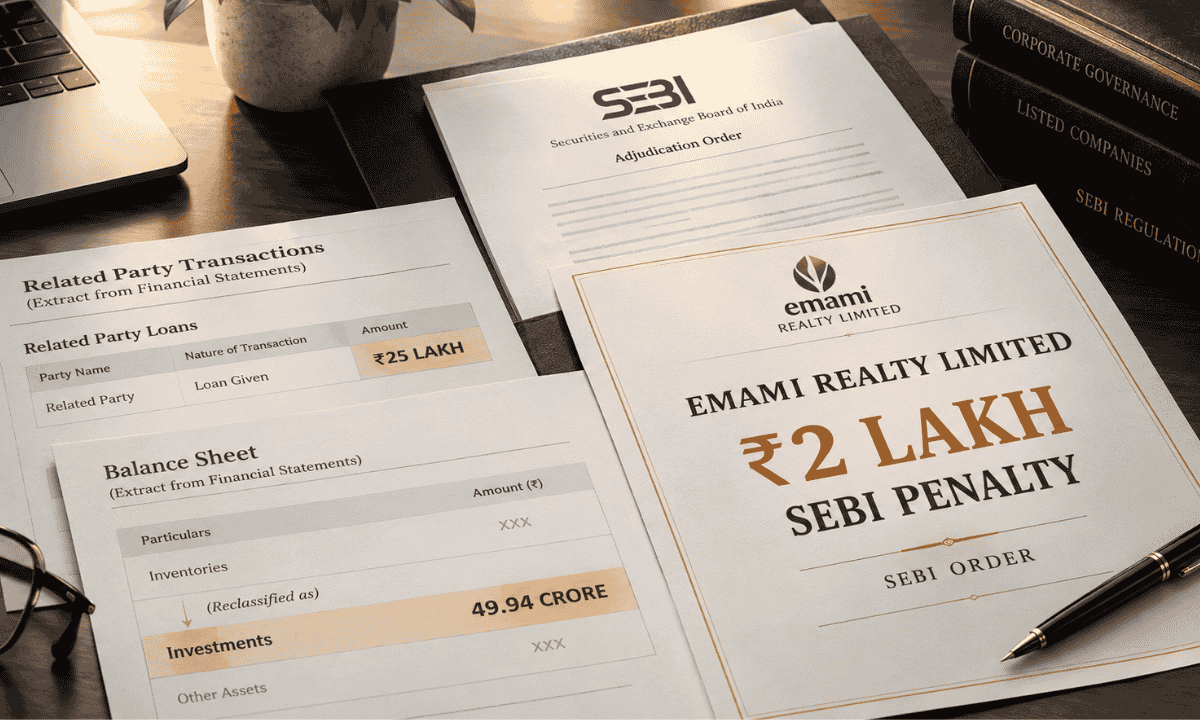
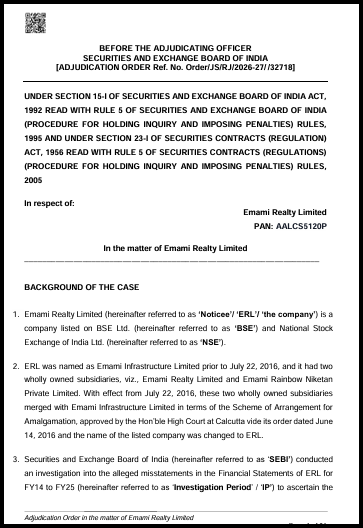
SEBI has fined Emami Realty Limited ₹2 lakh after an investigation covering over a decade of financial disclosures. Inspectors found ERL gave a related party an additional ₹25 lakh loan without securing audit committee approval first, and separately misclassified ₹49.94 crore in subsidiary investments as inventory instead of investments. A larger allegation, involving over ₹180 crore in undisclosed related-party loans from 2014 and 2015, was dropped after ERL argued the disclosures predated a corporate merger, and SEBI extended the benefit of the doubt.
A ₹2 lakh fine on a company that once moved over ₹180 crore in loans without full disclosure sounds like a mismatch.
That’s essentially what happened with Emami Realty Limited.
SEBI’s order, passed on September 11, 2026, tells the story of a company that fought hard, won on its biggest exposure, and still got penalised on two smaller but clear-cut lapses.
This one isn’t about misled investors. It’s about what happens when a listed company’s paperwork doesn’t keep pace with its transactions.
What SEBI’s Investigation Into Emami Realty Actually Covered?
Emami Realty Limited (ERL) is listed on both BSE and NSE.
Before July 2016, it operated under a different name, Emami Infrastructure Limited, before merging with two subsidiaries and being renamed, a scheme approved by the Calcutta High Court.
SEBI’s investigation stretched across financial years FY14 to FY25, a genuinely unusual span for a single inquiry.
The trigger came from NSE, which flagged issues in ERL’s FY22 and FY23 financial statements in an examination report submitted to SEBI in March 2024.
That report opened the door to a far wider look at ERL’s older disclosures too.
A Show Cause Notice followed on August 3, 2026, covering three separate sets of allegations. ERL, through its authorised representatives, contested all three at a hearing held on August 18, 2026.
The ₹180 Crore Related-Party Allegation That Didn’t Stick
The first and largest allegation involved three related parties: Emami Agrotech Limited, Add Albatross Properties Private Limited, and Sanjeevani Vyapaar LLP.
SEBI said ERL failed to disclose these entities as related parties in its consolidated financial statements for FY14 and FY15, despite lending or depositing significant sums with each of them.
The numbers were sizeable. ₹102.15 crore and ₹78.20 crore in loans to Emami Agrotech across the two years, ₹80 crore in deposits to Add Albatross, and ₹26.90 crore in loans to Sanjeevani Vyapaar.
ERL’s defence was that these amounts weren’t hidden. They appeared in the consolidated statements under an aggregate head called “Loans to Others,” just without naming the specific counterparties.
The company also argued the Show Cause Notice itself came far too late, over eleven years after the transactions, citing several Securities Appellate Tribunal rulings where SEBI’s own delay was held against it.
The AO wasn’t fully convinced by the “inadvertent” framing.
The same omission repeating across three separate related parties, over two consolidated statements, made that explanation harder to accept at face value.
And yet, the order still lands in ERL’s favour on this point.
Weighing ERL’s position as a successor entity through the 2016 merger, along with how old the underlying disclosures were, the AO chose a lenient approach and extended the benefit of the doubt.
This specific violation was found not established. No penalty attaches to it.
Also Read: Prrsaar Sampada SEBI Order, why would anyone lose money on the same trade, every single day?
The ₹25 Lakh Loan That Cost ERL Its Only Real Penalty
The second issue was smaller in rupee terms but far cleaner as a violation.
Lohitka Property LLP is a joint venture between the Emami Group and Mumbai’s Sheth Group, developing a residential project called Montana in Mulund West.
ERL has held a 10% profit share in Lohitka since April 2015, and the exposure has run into hundreds of crores over the years, with the outstanding balance standing at ₹99.59 crore in March 2022 and ₹69.98 crore by March 2025.
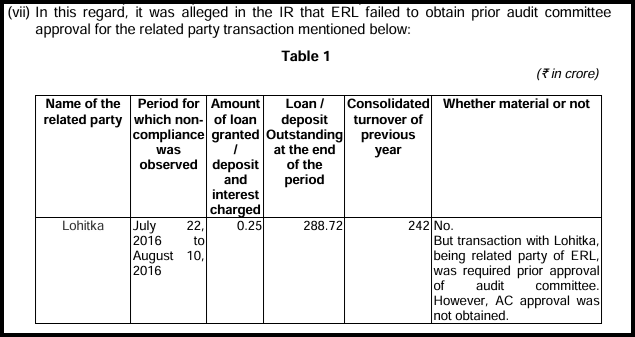
The specific problem was a smaller, additional ₹25 lakh loan disbursed on August 8, 2016. Audit committee approval for that loan only came three days later, on August 11.
ERL argued this was a continuation of a pre-existing, board-authorised arrangement, not a fresh transaction, and that the amount involved was too small to matter.
The AO rejected both points. Regulation 23(2) requires prior approval, with no exemption for small amounts, and the order leans on a Securities Appellate Tribunal ruling in SecureKloud Technologies Limited v. SEBI, which held that later ratification cannot cure a violation that already occurred.
This violation was found established under Regulation 23(2) of the LODR Regulations.
Why ₹49.94 Crore Sat Under the Wrong Balance Sheet Head?
The third issue concerned how ERL classified certain investments in its standalone financial statements for FY22 and FY23.
₹25.46 crore in equity investments across three subsidiaries, Sneha Ashiana Private Limited, New Age Realty Private Limited, and Delta PV Private Limited, plus ₹24.48 crore in convertible debentures of Prajay Urban Private Limited, were booked under “Inventories” rather than “Investments.”
ERL’s explanation leaned on economic substance.
Its business runs through special purpose vehicles holding land for development, so treating those holdings as inventory reflected how the business actually worked.
The AO didn’t accept this. Standalone financial statements follow specific accounting standards regardless of how the consolidated picture looks, and the classification had the effect of inflating ERL’s current assets on paper.
SEBI also noted that other listed real estate companies disclose similar investments under “Investments,” not “Inventories,” making ERL’s approach an outlier rather than an industry norm.
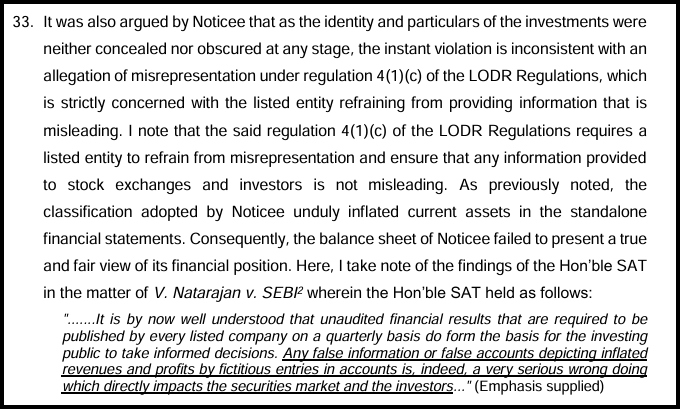
This violation was also found established, spanning multiple disclosure and governance provisions of the LODR Regulations.
The ₹2 Lakh Penalty, and a ₹5 Lakh History
Because the related-party disclosure allegation wasn’t established, no penalty applies under the Securities Contracts (Regulation) Act for that piece.
The two violations that did stick, the Lohitka approval lapse and the investment misclassification, together attracted a combined penalty of ₹2 lakh under Section 15HB of the SEBI Act.
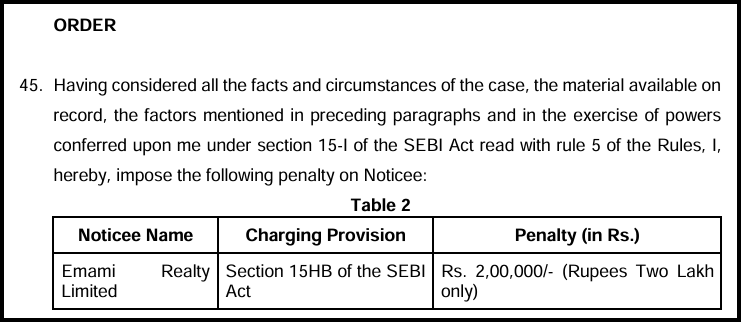
Worth noting, this isn’t ERL’s first brush with this exact provision.
The order records that SEBI had already imposed a ₹5 lakh penalty on the company under Section 15HB in an earlier adjudication dated March 6, 2023.
ERL now has 45 days from receiving this order to pay. Missing that window opens the door to recovery proceedings under Section 28A, which can extend to attaching company assets.
What This Means If You Hold Emami Realty Shares?
This order doesn’t allege investor loss, and no compensation or recovery amount is attached to it. It’s a corporate governance and disclosure matter, not a mis-selling case.
If you’re a shareholder with a separate grievance about how ERL, or any listed company, handles disclosures or governance, SEBI’s SCORES system does accept complaints directly against listed entities, not just brokers or advisors.
Filing there starts with the SEBI SCORES portal, where you can register a complaint against the company by name.
A separate note worth making here.
Unlike broker disputes, disclosure complaints against a listed company generally don’t move through SMART ODR or exchange arbitration, since those channels exist specifically for disputes with SEBI-registered intermediaries.
If your concern instead involves how your broker executed or reported trades in Emami Realty shares, that’s a different track entirely, and it runs through the exchange directly, using the NSE complaint email ID and grievance cell.
Before you act on any listed company’s disclosures, it’s worth taking a minute to check SEBI registered company status and enforcement history for yourself.
Conclusion
This order is a reminder that not every SEBI adjudication is a fraud case.
Emami Realty successfully pushed back on its largest exposure, over ₹180 crore in undisclosed related-party loans, but still couldn’t escape penalty on two narrower, better-documented lapses.
The ₹2 lakh fine is modest next to the numbers involved, but the underlying message for listed companies is consistent: prior approval means prior, and balance sheet classification has to match the accounting standard, not the business narrative.
Report. Recover. Stay Fraud Free.
SEBI imposed a ₹2 lakh penalty under Section 15HB of the SEBI Act, covering two established violations. ERL disbursed an additional ₹25 lakh loan to related party Lohitka Property LLP before getting audit committee approval, which came three days later. The AO extended benefit of the doubt, citing ERL's status as a successor entity following a 2016 merger and the age of the underlying FY14 and FY15 disclosures. ERL booked ₹49.94 crore in subsidiary investments and debentures under "Inventories" instead of "Investments" in its standalone financial statements, which inflated current assets and departed from applicable accounting standards. Yes, the order notes an earlier ₹5 lakh penalty under Section 15HB, imposed via a separate adjudication order dated March 6, 2023. No. The order does not allege or quantify any investor loss connected to these findings. SEBI's SCORES portal accepts complaints against listed companies directly, separate from the broker-specific process that runs through the exchange.Frequently Asked Questions




 Add us as a preferred source on Google »

