
Quick Summary
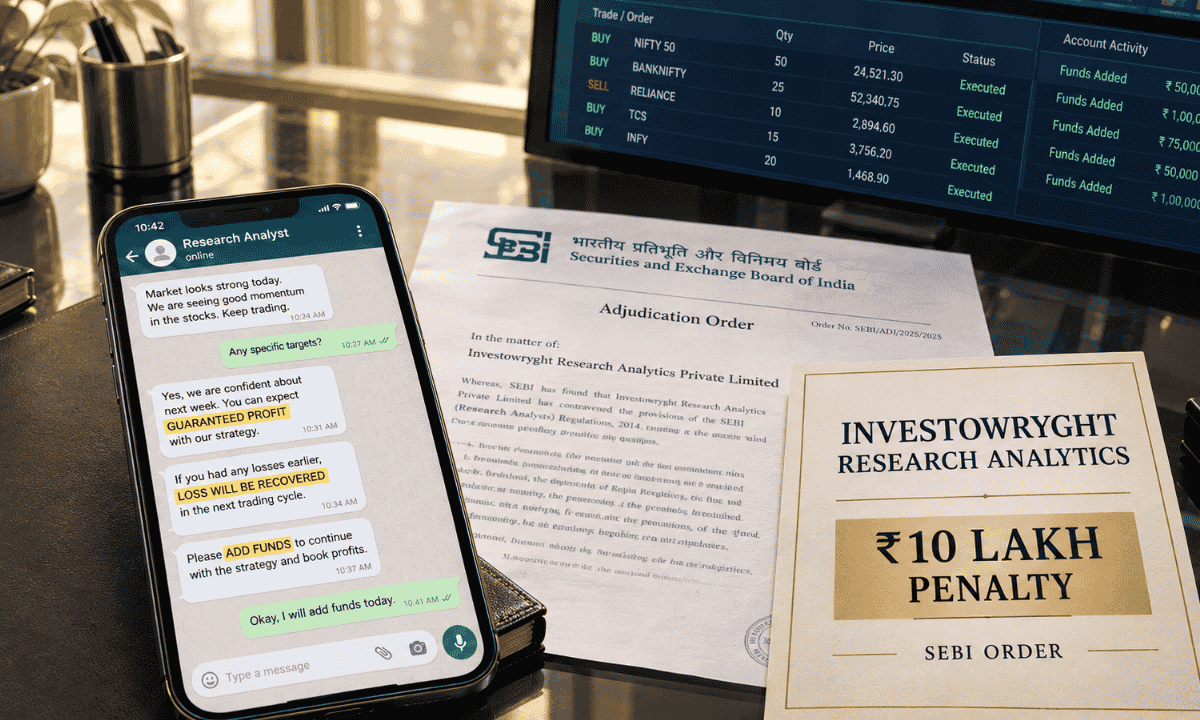
SEBI has penalised Investowryght Research Analytics Private Limited, a SEBI-registered research analyst, with a ₹10 lakh fine. The adjudication order found the firm’s representatives used WhatsApp to promise clients guaranteed daily returns and loss recovery while pushing them to keep adding funds and expanding trades. Two investor complaints backed by chat evidence formed the core of the case. SEBI also flagged missing KYC records, fee overcharges, and late regulatory filings. Investowryght did not respond to the hearing notice or appear before the adjudicating officer.
A SEBI-registered research analyst just got caught doing exactly what unregistered tip sellers usually get flagged for.
Investowryght Research Analytics Private Limited had a valid registration number and a functioning website. Its WhatsApp chats told a very different story.
SEBI’s adjudication order, passed on September 11, 2026, imposed a ₹10 lakh penalty after reading what the firm’s representatives were actually telling clients, in real time, on WhatsApp.
The order also stacked four separate compliance failures on top of that core finding, painting a picture of a firm that was cutting corners well beyond just one bad conversation.
What the SEBI Order Against Investowryght Actually Covers?
Investowryght is registered with SEBI as a research analyst under registration number INH000012157.
SEBI inspected the firm on September 23, 2025, covering the period from April 1, 2024 to August 31, 2025.
A Show Cause Notice followed on August 13, 2026, listing five separate sets of alleged violations.
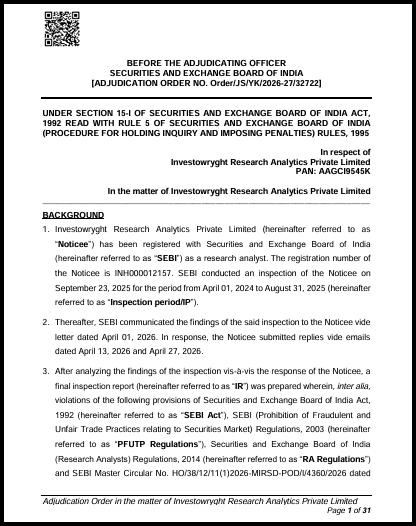
Investowryght was given a hearing date of September 9, 2026. It neither replied to the hearing notice nor showed up.
The order was passed two days later, on September 11, 2026, by Adjudicating Officer Jai Sebastian.
Inside the WhatsApp Chats That Undid the Firm’s Defence
The core allegation came from two SCORES complaints, referred to in the order only as XYZ and PQR to protect their identity.
Both complainants said Investowryght’s team assured them of guaranteed returns, promised to recover their losses, and pushed them to keep trading.
What made this case different from a plain “he said, she said” complaint is the evidence attached. XYZ’s complaint came with actual WhatsApp screenshots.
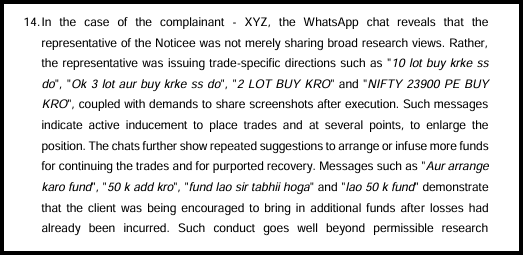
The messages weren’t vague market commentary. They were direct trade instructions, quantities and all, followed by requests to send screenshots after execution.
The chats also show a clear pattern of asking for more money after losses had already happened, with lines like “50 k add kro” and “fund lao sir tabhii hoga.”
The AO’s reading of these messages was blunt. Assurances of certain profit and guaranteed recovery are not something a research service is allowed to offer, no matter what the onboarding disclaimers say.
Investowryght argued that all it did was help clients understand and act on research recommendations, and that its fees were never linked to client profits.
The order rejected that defence directly, noting that advising someone to buy a specific quantity immediately, refuse a stop-loss, and add funds mid-loss “cannot be characterised as mere explanation of a research view.”
A second complainant, PQR, described being asked to pay ₹2 lakh that was supposedly meant for market investment, and later treated as a service charge instead.
Investowryght’s explanation for refunding PQR’s money was that a cyber-complaint had frozen its bank account, not that anything was wrong with the original transaction.
The AO accepted that a refund alone doesn’t prove wrongdoing, but noted the surrounding chat evidence still pointed the same way.
Interestingly, the order also shows where SEBI drew a line. It found no clear message demanding a fixed share of profits, so that specific “profit-sharing” allegation was given the benefit of the doubt.
But the core finding on assured returns and inducement to trade stood, and Investowryght was found in violation of the SEBI Act’s anti-fraud provisions along with the PFUTP Regulations and the RA Code of Conduct.
The Other Four Compliance Gaps SEBI Also Flagged
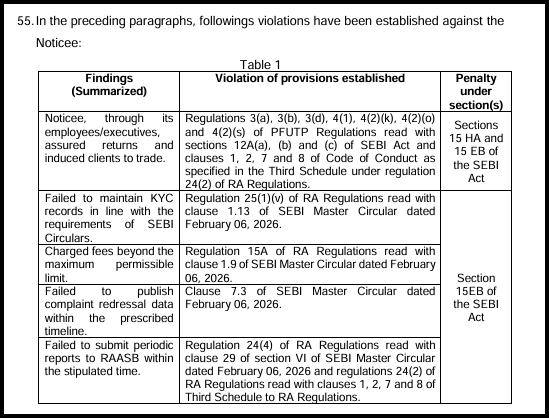
Beyond the WhatsApp evidence, the inspection turned up four more lapses that, on their own, might have been minor. Stacked together, they suggest a pattern.
KYC records fell short. Investowryght collected only basic details like name, PAN, and mobile number, and did not maintain the full CERSAI-prescribed KYC format required of every SEBI-registered intermediary.
Fees crossed the ₹1,51,000 cap. Nine clients were charged beyond SEBI’s prescribed annual fee limit for research analysts, adding up to roughly ₹6 lakh in excess collections.
The firm’s defence, that it simply hadn’t caught up with the new fee ceiling in time, was rejected. A registered intermediary is expected to track regulatory changes, not wait to be told.
Complaint redressal data went stale. As of April 2026, the firm’s website still showed complaint data only up to July 2025, well past the “7th of the following month” deadline SEBI requires.
RAASB reports went unfiled. Investowryght missed its half-yearly periodic reporting to the Research Analyst Administration and Supervisory Body for both the March 2025 and September 2025 cycles.
How SEBI Arrived at the ₹10 Lakh Penalty?
The order splits the penalty across two provisions of the SEBI Act.
₹5 lakh was imposed under Section 15HA, which covers fraudulent and unfair trade practices, for the WhatsApp-based inducement finding.
Another ₹5 lakh came under Section 15EB, the general penalty provision for research analysts who fail to comply with SEBI’s regulations, covering the remaining four lapses together.
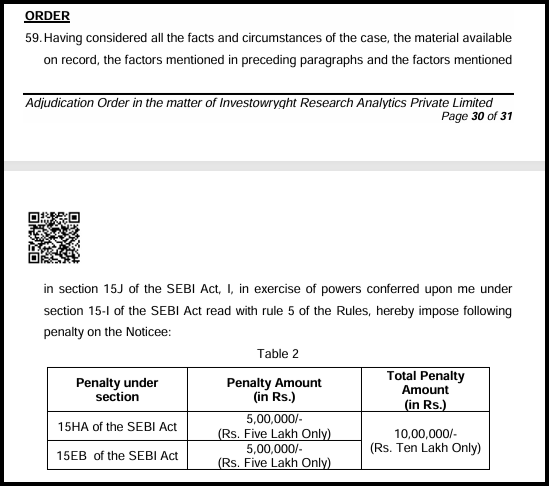
Under Section 15J, the AO is required to weigh disproportionate gain, investor loss, and whether the conduct was repetitive.
The order notes that exact investor losses weren’t quantified, but the ₹6 lakh in excess fee collection was on record, and there was no evidence of Investowryght repeating this kind of default before.
Investowryght now has 45 days from receiving the order to pay. Missing that window opens the door to recovery proceedings under Section 28A, which can extend to attaching the firm’s assets.
What If You’ve Already Taken Services From Investowryght Research Analytics?
If you’ve dealt with Investowryght and recognise any of the patterns described in this order, you’re not without options.
This SEBI order already establishes the core misconduct on record, which works in your favour if you decide to pursue your own complaint.
Document everything you have first. Chat screenshots, payment receipts, and any recorded calls will matter far more than a general description of what happened.
Once you have that evidence together, the escalation path generally follows this order:
- Start with a complaint on the SEBI SCORES portal, where you can file directly against a registered research analyst using their registration number.
- If SCORES doesn’t resolve things within the response window, move to SMART ODR login, SEBI’s conciliation platform that sits between SCORES and formal arbitration.
- If conciliation also fails, the final step is Share market arbitration, which results in a binding, enforceable award.
If you’d like the full process laid out in detail, including what evidence to prepare at each stage, our guide on complaint against SEBI registered research analyst walks through it step by step.
Conclusion
This order is a reminder that a SEBI registration is a starting point, not a guarantee.
Investowryght held a valid research analyst license while its representatives were reportedly running a WhatsApp operation that promised guaranteed returns and pushed clients to keep funding losing trades.
The ₹10 lakh penalty covers both that core conduct and four separate compliance failures uncovered during inspection.
For investors, the lesson isn’t to distrust registration itself, but to treat it as only the first check, not the last one.
Report. Recover. Stay Fraud Free.
SEBI imposed a total penalty of ₹10 lakh, split as ₹5 lakh under Section 15HA and ₹5 lakh under Section 15EB of the SEBI Act. The order found that its representatives assured clients of guaranteed returns and loss recovery over WhatsApp, and induced them to keep trading and adding funds. It submitted a written reply but did not respond to the hearing notice or appear for the scheduled hearing on September 9, 2026. Yes, its research analyst registration, number INH000012157, remains on record as of this order. SEBI flagged incomplete KYC records, fees charged beyond the ₹1,51,000 annual limit, delayed complaint redressal disclosures, and missed RAASB periodic reports. The order notes approximately ₹6 lakh collected in excess of the prescribed fee limit from nine clients. Start with a SCORES complaint using their registration number, and escalate through SMART ODR and arbitration if it isn't resolved, as outlined above.Frequently Asked Questions




 Add us as a preferred source on Google »

