

Quick Summary
SEBI Adjudicating Officer Jai Sebastian fined Swaraj Shares & Securities Private Limited, a merchant banker, ₹10 lakh on October 28, 2026. The order covers two open offers for G. D. Trading and Agencies Limited, the Micropro Software Solutions and Shoora Designs IPOs, and gaps in its insider trading database. The officer found due diligence and disclosure lapses on most counts and dropped one over a revenue typo. The penalty is due within 45 days.
A BSE restraint order that ran until 2027. A prospectus in which a return on net worth worked out negative but was printed as positive.
An insider trading database that the firm could not demonstrate to inspectors.
On October 28, 2026, SEBI fined Swaraj Shares & Securities Private Limited ₹10 lakh.
This Swaraj Shares SEBI order shows what a merchant banker is expected to check before putting its name on an offer document.
What Does The Swaraj Shares SEBI Order Say?
SEBI’s Adjudicating Officer fined the merchant banker ₹10 lakh under Section 15HB of the SEBI Act.
The order rests on seven issues from two open offers, two IPOs, and one internal control check.
The key details are set out below:
1. The Order And The Authority
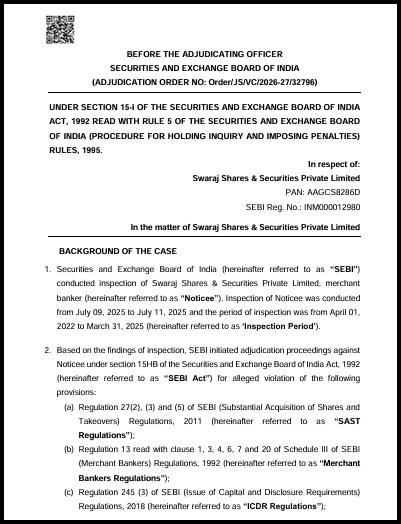
It is an Adjudication Order under Section 15-I of the SEBI Act, 1992, read with Rule 5 of the 1995 Rules.
The order number is Order/JS/VC/2026-27/32796.
Jai Sebastian, Adjudicating Officer, passed it in Mumbai on October 28, 2026.
2. The Noticee
The noticee is Swaraj Shares & Securities Private Limited, acting as a merchant banker in the matters covered. The order is titled “in the matter of Swaraj Shares & Securities Private Limited”.
3. The Penalty
The officer imposed ₹10,00,000 (Rupees Ten Lakh only) under Section 15HB. He called it commensurate with the violations.
4. What It Covers
Seven issues were examined. They cover two open offers, two IPOs, and the structured digital database under the insider trading rules.
From A July 2025 Inspection To An October 2026 Order: How The Case Moved?
The order records a long road from inspection to penalty. The matter also changed hands along the way.
Here are the dates it records:
1. The Inspection: July 9 to July 11, 2025
SEBI inspected the merchant banker. The inspection period ran from April 1, 2022 to March 31, 2025.
2. The Reallocation: July 9, 2026
The matter was reallocated from an earlier Adjudicating Officer. Jai Sebastian was appointed on July 9, 2026, under Section 19 read with Section 15-I.
3. The Show Cause Notice: September 7, 2026
The notice was issued under Rule 4(1) and asked why an inquiry should not be held and a penalty imposed under Section 15HB.
The reference number was SEBI/HO/EAD-2/JS/VC/23287-88/2026.
4. The Reply: October 5, 2026
The merchant banker replied in writing, and the order sets out its answers issue by issue.
5. The Hearing: October 21, 2026
A hearing notice dated October 8, 2026 fixed the date.
The promoter director and another authorised representative attended in person.
6. The Order: October 28, 2026
Jai Sebastian passed the adjudication order on this date and imposed the penalty.
What Did SEBI Find In The Two G. D. Trading Open Offers?
Both open offers involved the same target company, G. D. Trading and Agencies Limited, now known as RRP Semiconductors Limited.
The common thread was a BSE restraint order on the company.
The facts of each offer are set out separately below:
The First Open Offer By Ms. I. R. Mishra
The first acquirer agreed to buy 74,500 equity shares, or 74.50% of the voting capital, for ₹8,94,000.
That triggered an open offer.
1. The Restraint Order
BSE’s Notice No. 20170821-27 dated August 21, 2017 restrained the target company and Ceres Company Private Limited from accessing the securities market.
The restraint ran from August 23, 2017 to August 22, 2027.
2. What SEBI Alleged
The merchant banker became aware of the order in December 2023.
Its due diligence certificate, emailed on January 11, 2024, did not mention it.
3. What The Officer Held
He noted the merchant banker admitted it learned of the order during due diligence. He held that the certificate was incomplete and inaccurate.
He wrote that once it sought clarifications from the target, it should have adopted a cautious approach and disclosed the order.
4. The Defences The Officer Did Not Accept
The merchant banker said the order concerned the compulsory delisting of Shree Vindhya Paper Mills Limited, not the target company.
It also said the acquisition was a secondary purchase made before its engagement.
The officer held that neither point removed its duty of full, true and fair disclosure. The allegation stood established.
The Second Open Offer By Mr. R. K. Chodankar
The second acquirer signed a Share Subscription Agreement on April 23, 2024 for 1,01,50,000 preferential shares, or 74.50% of the expanded capital.
The price was ₹12,18,00,000.
1. The Core Concern
The preferential issue happened while the restraint on the target company was still in force. The draft letter of offer was filed on April 30, 2024.
SEBI’s concern was that the merchant banker did not examine whether that underlying transaction was permissible.
2. What The Records Showed
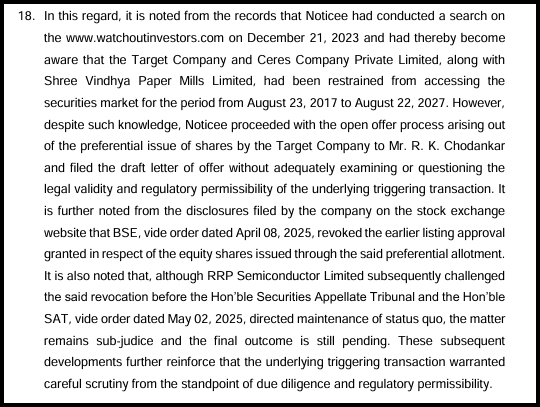
The officer noted that the merchant banker searched the Watch Out Investors portal on December 21, 2023. That is how it learned of the restraint.
BSE later revoked the listing approval for the preferential shares by an order dated April 8, 2025.
3. The SAT Position
The target company challenged the revocation before the Securities Appellate Tribunal. On May 2, 2025, the SAT directed status quo, and the matter is still pending.
4. What The Officer Held
He held that accepting the mandate meant it had to satisfy itself about the legal validity and permissibility of the transaction behind the offer.
Its limited role as manager did not remove that duty.
He found violations of Regulation 27(2), (3) and (5) of the SAST Regulations and Regulation 13 of the Merchant Bankers Regulations.
What Went Wrong In The Micropro Software Solutions IPO?
The Micropro IPO raised three separate points.
Each one tests whether the merchant banker checked the issuer’s papers or only passed them on.
1. Working Capital: Data Passed On, Not Tested
One object of the issue was working capital. The officer found no documentary evidence of independent due diligence.
When the exchange asked for a rationale, the merchant banker forwarded the company’s data.
Annexures filed with the exchange expressly said the estimates came from the company’s management.
2. The Cash And Cash Equivalents Contradiction
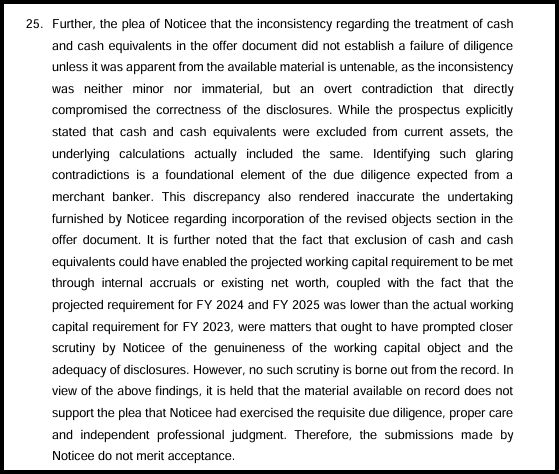
The prospectus said cash and cash equivalents were excluded from current assets in the working capital calculation. The underlying computation included them.
The officer called it an “overt contradiction”.
Without cash, the projected need could have been met from internal accruals or existing net worth.
3. Underwriting at 94.98%
Clause 2.1 of the underwriting agreement showed 36,00,000 shares at ₹81, or ₹2,916 lakh, which is 94.98% of the issue. Regulation 260(1) requires 100% underwriting for an IPO.
The prospectus and the undertaking under Regulation 260(4) both said the issue was fully underwritten.
4. What The Officer Held On Underwriting
The merchant banker said clause 2.1 excluded the market maker reservation portion. The agreement read as a whole contemplated 100% underwriting.
The officer called it an inconsistency in the documents. He noted the merchant banker was itself the underwriter and should have made the terms clear.
5. The RTA Addendum On Plain Paper
An addendum dated October 23, 2023 between the issuer and the registrar to the issue was executed on plain paper without apparent stamp duty.
The merchant banker admitted that this could have been identified and escalated.
The officer held that scrutiny of material contracts was part of its duty, even though it was not a party.
Also Read: MCS Share Transfer Agent SEBI Order On Registrar Lapses
What Went Wrong In The Shoora Designs IPO?
The Shoora Designs IPO led to four findings and one dropped allegation.
The theme matches Micropro: numbers in the prospectus that did not tie up.
1. Working Capital Jumped More Than 100%
The prospectus showed working capital rising from ₹15.52 crore (actual, March 31, 2023) to ₹35.06 crore (projected, March 31, 2024).
That is an increase of more than 100%.
The officer found the rise unsupported by any credible rationale or documents.
2. Figures That Did Not Match
Projected working capital for FY 2024 and FY 2025 in the reply to the exchange did not match the prospectus. The merchant banker did not explain.
The prospectus also included long-term loans and advances in current assets. The merchant banker said these were supplier advances but gave no documents.
The officer said it acted as a “passive conduit” for the company’s estimates.
3. Forward-Looking Statements
The prospectus said the issue funds would be used in FY 2024, yet it gave FY 2025 projections. It also said funding working capital would lead to higher profitability.
The merchant banker said the FY 2025 figure was added after a BSE query.
The officer called that a fundamentally misconceived view of its role, and noted it gave no reply on the profitability claim.
4. Basis Of Issue Price: A Negative Return Printed As Positive
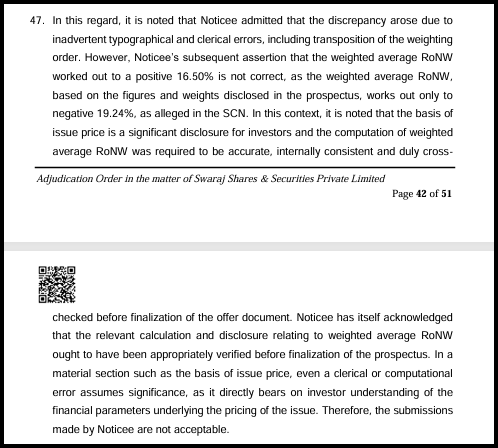
The weighted average return on net worth was shown as 19.24%. Using the figures and weights in the same table, it works out to negative 19.24%.
The merchant banker called it a typographical error and said the correct figure was a positive 16.50%. The officer rejected that figure.
5. The Revenue Typo That Was Dropped
The “Our Business” section stated revenue of about ₹105.59 lakh, while the table showed about ₹210.59 lakh. The officer noted the error understated revenue and was confined to narrative text.
He took a lenient view and dropped this allegation.
6. Key Industry Regulations
The “Key Industry Regulations and Policies” section left out the LODR and ICDR Regulations. The merchant banker said they appeared elsewhere in the prospectus.
The officer held that this did not cure the omission in the section meant for them.
Structured Digital Database: What SEBI Found During The Inspection?
The last issue has nothing to do with any one offer. It concerns the merchant banker’s own insider trading controls.
The inspection found three gaps:
1. The Software Could Not Be Demonstrated
The merchant banker could not show the working of its software for the Structured Digital Database.
The invoice it produced showed the software was procured in May 2024.
2. No Separate Restricted List Or Review Records
It had not maintained a separate restricted list.
It also had no documents showing periodic review of internal controls and checks.
3. The IPOs Before The Software
The officer noted the merchant banker handled eight IPOs in the inspection period, six of them in FY 2023-24. Those six came before the software purchase.
He held that these were handled without any SDD platform in place. He found violations of Regulation 3(4) and (5) and Schedule C, read with Regulation 9A, of the PIT Regulations.
What Did Swaraj Shares Argue Before SEBI?
The merchant banker replied in writing on October 5, 2026, and repeated its points at the hearing.
The order gives its case for each issue.
Here are the main arguments:
1. The First Open Offer
It said the restraint concerned a different company’s delisting.
It also said SEBI processed the open offer without raising the point, and the matter was disclosed in the draft letter of offer.
2. The Second Open Offer
It said it was engaged only after the preferential allotment and had no role in it. It also pointed out that the restraint order was disclosed in the offer documents.
3. The IPOs
It said its diligence relied on restated financials, management-certified assessments, bank statements and exchange queries.
For several errors, it said they were inadvertent and clerical.
4. Admissions And Undertakings
It acknowledged that several discrepancies should have been caught, and said it had strengthened its cross-checking.
It undertook enhanced diligence in the future.
5. Who Was In Control
At the hearing, its representatives said the lapses happened while certain key managerial personnel controlled the Mumbai operations.
They said the promoter director, based in Kolkata, now controls it with a more linear team.
How SEBI Fixed the ₹10 Lakh Penalty?
After the findings, the officer turned to the penalty.
He started from the legal basis and then weighed the factors in Section 15J.
1. The Legal Basis
Section 15HB covers violations with no separate penalty. It provides for a penalty from ₹1 lakh to ₹1 crore.
The officer cited SEBI v. Shriram Mutual Fund, which says penalty follows once a contravention is established, whatever the intent.
2. Gain, Loss And Repetition
The record showed no quantifiable gain to the merchant banker and no measurable investor loss.
On repetition, the officer noted a WTM order dated August 19, 2025 that suspended the firm for three months.
SAT later modified that order. It limited the suspension to one month and barred onboarding new clients for two months after the suspension ended.
3. Why The Officer Called It Serious
He wrote that the lapses weaken the due diligence framework and the integrity of open offers and IPOs. For the SDD gaps, he added that they raise the risk of UPSI being handled without a trail.
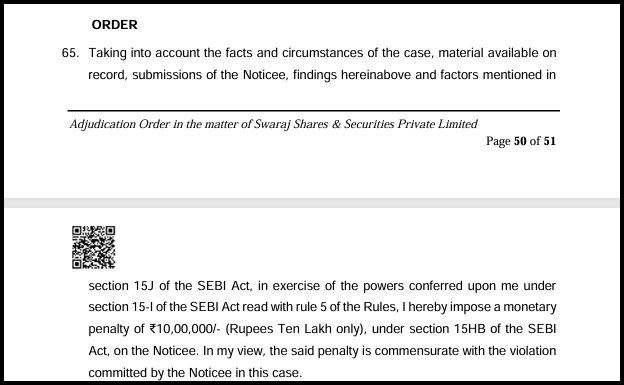
The officer concluded that ₹10 lakh was commensurate with the violations.
Also Read: Abhipra Capital SEBI Order
Is Swaraj Shares & Securities SEBI Registered Or Not?
Readers searching for the firm often want this answer first. The order gives it in its heading.
Swaraj Shares & Securities Private Limited holds SEBI registration number INM000012980 as a merchant banker.
The order states that SEBI inspected it as a merchant banker.
1. What The Order Does Not Do
The order does not cancel or suspend the registration. It imposes only a monetary penalty.
2. What The Order Does Say About The Past
It records the earlier WTM suspension of August 19, 2025, which SAT then reduced.
That sits in the penalty reasoning and is not a new direction.
How And When Must the Penalty Be Paid?
The order sets a clear deadline and route for payment. It also states what follows if the deadline is missed.
1. The 45-Day Window
The merchant banker must pay within 45 days of receiving the order.
2. The Payment Path
Pay online on sebi.gov.in under ENFORCEMENT, Orders, Orders of AO, then PAY NOW.
3. If Payment Is Missed
SEBI may start recovery under Section 28A of the SEBI Act. That can include attachment and sale of movable and immovable property, with interest.
4. Copies
A copy goes to the noticee and to SEBI under Rule 6.
What The Swaraj Shares SEBI Order Means For Open Offer And IPO Investors?
The order is about compliance by a merchant banker, and it records no quantified investor loss.
It still shows what an investor can check in the documents.
1. Check The Offer Document For Internal Consistency
Several findings were about numbers that contradicted each other within the same document. Compare the narrative with the tables.
2. Read The Risk Disclosures
In the first open offer, a restraint order on the target company mattered to public shareholders. Look for any regulatory action disclosed about the company you are tendering to.
3. Look At The Object Of The Issue
Working capital was an object in both IPOs. Check whether the document explains why fresh funds are needed.
4. Know Where To Raise A Concern
If an offer document looks wrong, you can raise it with SEBI. The steps to file a SCORES complaint with SEBI are simple to follow.
Conclusion
SEBI fined a merchant banker ₹10 lakh after finding it passed on company figures, missed a restraint order in disclosures, and could not show its insider trading database.
One count on a revenue typo was dropped.
The order records no quantified gain or investor loss. Its message is about the duty of independent checking.
For investors, the lesson is to read offer documents for contradictions and regulatory flags.
Report. Recover. Stay Fraud Free.
SEBI fined Swaraj Shares & Securities Private Limited ₹10 lakh on October 28, 2026. The order covers two open offers, two IPOs and its insider trading database. Jai Sebastian, SEBI Adjudicating Officer, passed it in Mumbai on October 28, 2026. The Micropro Software Solutions and Shoora Designs IPOs. The open offers were for G. D. Trading and Agencies Limited. Yes. The officer dropped the allegation on the revenue figure in the Shoora Designs "Our Business" section. Within 45 days of receiving the order, through the SEBI payment portal. Recovery under Section 28A may follow if it is missed. No. The order imposes only a monetary penalty. No. The officer noted no quantifiable gain to the firm and no measurable investor loss.Frequently Asked Questions




 Add us as a preferred source on Google »