
Quick Summary
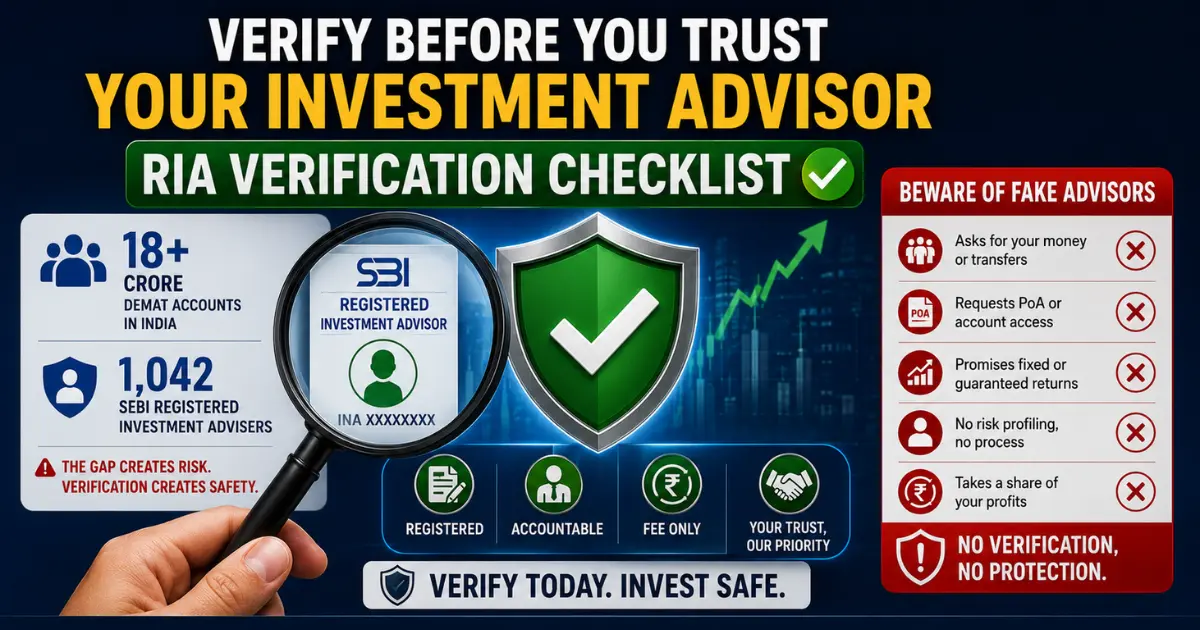
A SEBI registered Investment Adviser holds an INA number under the Investment Advisers Regulations, 2013. India has roughly 1,042 registered RIAs, a small number against millions of investors. RIAs must charge fees directly and cannot earn commission on products they recommend. RIAs also cannot hold your money, take a Power of Attorney, or trade on your behalf.
India has over 18 crore demat accounts and roughly 1,042 SEBI registered investment advisers.
Do that math, and you’ll see why every finfluencer suddenly calls themselves an advisor.
Most of them are simply filling a gap that real, accountable RIAs can’t reach.
Pay the wrong one and there’s no regulator standing behind a single rupee you lose.
This checklist confirms the badge is real before you sign anything.
What a Genuine RIA Can and Cannot Do
This distinction alone filters out most fraudulent advisory pitches before you get any further.
| Action | A Genuine RIA | A Red Flag Operator |
| Handling your funds | Never takes custody of money or securities | Asks you to transfer funds to them directly |
| Account access | No Power of Attorney over your trading account | Requests PoA or your login credentials |
| Fee model | Direct, disclosed, capped advisory fee | Ties fee to a share of your future profits |
| Advice basis | Follows a documented risk profiling process first | Jumps straight to recommendations, no profiling |
| Return promises | Never assures a fixed or guaranteed outcome | Promises specific daily or monthly returns |
RIA Verification Checklist
Work through this list before signing any advisory agreement or paying a fee.
- INA number: Ask for the exact registration number and confirm it on the SEBI website.
- Name and firm match: The registered entity name should match the agreement and payment details exactly.
- Fee model: Fees should be transparent and capped, not tied to a share of your returns.
- No PoA request: A genuine RIA will never ask for control of your demat or trading account.
- Risk profiling done first: Advice should follow a documented assessment of your goals, not come before it.
- Conflict of interest disclosure: The RIA should disclose any product tie ups or referral arrangements upfront.
- Written agreement: Insist on a signed advisory agreement before any payment changes hands.
Searching the SEBI RIA Database
A more detailed breakdown of RIA rules and real cases is available in SEBI registered investment advisor.
1. Visit SEBI’s website: and open the Intermediaries, Recognised Intermediaries section from the menu.
2. Select Investment Adviser: from the category list to filter results to this entity type only.
3. Search by name or firm: and compare the result against the exact name on your proposed agreement.
4. Note the registration validity: since registrations can lapse or be suspended over time.
Why the Supply Gap Matters to You
With roughly 1,042 RIAs against a far larger investor base, demand outpaces supply badly.
This gap is exactly why unregistered tipsters and finfluencers find such an easy audience.
A verified RIA is harder to find, but far safer to trust with your money, and worth the extra search time.
A Quick Sanity Check Before You Pay
If an adviser skips risk profiling and jumps straight into a pitch, that alone is worth pausing over.
If they ask for account access instead of a fee, the conversation should end right there.
Genuine advisers rarely mind a slower, more deliberate onboarding process, since it protects them too.
Bottom Line
Registration confirms accountability, qualification, and a fee only model, not investment success.
Run a full check SEBI registered investment advisor lookup, along with checklists for every other entity type, through Fraud Free.
If an adviser overcharged you or handled your account without authority, you can file a complaint against your RIA directly.
Report. Recover. Stay Fraud Free.
Frequently Asked Questions
A SEBI registered Investment Adviser carries an INA number. You can verify this directly on the SEBI website under Intermediaries, Recognised Intermediaries, by searching the adviser's name or number.
No. A genuine RIA gives advice only and cannot accept a Power of Attorney or hold custody of your funds or securities under SEBI's Investment Advisers Regulations, 2013.
An RIA charges a direct fee and gives personalised advice with no product commission. A distributor earns commission on products sold, which can create a conflict of interest in recommendations.
Yes, SEBI caps advisory fees per client family per year. Ask your adviser for their exact fee structure in writing before agreeing to any advisory arrangement.
Stop the engagement immediately and avoid sharing further financial details. You can report unregistered advisory activity through SEBI SCORES or by emailing SEBI's investor grievance desk directly.
With roughly 1,042 registered RIAs against a far larger pool of investors, demand consistently outpaces supply. That gap is exactly what unregistered advice givers step in to fill.





 Add us as a preferred source on Google »

