
Quick Summary
Stoxo is an AI chatbot built specifically for the Indian stock market, launched by StockGro on September 1, 2025, and it lives at its own address, stoxo.club, separate from the main app though built into StockGro’s paid plans too. StockGro describes it as “India’s First Stock Market AI Research Engine,” combining AI with “the intelligence of SEBI-registered analysts.” At the same time, StockGro’s own Terms and Conditions state that Stoxo’s outputs may be inaccurate, incomplete, or outdated, and have not been independently verified by a human. This page walks through what the tool actually does, what the marketing says, and what the legal terms say instead.
You’ve typed a stock question into Stoxo, StockGro’s AI research assistant, expecting something smarter than a generic Google search.
Maybe you’ve even seen it described as “India’s first stock market AI research engine” and wondered if that’s really true.
Here’s what’s actually worth knowing before you lean on it for a real decision.
Stoxo AI genuinely exists, genuinely runs on real market data, and genuinely answers the kind of questions you’d ask a human analyst.
But the same company that markets it as “credible” and “real-time” also writes, in its own legal terms, that its answers might be wrong. This page lays out both sides plainly, so you know exactly what you’re relying on.
Stoxo AI
Stoxo is an AI chatbot built specifically for the Indian stock market.
It was launched by StockGro on September 1, 2025, and lives at its own address, stoxo.club, separate from the main StockGro app, though it’s built into StockGro’s paid subscription plans too.
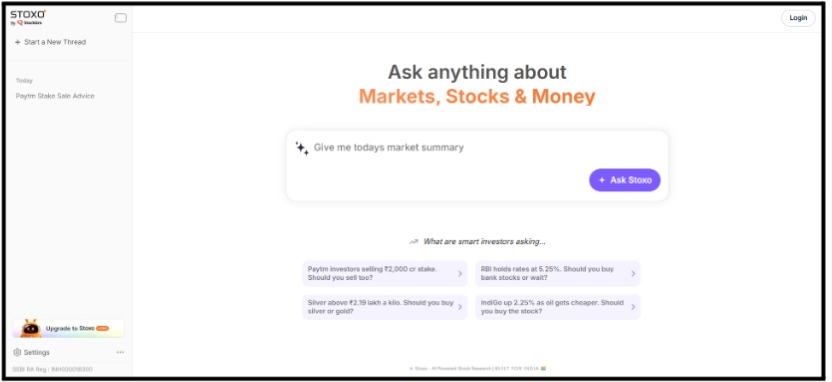
The idea is simple. Instead of typing a stock question into Google or scrolling through YouTube and Telegram groups, you type it into Stoxo AI, things like “Is now a good time to invest in PSU banks?” or “What’s the trade outlook for Zomato?”, and it gives back a written answer, meant to read like something a human analyst would say rather than a wall of search results.
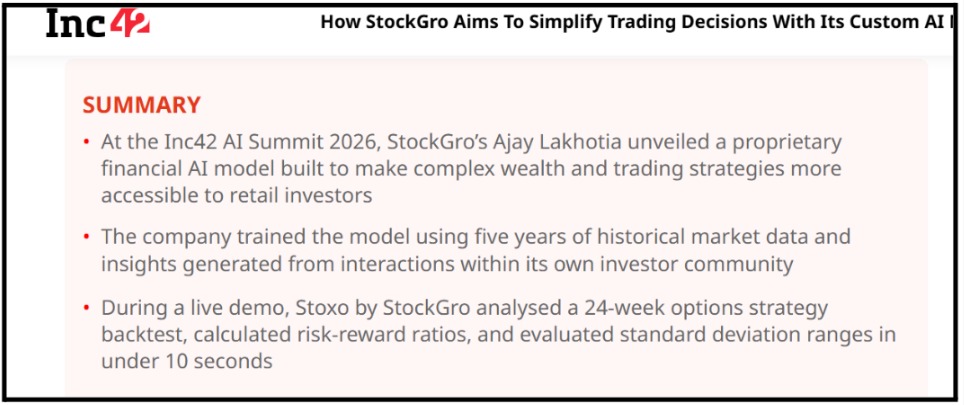
Later, in 2026, StockGro stated it had rebuilt Stoxo as its own custom AI model, not simply a wrapper on top of an existing AI, trained specifically on five years of market data and patterns from its own investor community, rather than relying purely on general internet data.
Also Read: Fintrekk Capital, is this SEBI-registered Research Analyst firm genuine, and how safe are its stock strategies?
How Does StockGro Describe Stoxo?
In its own launch announcement, StockGro called Stoxo AI by StockGro three specific things worth quoting directly.
First, “India’s First Stock Market AI Research Engine.” Second, a tool built to deliver “credible, relevant, accurate, and real-time stock market intelligence.”
Third, something that combines “AI with the intelligence of SEBI-registered analysts.”
Founder Ajay Lakhotia has described it as “an investing buddy” that gives users “the confidence to make informed decisions,” and said it’s built to be “fast, fluid, credible.”
For his fuller career background and how he’s spoken about the company’s direction in other interviews, our page about the StockGro founder covers that in full.
What Do Stoxo’s Own Legal Terms Actually Say?
Here’s where the picture becomes more nuanced.
Separately from the marketing language above, StockGro’s own Terms and Conditions include a specific section addressing this exact AI tool, and it’s worth reading in the company’s own words.
The tool’s responses “are for testing and informational purposes only and should not be construed as advice on any subject matter.”
The terms go further, stating that “the outputs generated by this AI tool may be inaccurate, incomplete or outdated and have not been independently verified or reviewed by a human.”
Users are “expressly advised to independently verify the information and not solely rely on the tool.”
And the company states it will not be held liable “under no circumstances” for “any direct, indirect, incidental, consequential, or special damages, including but not limited to financial losses” arising from using this tool.
So on one hand, the tool is marketed with words like “credible,” “accurate,” and “real-time.”
On the other hand, the same company’s legal terms state that the same tool’s answers might be wrong, outdated, unchecked by a human, and that the company won’t be responsible if a user loses money trusting it.
Both statements can technically be true at once. AI tools generally carry disclaimers like this across the industry, not just here.
But it’s worth any new user knowing that the confident tone of the marketing and the cautious tone of the terms don’t fully match up, and the terms are the ones that actually govern what happens if something goes wrong.
Also Read: Eqwires Research Analyst, another SEBI-registered analyst worth knowing about.
Is Stoxo Covered by a SEBI Registration?
Stoxo’s own webpage displays “SEBI RA Reg: INH000018300,” the same Research Analyst registration that belongs to StockGro’s Bengaluru-based entity.
This registration is real.
But a SEBI research analyst registration is a license for a company doing analyst-style research work; it isn’t a certification that an AI model’s specific answers are accurate or individually reviewed by SEBI.
That distinction is worth holding onto clearly, since the registration covers the company, not the AI’s individual outputs.
A quick SEBI registration check takes only a couple of minutes and is worth doing yourself rather than relying on what any app displays.
Search the registration number directly on SEBI’s own portal to confirm the entity name, category, and status match what’s shown here; the same habit is worth applying to any registered analyst or advisor before you trust their claims.
Does Stoxo’s Marketing Language Match SEBI’s Advertising Rules?
Beyond what Stoxo’s answers actually say, it’s worth looking at how the tool describes itself, since SEBI holds registered analysts to specific rules about the language they use in promotional material.
Superlative claims appear across Stoxo’s marketing.
The phrases “India’s leading investment advisory and knowledge platform” and “India’s First Stock Market AI Research Engine” both use the kind of “leading” and “first-in-category” language that SEBI’s advertisement rules restrict registered analysts and advisers from using.
This is worth stating plainly as a factual comparison, not a settled conclusion.
SEBI’s advertising guidelines are published and publicly available, and the exact wording used in Stoxo’s own marketing is equally public.
Anyone can place the two side by side and judge the comparison for themselves, which is exactly what this section invites you to do, rather than asking you to accept a verdict secondhand.
Also Read: Ethical Research Analyst. The SEBI-registered firm claims a 95% client retention rate, but how credible are its claims?
What Performance Claims Has Stoxo Made?
Beyond how Stoxo describes itself in general marketing language, it’s worth looking at one specific, measurable claim StockGro has made about the tool’s actual performance.
In a 2026 product demo covered by Inc42, StockGro stated that Stoxo analyzed a 24-week options strategy backtest and calculated risk-reward ratios “in under 10 seconds.”
The same coverage noted this demo took place at the Inc42 AI Summit, where founder Ajay Lakhotia presented the tool’s custom AI model, trained on five years of historical market data.
Speed claims like this are easier to demonstrate in a controlled demo setting than to verify in everyday use.
A staged demonstration lets a team choose the exact scenario being shown, while a real user’s own query happens live, without that same preparation.
This distinction matters especially here, since the tool’s own disclaimer states its answers may not be checked by a human at all, which means a fast answer and an accurate one aren’t necessarily the same thing.
How Much Does Stoxo Cost to Use?
Beyond the free-versus-paid question of accuracy already covered, price is worth understanding clearly too, since it affects how often you can realistically use the tool.
Stoxo sits inside a paid subscription model, layered across StockGro’s existing plan tiers rather than sold as a separate product.
The screenshot below shows exactly how this breaks down across the three paid plans, so you can see the actual numbers rather than a summary of them.
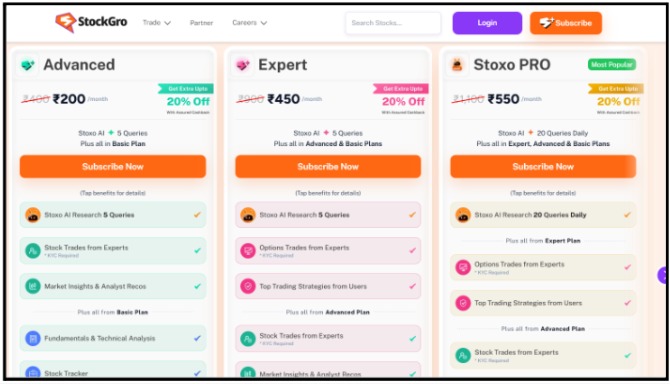
Reading that screenshot left to right, here’s what it actually shows. The Advanced plan runs ₹200 a month, listed against a crossed-out ₹400, and includes five Stoxo AI queries.
The Expert plan runs ₹450 a month, listed against a crossed-out ₹900, also capped at five Stoxo queries, with additional features layered on top.
Stoxo PRO, marked “Most Popular” and priced at ₹550 a month against a crossed-out ₹1,100, is the only tier that unlocks the full 20 queries a day, more than triple what either lower tier allows.
This structure is worth sitting with for a moment.
A tool marketed around making research accessible to everyday investors caps free daily use at five questions, and meaningfully more access only opens up once you’re paying for the highest tier.
Five questions a day may suit someone checking on one or two specific stocks occasionally, but it’s a real constraint for anyone hoping to use Stoxo as a daily research habit without upgrading.
Whether that cost feels worth it in practice is best judged against what actual subscribers have said after paying for it, and real accounts covering the broader StockGro experience are documented in full on our page: StockGro Reviews.
What Should You Take Away From All of This?
You’ve now seen both sides: the confident marketing, and the cautious legal language sitting right behind it.
Here’s what that actually means for you, in plain terms, before you use Stoxo for anything real.
- Stoxo is a genuine AI tool, backed by a real, SEBI-registered company. This isn’t a fake or unregistered app, and the technology genuinely exists and functions as described.
- Don’t take any single answer at face value, especially for buy or sell decisions, entry or exit points, or risk calls. The company’s own terms say plainly that an answer could be wrong, might never have been checked by an actual person, and that StockGro carries no responsibility if it turns out to be inaccurate.
- Treat it like any AI tool giving financial-sounding answers. Good as a starting point to explore an idea, not something to act on directly without checking it elsewhere first.
If you’re weighing whether the broader app itself deserves your trust beyond just this AI feature, that’s examined in full on our page: StockGro app is real or fake.
Already lost money acting on a Stoxo answer?
Tell us what it told you and what happened after. We’ll help you figure out whether that’s just an ordinary market outcome, or something worth filing a formal complaint over.
Conclusion
Stoxo is a genuine AI tool, backed by a real, registered company, not a fabricated feature.
That much is fair to state plainly.
What deserves equal weight is the clear gap between how Stoxo is marketed, credible, accurate, real-time, and what its own legal terms say about its answers: potentially inaccurate, unverified, and carrying no liability if something goes wrong.
Neither fact cancels the other out, and both are worth knowing before you let any Stoxo answer guide a real financial decision.
Report. Recover. Stay Fraud Free.
Stoxo is an AI chatbot built by StockGro specifically for the Indian stock market, launched September 1, 2025, offering written answers to stock-related questions. StockGro markets it as credible and real-time, though the company's own Terms and Conditions state that outputs may be inaccurate, incomplete, or outdated and have not been independently verified by a human. Stoxo displays SEBI Research Analyst registration INH000018300, the same registration held by StockGro's parent entity. This covers the company, not a certification of the AI's individual answers. A limited number of daily questions, commonly five, is available for free, while the Stoxo PRO subscription tier unlocks up to 20 questions a day. StockGro's own terms advise users to independently verify any information from the tool rather than relying on it solely, and state the company carries no liability for losses arising from its use.Frequently Asked Questions





 Add us as a preferred source on Google »

