
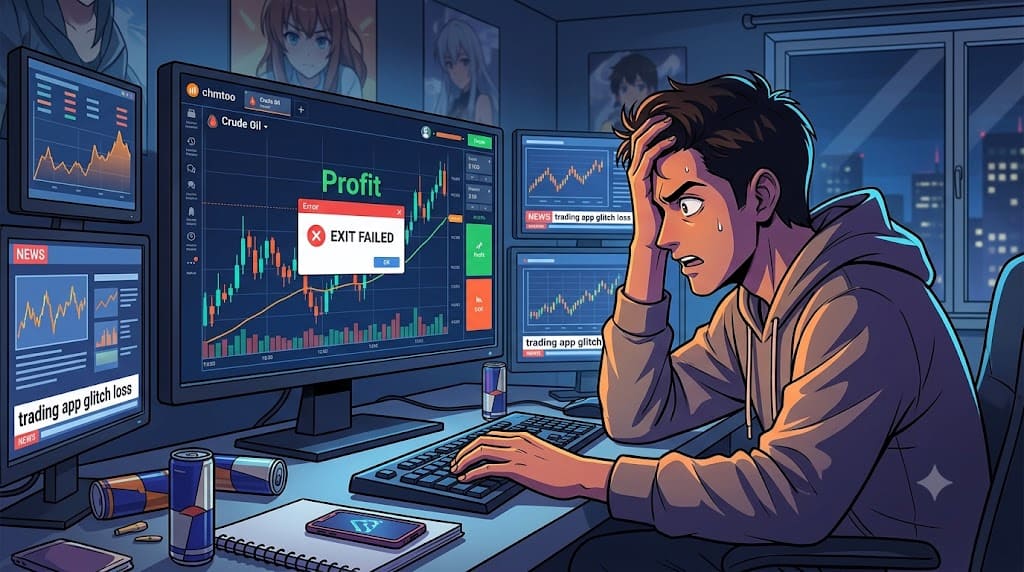
It was a little after noon when Ravi (name changed), a trader from Ahmedabad, tapped “sell” for the third time. Nothing happened.
His crude oil position was in profit. The price was right there on the screen. And the app simply would not let him out.
He had been trading carefully for over a year, the kind of person who watches market content, takes notes, and does not gamble. That afternoon, he had taken a buy in crude oil, and for a while, everything went the way it was supposed to. The trade moved in his favour. He decided to book it.
That was the moment everything stopped working.
His exit orders kept cancelling on their own. The quantity would not update. The amount would not load.
He placed the order again. It was cancelled again. He sat there watching the price drift while his finger kept hitting a button that did nothing at all.
When he finally got through to the broker’s support, they told him what he already feared.
“Sir, system mein glitch aa raha hai.”
A technical problem was running on their end. By the time the app came back to life, the move was gone, and so was the trade.
How a Minor Trading App Glitch Caused Major Loss?
This time, the damage was modest. But Ravi understood something most traders learn far too late: this loss did not come from the market. It came from the platform. He had done nothing wrong. The system that was supposed to execute his decision had taken the decision away from him.
That is when he reached out to us. We have taken up his case and begun the complaint process — and the principle behind it is one every trader should know before it happens to them.
Why a Glitch Is the Broker’s Problem, Not Yours
A SEBI-registered broker is required to run systems that stay stable, especially in fast-moving segments like futures, options, and commodities, where being locked out for even a few minutes can flip a profit into a loss.
When the platform fails at the exact moment you need to act, three things usually go wrong, and each one is claimable:
- Orders that reject or cancel on their own while the price runs away from you.
- A square-off that simply will not go through, leaving you stuck holding a position you actively tried to close.
- An app freeze or login failure during volatility — the one window where exiting matters most.
Here is the part that should worry you. Ravi’s loss was small because his position was small. Put the same frozen screen in front of a 50-lot position, or a ₹50 lakh account, and that glitch is no longer an annoyance. It is a wipeout.
Real Cases: Times When Retail Traders Face Losses Due to Technical Glitches
It is easy to think Ravi’s story is an isolated piece of bad luck, but system failures have repeatedly disrupted the Indian trading community.
Over the last few years, major platforms have faced severe backlash over digital lockouts that left retail investors completely helpless:
1. BSE Technical Glitch
On July 12, 2024, a trader experienced a severe technical glitch during a BSE trading session.
An executed order was reversed without his consent, and his stock was sold at a lower price, resulting in a direct financial loss.
Despite the trader having clear trade confirmations and holding the stock, the order was rolled back by the exchange.
When the trader complained, his broker initially refused to take responsibility and blamed the exchange instead.
With our assistance, the trader drafted a robust complaint, compiled essential proof (including order history, screenshots, and trade confirmations), and escalated it to the broker’s compliance team, the BSE grievance cell, and ultimately onto SEBI’s SCORES platform.
Due to regulatory pressure and follow-up, the issue was formally acknowledged, and the trader successfully recovered a full refund of ₹4.53 Lakh.
2. Zerodha Technical Glitch
In July 2024, a developer-side implementation error on Zerodha’s Kite platform caused a technical glitch where market orders falsely appeared as “OPEN” despite being successfully executed on the NSE backend.
Unaware that the trades had actually gone through, the trader attempted multiple failed cancellations because the platform failed to sync and update the correct order status.
The technical glitch resulted in a total trading loss of ₹10 lakhs (of which Zerodha later refunded ₹9 lakhs following public outrage and evidence submission).
3. Groww Technical Glitch
On June 27, 2024, a trader named Raman Mandal lost ₹50,000 due to a technical glitch on the Groww app that prevented him from modifying, canceling, or squaring off his options orders.
Despite emailing Groww and filing complaints with SEBI, he received no relief.
Guided by the FraudFree team, Raman escalated the issue to the Smart ODR platform.
During a subsequent video conference involving an NSE advocate and Groww’s compliance officer, our team successfully argued against Groww’s defensive clauses by highlighting that the broker failed to provide an alternative order execution method.
Consequently, Groww agreed to refund ₹28,000
Related Article: Facing trading execution errors or the Groww app not working today? Here is how to take action against such issues.
How to Report a Technical Glitch?
- Screenshot everything immediately — the error, the cancelled order, the frozen screen, the price at that second.
- Raise a support ticket inside the app right away. The ticket number and timestamp are your strongest proof that you were trying to act and the system stopped you.
- Get the broker’s glitch admission in writing. If support says it on a call, follow up so it sits in text.
Your Step-by-Step Path to Claiming Compensation
Step 1: Raise it formally with the broker’s compliance team, in writing, with your evidence.
Step 2: No fix in 15 working days? File on SEBI SCORES.
Step 3: Escalate to SMART ODR, SEBI’s online dispute resolution platform.
Step 4: If it still stands, go to exchange arbitration for a binding award.
Recovery is often partial, since an arbitrator weighs how much of the loss the glitch caused versus normal market movement. But a documented technical failure is one of the cleaner cases a retail investor can bring.
Frequently Asked Questions
1. My broker’s app glitched and I lost money. Can I claim it back?
Yes, if you can show the failure stopped you from acting. Screenshots and a timestamped support ticket are what turn “bad luck” into a provable claim.
2. The broker says it was market volatility, not a glitch. What then?
This is exactly why the in-app ticket and any written glitch admission matter. They separate a system failure from an ordinary losing trade.
3. How long does a technical-glitch complaint take?
Realistically, around 40 to 45 days once filed and escalated properly. Patience and clean documentation decide the outcome.




 Add us as a preferred source on Google »

