

Sudhir Garg opened his trading account with SMIFS Limited the way most investors do, with paperwork, trust, and quiet optimism. The broker was SEBI-registered. Established. Full-service.
He had no reason to doubt any of it.
But then contract notes started arriving for trades he had never placed. Losses kept growing from positions he had never approved.
And when he raised it, the broker looked him in the eye and said: these were your trades.
They weren’t.
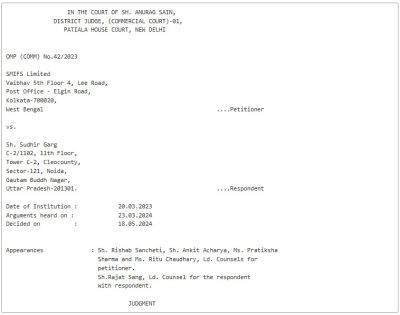
Months of unauthorised trading wiped out a significant portion of his capital. He fought against the broker and recovered ₹18,56,140.

This blog covers exactly what happened to him, what went wrong in his account, and the step-by-step process that delivered that result.
From Trust to Unauthorized Trading: How a SEBI Registered Broker Took Control?
The beginning looked perfectly ordinary.
Sudhir completed his KYC and submitted all required documents. After that, the broker confirmed that everything was in place. Initially, everything seemed normal.
However, things soon changed.
Contract notes began appearing for trades he did not recognise. In addition, transactions showed up across segments he rarely used. F&O positions were opened and closed.
Commodity trades were executed and squared off. Yet Sudhir insisted he had not placed any of them.
The trades were real. The losses they created were real. But the one person who should have been at the centre of every transaction, Sudhir himself, had never been consulted at all.
Broker Blamed the Client for Every Trade: How Sudhir Challenged SMIFS and Demanded Proof?
When Sudhir approached SMIFS and disputed what had happened in his account, the response came quickly and confidently.
“Yeh aapki hi trades hain.”
You placed these trades. That was the line. Said with certainty, repeated without hesitation, designed to make him feel like he was the one who didn’t understand.
He asked for supporting documents & the call recordings. He also demanded written proof of any instruction he had supposedly given before each trade. What came back was incomplete.
What came back was incomplete. The recordings were either unavailable or told only part of the story. The written records that SEBI requires a broker to hold before any trade is executed simply were not there.
But SMIFS continued to insist. It was all him, they said. Every position. Every transaction.
Sudhir knew what he had and had not done. And he refused to accept an answer that didn’t hold up.
1. No Pre-Trade Authorization on Record
SEBI is clear: before any trade is placed in a client’s account, the broker must hold verifiable instructions from that client, whether a written order, an email, an SMS, or a recorded call.
For every disputed trade in Sudhir’s account, SMIFS could not produce that evidence. Not for a single transaction. Not once.
2. Call Records That Didn’t Tell the Full Story
When recordings from the relevant trading dates were examined, what was available was either missing or incomplete. That gap is not a minor administrative issue.
It is precisely the evidence a broker is required to maintain to prove a client gave instructions.
Without it, the broker has no basis to claim a trade was client-authorised.
3. Trading Patterns That Didn’t Match Sudhir’s Profile
The activity across his account showed a growing complexity of trades, spanning segments and volumes that were entirely inconsistent with how a self-directed retail investor manages his own account.
The pattern pointed toward someone on the broker side making trading decisions on Sudhir’s behalf, without his knowledge, without his consent, and without any authorisation to do so.
How Trader Got 18.5 Lakh Back?
Sudhir chose a different path. Instead of giving up, he followed the regulatory dispute resolution process step by step.
By maintaining records, escalating the issue through the proper channels, and presenting evidence at every stage, he was able to obtain a favourable award.
Here’s how the process unfolded:
Step 1: Collecting and Organising the Evidence
Sudhir began by gathering every document related to the dispute. This included trade logs, contract notes, account statements, emails, and all communication exchanged with the broker.
Instead of relying on assumptions, he focused on building a complete record of events.
The objective was to identify missing information, unanswered queries, and instances where the broker’s actions appeared inconsistent with regulatory requirements.
Step 2: Filing a Detailed Complaint
Once the records were organised, Sudhir filed a formal complaint outlining the specific issues he had identified.
The complaint was supported by documents, transaction records, and relevant evidence. Rather than making broad allegations, it clearly explained what had happened, what information was missing, and why he believed the broker had failed to meet its obligations.
Step 3: Escalating the Matter to the Investor Grievance Redressal Panel (IGRP)
When the broker’s response did not satisfactorily resolve the dispute, Sudhir escalated the matter to the Investor Grievance Redressal Panel (IGRP).
The complete set of documents and supporting evidence was submitted for review.
After examining the material, the panel found merit in the complaint and noted deficiencies in the broker’s compliance with applicable regulatory requirements.
Step 4: Pursuing Arbitration
Following the IGRP proceedings, the dispute moved to formal arbitration.
The arbitral tribunal reviewed the evidence, examined the records presented by both parties, and considered whether the broker could substantiate its position regarding the disputed transactions.
The tribunal ultimately ruled in favour of the investor.
After pursuing the matter through the formal dispute resolution process, Sudhir obtained a favourable award.
| Particulars | Amount |
|---|---|
| Total Amount Recovered | ₹18,56,140 |
The case demonstrates that investors who maintain proper records, follow the prescribed grievance process, and present clear evidence can successfully pursue recovery through the regulatory and arbitration framework available in the securities market.
SMIFS Unauthorised Trading: Red Flags to Watch for in Your Account
Stock broker scams involving unauthorised trading by stock broker employees follow a remarkably consistent pattern across India.
The unauthorized trading risk is highest precisely when investors trust their broker completely and stop monitoring their account activity closely.
This leaves many victims wondering: is SMIFS Limited a genuine broker? The answer is they are a legitimate, SEBI-registered entity.
However, as the Sudhir case demonstrates, regulatory registration alone does not make an investor immune to unauthorized actions by a broker’s internal employees if account monitoring is left entirely to trust.
If any of the following sound familiar, take it seriously.
- Trades appeared in your order history that you have no memory of placing.
- Contract notes arrived for positions you never discussed with anyone at the broker.
- Your account was active across F&O, commodities, or cash segments in ways that don’t match how you actually trade.
- When you raised a dispute, the broker told you aapne hi instruction diye the, you gave the instruction yourself, without showing any proof.
- You asked for call recordings or written order records and were told they were unavailable, or what was shared was incomplete.
- Losses grew across a period when you were not actively trading or monitoring your account closely.
- Positions were closed or settled without your prior knowledge or consent.
Most of these investors did nothing wrong. They trusted their broker. That trust was used against them.
Whatever the starting point, the damage is the same. And the moment you recognise any of these signals, waiting only makes recovery harder.
How to Complain Against SMIFS Limited?
If this has happened to you, hear this clearly: Recovery is not guaranteed. But Sudhir’s case shows exactly what is possible with the right documentation, through the right process, at the right time.
Every day that passes gives the other side more time. Evidence becomes harder to retrieve. Timelines grow complicated. Start now.
Here are the steps to report against unauthorized trading:
- Save everything without delay: Contract notes, trade history, account ledger, every email and message you have from the broker. All of it. Right now, before anything disappears.
- File a Formal Written Complaint: Send an official email to the broker listing every disputed trade with dates, order IDs, and specific amounts.
- Raise a Complaint with SEBI SCORES: Submit a formal regulatory complaint with your organised documentation if the broker refuses to resolve the issue.
- Raise a Complaint with SMART ODR: If Issues are not resolved with SCORES, you can file for online mediation to get a faster, structured resolution before moving to formal arbitration.
- Share Market Arbitration: If mediation does not resolve the dispute, pursue exchange arbitration, where an independent arbitration panel will hear the case and issue a binding decision.
We help investors through every stage of this process.
Here is what we do:
- Free Case Assessment: We review your account activity, identify every applicable regulatory breach, and tell you precisely where your case stands. Before you commit to anything.
- Evidence Organisation: We take your documents, structure them against the SEBI regulations they address, and build a complaint that the arbitral process takes seriously from the first submission.
- End-to-End Representation: IGRP, SEBI SCORES, SMART ODR, arbitration. We handle every stage. You do not have to navigate any of it alone.
If trades appeared in your account that you never authorised, and the broker is telling you that you placed them, your case may be considerably stronger than it feels right now.
Reach out to us today.
Conclusion
SMIFS Limited is SEBI-registered. Sudhir trusted that registration. He had every reason to.
But the trades kept coming. Losses accumulated from positions he had never approved. And when he raised it, the answer was always the same. Yeh aapki hi trades hain.
However, the evidence told a different story. First, the broker failed to provide any pre-trade authorisation records.
Moreover, complete call recordings were missing. As a result, the available documents could not withstand scrutiny during the proceedings.
The IGRP found SMIFS at fault. The arbitral tribunal agreed. And Sudhir recovered ₹18,56,140 from a broker that had denied any wrongdoing from the very first conversation.
The process works. But only when you act, and only when you have the right people helping you build the case it deserves.
If your account looks anything like what Sudhir went through, don’t sit on it. Reach out to us today.
Disclaimer: This content is for informational and awareness purposes only. It does not constitute legal or financial advice. Recovery outcomes depend on individual case details, evidence quality, and applicable regulations. Past outcomes do not guarantee future results.
Frequently Asked Questions
1. I found trades in my SMIFS account that I never placed. Does that automatically count as unauthorised trading?
Yes, if you did not give prior instruction for a trade and the broker cannot produce documented proof that you did, those trades can be formally challenged as unauthorised.
SEBI requires brokers to hold verifiable client authorisation before executing any transaction.
The absence of that record is significant and works in your favour when you escalate through the right channels.
2. SMIFS is telling me I placed the trades myself, but I have no memory of doing so. What should I do?
Do not accept that answer without proof. Ask the broker to produce the pre-trade order record for each disputed transaction, whether a written instruction, email, SMS, or call recording.
If those records are incomplete, unavailable, or missing entirely, that is a regulatory failure on the broker’s part.
Document every response you receive and escalate immediately if the proof is not forthcoming.
3. What evidence do I need to challenge an unauthorised trade by a broker?
Collect your contract notes, complete trade history, account ledger statements, and all correspondence with the broker.
Note the specific dates, times, and order IDs of trades you are disputing. Any gaps in the broker’s pre-trade authorisation records, any missing or incomplete call recordings, and any written communication where the broker fails to produce proof of your instruction all become critical evidence.
The stronger and more organised your documentation, the stronger your case.
4. Can I still file a complaint if the unauthorised trades happened several months ago?
Yes. IGRP, SEBI SCORES, and arbitration can all consider well-documented complaints regardless of when the trades occurred.
Strong evidence matters more than timing. Start collecting and organising your records now and raise the complaint as soon as possible, because delay does make evidence harder to retrieve.
5. SMIFS Limited is SEBI registered. How could unauthorised trading still happen?
SEBI registration means a broker is regulated and must follow SEBI rules; it does not prevent individual representatives from acting outside those rules.
In Sudhir’s case, the broker was registered, but the trades had no pre-authorisation records, and the call recordings were incomplete.
Registration did not protect him. It did, however, give him a regulatory framework to fight back through.





 Add us as a preferred source on Google »

