
Mohd Arif Shaikh lost ₹85,000 in 20 days.
Not to the market. To an employee at SMIFS Limited’s Mumbai branch.
When he brought it to management, he expected accountability. Instead, management sided with the employee. Not with him. Not with the person whose money had disappeared.
He ended his public review with one direct request: “Do not open an account with any share trading company like SMIFS.”
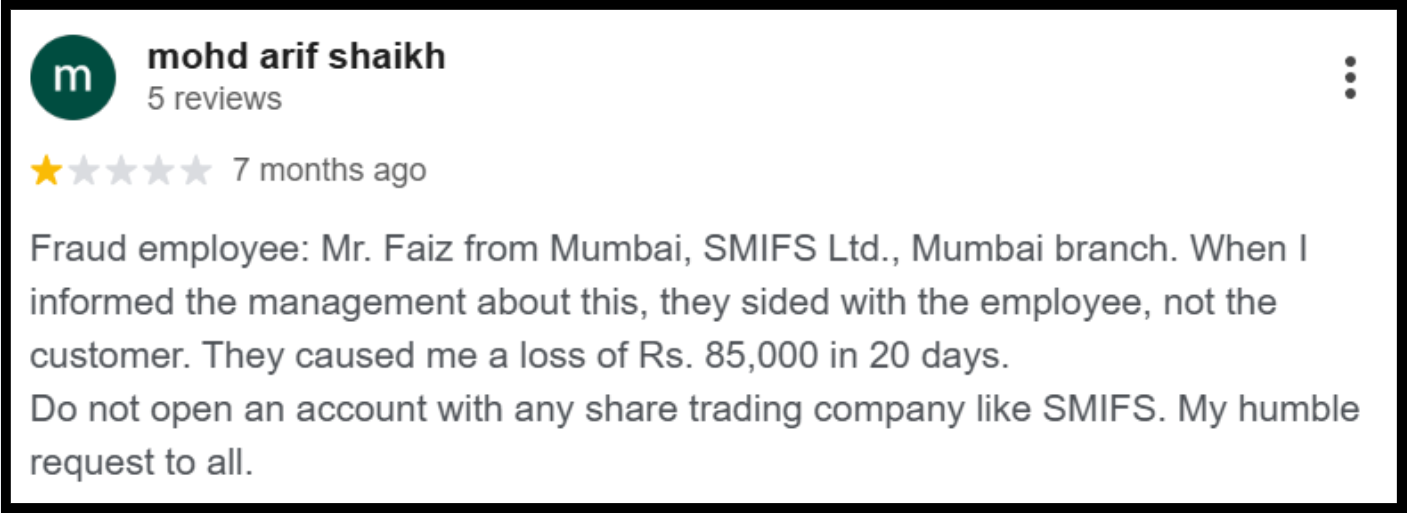
That review is still online. The money is still unrecovered. And similar stories from other SMIFS clients keep appearing.
So, Is SMIFS Limited a Genuine Broker or Not?
That’s the question many investors ask before opening an account or trusting a broker with their money.
SMIFS Limited is a registered stockbroker, but registration alone does not tell the complete story.
To form a balanced view, investors should also look at customer experiences, dispute records, SMIFS unauthorized trading complaints, arbitration cases, and the broker’s response when issues arise.
Before deciding whether SMIFS Limited is the right broker for you, it is worth understanding some of the recurring issues in detail that have been raised by traders and investors over the years.
1. Market Fluctuations Is Not an Excuse for Every Complaint
Every trader understands that markets move. But “market fluctuations” cannot serve as a final response to a complaint about specific trades.
It avoids every real question.
Was the trade authorised? Was the client informed of the risk? Did the broker execute it properly?
Push for a trade-level explanation every single time.
2. Verbal Confirmation Gets Used Against Clients
Phone calls can be twisted in multiple directions. “You gave verbal confirmation” becomes a catch-all defence when a client disputes a trade.
But SEBI regulations require brokers to maintain documented records of client instructions.
A verbal claim is challengeable, and it should be challenged.
3. Management Siding With an Employee Against a Client
When a client reports employee misconduct, and management defends the employee, the internal escalation path closes permanently. This is not a customer service failure alone.
It is a broker conduct failure. The right response at that point is not to keep pushing internally.
It is to move to formal external escalation immediately.
4. Charges on Disputed Trades Leading to Losses
Deducting fees on trades a client disputes, trades they may not have properly authorised, adds a second layer to the original problem.
Every charge on a disputed transaction belongs in the complaint record as a separate, documented issue.
5. A Support Team That Cannot Explain Trades
Full-service means full accountability. When support staff cannot explain trade decisions or justify charges, the service label becomes a claim with nothing behind it.
That gap belongs in a formal complaint.
The Fake SMIFS Trap: Are You Being Targeted?
Pay close attention before trusting any SMIFS-branded communication.
Reports have surfaced about entities misusing SMIFS Limited’s name, logo, and SEBI registration number.
Fake websites, mobile apps using names like “SMIFSMAX,” WhatsApp groups, and unauthorised webinars have appeared.
These entities collect money from investors while carrying false SMIFS branding.
SMIFS Limited itself has publicly warned investors. The company says it has zero connection to these entities.
We have no proof linking the actual company to these activities. But investors need to stay alert regardless.
Before transferring any money to anyone claiming to represent SMIFS: verify the contact directly through SMIFS’s official registered website.
Any SMIFS communication arriving through an unofficial app, an unknown WhatsApp group, or an unverified webinar deserves deep scrutiny before you act on it.
Promises of guaranteed returns from any such channel signal fraud immediately.
Also Read: Is Acumen Capital Market genuine, a real registration, and a real ₹5 lakh SEBI penalty attached.
Key Red Flags for SMIFS Investors
These signals appear consistently across SMIFS complaints and across broker complaints generally. Recognising them protects you now and in any future account.
If any of these sound familiar, you have grounds to complain:
- “Market fluctuations” arrives as a final answer to a specific loss: It closes the conversation without addressing any part of it. Never accept it as a complete response.
- Charges appear on your account that you cannot trace to any documented trade instruction: Unexplained deductions are not administrative errors. They demand a written breakdown before anything else.
- Your branch contact becomes unreachable exactly after a loss occurs: That timing is not coincidence. It is a pattern.
- The broker cites verbal confirmation as the reason your complaint has no merit: Request the actual call recording in writing. Immediately.
- Internal escalation leads you back to the same person whose conduct you disputed: When the internal chain loops back on itself, external escalation is no longer optional.
- Someone contacts you about SMIFS through an app called SMIFSMAX, an unofficial WhatsApp group, or an unverified webinar: Verify everything through SMIFS’s official registered website before taking any action.
- A specific named employee links to your losses but management produces no accountability: Named employee, specific branch, documented loss, management silence; this combination belongs in a formal external complaint.
For a real, documented example of exactly this pattern, unauthorised trading, an employee, and a binding arbitration outcome, see our full unauthorized trading arbitration award recovery case against this same broker. - Charges keep running on trades you have formally disputed: Continuing to collect fees on disputed transactions while a complaint is open is itself a separate conduct failure.
Even one of these matching your experience is worth escalating formally. Do not wait for it to become five.
How to Complain Against SMIFS Limited?
Mohd Arif’s management dismissed him. Another trader had no comeback against a verbal claim. None of those endings needed to be permanent.
Here is the step by step process you can follow to file a complaint against a stockbroker.
Step 1: Pull All Your Evidence Together Before Anything Else
Download your complete trade history today. Export your account ledger. Screenshot every communication with the broker, emails, in-app messages, anything in writing.
If the dispute involves a phone call, request the call recording in writing immediately. Brokers must maintain these records.
Compile everything chronologically before you raise any complaint.
Step 2: Write to SMIFS Compliance
Branch-level complaints close at the branch level. Go directly to SMIFS’s compliance officer in writing.
Name the specific trade. State the date, the amount, and the exact problem.
Attach your evidence. Set a response deadline. Keep the entire thread.
This creates the paper trail that the next stage depends on.
Step 3: Raise a Complaint with SCORES
If SMIFS does not respond adequately, take the matter immediately to SEBI’s SCORES portal. Attach your full documentation.
Name the specific conduct failure, disputed trade, unauthorised charges, lack of documented instructions, or management misconduct.
SEBI mandates a formal response. A SCORES complaint carries weight that a branch complaint never will.
Step 4: File a Complaint with SMART ODR
Still no resolution? Move to SEBI’s SMART ODR platform. This is structured, time-bound mediation managed by neutral parties.
It works well in broker disputes where the evidence is organised, and the conduct failures are specific.
Most matters progress meaningfully within 30 days of initiation.
Step 5: Stock Market Arbitration
For larger losses: Mohd Arif’s ₹85,000 is a clear example; formal exchange arbitration delivers a binding, enforceable decision.
Evidence of disputed trades, undocumented authorisation, and conduct failures carries genuine legal weight in arbitration. This is where cases that demand a definitive outcome get one.
Don’t Let Them Keep Your Money: Fight Back Today
Mohd Arif hit the dead end that most SMIFS clients hit. Management backed the employee. Internal escalation closed against him. That is where most people stop.
It is not where the road ends.
Here is what actually happens when someone brings their SMIFS situation to us.
We review your trades, account statements, and broker communications and tell you honestly whether what happened qualifies as misconduct and what recovery is realistic.
If you have a case, we map every conduct failure against SEBI regulations, draft the complaint correctly, and file through SCORES, SMART ODR, and arbitration if it comes to that. So, register with us today.
We handle every procedural step. You focus on what comes next.
Management dismissed Mohd Arif. The right complaint, filed through the right channel, does not get dismissed the same way.
Conclusion
SMIFS Limited holds valid SEBI registrations. It has operated for over three decades. Both facts are real.
But registration means the broker cleared a minimum regulatory threshold. It says nothing about how they handle a complaint. It says nothing about what happens when a named employee causes a client’s loss.
And it says nothing about whether management protects clients or protects employees when things go wrong.
The client reviews on record speak to all three.
If you already hold a SMIFS account and something has gone wrong, a disputed trade, an unexplained charge, a dismissive branch response, do not let the internal process close your case.
The external complaint path exists precisely because internal escalation fails real clients every single day.
Your money deserves a proper answer. That is exactly where this starts.
Disclaimer: This content is for informational and awareness purposes only. It does not constitute legal or financial advice. Recovery outcomes depend on individual case details, evidence quality, and applicable regulations. Past outcomes do not guarantee future results.
Frequently Asked Questions
1. I lost money with SMIFS, and they told me it was due to “market fluctuations.” Can I formally challenge that?
Yes. “Market fluctuations” does not satisfy the regulatory obligation a broker holds when a client disputes a specific trade. SEBI requires brokers to maintain documented records of client instructions before executing any transaction.
If SMIFS cannot produce a clear, documented record showing you gave prior authorisation for the disputed trade, that gap alone gives you grounds to file a formal complaint through SEBI SCORES.
2. SMIFS used a verbal confirmation to justify a trade I have no memory of approving. What can I actually do?
Request the call recording for the date of the disputed trade in writing immediately. Brokers have an obligation to maintain these records.
If the recording is unavailable, incomplete, or does not clearly show your authorisation before the trade was executed, that absence directly supports your complaint.
File a written complaint with SMIFS compliance first, then escalate to SEBI SCORES if the response falls short.
3. A SMIFS employee caused me a specific financial loss, and management dismissed my complaint by taking the employee’s side. Where do I go from here?
Internal escalation that closes against the client is the starting point for external action, not the end of the road.
Document the entire internal exchange: the complaint you raised, who you spoke to, every response you received.
Then file directly on the SEBI SCORES portal, where the broker must respond formally and where a management dismissal at branch level carries no weight whatsoever.
4. I came across an app called SMIFSMAX claiming to represent SMIFS Limited. Is it genuine?
No. SMIFS Limited has publicly warned that entities using names like SMIFSMAX, fake websites, WhatsApp groups, and unauthorised apps are misusing their brand without any connection to the actual company.
Before transferring any money or sharing personal details with anyone claiming to represent SMIFS, verify the contact directly through SMIFS’s officially registered website.
Any promise of guaranteed returns from such channels signals fraud.
5. I have already filed a complaint with SMIFS internally, and they closed it without resolution. Does that hurt my SCORES complaint?
No, it strengthens it. A documented internal complaint that was dismissed or closed without proper resolution is additional evidence of the broker’s conduct failure.
Attach your original complaint, SMIFS’s response or non-response, and the date it was closed.
SEBI SCORES treats an internal dismissal as grounds for escalation, not as a reason to reject your external complaint.



 Add us as a preferred source on Google »

