
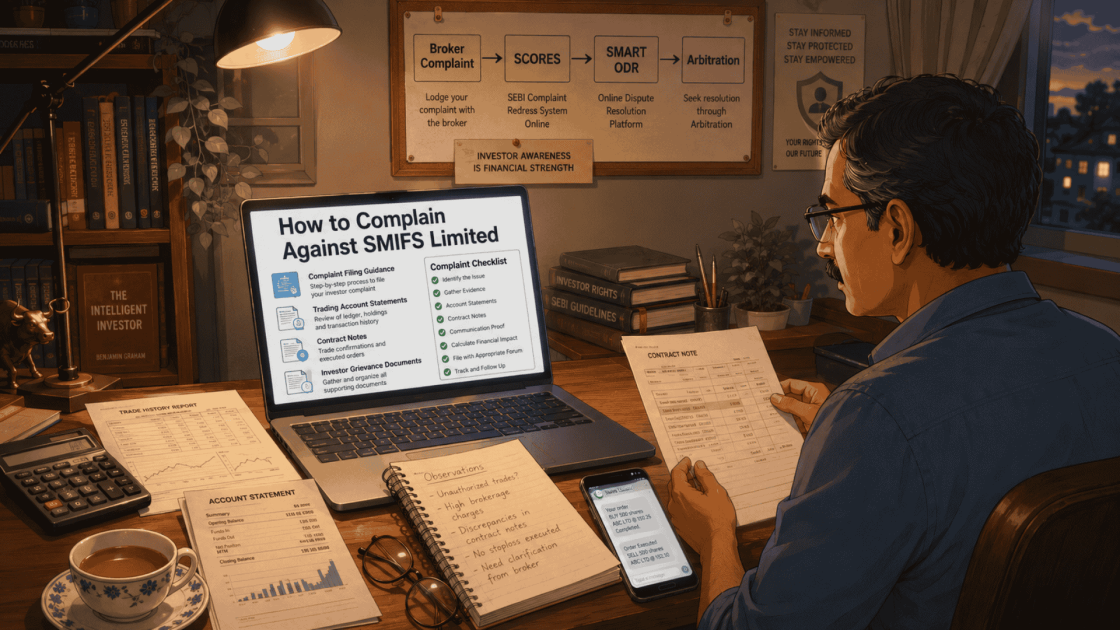
Your SMIFS Limited relationship manager was always quick to call. Confident. Friendly. Full of assurances.
Then the losses appeared. And now nobody picks up.
Trades in your account that you never approved. Charges in your ledger you cannot explain.
And when you raised it internally, silence, or a response that explained nothing.
You are not overreacting. And you are not out of options.
How to File a Complaint Against SMIFS Limited?
You came here for this. So here it is first: the complete complaint process, in the right sequence.
Here are the steps to report against a stock broker:
Step 1: Secure Your Evidence Before You Do Anything Else
This is the most important step. Do it before you contact anyone.
Download everything from your SMIFS account: complete trade history, contract notes, ledger statements, fund transfer records, and account statements.
Take a screenshot of your current portfolio and margin utilisation.
Save every WhatsApp message, email, and text from your RM or branch staff. Note the dates and content of any phone calls you remember.
If you have even a partial audio recording, preserve it immediately. If you do not, preserve everything else. A pattern of trades combined with written communication can still build a strong case.
Evidence gathered now is significantly stronger than evidence gathered after a complaint is filed.
Step 2: Raise a Formal Written Complaint with SMIFS Directly
Before escalating externally, write to SMIFS’s official grievance channel. Do not call. Do not message informally. Write a formal email.
State your account number, the specific dates and trade IDs you are disputing, the nature of the issue, and the resolution you are seeking. Attach all supporting documents.
Keep the complete email thread.
SMIFS is required to acknowledge your complaint and respond within a defined time frame. Their response, or their silence, becomes part of your next step.
Step 3: File a Complaint with SEBI SCORES
If SMIFS does not resolve your complaint satisfactorily within 30 days, escalate to SEBI’s SCORES portal immediately.
Go to the SEBI SCORES website.
Create an account. Select “Stock Broker” as the complaint category and choose SMIFS Limited.
Upload your full documentation, your complaint to SMIFS, their response, and all supporting evidence.
Once filed, the complaint carries official regulatory weight. SMIFS must respond formally. Unresolved or poorly handled SCORES complaints attract direct SEBI scrutiny.
This step transforms your grievance from an internal support ticket into a formal regulatory matter. That distinction matters enormously.
Step 4: Register a Complaint with SMART ODR
If SCORES does not produce a satisfactory resolution, take your case to SEBI’s SMART ODR platform. This is a structured, digital dispute resolution mechanism.
A neutral third party reviews your case. Most disputes receive a decision within 30 days.
You do not need a lawyer for SMART ODR. You need well-organised evidence and a clear, factual account of what happened.
Step 5: Share Market Arbitration
For significant financial losses, formal arbitration through NSE or BSE produces a legally enforceable decision. An independent arbitrator reviews submissions from both sides and delivers a binding award.
Every contract note, trade log, and communication you preserved in Step 1 becomes critical evidence at this stage. Arbitration is accessible to retail investors.
It moves faster than civil court. And it has produced results for SMIFS clients in prior disputes.
Also Read: ACML Capital Markets complaints, login access, authentication, and KYC. The three real recurring issues.
Spotting the Red Flags: Has SMIFS Crossed the Line?
When unexpected losses pile up, the first question most investors ask themselves is straightforward: is SMIFS Limited a genuine broker, or is something more problematic happening behind the scenes?
The complaint process above applies to genuine misconduct. So now the important question: did what happened to you actually cross a regulatory line?
Read through each of these. Be honest about your experience.
1. Trades Appeared in Your Account That You Did Not Authorise
This is the clearest sign. Every trade in a client’s account must carry verifiable proof of client instruction.
If SMIFS or your RM cannot produce documented evidence that you specifically approved a trade, the burden falls on them.
Documenting every instance of SMIFS unauthorized trading is what turns a simple dispute into an open-and-shut case.
One unexplained trade is worth questioning. A pattern of them is worth escalating immediately.
2. Your RM Made Verbal Promises About Returns or Outcomes
Full-service brokers like SMIFS assign relationship managers to clients. That creates an advisory relationship. However, RMs are not registered Investment Advisers.
When an RM tells you a position is “safe,” “assured,” or “certain to recover,” they are making promises they have no legal authority to make. SEBI prohibits guaranteed return assurances from any market intermediary.
3. Your Ledger Shows Charges You Cannot Explain
Brokers must charge fees within permitted limits and maintain transparent records.
If your ledger shows deductions that were never communicated, that is a transparency failure.
Ask for written clarification. If the explanation is vague or absent, that absence becomes evidence.
4. Your Account Balance Does Not Match Your Expected Position
Unexplained deductions, funds that did not arrive on time, or balances that differ from what your statements show, these point to potential fund handling failures.
Report any discrepancy the moment you spot it.
5. The Broker Says You Confirmed on a Call. But There Is No Written Record.
This is the defence SMIFS clients frequently encounter.
Your verbal confirmation, according to SEBI regulations, is not sufficient standalone authorisation for specific F&O trades.
Documented, timestamped order placement is required.
If the broker cannot produce that, the verbal confirmation argument weakens significantly.
6. Your Internal Complaint Was Dismissed or Ignored
An unresolved internal complaint does not mean your concern was invalid.
It means the broker failed its own grievance obligations.
That failure itself is grounds for external escalation.
Also Read: Fortune Capital complaints, covering the account statements, receipts and chats worth gathering before you write to the broker.
What Your SMIFS RM Was Not Legally Permitted to Do?
This section matters for your case. Understanding the boundary helps you frame your complaint correctly.
A SMIFS relationship manager plays a client servicing role. They help with account queries, order placement support, and product information.
However, they are not registered Investment Advisers under the SEBI (Investment Advisers) Regulations, 2013.
That registration matters.
Without it, an RM cannot legally advise you on which specific securities to buy or sell. They cannot recommend F&O strategies tied to your account.
They cannot assure any return outcome. And they certainly cannot approve trades on your behalf.
Every time an RM gives you a specific trade call, promises recovery, or makes decisions in your account without your documented approval, they are stepping outside their permitted function.
That overreach is not just poor practice. Depending on the nature and impact, it can constitute regulatory misconduct you can formally challenge.
Can You Recover What You Lost from SMIFS?
Yes. Recovery is possible. However, it depends entirely on your documentation and how quickly you move.
Cases involving SMIFS have reached arbitration and produced outcomes in favour of clients.
The investors who succeeded shared two things in common: they preserved their evidence carefully, and they escalated through the right channels in the right sequence.
Your position is strongest when you have:
- Contract notes showing trades on dates you cannot account for.
- WhatsApp or email records where the RM gave instructions or assurances.
- A timeline of when your balance changed and what trade activity preceded it.
- Written records of complaints you raised that went unanswered.
- Any message where recovery, safe returns, or guaranteed outcomes were implied.
You do not need all of these. Even a few well-preserved documents can form the foundation of a valid claim. The absence of call recordings is not fatal to your case. Patterns in trading data often tell the story more clearly than any single recording.
The earlier you act, the more of this evidence is still recoverable.
Dismissed by SMIFS? We Ensure It Doesn’t Happen Again
Here is what most SMIFS victims describe when they come to us.
The issue was first raised informally. However, it was dismissed as valid confirmation. Next, escalation went to the branch. Still, the same response was repeated.
After that, an email was sent. Yet, no reply was received.
By the time they reach us, they feel like the broker has already won.
That feeling is understandable. But it is wrong.
An internal dismissal is not a final decision. A closed support ticket is not a closed case.
And a broker’s verbal defence does not hold up when it meets a properly documented, regulation-mapped complaint filed through the right regulatory channel.
What changes when you work with us is not just the process. It is the way the complaint lands.
A complaint filed by an investor alone often reads as a frustrated grievance.
A complaint structured around specific SEBI regulatory violations, supported by organised evidence and filed correctly through SCORES, reads as a case that demands a formal response.
Here is exactly what we bring:
- Free Case Assessment: We review your trade history, account statements, and communications. We tell you honestly what happened, whether it qualifies as misconduct, and what recovery is realistic. No upfront cost. No commitment.
- Complaint That Regulators Take Seriously: We map your experience against SEBI’s broker conduct regulations, draft a complaint that cites specific violations, and structure it so it cannot be dismissed on a technicality.
- Full Escalation Support: From SMIFS grievance to SEBI SCORES to SMART ODR mediation and exchange arbitration, we handle every stage. You do not figure out the next step alone.
If SMIFS’s misconduct cost you money and their support team has given you nothing but silence or deflection, reach out to us today.
We will review your situation for free and tell you exactly what is possible before you commit to a single thing.
Conclusion
Most of the time, after such a case, the RM stops picking up the call; the branch moves on to the next client
That is how these situations end for most victims. Not with resolution. With silence.
But silence is not the only option.
SMIFS Limited is a SEBI-registered broker. That registration comes with obligations, obligations around trade authorisation, client fund handling, transparent charges, and honest advisory conduct.
When those obligations are not met, you have every right to challenge it formally.
The complaint pathway is real. The regulatory system works when you use it correctly. And the documentation you preserve today becomes the case you present tomorrow.
Do not let the dismissal become the final word.
Document what happened. File the complaint. Escalate through every channel available to you. And if you need someone who knows exactly how to do that, we are here.
Frequently Asked Questions
1. My SMIFS RM says I verbally approved the trades on a call. I have no recording. Can I still complain?
Yes. A verbal confirmation alone is not sufficient documented authorisation for F&O trades under SEBI’s requirements.
If SMIFS cannot produce specific, timestamped order placement records confirming your approval, your complaint has a valid foundation.
Your trading pattern, message thread, and the absence of written instruction evidence all support your position.
2. I raised the issue with my SMIFS branch, and they dismissed it. Is there still a point in escalating?
Absolutely. A branch dismissal is not a regulatory decision. It is an internal response. You can escalate to SEBI SCORES regardless of how SMIFS handled your complaint internally.
In fact, the dismissal, especially if it is in writing, becomes additional evidence in your formal complaint.
3. There are charges on my SMIFS ledger I cannot identify. How do I challenge them?
Start by requesting a written, itemised explanation from SMIFS in writing. If the explanation is absent, unsatisfactory, or inconsistent with your contract notes, those charges are formally contestable.
Preserve your current ledger statements immediately as evidence before anything changes.
4. SMIFS Limited has not responded to my grievance email for over three weeks. What should I do?
Escalate to SEBI SCORES immediately. Their non-response becomes part of your SCORES complaint.
Upload your original email and document the date you sent it. SEBI requires registered brokers to respond to formal grievances within a defined time frame.
Non-compliance with that obligation invites additional regulatory scrutiny.



 Add us as a preferred source on Google »

