
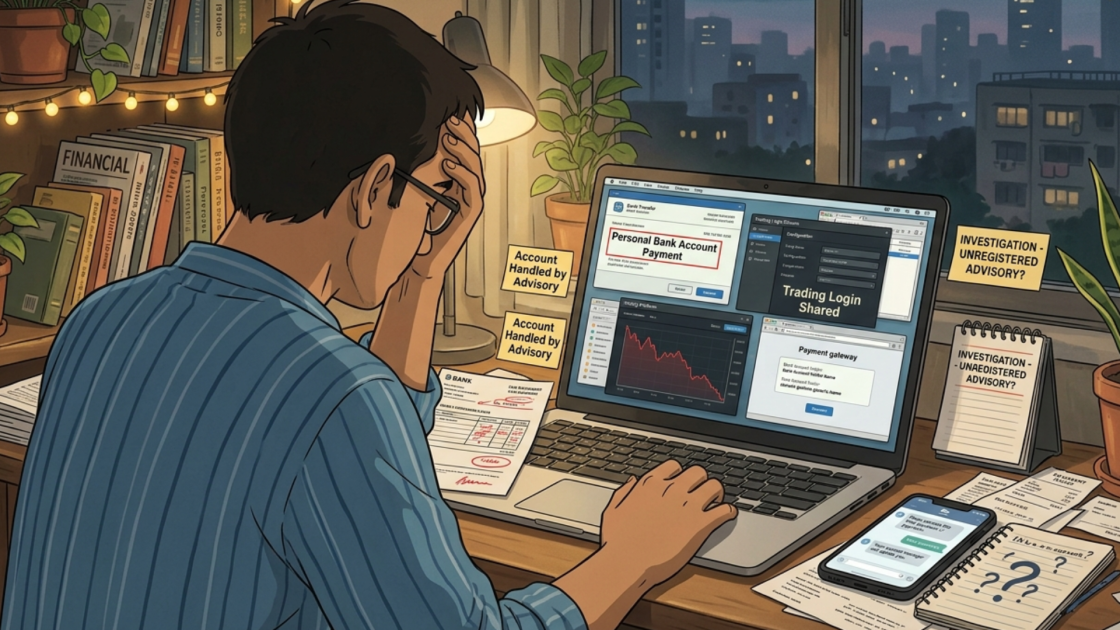
Sandeep (name changed), from Madhya Pradesh, signed up with a research and advisory firm that presented itself as the real, registered thing. He paid them a fee, not once, but three times over.
There was a warning sign right at the payment screen, and he talked himself past it. The bank account he was paying into was in a different name. When he asked, the answer was casual: “it’s the owner’s wife’s account.” A registered firm, taking its fee into someone’s personal account. He paid anyway.
Then came the bigger step. They did not just advise him, they asked for his trading ID and password, so they could “handle” the account for him. He handed it over.
They handled it. In a single day, the account was in the red. The fee was gone, the account was wiped, and he was left talking to ‘researchers’ who were still cheerfully operating as if nothing had happened.
When he came to us, he assumed the trades had simply gone wrong. They had not. Two separate things in this story were never allowed to happen at all. We have taken up his case, and both of them are the kind of detail that decides it.
A Research Advisory Can Never Run Your Account
This is the line that matters most, and it is absolute.
A research analyst or advisory is licensed to give you views and research and this is what a SEBI registered research analyst can do. That is the whole of it.
It cannot log into your account and trade for you. Ever. There is no version of “handling your account” that is permitted for an advisory, not with your permission, not with your password, not “to help you.”
So the moment Sandeep shared his ID and password and they started operating the account, the firm was doing something it had no licence to do. The loss that followed is not “a bad trading day.” It is the direct result of an entity running an account it had no business touching.
The practical lesson that sits right next to it: never hand your trading login to anyone. An advisory that asks for it is telling you, in advance, exactly what kind of advisory it is.
And it does not matter that an advisory fee paid to personal account had already been the first warning, once the login was shared, the damage was inevitable.
A Fee to a Personal Account Is a Red Flag, Not a Detail
Now the part Sandeep waved away.
When you pay a registered firm, the money goes to the company and you get a proper bill or receipt in the company’s name. That is how a real, accountable entity takes payment.
A fee routed into someone’s personal account, “the owner’s wife,” a “relative,” anyone, is the opposite of that. It means the money is being kept off the company’s books.
Now the issue was no longer the amount being requested. The real question was: can research analysts take payment in personal accounts?
A genuine registered intermediary does not collect its fees into a private individual’s account, because it has nothing to hide and a structure to answer to. Every advisory fee paid to personal account is a transaction the firm cannot officially explain.
So the name on that payment screen was not a small inconvenience. It was the firm quietly showing him how it really operated.
If you are ever asked to pay a “registered” service into a personal account, stop. That single fact is often the whole story.
“You Authorised It” Is Not a Defence
When a firm like this is challenged, the defence is predictable: “you gave us access, you authorised it.”
The answer is simple, and it is the spine of the claim: what service did you charge the fee for and where is it?
A registered advisory cannot take a fee for “research” and then run your account into the ground in a day. That is not a bad call on their part. That is unauthorised trading risk.
If it handled the account, that was never permitted. If it only advised, then it has to show the research you paid for. It does not get to have it both ways.
That is why a case like this goes after both the fee and the loss.
How To Get Your Money Back?
If you have been through what Sandeep went through, do not assume the money is simply gone.
Indian securities law gives investors a structured path to challenge exactly this kind of misconduct and pursue recovery of both the fee and the trading losses.
Here are the steps to raise a complaint against research analyst:
- File a Complaint with the Firm’s Compliance Officer: Submit a detailed written complaint naming every violation clearly. Cover the shared login and password, the unauthorised account handling, the fees paid, and the personal account the money was routed into. Be specific and violation-wise.
- File a Complaint on SCORES: If the firm does not resolve the matter within 21 days, escalate to SEBI’s SCORES grievance platform.
- Register a Complaint in SMART ODR: If SCORES does not produce a resolution, move to the SMART ODR platform for mediation and conciliation.
- Stock Market Arbitration: If mediation fails, take the dispute to arbitration before an independent panel for a binding decision.
Save everything: the payment proofs showing the personal account name, the WhatsApp chats, and any record of the login credentials being shared. Those are not embarrassing details. They are the case.
A receipt or screenshot showing an advisory fee paid to personal account is often the strongest document in the file.
The line worth keeping: a real advisory never needs your password, and a registered firm never collects its fee into someone’s personal account. Either one, on its own, is your answer.
Need Help?
You were told it was convenient and you paid into a personal account because they had an explanation for it. You handed over your login because they called it “handling.” Now the money is gone and the stress is real.
Don’t worry. Register with us and we will take it from here.
Our team will identify the violations, build the case, and guide you through every step, from the complaint to SCORES, SMART ODR, and arbitration if needed.
Reach out today. The sooner you start, the stronger your case.
Frequently Asked Questions
1. Is it safe to pay a stock advisory fee into a personal bank account?
No. A registered firm’s fee goes to the company and comes with a proper receipt. A fee routed to an individual’s personal account is a serious red flag that the money is being kept off the books.
2. I gave my trading login and password to an advisory. Is that allowed?
No. A research analyst or advisory can advise you, but it can never operate your account. If it logged in and traded, that is unlicensed account handling and it is claimable.
3. They say I authorised everything. Can I still recover?
Yes. A registered advisory cannot take a fee and also run your account into losses. The claim covers the fee and the loss, pursued through SCORES and SMART ODR.





 Add us as a preferred source on Google »

