Groww is an online investment platform that allows people to invest in various things like stocks, mutual funds, ETFs, and IPOs through a mobile app or website.
Its simple and user-friendly interface allows people to open an account online without complicated paperwork.
The several services offered by Groww make it a digital brokerage platform that simplifies investing, especially for beginners and retail investors.
Because of this convenience and relatively low brokerage charges, Groww has become one of the most widely used investment platforms in India today.
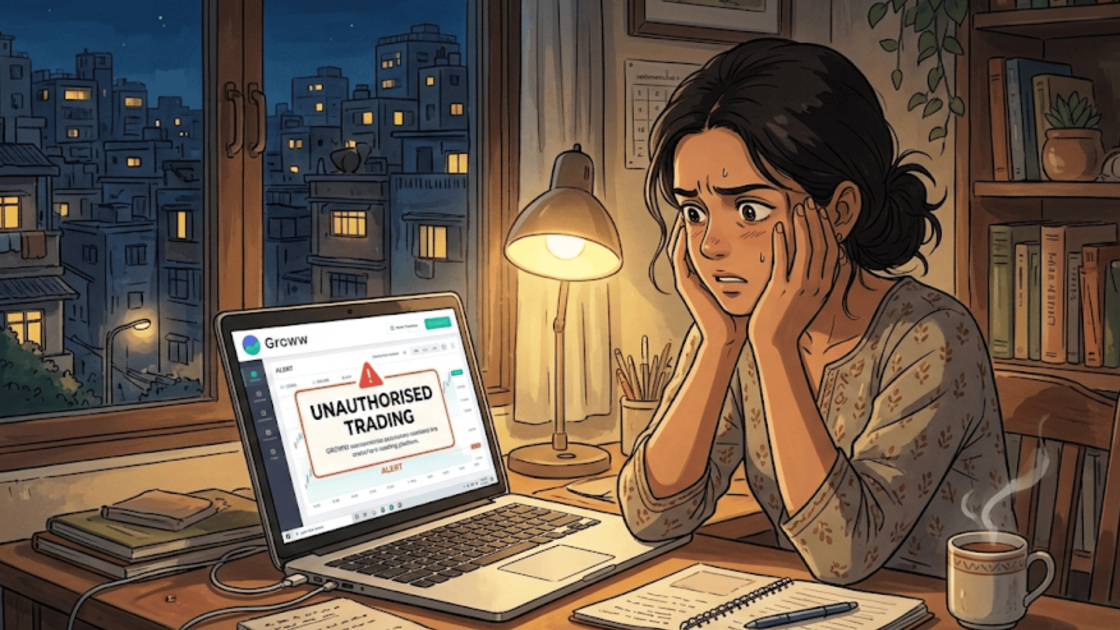
However, even users of Groww have faced a few issues related to unauthorised trading.
Let us look at the complaints against the platform to understand it better.
Groww Unauthorised Trading Complaints
Unauthorised trading is when the broker makes trades or invests your money without your permission.
To make any trades on behalf of a client, the broker must first obtain the client’s explicit consent.
Without consent, the trade can be complained against. Complaints are normal, but they should not be normalised.
Groww, despite being a user-friendly platform, has quite a lot of complaints from its users.
If you were to go by simple word of mouth, you would never find this data.
Which is why it is all the more important to do proper research and analyse data before you commit your money to a digital brokerage platform.
The analysis below discusses in depth the condition of user complaints on Groww- especially regarding unauthorised trading.
| Financial year | Total clients | No. of complaints | % of complaints w.r.t. Total clients | Resolved complaints | % resolved w.r.t. complaints |
| 2023-24 | 9538609 | 834 | 0.008 | 814 | 97.60 |
| 2024-25 | 12921210 | 1994 | 0.015 | 1994 | 100 |
| 2025-26 | 12480505 | 1406 | 0.011 | 1249 | 88.83 |
Groww has a large user base and a fairly strong complaint resolution rate, but the sharp rise in complaints, especially the jump to 1,994 cases in 2024–25, raises concerns for investors.
Even if the percentage appears small, the actual number of affected users and unresolved complaints highlights the importance of looking beyond basic statistics.
But how does this all relate to unauthorised trading?
This is how:
| Financial year | No. of complaints | No. of unauthorised trading complaints | % of unauthorised trade w.r.t. complaints |
| 2023-24 | 834 | 40 | 4.79 |
| 2024-25 | 1994 | 27 | 1.35 |
| 2025-26 | 1406 | 346 | 24.60 |
Approximately five per cent of complaints in 2023-24 were about unauthorised trading– not as small a percentage as one might think.
The dip in 2024-25 is certainly commendable and yet nothing compared to the huge rise in 2025-26 with 346 cases of unauthorised trading, that is, almost one-fourth of the total number of complaints and a whole lot of aggrieved users.
When Can You Take Action Against A Broker?
Take action as soon as you discover that funds in your account may have been used without your consent.
Acting quickly can help prevent further losses and strengthen your position if a dispute arises.
Check your emails and SMS alerts from the last 24 hours for any trade confirmations or notifications related to transactions you did not explicitly approve.
Action can be taken when:
- Trades are executed without your permission.
- The broker refuses to provide trade confirmations or call recordings.
- The broker ignores your complaint or fails to resolve the issue.
- There is a clear misuse of trading authority or account access.
- Trades are made very frequently without your consent, leading to unnecessary losses or high brokerage charges.
In such situations, investors should immediately gather all relevant records, including contract notes, account statements, emails, SMS alerts, and any call recordings or communications with the broker.
These documents serve as important evidence and can help demonstrate that the trades were carried out without the account holder’s authorisation.
It is also important to report the issue without delay.
Filing a complaint early makes it easier for regulators or exchanges to review the matter and trace the sequence of events.
Taking prompt action and maintaining proper documentation can help investors protect their rights and significantly improve the chances of resolving the issue successfully.
How To Complain Against the Groww App?
Step 1: Preserve Evidence Immediately
Compile everything you can: screenshots, documents, contract notes, etc.
This will help determine whether consent was given and support your claim against the broker.
Step 2: Contact the Broker First
Reach out to them first in case they can solve your issue.
Use the support contact number or email available on their site and file a complaint for your issue with established evidence.
Step 3: Lodge a complaint with SCORES
File a complaint on the Securities and Exchange Board of India’s SCORES portal for regulatory oversight, especially when audit evidence remains unavailable.
Step 4: Arbitration in Stock Market
If either party disagrees with IGRP:
- Proceed to arbitration under the exchange bye-laws
- Evidence, timelines, and SEBI circulars drive outcomes
Need Help?
Are u looking for the answer to how to file a Complaint Against Unauthorised Trading online?
Unauthorised-trade disputes succeed or fail on process, not volume.
Register with us; we provide practical guidance on:
- Identifying whether a case qualifies as unauthorised trading risks
- Requesting the right evidence from brokers
- Structuring complaints that stand up at IGRP and arbitration
- Understanding RMS, margin rules, and square-off mechanics
- Help in filing SEBI Complaint
- Monitoring the SEBI complaint status for you
- Escalate the complaint through SMART ODR.
The focus stays on facts, timelines, and documentation, not assumptions.
Conclusion
Groww may be one of the most popular investment platforms today, but the complaint data shows that popularity does not mean there are no problems.
The rise in complaints, especially those related to unauthorised trading, should definitely make investors pause and think.
It simply highlights why staying alert about your own account activity is so important.
Always check your contract notes and trade alerts carefully, and if something looks suspicious, raise a complaint quickly so that the issue can be addressed before it gets worse.