Every investor enters the market with a simple expectation: My money will move only when I decide.
That belief is what allows people to take risks, stay invested during volatility, and slowly build confidence in the markets.
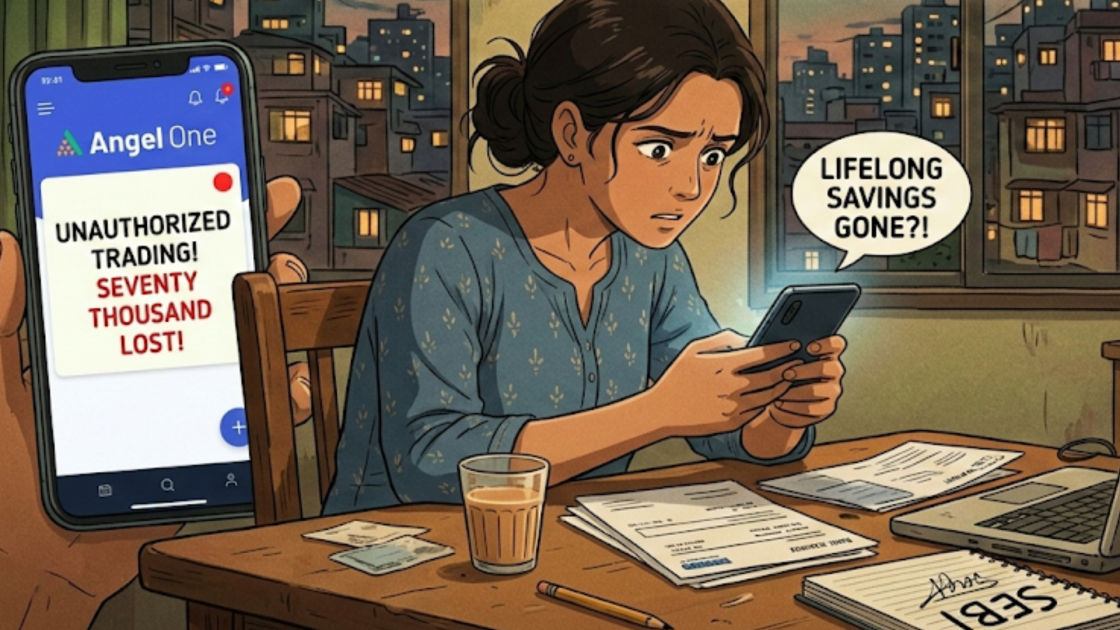
So when trades appear in your account that you do not remember placing, the feeling is unsettling in a very personal way.
It feels like losing control of your own trading account.
Over the years, concerns of unauthorised trading by Angel One have been raised by investors through complaints and dispute mechanisms.
This does not mean that every Angel One client has faced this issue.
But when complaints continue to surface across years, they cannot be brushed aside as isolated misunderstandings.
They deserve attention, context, and clarity, especially from a retail investor’s point of view.
Angel One Overview
Angel One is one of India’s most widely used retail brokerage platforms. It serves a broad investor base ranging from first-time traders to experienced market participants.
The broker provides access to:
- Equity and derivatives trading
- Commodities and currency segments
- Mutual funds, IPOs, ETFs, and bonds
Trading can be done through:
- A mobile trading application
- A web-based trading platform
- Dealer-assisted or offline channels
For many investors, Angel One becomes their primary trading account. All positions, margins, and investment decisions flow through a single platform.
Over the years, a significant number of Angel One complaints have specifically centered on unauthorized trading, where transactions are executed without the investor’s explicit consent.
Angel One Unauthorised Trading Complaint
Unauthorised trading is when a broker, dealer, or financial advisor places trades in an investor’s account without the investor’s permission or approval.
In simple terms, it means transactions are executed in your trading account even though you did not ask for them or approve them.
Complaint data helps move the discussion away from individual experiences and towards broader trends.
Here is an overview of complaint data over recent years:
| Year | Total Complaints | Angel One Unauthorised Trading Complaints | Percentage of Unauthorised Complaints |
| 2021–22 | 1,302 | 145 | 11.14% |
| 2022–23 | 746 | 145 | 19.43% |
| 2023–24 | 1,203 | 150 | 12.47% |
| 2024–25 | 2,011 | 414 | 20.59% |
| 2025–26 | 1,070 | 202 | 18.88% |
What stands out is the recurring presence of unauthorised trading complaints across multiple periods.
While the percentage fluctuates, the issue does not disappear.
Every year, a number of investors raise concerns that trades were executed without their clear approval. That consistency is important.
It shows that unauthorised trading is not a one-off mistake; it is an issue that keeps resurfacing and therefore cannot be ignored.
Impact of These Complaints on Retail Traders
For retail traders, complaints about unauthorised trading are extremely serious and often create significant stress.
From a financial perspective, unexpected trades can result in sudden losses, blocked margins, or forced exits that were never part of the investor’s strategy.
In many cases, traders realise the consequences only after the damage has already been done.
The emotional impact can be even deeper.
Investors may begin to doubt their own judgment or question whether they missed something while placing orders.
Some start checking their trading apps repeatedly to make sure that no new trades have appeared without their consent.
Others reduce their trading activity or stop trading altogether, not because of market volatility, but due to a loss of trust.
For first-time or conservative investors, this loss of confidence can be particularly harmful.
Investing, which should be a planned and rational financial activity, gradually turns into a source of anxiety and uncertainty.
Angel One Limited Arbitration Case
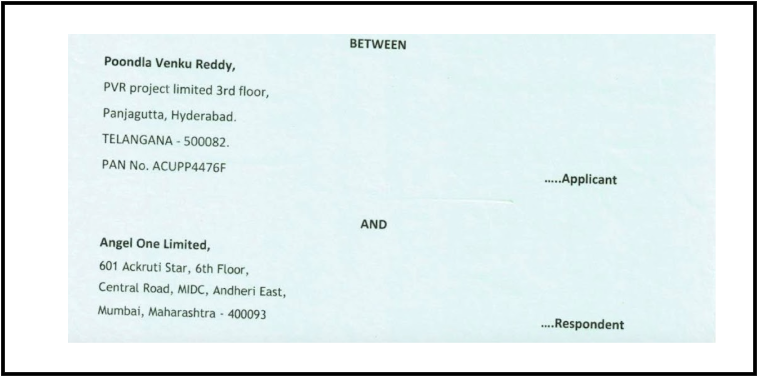
Poondla Venku Reddy (Applicant) challenged Angel One Limited (Respondent), seeking compensation for a total loss of Rs. 10,00,000 from his trading account.
-
Background of the Case?
The Applicant alleged that several loss-making trades were executed without his authorisation, which ultimately wiped out his investment.
While some trades were placed online by the client himself, the Tribunal found that multiple high-loss trades were executed offline by the broker’s associate without mandatory pre-order confirmation.
Angel One relied on post-trade confirmations such as SMS and email alerts.
However, the Tribunal clearly held that post-trade communication cannot validate a trade that lacked prior authorisation.
-
Award
The Appellate Tribunal partially allowed the appeal and awarded Rs. 8,96,208, along with 9% interest if the amount was not paid within 30 days.
The ruling reinforced that brokers are strictly liable for losses arising from unauthorised offline trades.
-
Key Takeaways
This case highlights several important lessons for both investors and brokerage firms.
- Pre-order confirmation is mandatory for offline trades.
- The burden of proof lies entirely on the broker.
- Clients are responsible for trades placed through their own login, not dealer-entered trades without consent.
- Client negligence in checking messages does not give brokers unrestricted trading authority.
When Can You Take Action Against a Broker?
Many investors assume that once a trade is executed, responsibility automatically shifts to them. That assumption is incorrect.
Brokers can be held accountable under several situations.
- When There Is No Clear Proof of Authorisation: Authorisation must be clear, not assumed. If a broker cannot produce call recordings, written instructions, or verified order logs, the trade can be questioned.
- When Trades Exceed What Was Discussed: Even if an investor is allowed limited trading, executing higher quantities, additional positions, or frequent trades without clear discussion can still qualify as unauthorised activity.
- When Records Are Missing During a Complaint: Once a dispute is raised, the burden shifts to the broker. If the broker fails to produce the records, explanations alone are not sufficient.
- When Trades Are Blamed on Technical or Dealer Errors: System issues or dealer mistakes do not automatically favour brokers. The app control, supervision, and access management are their responsibilities and not the investors’.
How you respond in the early stages can significantly affect the outcome. Here is what you can do in similar cases:
- Pause Before Acting: Avoid panic trading or hurried exits. First, understand exactly which trades you did not authorise and when they occurred.
- Collect and Preserve Evidence: Download contract notes, ledger statements, margin reports, and trade history. Save emails, SMS alerts, app notifications, and screenshots.
- Raise a Written Complaint: Always communicate in writing. Ask for a clear explanation and proof of authorisation for the disputed trades.
- File a Complaint at SCORES: If responses are vague or delayed, lodge a complaint at SEBI thorugh the SCORES portal and then the stock exchange grievance mechanism.
- Prepare for Arbitration if Required: If the issue remains unresolved, arbitration in the stock market becomes the final step.
Success here depends on clear identification of unauthorised trades, absence of pre-order authorisation proof, and consistency in your complaint narrative.
Need Help?
Many investors struggle not because their concern is weak, but because they do not know how to structure it properly.
We help investors by:
- Reviewing trade data and statements objectively
- Identifying whether trades may qualify as unauthorised
- Organising evidence in a clear, logical manner
- Drafting precise complaints and escalation responses
- Guiding investors through regulatory and arbitration processes
If you are still confused about how to complain against Angel One, or need assistance in filing an NSE arbitration against Angel One, you can register with us today.
Our team will guide you through the entire process and help represent your case during the arbitration proceedings.
Conclusion
Unauthorised trading concerns related to Angel One do not define every investor’s experience. But recurring complaints and arbitration findings show why you should be careful.
For investors, the takeaway is practical rather than philosophical. Know how your trades are supposed to be authorised.
Check statements regularly. Keep communication in writing. And if something feels inconsistent with how you trade, pause and question it early.
Markets will always involve risk. And, losing control over how trades are placed should not be one of them.