
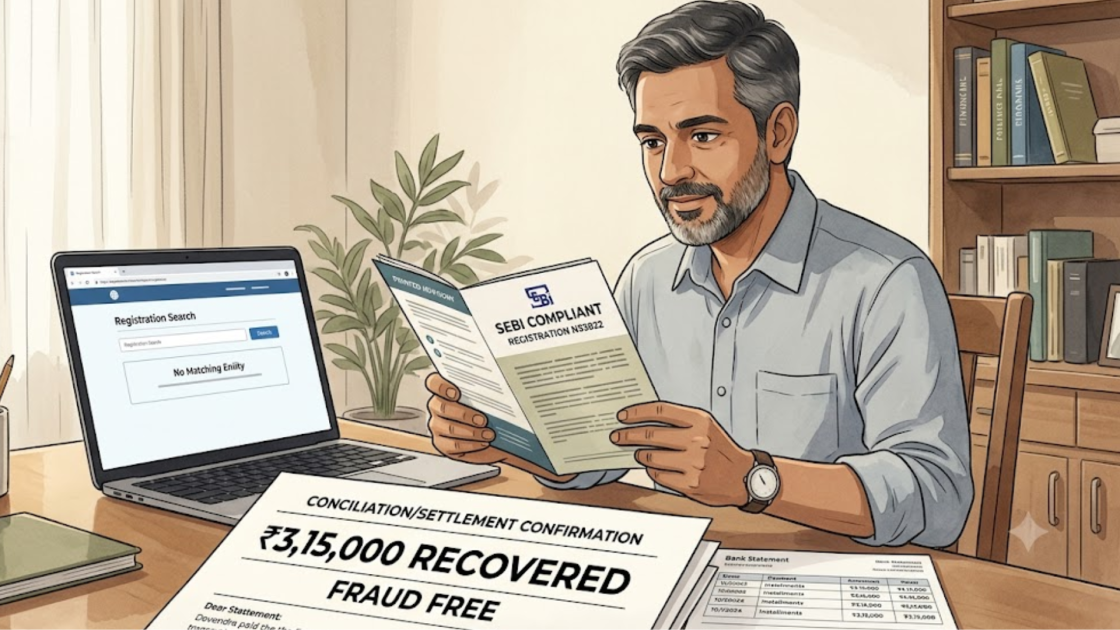
Quick Summary
Devendra Choudhary (name changed) paid 3,11,000 in fees to a firm that repeatedly described itself as SEBI compliant. It held no registration at all. His claim reached 6,00,000. The false registration claim, layered on top of the underlying unregistered activity, became the strongest point in the file. Our team recovered 3,15,000, a 52.5 percent share.
Devendra (name changed) first came across the firm through a paid social media campaign claiming the service was fully SEBI-compliant. Its website and brochures prominently displayed a registration number, making the firm appear legitimate.
Trusting those claims, Devendra paid fees in several instalments under different scheme names. By the end, he had paid ₹3,11,000.
Then he checked the registration number himself.
It did not match any registered entity on the SEBI website. The number either belonged to someone else or simply did not exist as a valid registration.
That changed the entire picture.
A firm cannot legally charge for investment advice without the required registration. So this was not a case of poor advice. The firm was not authorised to provide paid investment advice in the first place.
And there was another problem: displaying a false registration number is an additional violation, separate from operating without registration.
Fortunately, Devendra had saved the evidence. He had the original brochure and a screenshot of the website showing the registration number before the website was later taken down.


How We Built Devendra’s Case: Following the Registration Trail
We kept the strategy straightforward: verify the registration, trace the money, and preserve the evidence.
Step 1: Check the registration number
We searched the exact number Devendra had saved on SEBI’s database. It did not match the firm’s name or any valid registration record.
Step 2: Bring all payments together
The firm had charged Devendra under different scheme names, so we gathered every payment and combined them. The total came to ₹3,11,000.
Step 3: Establish both violations
We then focused on two separate issues: the firm was operating without registration, and it had displayed a registration number that was not genuinely its own.
Step 4: Put the strongest evidence first
The complaint led with Devendra’s saved brochure and website screenshot showing the registration number. We backed this up with the complete payment trail across all the schemes.
The firm later denied ever claiming to be registered and blamed a third-party marketing agency for the brochure.
But that did not answer the bigger question. The firm had accepted Devendra’s money. Whoever created the advertisement, the fees had gone to the firm.
The Result: We Recovered ₹3.15 Lakh for Devendra
We helped Devendra recover ₹3,15,000 out of his ₹6,00,000 claim, giving him back 52.5% of the amount claimed.
We put the false registration number, saved brochure, website screenshot, and payment records together to show exactly what had happened.
With the evidence clearly presented, the firm agreed to settle the matter instead of taking the dispute further. For Devendra, that meant getting ₹3.15 lakh back from money he had paid for an unregistered service.
The recovered amount slightly exceeded his total fees paid, reflecting how firmly the registration evidence anchored the case.
Fell for an Unregistered or Fake SEBI Registration Claim?
Our team audits firm credentials, builds joint evidence timelines, and represents your case across official regulatory channels.
Conclusion
An unregistered firm is not outside the reach of a complaint. It is often at the centre of a stronger one, especially when it falsely claimed to be registered.
Save any brochure, website page, or message where a firm displays a registration number. That single piece of evidence can carry an entire file if the number turns out to be false.
Beyond the standard SEBI SCORES route, our team also raises general complaints against SEBI intermediaries where an unregistered entity is involved.
We also escalate through the SMART ODR portal when needed.
Report. Recover. Stay Fraud Free.
Frequently Asked Questions
Search the exact number on the SEBI website's intermediary registry. If it does not return a match to the firm's name, that mismatch is documentable evidence.
No. In this case it strengthened the claim, since charging for advice without registration is itself the violation, on top of any other issue.
The firm that collected the fees is responsible for the claims made in its own name, regardless of who produced the marketing material.
The 3,15,000 recovery reflected the strength of the documented registration mismatch, which gave the file more leverage than the raw fee total alone.





 Add us as a preferred source on Google »

