
Most investors don’t check much once they see two words- “SEBI Registered.”
It instantly creates comfort. It feels official. Regulated. Safe.
But here’s something we rarely pause to ask: What exactly does SEBI registration allow someone to do?
And more importantly, how can you verify whether that registration is active and being used properly?
In the stock market space, where research calls and advisory services are everywhere, blind trust can be expensive.
So in this article, let’s calmly and factually examine Yagnesh Patel; his website, the services he offers, and his SEBI registration status, so you can decide with clarity instead of assumptions.
Who is Yagnesh Patel?
Yagnesh Patel operates through the website yagneshpatel.in, where he presents himself as a stock market professional and SEBI Registered Research Analyst.
Through his platform, he offers:
- Equity stock recommendations
- F&O (derivatives) trading ideas
- Subscription-based research services
- Stock market training courses
The website focuses largely on technical analysis and trading strategies. There are also educational programs for beginners and intermediate traders who want to understand market movements better.
In simple terms, the platform appears to operate as a research and recommendation service, where subscribers receive market insights and trade ideas.
Now the important part is not just what is being offered, but whether it is being offered under the correct regulatory framework.
That brings us to the next question: is the SEBI registration valid, and what does it actually allow?
Is Yagnesh Patel SEBI Registered?
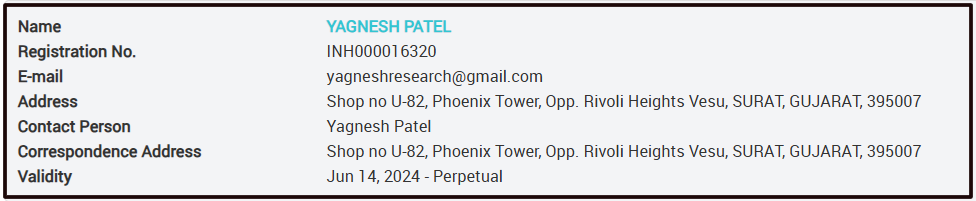
As per publicly available SEBI records, Yagnesh Patel holds a valid Research Analyst (RA) registration with Registration Number INH000016320.
Now let’s understand what that actually means.
A Research Analyst (RA) registered with SEBI is allowed to:
- Publish stock research reports
- Provide buy/sell recommendations
- Offer technical or fundamental analysis
- Sell subscription-based research services
In short, an RA can share research-backed opinions and market insights with investors.
However, there are clear boundaries.
A Research Analyst is not allowed to:
- Manage client funds
- Offer portfolio management services
- Provide guaranteed returns
- Give personalised investment advice like a SEBI-registered Investment Adviser (IA), unless separately registered
Based on the website, the services being offered, such as stock recommendations, F&O strategies, and educational courses, generally fall within the scope of what a Research Analyst can provide, provided proper disclosures and compliance norms are followed.
Registration is one important checkpoint.
But the next question investors often ask is: has SEBI ever taken action against the individual?
Has SEBI Issued Any Orders Against Yagnesh Patel?
Whenever we review any advisory platform, one of the first things to check is whether SEBI has issued any regulatory action, penalty, or restriction against the individual.
A search of publicly available SEBI enforcement orders, penalty records, and regulatory announcements does not show any order issued against Yagnesh Patel as of the date of this article.
In simple terms, there is no visible public SEBI action or ban related to his Research Analyst registration.
However, it’s important to understand something clearly absence of an SEBI order does not automatically mean zero risk. It simply means that no public enforcement action is currently available in SEBI’s records.
Market participation always carries risk. And regulatory registration does not eliminate that risk; it only ensures that the person is operating under a regulatory framework.
That brings us to a more practical question.
When should an investor consider reporting a Research Analyst?
What SEBI Permitted a Research Analyst to Do?
It is the permitted activities that truly define the value a professional Research Analyst (RA) brings to your investment journey.
When an RA operates within these regulatory boundaries, they serve as a critical filter, transforming raw market noise into structured, actionable insight.
Below is a clear breakdown of what a SEBI-registered Research Analyst is legally authorised and encouraged to do under the framework laid down by SEBI.
- Publish Data-Driven Research Reports: The core function of a Research Analyst is to act as a financial architect, building an investment case grounded in evidence, not emotion. An RA may publish detailed research reports covering: Individual stocks, Sectors or industries, Broader market trends.
- Buy, Sell, or Hold Recommendation: A Research Analyst is permitted to provide clear, directional views when backed by rigorous analysis. Every recommendation must be supported by a documented research process. Each call must include appropriate risk disclosures.
- Offer Macro and Sectoral Insights: Beyond stock-specific views, RAs are allowed to step back and analyse the broader economic landscape. They may publish deep dives on themes such as EVs, renewable energy, banking, or infrastructure.
- Charge Transparent and Compliant Fees: Fees must be disclosed and agreed upon before services begin. Compensation must follow a fixed-fee or subscription-based model. It cannot be linked to trading profits, performance, or capital size.
When Should You Report a Research Analyst?
Most investors hesitate to complain. They assume losses are just “market risk.” And yes, markets do fluctuate.
But there’s a difference between market loss and regulatory misconduct.
You should consider reporting a Research Analyst if:
- You are promised fixed or guaranteed returns.
- You are pressured aggressively to upgrade to higher-priced packages.
- You are asked to transfer money to a personal bank account instead of an official business account.
- Proper disclosures (SEBI registration number, risk disclaimer, conflict of interest) are missing.
- Your funds are being managed without your written authorization.
- You suspect that recommendations are misleading or intentionally misrepresented.
Remember, a Research Analyst can provide research and recommendations, but cannot guarantee profits or manage your money unless separately registered for those activities.
If something feels unclear, forced, or too good to be true, it deserves verification.
How to Report a Research Analyst?
If you believe a Research Analyst has acted improperly, the process should be structured and evidence-based. Here’s how you should approach it.
1. Collect and Organise Evidence
Before filing any complaint, gather everything related to your interaction.
This includes payment receipts, bank statements, subscription invoices, WhatsApp or Telegram chats, emails, research reports, and screenshots of any promises or claims made.
Clear documentation strengthens your case. Vague complaints rarely move forward without proof.
2. Contact the company first
If the matter is related to service quality or a misunderstanding, you may first write to the official support email of the Research Analyst and seek clarification.
Keep communication written and professional. Avoid verbal-only discussions. Written records matter.
If the issue remains unresolved, move to the next step.
3. File a Complaint on SEBI SCORES
SEBI provides an official grievance platform called SCORES (SEBI Complaints Redress System).
You can submit your complaint online by providing:
- Name of the Research Analyst
- SEBI registration number
- Description of the issue
- Supporting documents
SEBI then forwards the complaint to the concerned entity for a response.
4. File Arbitration at the Stock Exchange
Need Help
If you feel misled by any research analyst or advisory platform, you don’t have to handle it alone.
Sometimes the biggest mistake investors make is waiting too long. Early action increases clarity and improves the chances of proper resolution.
If you need structured guidance, you can register with us. We can help you understand your options, organize your evidence properly, and guide you on filing the right complaint in the correct format.
Conclusion
Yagnesh Patel appears to hold a valid SEBI Research Analyst registration, and no public SEBI orders are visible at the time of writing.
That said, registration should not replace due diligence.
Before subscribing to any advisory service, verify the registration independently, read the terms carefully, understand the risks involved, and never rely solely on promotional claims.
In the stock market, informed decisions matter more than assumptions.