
In India’s increasingly complex financial markets, many investors turn to research platforms, advisory services, and market analysts for guidance before making investment decisions.
While legitimate research can help inform choices, not all platforms operate with full regulatory compliance or transparency.
Yieldx Research is one name that has attracted attention in the investment research space.
Before relying on any research or recommendations, investors must understand exactly what Yieldx Research represents, whether it is properly registered, and how it operates within regulatory frameworks.
Yieldx Research Review
Yieldx Research presents itself as a professional investment research platform offering equity and fixed income analysis, claiming to operate as a SEBI Registered Research Analyst.
It advertises services such as company valuation, sector research, technical and fundamental analysis, bond analysis, credit risk assessment, and market trend insights.
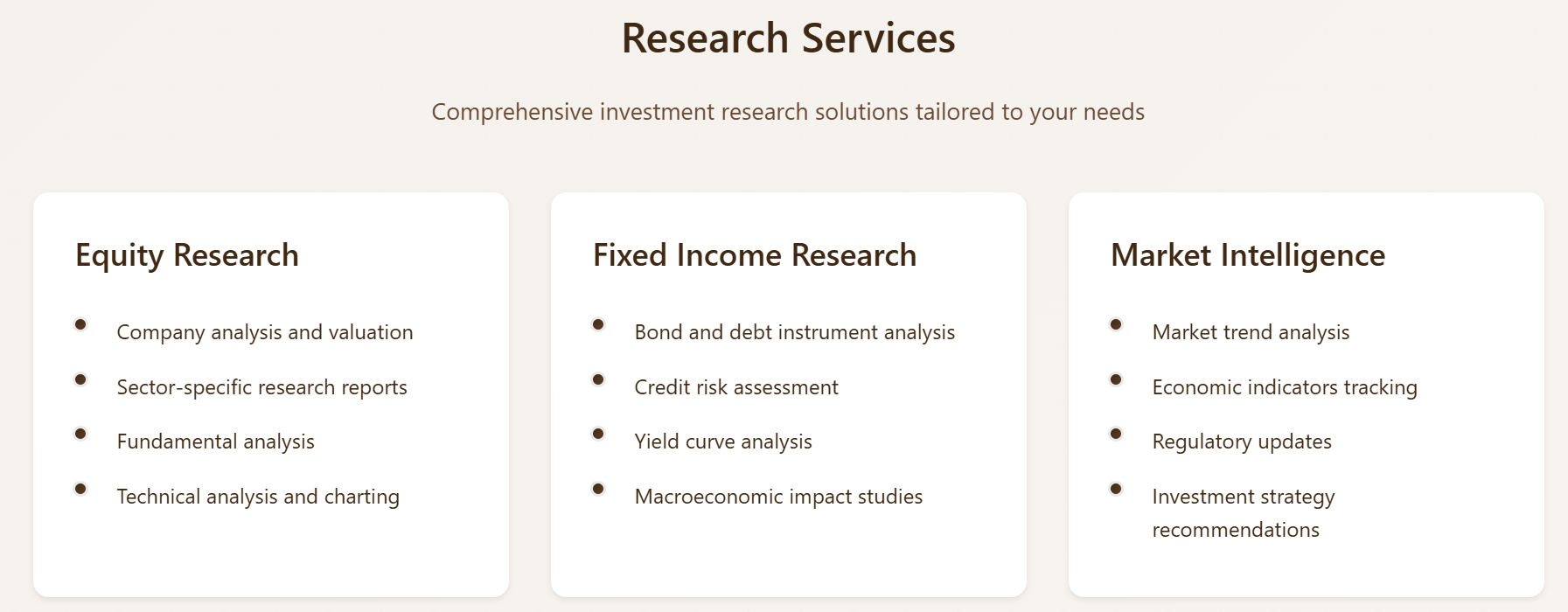
While these activities fall within the scope of research services, investors must independently verify their SEBI registration and carefully review disclosures.
Research services cannot guarantee returns, and any promotional claims suggesting assured profits or low-risk investments should be treated with caution.
Always verify credentials through official sources before acting on recommendations or making payments.
Is Yieldx Research SEBI Registered?
Yieldx Research is registered with the Securities and Exchange Board of India (SEBI) as a Research Analyst.
Registration No.: INH000024161
Validity Period: December 12, 2025 – December 11, 2030
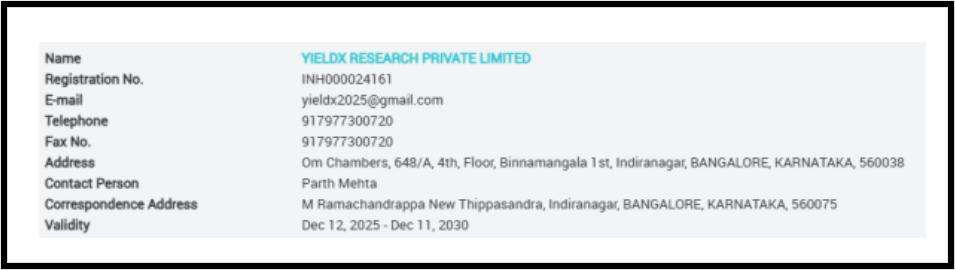
A valid SEBI registration requires the entity to comply with the SEBI (Research Analyst) Regulations, including disclosure norms, conflict-of-interest policies, record-keeping standards, and fair communication practices.
Registration, however, does not eliminate market risk—it ensures regulatory oversight and accountability.
RA Legal Operations in India
Under SEBI regulations, a registered Research Analyst may prepare and publish research reports on securities, including equities and other listed instruments.
They can provide recommendations supported by analytical frameworks, valuation models, and documented rationale.
They may also offer structured market commentary, sector analysis, and price targets, provided proper risk disclosures and conflict-of-interest statements are clearly mentioned.
Portfolio review guidance may also be offered, but without directly handling or managing client funds unless separately registered under Portfolio Management Services (PMS) regulations.
All recommendations must be research-backed, documented, and compliant with regulatory standards.
What a Research Analyst Cannot Do?
A SEBI-registered Research Analyst cannot guarantee fixed or assured returns. The securities market involves inherent risks, and any promise of “risk-free” or “monthly assured profit” would violate regulatory norms.
An RA is also not permitted to directly manage or pool client funds unless separately registered under relevant SEBI categories.
Accepting money into personal accounts for trading or offering profit-sharing arrangements without proper authorisation is not allowed.
Misleading advertisements, selective display of performance results, and suppression of risk disclosures are also prohibited under SEBI regulations.
How To Report A Research Analyst?
If you suspect misleading research, regulatory violations, unauthorised activity, or financial loss, prompt and structured reporting is essential.
Following the correct escalation path improves regulatory response and dispute resolution outcomes.
1. Preserve Evidence and Records Immediately
Before initiating any complaint, secure and organise all supporting evidence. This step is crucial for both regulatory review and dispute resolution.
Preserve:
- Research reports, recommendations, and subscription documents
- Screenshots of promotional claims, performance highlights, or advertisements
- Any risk disclosures or disclaimers shared (or not shared)
Well-documented evidence strengthens your case at every stage.
2. Raise the Grievance with the Research Analyst First
SEBI regulations require registered Research Analysts to maintain an internal grievance redressal mechanism.
Submit a written complaint (preferably via email) clearly stating:
- The issue faced and relevant dates
- The amount involved, if any
- The resolution you are seeking
Retain proof of submission and responses received. If the issue is resolved at this stage, further escalation may not be required.
3. File a Complaint on SCORES
If the grievance is unresolved or ignored, file a complaint in SEBI (SEBI Complaints Redress System) portal.
On the portal:
- Register using your PAN and contact details
- Select the correct intermediary category (Research Analyst or Investment Adviser)
- Upload all relevant evidence
SEBI forwards the complaint to the concerned entity and monitors their response. A complaint reference number is issued for tracking.
4. Escalate the Dispute Through SMART ODR
If your complaint on SCORES is closed without satisfactory resolution, or if a dispute remains unresolved, you may escalate the matter through SMART ODR.
SMART ODR is SEBI’s online dispute resolution mechanism that enables:
- Conciliation or mediation
- Arbitration in the stock exchange
This process provides a structured, time-bound alternative to traditional litigation and is particularly relevant for fee disputes, service deficiencies, or compliance-related disagreements.
Need Help?
If you are unsure about the legitimacy or compliance status of a research or advisory service, or if you have already suffered financial loss, you can reach out to us for assistance.
We help by reviewing your case details, identifying the correct regulatory category, organising supporting evidence, and guiding you through complaint filing on SEBI SCORES, SMART ODR, or the appropriate cybercrime channels.
We also assist with follow-ups and escalation where required, and track online SEBI complaint status.
Our support is limited to procedural and regulatory guidance. We do not promise recovery outcomes or influence regulatory decisions.
Conclusion
Regulatory compliance is not optional in the securities market; it is a legal requirement designed to protect investors.
For investors, the key lesson is clear: always verify registration status directly on SEBI’s official website before paying fees or acting on investment advice.
Unregistered advisory services expose you to significant financial and legal risk.
Vigilance, verification, and timely reporting are your strongest safeguards. When in doubt, pause, verify credentials, and protect your capital before making any investment decision.