

In a financial landscape where every other advisory platform promises multibagger returns and “sure-shot” calls, a firm that chooses to anchor itself in quantitative models, factor-based frameworks, and measurable transparency is something worth examining carefully.
Fincrave Capital, founded by Chartered Accountant Abhishek Jain out of Guwahati, Assam, is a SEBI-registered equity research firm that explicitly positions itself against emotion-driven investing.
Its stated philosophy: process over prediction, research over speculation, and consistency over impulsive decisions.
But does the substance match the positioning?
In this blog, we take a structured look at who Fincrave Capital is, what the firm is regulated to offer, and what every investor should weigh before subscribing to any research analyst service.
Abhishek Jain & Fincrave Capital Review
Fincrave Capital was founded by Abhishek Jain, a Chartered Accountant with over 15 years of experience in the Indian stock market.
The firm holds a valid SEBI Research Analyst registration (Reg. No. INH000023232) and is based in Guwahati, Assam – 781000.
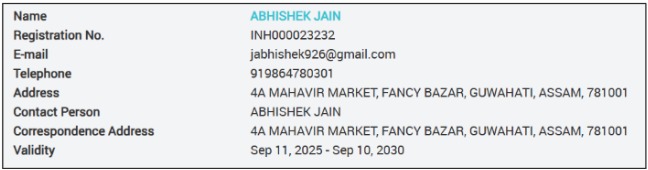
What distinguishes Abhishek Jain’s background from the typical stock market advisory founder is his professional grounding.
As a qualified CA, his experience spans financial accounting, statutory and internal auditing, due diligence, and tax advisory, with a client base that has included public sector banks, listed and unlisted companies, NGOs, and trusts.
On LinkedIn, he describes himself as a “Start Up and Microcap Investor,” signalling a particular interest in identifying early-stage and underresearched growth opportunities within Indian equities.
Having navigated multiple market cycles, Jain brings a pragmatic, cross-disciplinary lens to equity research, combining a CA’s understanding of business fundamentals with a systematic, quantitative approach to market analysis.
Fincrave Capital’s stated objective is not to predict market movements but to offer structured, evidence-based insights that help investors make more disciplined decisions.
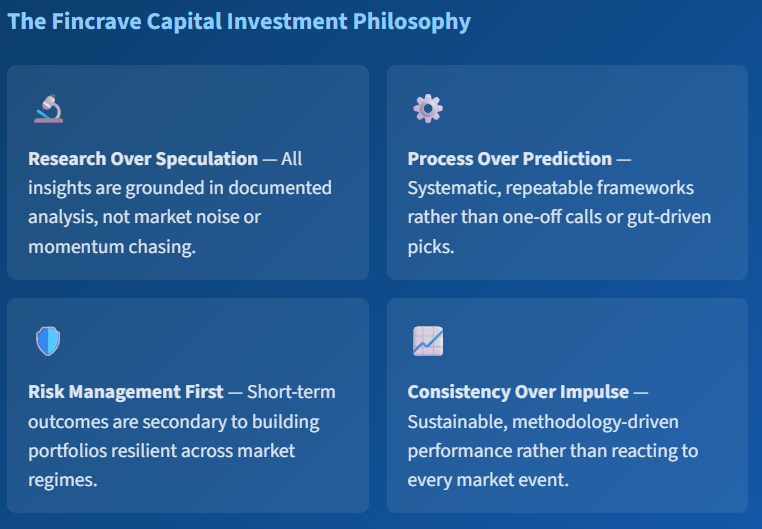
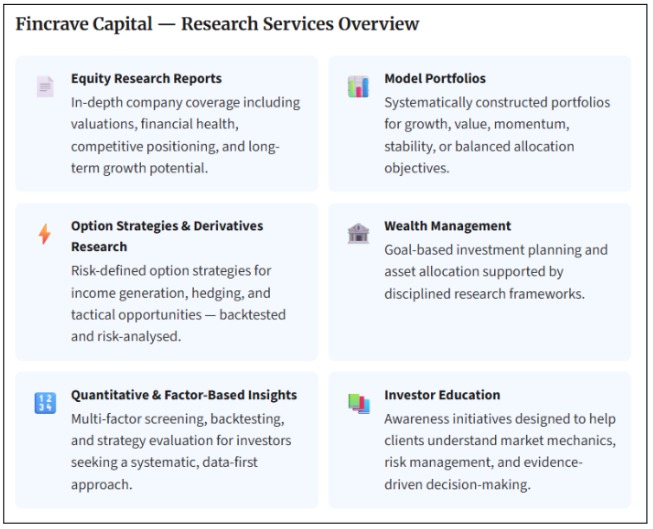
The firm’s service suite is notably broad for an independent research analyst operation.
Rather than focusing solely on tip-sheet style stock calls, Fincrave Capital offers a multi-dimensional research platform designed to serve investors with different objectives and time horizons.
It is also worth noting that all of this is delivered with an explicit acknowledgement on the website: services are provided “without any assurance or guarantee of returns.”
That single line is not just legal boilerplate; it is a meaningful signal about how the firm frames its relationship with clients, and it aligns with what SEBI’s regulatory framework requires of registered RAs.
Fincrave Capital’s website does not display any investor grievance data or complaint status, which is expected as part of mandatory disclosures for SEBI-registered Research Analysts.
The absence of such transparency may indicate non-compliance with SEBI’s disclosure requirements, where firms are required to publicly share complaint-related information for investor awareness.
What SEBI Allows a Registered Research Analyst to Do?
Fincrave Capital operates under SEBI (Research Analysts) Regulations, 2014.
Understanding the regulatory scope helps investors properly calibrate what to expect from any RA’s services.
It is essential to stay informed about the research analyst SEBI guidelines to ensure the service you receive aligns with legal mandates.
- Publish Structured Research Reports: Registered RAs can release in-depth reports on Indian equities and sectors, covering valuations, financial analysis, competitive positioning, and market outlook. All such research must be supported by documented methodology and must not imply guaranteed outcomes.
- Build and Share Model Portfolios: RAs may construct and share systematically designed model portfolios for different investor profiles. These must be framed as research-based frameworks, not as personalised investment advice or portfolio management (which requires a separate SEBI registration).
- Conduct Quantitative and Factor-Based Analysis: Backtested strategies, multi-factor screeners, and systematic research frameworks are all within the permitted scope of a registered RA’s services. These outputs must clearly disclose the assumptions, data sources, and limitations of the models used.
- Charge Transparent, Fixed Subscription Fees: Research subscription fees are permissible provided the fee structure is disclosed upfront in writing, is not linked to client investment outcomes, and is not structured as a profit-sharing arrangement.
What SEBI-Registered Research Analysts Cannot Do?
Even within a well-regulated and process-driven firm like Fincrave Capital, understanding the boundaries of what is legally prohibited is essential for every investor engaging with a research analyst.
- No Guaranteed Return Promises: No registered RA, regardless of the sophistication of their models, can assure positive returns or minimum gains to clients. Market outcomes are inherently uncertain, and any such representation is considered misleading under SEBI regulations.
- No Personalised Portfolio Management Without Separate Registration: While model portfolios are permitted, individually managed discretionary accounts require a separate SEBI Portfolio Manager registration. A Research Analyst licence alone does not authorise discretionary asset management.
- No Profit-Linked Fee Structures: Fees must be fixed and declared in advance. Any arrangement where the RA’s compensation depends on the client’s realised gains constitutes a conflict of interest and is prohibited.
- No Selective Disclosure of Performance: Showcasing only winning recommendations while omitting underperformers from any public-facing track record is contrary to SEBI’s transparency standards for research analysts.
- Full Documentation Mandatory: Before services begin, clients must receive a written service agreement, a risk disclosure document, and all SEBI-mandated disclosures. Missing documentation is a compliance failure regardless of the quality of the research itself.
What Should You Do If Problems Arise With Your RA?
If you experience concerns with Fincrave Capital or any other SEBI-registered Research Analyst, whether around service delivery, documentation, or the accuracy of representations made during onboarding, the most effective response is a calm, structured, and documented approach.
India’s investor grievance framework is accessible and well-defined. Using it correctly strengthens your position at every stage.
- Organise all documentation: Gather payment receipts, bank records, all written communications, screenshots of recommendations or claims, and any service agreements signed. Arrange them chronologically to establish a clear sequence of events.
- Draft a fact-based summary: Prepare a concise account of the service period, fees paid, specific representations made, outcomes experienced, and where the analyst’s conduct deviated from regulatory norms. Keep language factual and date-anchored.
- Contact the analyst or platform directly first: Reach out to the research analyst through their registered contact channels. Document every response, or the absence of one, as this forms part of the grievance trail.
- Lodge a complaint with SCORES: Register at the SEBI SCORES portal with KYC-matching credentials. Select the Research Analyst category, enter the registration number, and upload all supporting documents. Describe each grievance point clearly and separately.
- Monitor and respond promptly: Check your SEBI complaint status online regularly. Respond quickly to any requests for additional evidence or clarification from SEBI or the intermediary.
- File a Complaint in SMART ODR: For disputes eligible under the Online Dispute Resolution mechanism, the SMART ODR portal offers a faster, structured resolution pathway as an alternative to conventional arbitration.
- Share Market Arbitration: If the issue remains unresolved, arbitration becomes the final option. This is a formal process where your case is reviewed, and a decision is made based on evidence.
- Preserve all records: Maintain copies of every submission, acknowledgement number, and official response throughout. These documents are essential if the matter requires further regulatory or legal escalation.
Need Help?
Many investors find that even when dealing with well-structured, professionally run research firms, questions arise around what the service actually covers, whether documentation was complete, or whether specific representations made during onboarding were compliant with SEBI norms.
You can register with us, and we will help you with:
- Verifying SEBI RA registration status and checking for any regulatory actions.
- Drafting clear, evidence-backed complaints for SEBI SCORES or cybercrime authorities.
- Navigating SMART ODR and arbitration if initial grievance resolution fails.
Conclusion
Fincrave Capital, founded by Chartered Accountant Abhishek Jain, offers a genuinely broad range of services, equity research, model portfolios, quantitative frameworks, options strategies, and wealth management, grounded in a philosophy that prioritises process, data, and risk management over speculative calls.
Jain’s background as a CA with over 15 years of market experience and a declared focus on start-ups and microcap equities gives the firm a distinct analytical identity compared to the more generic intraday-tips model that dominates much of India’s research advisory landscape.
The firm also correctly disclaims any assurance of returns on its website, which is consistent with SEBI’s regulatory requirements. Before subscribing, read the service agreement and risk disclosure documents carefully.
Verify the registration independently, understand exactly which services fall within the scope of a Research Analyst licence versus those requiring additional registrations, and ensure you receive all mandatory onboarding documentation.
A sophisticated framework is valuable, but an informed investor is always the most important safeguard of their own capital.





 Add us as a preferred source on Google »

