

Quick Summary
Trades you never placed keep appearing, and you are not imagining the pattern. Nearly one in three complaints filed against Motilal Oswal across the last four financial years involve trades clients say they never approved. The law sits on your side here, because SEBI’s 2018 circular puts the burden on the broker to prove you authorised every disputed trade, and when it cannot, tribunals order the money back, from ₹30,000 wins to a ₹1,12,48,910 award for an elderly investor, and a full ₹28 lakh recovery our own team secured. This page shows you the signs, the data, the winning cases, and exactly where to start.
A dealer once told an investor five words that cost her everything: leave the trading to me.
That sentence, in its many versions, is where almost every story on this page begins.
It makes people ask the hard question: is Motilal Oswal trustworthy, or is it just another name where convenience turns into control?
It sounds like service. It feels like care. And the day the losses surface, it turns out nobody can show a single record of you approving a single trade.
That missing record is not your problem.
Under SEBI’s rules, it is the broker’s, and this page shows how investors turned that one fact into recoveries of up to ₹1.12 crore.
What Is Unauthorised Trading by Motilal Oswal?
Unauthorised trading is simple to say and painful to live through. It means trades happened in your account that you never asked for and never approved.
The rule behind it is just as simple. Your money, your account, your decision.
A broker or its representative can press the buttons only after you say yes to that specific trade, and every yes must leave a record: a recorded call, a written instruction, or your own login placing the order.
The moment a trade exists without that yes behind it, it is unauthorised, and it stops being bad service. It becomes a violation of SEBI’s rules, one you can formally act on.
The tricky part is that this rarely announces itself. It arrives dressed as help, through a friendly voice managing things for you, and victims usually realise only after the losses surface.
So before the data and the cases, check your own memory. The lines below come from real complaints, and each one sounded harmless when it was said.
Count how many you have heard:
- A dealer or representative suggested they would handle trades on your behalf.
- You were told not to worry because they would monitor the market for you.
- Leave the trading decisions to me; I will manage your account.
- You were asked to share login credentials or OTPs so someone else could trade.
- You were assured that losses could be recovered through the next trade.
- You were encouraged into options or derivatives you did not fully understand.
- You noticed trades you do not remember authorising.
- You were repeatedly advised to hold a little longer despite mounting losses.
- You were promised stop loss protection, yet losses kept increasing..
- Trade quantities were decided by the representative, not you.
- You felt pressured to trust their judgment over your own.
Even one yes puts you inside the pattern this page exists for. Several, and the numbers below explain why your story sounds so familiar.
Also Read: JM Financial unauthorised trading, what happens once an exchange actually investigates a claim.
Motilal Oswal Unauthorised Trading Complaints: The Data
You might assume your situation is rare. The broker’s own exchange reported numbers say otherwise.
The table runs four years, and the last column is the one that should stop you:
| Financial Year | Total Complaints | Unauthorised Trading Complaints | Share |
|---|---|---|---|
| 2025-26 | 761 | 286 | 37.58% |
| 2024-25 | 1,079 | 366 | 33.92% |
| 2023-24 | 498 | 174 | 34.94% |
| 2022-23 | 516 | 195 | 37.79% |
Read that share column again. Roughly one out of every three complaints against this broker, year after year, involves trades the client says they never approved.
Totals rise and fall, but the proportion never breaks, which tells you this is not one bad quarter or one rogue branch. Concerns about trade authorisation form a permanent, major share of what investors formally report.
For retail investors, the damage runs past money.
Unexpected trades drain savings, force panicked decisions, and in derivatives, leverage multiplies the wound. Many stop trading altogether, and the lost trust outlasts the lost capital.
Also Read: ATS Share Brokers unauthorised trading, 0% in 2022, 65.4% by 2025-26.
When Can You Take Action Against the Broker?
By now you may have counted your yeses on that list and felt the anger rising, and this is exactly where a case gets won or lost, because anger alone convinces no tribunal.
Losing money in the market is legal. Losing it to a broker who skipped your permission is not, and the difference between the two sits in four specific situations that arbitrators actually act on.
Read each one against your own account, and mark the ones that fit, because whichever ground matches your story becomes the spine of your complaint:
- The broker traded without asking you: SEBI’s directions permit trades only after proper client authorisation, so a single unapproved trade is already a complaint ground.
- The broker holds no proof: A valid trade needs evidence you placed it, a signed instruction, a recorded call, an email from your registered ID, or online logs. No proof means you can act.
- You complained, and they produced nothing: The moment you dispute a trade, the burden shifts to the broker to produce records. Failure makes the trade unauthorised.
- Technical excuses without justification: Even claiming a system issue, the broker must still prove the trade was not placed without permission, and weak controls invite penalties of their own.
Hold those four in mind, because every case on this page was won on one of them.
Also Read: PhonePe Wealth Broking unauthorised trading, the complete two-year data trend, read table by table.
When Does Account Handling Become Unauthorised Trading?
Most investors never hear the phrase account handling until something in their account stops making sense, so here is the boundary in plain words, because it decides whether your dealer’s helpfulness was actually a violation.
Account handling is the everyday way your account gets operated and controlled, and any of these becomes a formal concern the moment it runs without your documented approval:
- Dealer-assisted trading where your role in approving each trade is unclear.
- F&O exposure and position rollovers you did not specifically instruct.
- Margin usage grown beyond what you understood you agreed to.
- Intraday activity directed by a dealer or relationship manager.
- Positions or shares liquidated without adequate prior notice.
- Debit balances and interest charges never clearly explained.
The rulebook draws the line sharply.
When you open an account, you may sign a Power of Attorney, allow running account adjustments, and consent to margin trading, but that authorisation has defined boundaries.
An authorised person is the broker’s agent, not yours.
Their obligation is to execute your instructions, never to replace them with their own judgment, and SEBI’s pre-trade confirmation mandate is compliance, not courtesy.
And one principle deserves bold print, because brokers lean on the opposite assumption.
Having online access to your account data does not mean you understood or authorised the positions taken in it. Online access is not informed consent.
If the list above reads like your account’s recent history, the cases that follow show what that recognition is worth.
Also Read: Unauthorised Trading by Acumen Capital, trade alerts and contract notes, worth checking line by line.
Can You Complain If Your Loss Is Small? This ₹8,600 Case Says Yes
Before the crore-scale awards, one small story, because most losses do not run in lakhs, and the pattern does not care about size.
An investor was contacted by a representative who encouraged him to start trading under guidance, beginning with a deposit of just ₹10,000.
The script was the full one, miniaturised. Losses would be recovered through future trades. Profits were described as highly likely, almost assured.
Trade quantities and positions were decided by the representative, not by him.
The stop loss protection he was promised never materialised, and when losses came, the advice was to keep holding for the profits ahead.
By the end, approximately ₹8,600 of his ₹10,000 was gone, between trading losses and brokerage.
The amount is small.
The violations are identical to the crore case below, and that is exactly the point. The pattern scales to whatever you deposit, which is why your records matter at every size.
And notice what did the heaviest damage here. Not the market, the brokerage.
When charges swallow a deposit that fast, a second violation usually sits beside the first one, and how brokerage itself becomes the weapon, with the refunds tribunals ordered for it, is all on guide: Motilal Oswal excess charges.
Case Study: The ₹1.12 Crore Award Against Motilal Oswal
Now the case that set the ceiling, told from the beginning, because everything this page teaches lives inside it.
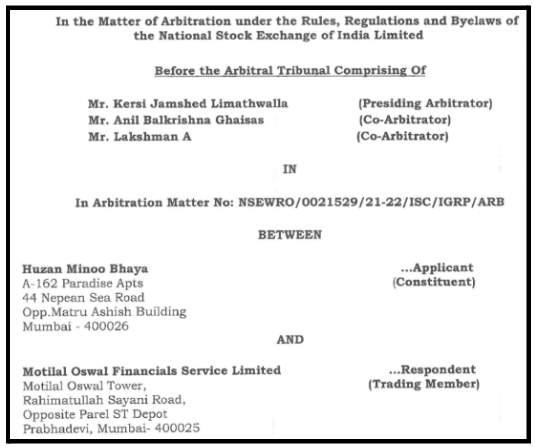
Huzan Minoo Bhaya, a Mumbai-based investor, was a conservative woman with an inherited portfolio and her own savings. Her instinct, and her mother’s, was caution. Mutual funds, government bonds, nothing exotic.
She approached the broker’s authorised person to manage exactly that.
Instead, he suggested Futures and Options with a one crore margin, promising about a lakh a month, personally and safely managed. She said plainly she knew nothing about F&O. She was reassured, and she trusted, because the man was backed by a reputable firm.
Then the arrangement showed its true shape. According to her claim, the authorised person took her signatures on blank forms, filled in details contrary to her instructions, and executed every trade himself, with no pre-trade confirmation from her for any of it.
The tribunal would later call it what it was: a back door portfolio management scheme run outside the regulated framework.
When the pandemic crashed the markets in March 2020, and losses exploded, he avoided her for three weeks, kept rolling positions over against her stated wish to close, and repeatedly told her not to worry.
At the hearing of matter NSEWRO/0021529/21-22/ISC/IGRP/ARB, the broker’s story collapsed in stages. It told the exchange pre trade confirmation existed. Then admitted it did not.
Then claimed her daughter would visit the office to place orders.
The tribunal found the broker had totally disregarded SEBI’s circular of 22 March 2018 on compulsory pre-trade confirmation, had belied and misled the NSE, and that the authorised person, overwhelmed by the market, had misguided and misled her instead of being forthright about the losses.
The tribunal flagged the deeper wrong too. Suggesting a sophisticated, high-risk segment to a conservative investor of modest means, dressed up as an informal arrangement, raised serious questions about the broker’s practices on its own.
The award did its arithmetic openly.
The core F&O loss of ₹1,22,11,366 was reduced by ₹9,62,456, the amount that would have been lost even with a timely square-off on 3 March 2020, and the GRC’s earlier ₹5,67,499 brokerage write-back was set aside.
The final direction, signed on 3 April 2023 in Mumbai: Motilal Oswal pays ₹1,12,48,910, with 12 percent interest.
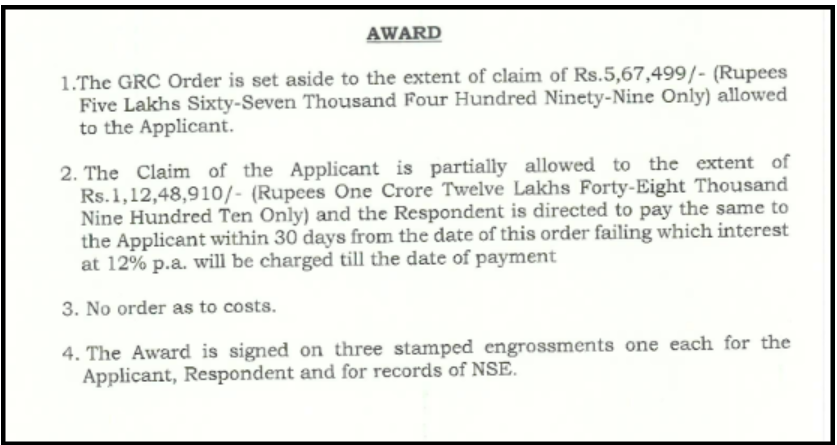
A conservative investor who wanted bonds ended up owed more than a crore by her broker, and she won because of one simple thing.
The broker could not produce a single record of her authorising a single trade.
How Much Can You Recover for Unauthorised Trades? Real Award Amounts
The crore case is the ceiling, but the rule under it pays at every level, and these are the wins most readers will recognise themselves in.
One investor never opted for F&O in his KYC at all, yet 176 derivative trades ran through his account on just say OK instructions. The tribunal held those could never be authorised and awarded ₹30,000, everything he had deposited.
Another had ₹2,00,000 returned in full because the broker, on being asked, could not produce a single pre-trade authorisation for his offline trades.
A client recovered ₹2,14,572 where the broker admitted it had not furnished the call records. Another won ₹3,72,814 where the dealer traded past an agreed halt and could not prove she placed the orders.
And where an authorised person did the trading, the tribunal applied the principal-agent rule and made the broker pay ₹1,13,642, because the agent’s WhatsApp chats were no substitute for actual order recordings.
The broker can never hide behind its representative, and when the local face of your damage was a franchise or sub-broker, the route runs through our page: Motilal Oswal authorised person complaint.
Every win turned on the same weak spot. The broker could not back its own records, and the moment the paper trail cracked, the trades became unauthorised.
How arbitrators weighed that evidence across all 32 published awards, the full scoreboard sits on our page on Motilal Oswal arbitration.
How We Helped Our Client Recover ₹28 Lakh From Motilal Oswal in Full?
The cases above came from the tribunals. This one came through our own desk, and it ended in a 100 percent recovery.
A retired investor reached us after discovering trades executed in his Motilal Oswal account without proper authorisation, and by then the damage stood at approximately ₹28 lakh.
We reviewed everything and found violations stacked across client authorisation, account access, communication records, and trade execution procedures.
Then we worked the sequence:
- Reviewed and analysed every piece of available evidence.
- Documented each applicable regulatory violation.
- Prepared a structured complaint supported by the documents.
- Escalated to the broker and the regulatory authorities.
- Represented him through every stage of the dispute.
- Managed the matter through the recovery channels to the end.
The result was a full recovery of ₹28,00,000.
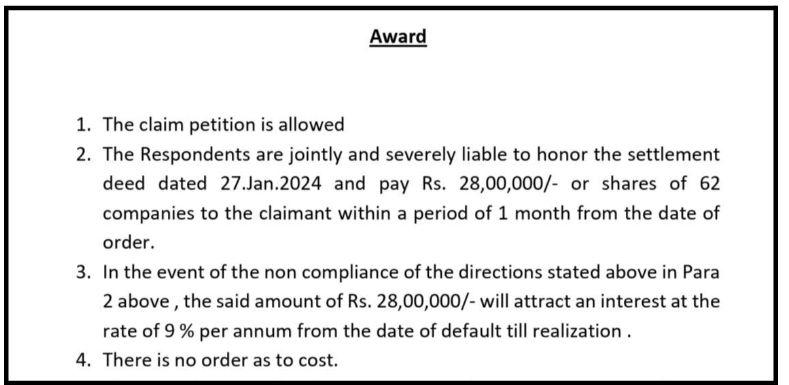
Every case rests on its own facts, and no outcome is guaranteed. But this one disproves the assumption that keeps most victims silent, that unauthorised losses are simply gone.
When Unauthorised Trading Claims Win, and When They Fail?
One thing this page owes you before the action steps, because overselling helps nobody.
Trades placed through your own online login are generally yours in a tribunal’s eyes, and that is hard to shift.
Trades placed offline by the broker or its people, where no authorisation can be produced, are where clients win, from ₹30,000 to ₹1.12 crore.
Most real cases tangle both kinds together, and the work that decides them is separating the two, then building the offline claim on the records the broker cannot supply.
Still scrolling your contract notes tonight, finding trades with no memory attached to them?
We will pull your ledger against the order logs, pin down exactly which trades the broker cannot prove you authorised, and build the claim around the records tribunals actually act on, the same way ₹28 lakh came back in full.
Trades You Never Placed Have a Route. Take It in This Order
Everything above is proof the fight pays. Your own fight starts with five moves, in sequence.
Lock your account first. Change the password, enable two-factor authentication, and demand removal of any trading access you never approved. The platform’s technical record tells the same tale from the user’s side, outages and glitches included, gathered on Motilal Oswal not working.
Mark the trades. Go through contract notes and note every unauthorised trade with dates, quantities, and losses.
Demand the records in writing. Ask the broker by email for the call recordings and order logs behind each disputed trade. This is the single step that wins cases, because a tribunal only notices a missing record when someone asked for it, and in win after win, the broker’s failure to produce is what decided everything.
Object in writing, early. State plainly that the trades were unauthorised, and note the date you first noticed and first objected, because both dates matter later.
Then escalate on the record. The complete route beyond the broker, from the grievance emails and phone numbers to SCORES and the exchange, is covered step by step in our guide on how to file complaint against Motilal Oswal.
Conclusion
One in three complaints. A ₹1.12 crore award with a name and a case number. A full ₹28 lakh recovery. The pattern and the remedy are both real.
Unauthorised trading is a SEBI violation, not bad service, and the burden of proving every trade sits with the broker, not with you.
The earlier you lock the account, mark the trades, and demand the records, the stronger you stand, because the case lives on records, and records have a shelf life.
Report. Recover. Stay Fraud Free.
Frequently Asked Questions
Any trade executed in your account without your explicit approval, whether by a dealer, relationship manager, or authorised person. Under SEBI's 2018 circular, every trade needs prior client confirmation, and the broker must produce proof of it when disputed.
You do not carry that burden, the broker does. Demand the call recording, signed instruction, or trading log behind the disputed trade in writing, because if the broker cannot produce it, the trade stands unauthorised, which is exactly how the reviewed cases were won.
Usually not, since tribunals hold clients responsible for trades placed through their own online credentials. Claims succeed for offline trades executed by the broker or its representatives where no authorisation exists, and most real cases need the two separated.
Reviewed awards run from ₹30,000 to ₹1,12,48,910 with 12 percent interest, and our own team secured a full ₹28,00,000 recovery for a retired investor. Every amount tracks the loss actually proven against the missing records.
Yes. Tribunals apply the principal agent rule, holding the broker fully liable for its representative's trades, and WhatsApp chats with the agent are no substitute for the order records the broker itself must maintain.



 Add us as a preferred source on Google »

