Anand Rathi Share and Stock Brokers Limited is a brokerage firm that offers trading and investment services to retail, high-net-worth (HNI), ultra-high-net-worth (UHNI), and institutional clients.
The firm operated over 90 branches across 54 cities and has multiple online trading platforms like ‘Trade Mobi’ and ‘AR Invest’.
Although Anand Rathi Share and Stock Brokers Limited is a reputed trading platform, it is important to note that reputation or experience does not make anyone immune to complaints.
Here, let us look at the complaints against the firm and the SEBI order passed on the matter.
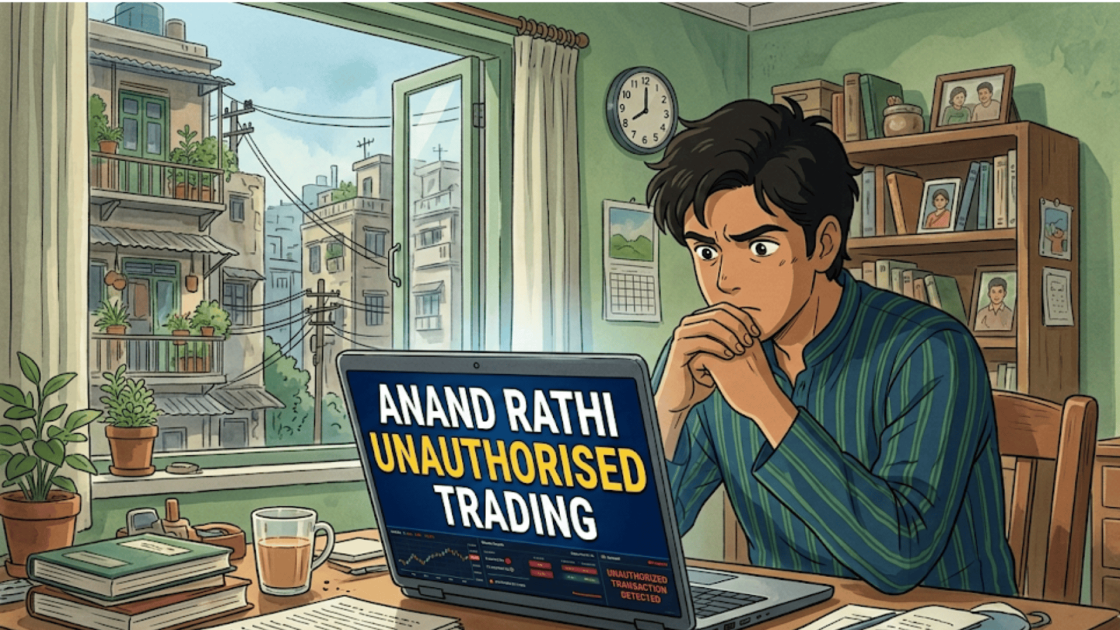
Anand Rathi Unauthorised Trading Complaints
Unauthorized trading is when a broker uses your funds to invest or trade on their platform without your permission.
If the broker has to make trades on your behalf, it should have your explicit consent to do so. However, that is not always the case.
Anand Rathi Share and Stock Brokers Limited has seen its fair share of complaints over the years regarding multiple issues.
For this blog, we will specifically discuss complaints about unauthorised trading.
Aanad Rathi Complaints Data
The table given below displays the trends of total clients, number of complaints and proportion of complaints with respect to total clients over the years.
Complaints on the platform increased even when the client base initially stayed the same, and the sharp rise in users later also came with a higher number of complaints.
| Financial Year | Total clients | No. of complaints | % of complaints w.r.t. Total clients | Resolved complaints | % resolved w.r.t. complaints | Arbitrations |
| 2022-23 | 125264 | 51 | 0.04 | 48 | 94.11 | 1 |
| 2023-24 | 125264 | 69 | 0.05 | 67 | 97.10 | 1 |
| 2024-25 | 146319 | 185 | 0.12 | 185 | 100 | 0 |
| 2025-26 | 145667 | 154 | 0.10 | 147 | 95.45 | 0 |
Although the resolution rate remained above 90%, the presence of recurring issues and arbitration cases raises concerns about the overall user experience.
But how much of it is actually related to unauthorised trading? You will find your answer to this in the next table. Let us analyse.
Complaints on the platform increased even when the client base initially stayed the same, and the sharp rise in users later also came with a higher number of complaints.
Although the resolution rate remained above 90%, the presence of recurring issues and arbitration cases raises concerns about the overall user experience.
But how much of it is actually related to unauthorised trading? You will find your answer to this in the next table. Let us analyse.
| Financial Year | No. of complaints | No. of unauthorised trading complaints | % of unauthorised trade w.r.t. complaints |
| 2022-23 | 51 | 16 | 31.37 |
| 2023-24 | 69 | 20 | 28.98 |
| 2024-25 | 185 | 1 | 0.54 |
| 2025-26 | 154 | 65 | 42.20 |
The number of complaints regarding unauthorised trading is not negligible in any financial year, except perhaps 2024–25 when there was only one complaint regarding this matter.
However, perhaps because the number of complaints for unauthorised trading is a measly 0.54% in 2024-25, the 65 complaints (more than one-third) in 2025-26 feel so highlighted. After all, an almost 41% increase in the matter should not be taken lightly.
Perhaps considering the same, SEBI investigated this matter too and the following order was passed on January 30, 2025.
Anand Rathi SEBI Order on Unauthorised Trading
There had been several complaints against Anand Rathi Share and Stock Brokers Limited regarding how they managed their clients’ accounts.
SEBI decided to investigate this matter further through an adjudicating order.
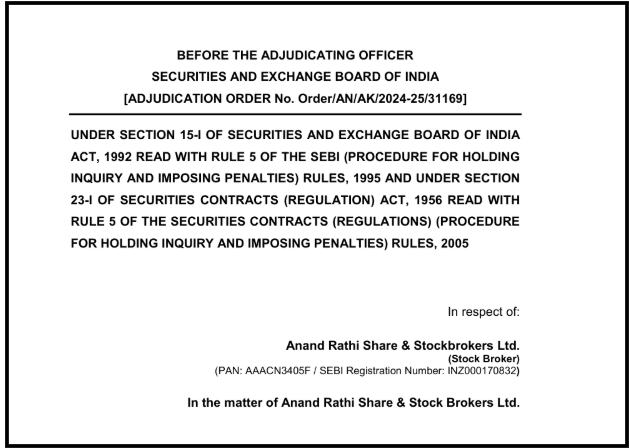
The main issue that arose was that the broker was making trades for clients without having clear proof that the clients actually asked for those specific trades.
- SEBI looked at a sample of trades and found 28 cases where the broker couldn’t show any evidence, like a phone recording or an email, to prove that the client gave them the permission to trade on their behalf.
- In many cases, when SEBI asked for the “order placement” logs (which are legally required), the broker simply couldn’t present them either.
- The broker also tried claiming that because of COVID-19, their staff was working from home and couldn’t record calls properly. SEBI rejected this, noting that many of these unauthorised trades happened before the pandemic rules even started.
Penalties
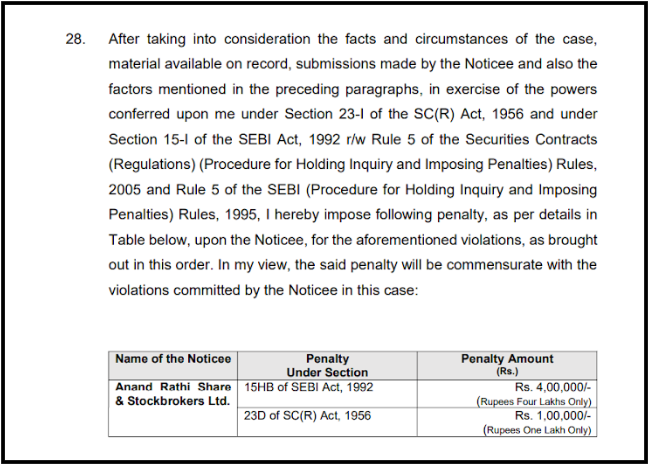
Because the broker failed to follow the rules and didn’t cooperate fully with the investigation, SEBI imposed ₹5,00,000 fine on Anand Rathi, which was broken into two different parts.
- ₹4 Lakhs was for general rule-breaking, including the unauthorised trades and failing to maintain proper records.
- ₹1 Lakh was specifically because they failed to properly segregate client funds and securities as required by law.
SEBI also pointed out that this wasn’t the broker’s first time getting into trouble for these kinds of issues, which is why a financial penalty was necessary to send a message.
Why This Matters For Investors?
SEBI has strict rules to protect you from brokers playing with your money.
- A broker must keep a record of your order. This can be a signed paper, a recorded phone call, an email from your registered ID, or a digital log if you used their app.
- If you claim a trade was unauthorised, it is not your job to prove you didn’t do it. It is the broker’s legal job to prove that you did, in fact, authorise it.
Key Takeaways
- If you see a trade in your account that you didn’t make, the broker is responsible for presenting evidence and will face consequences if they are unable to present said evidence.
- This order proves that SEBI takes these “missing recordings” very seriously and will fine brokers who can’t prove they had your permission.
- Always check your “Contract Notes” within 24 hours. If something looks wrong, complain immediately so they can’t claim you “silently agreed” to the trade.
When Can You Take Action Against a Broker?
Take action as soon as you discover that funds in your account may have been used without your consent. Acting quickly can help prevent further losses and strengthen your position if a dispute arises.
Check your emails and SMS alerts from the last 24 hours for any trade confirmations or notifications related to transactions you did not explicitly approve.
Action can be taken when:
- Trades are executed without your permission.
- The broker refuses to provide trade confirmations or call recordings.
- The broker ignores your complaint or fails to resolve the issue.
- There is a clear misuse of trading authority or account access.
- Trades are made very frequently without your consent, leading to unnecessary losses or high brokerage charges.
In such situations, investors should immediately gather all relevant records, including contract notes, account statements, emails, SMS alerts, and any call recordings or communication with the broker.
How to Complain Against a Stock Broker in India?
Finding yourself in a situation where your own money was used without your consent can be stressful and will most definitely make it hard for you to trust your broker like you once did.
Which is why it is so important to know these details about your broker.
But the question that arises is, what could you do if you find yourself in a similar situation? How should you proceed?
1. Gather All Evidence
Start by collecting all relevant documents and records that can support your claim. These may include account statements, contract notes, transaction records, email correspondence, SMS alerts, call recordings (if available), and screenshots of your trading account.
Maintaining proper documentation is essential, as it serves as crucial evidence when filing a complaint or taking further action.
2. Contact Your Broker Immediately
As soon as you notice any unauthorised transactions, contact your broker or trading member without delay.
Inform them in writing, preferably through email, and request a clear explanation for the trades.
3. File a Complaint in SCORES
If the broker’s reply is unsatisfactory or the matter remains unresolved, you can file a complaint with SEBI.
This online grievance redressal system, managed by the Securities and Exchange Board of India, allows investors to raise complaints against listed companies and registered intermediaries.
Make sure to attach all relevant documents and evidence to support your complaint.
4. Escalate the Matter and File for Arbitration
If the issue is still not resolved through SCORES or at the broker level, you can escalate the matter by initiating arbitration in the stock market.
When the dispute involves financial loss or negligence and remains unresolved, investors can begin arbitration proceedings by filing a complaint with SMART ODR.
This process provides a formal mechanism to resolve disputes between investors and market intermediaries.
Need Help?
If you are still unsure about how or where to begin, register with us.
Our team can simplify the entire process for you, from drafting and filing professional complaints to representing you before SEBI if the matter escalates.
Having experienced professionals by your side ensures that you receive the right guidance and support while pursuing justice.
Let our experts handle the complexities while you focus on peace of mind.
Conclusion
In the end, the key takeaway is simple: always stay alert about what is happening in your trading account. Even when a broker is well-known, issues like unauthorised trading can still occur.
The complaint data and the action taken by the Securities and Exchange Board of India show why investor awareness is so important.
Regularly check your contract notes, keep track of your trades, and report anything suspicious immediately.
Being informed and acting quickly can make a big difference in protecting your money and your rights as an investor.