
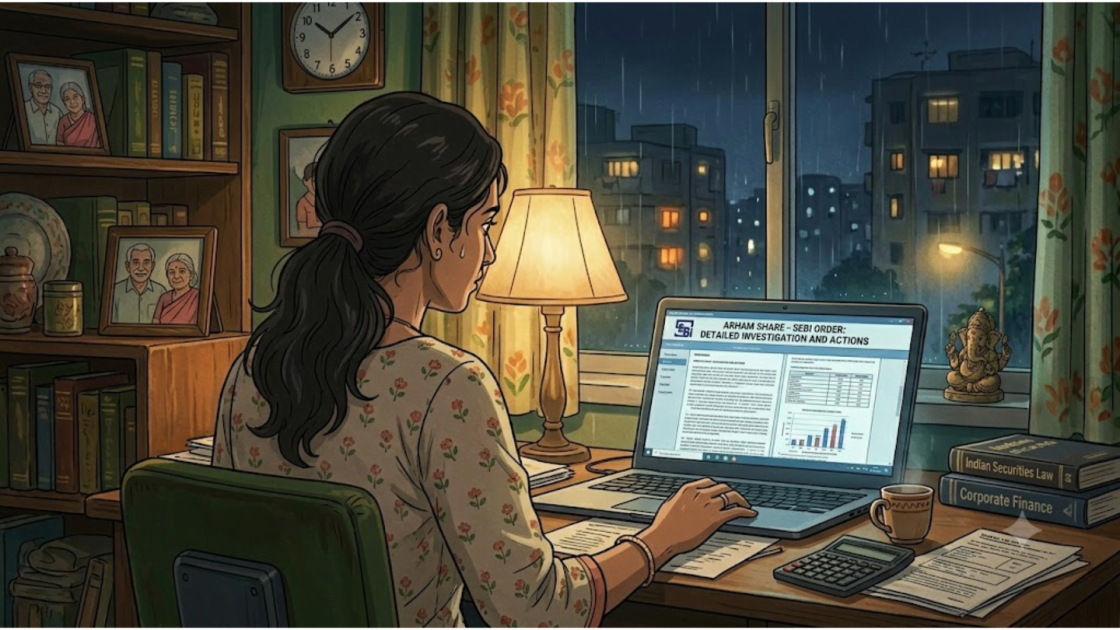
You opened an account with Arham Share. The SEBI registration inspired confidence. It seemed reasonable to believe that qualified and authorised professionals were handling the operations.
SEBI’s formal inspection found a very different picture.
Unauthorised individuals operating trading terminals. Cash payments to a client for proprietary trading supervision. Margin norms circumvented through informal arrangements. Deposits of departing dealers not returned.
This blog breaks down everything the Arham Share SEBI Order revealed and tells you exactly what to do if any of it affected your account.
Kavya Trusted Arham Share With Her Money But She Had No Idea Who Was Actually Operating Behind Her Account
Kavya Mehta (name changed) was a working professional from Surat. She opened her trading account with Arham Share based on a simple reason: it was a local broker with SEBI registration and a decade of operations. It felt safe.
Her relationship manager appeared helpful. He explained the platform, addressed her queries, and seemed knowledgeable. However, things later took a different turn.
Then, slowly, things started feeling off.
Kavya noticed small discrepancies in her ledger. Charges she could not trace back to any trade. Fund movements that did not align with her statements. She asked her RM for clarification. The answers were vague.
She escalated to the branch. The response was slower. Then it stopped.
What Kavya did not know, what nobody told her, was that the people processing activity in accounts like hers were not always the authorised employees Arham Share was supposed to have at those terminals.
She was not alone in this situation. SEBI’s own inspection of Arham Share confirmed it.
Here Is What SEBI Found When They Formally Inspected Arham Share
The adjudication order, Order/NH/YK/2024-25/31202, was passed on February 20, 2025. SEBI’s Chief General Manager N Hariharan passed it after a detailed inspection of Arham Share’s internal operations.
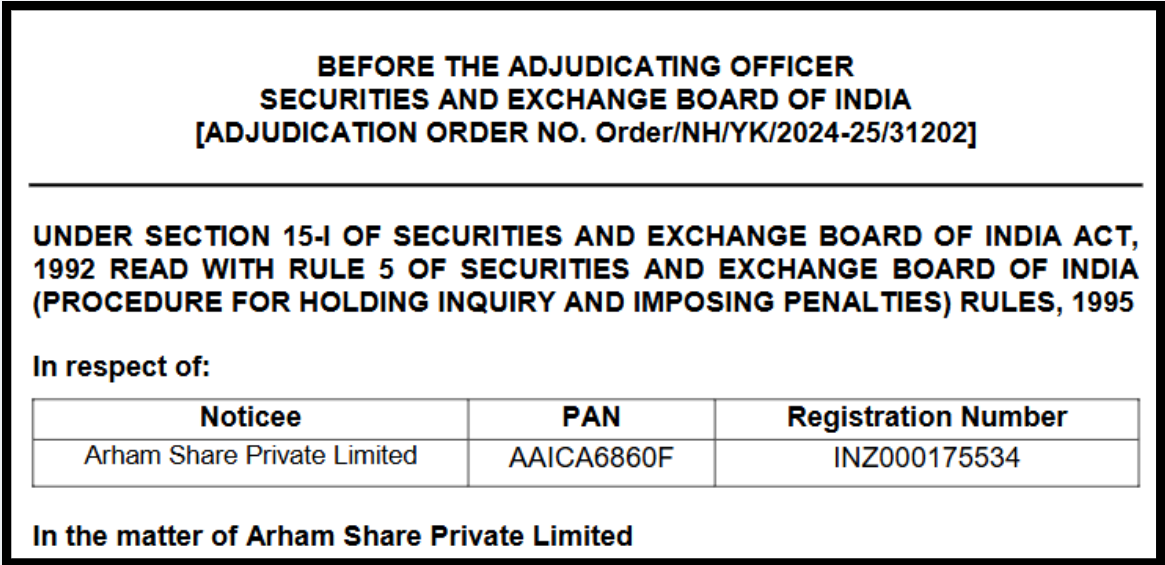
The findings were not speculative. SEBI recorded joint statements from key individuals including Hemang Shah, Raghav Kedia, and Ramesh Saraogi. Those statements formed the core of what SEBI documented.
Four violations emerged from that inspection. Each one tells you something important about what was happening inside this broker.
Violation 1: Cash Paid to a Client for Supervising Proprietary Trading
SEBI found that Arham Share paid cash to a client, not an employee, named Ramesh Saraogi. The payments were for supervising and advising on the firm’s proprietary trading activity.
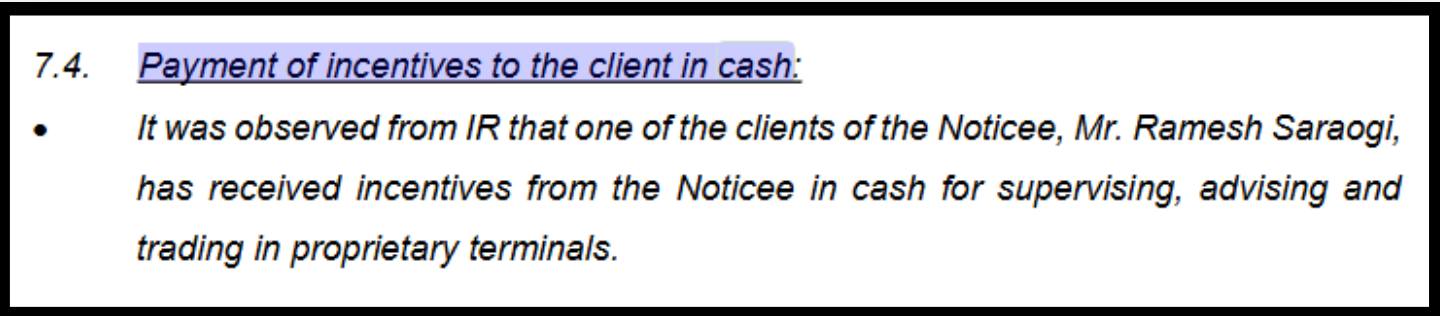
This is a direct regulatory breach. SEBI rules require all broker-client financial transactions to go through banking channels. Cash payments in connection with securities market activities are strictly prohibited.
Arham Share denied the finding. The firm produced an affidavit from Mr. Saraogi retracting his earlier recorded statement. SEBI dismissed that retraction. The original joint statement from the inspection was treated as credible. The retraction was called an “afterthought” with no supporting evidence.
The violation stands on record.
Violation 2: Unauthorised Individuals Operating Trading Terminals
SEBI’s rules require only approved, registered employees of a stockbroking firm to operate its trading terminals. This rule exists to protect accountability and market integrity.
Arham Share violated it across multiple instances.
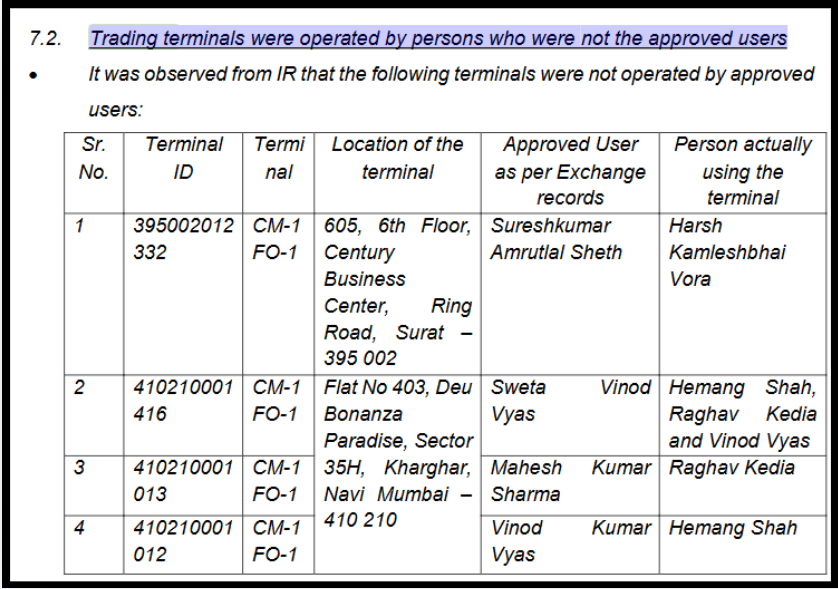
Ramesh Saraogi, a client with no employee status, operated proprietary terminals at a branch location. The firm claimed the premises were leased to a separate entity. SEBI found that explanation insufficient. Evidence confirmed trades were executed under guidance from Arham Share’s head office, at times based on Mr. Saraogi’s input.
Terminal ID 395002012332 was officially assigned to one person. SEBI found that a different unapproved individual was actually using it.
Hemang Shah, Sweta Vyas, and Vinod Vyas were only formally added to Arham Share’s payroll on September 1, 2023. Records showed they had been operating trading terminals before that date as non-employees.
In each of these cases, the person operating the terminal had no regulatory approval to be there.
Violation 3: Margin Collection Norms Bypassed
SEBI found that Arham Share used deposits collected from proprietary terminal dealers to meet its margin requirements with the Clearing Corporation.
Margins must be collected from clients through regulated, prescribed channels. Using informal dealer deposits to fulfil that obligation bypasses the framework entirely.
When five proprietary terminal dealers left the company, their deposits were not returned. These individuals had placed money with Arham Share as a condition of terminal access. When they exited, Arham Share did not settle those obligations.
Violation 4: Breach of the Code of Conduct for Registered Intermediaries
A SEBI-registered stockbroker must maintain integrity, follow regulatory norms, and ensure only authorised persons operate market infrastructure. These are not suggestions. They are binding obligations under the Stock Brokers Regulations.
Arham Share’s conduct across all three violations above represents a collective failure to meet those obligations. SEBI’s order was direct: Arham Share’s attempts to justify its violations did not befit a registered intermediary.
The penalty: ₹7,00,000 imposed on Arham Share Private Limited.
What These Violations Actually Mean for You as an Arham Share Client
Each violation in the SEBI order has a direct implication for anyone who held an account with Arham Share.
- Unapproved people at the terminals means the integrity of your account activity is in question: When non-employees operated trading terminals, the accountability chain behind your trades broke. If anything went wrong, a mistaken execution or an unauthorised trading position, the clear line of responsibility that should protect you simply was not there.
- Cash payments to a client for proprietary trading supervision signals an internal culture of regulatory disregard: A broker willing to make undisclosed cash arrangements is one whose compliance culture puts its own interests above client protection.
- Bypassing margin collection norms exposed client funds to structural risk: When a broker does not follow prescribed margin frameworks, the safety net those rules provide does not fully exist. Your funds were part of a system that cut corners on the very rules designed to protect them.
- Unresolved deposits of departing dealers show a pattern of not settling obligations: If a broker does not return funds to its own dealers after they leave, that pattern raises questions about how it handles client funds when disputes arise.
None of this means your specific trades were all fraudulent. What it means is that the broker’s internal controls failed in documented, SEBI-confirmed ways. That failure is the foundation of any complaint you choose to raise.
Your Arham Share Account May Have Been Affected If Any of These Are True
Read through these carefully. Be honest about what you experienced.
1. Trades Appeared in Your Account That You Did Not Place
If you found executed positions you never instructed, and if those positions generated losses, the regulatory failures SEBI documented provide direct context for your complaint.
2. Your Ledger Shows Charges You Cannot Explain
Unexplained deductions or fees that do not correspond to trades you placed are worth questioning formally. Request an itemised written explanation from Arham Share.
3. Your RM Changed or Left and Nobody Told You What Happened Next
When relationship managers depart, broker obligations for continuity do not. If your account had no active management during a period of activity, that is a governance gap.
4. You Were Never Told About the Margin Structure Behind Your Account
Margin obligations should be transparent. If you did not receive clear documentation about how your funds were being used as margin or how margin shortfalls were handled, that omission matters.
5. You Raised a Complaint That Was Never Properly Resolved
Arham Share’s pattern of compliance failure extended to how they handled regulatory obligations. If your internal complaint went unanswered or unresolved, that non-response is itself grounds for formal escalation.
6. You Deposited Funds That Were Not Returned After You Stopped Trading
Given SEBI’s finding that five departing dealers did not get their deposits back, any client who finds their withdrawal request delayed or unresolved should treat that as a priority complaint.
Recognising your situation within these points is the first step. The next is knowing how to use that recognition to build a formal case.
Can You Recover Money Lost Through Arham Share?
Yes. Recovery is possible. Your speed and documentation determine how far that possibility goes.
SEBI’s order against Arham Share is now a public, official record. That record matters. When you file a complaint, it provides regulatory backing that no amount of broker denial can simply dismiss.
Your position is strongest when you have:
- Account statements and ledger records from the period in question
- Contract notes for trades you did not place or cannot account for
- Screenshots of any discrepancies between your app view and your official statement
- A record of complaints you raised internally and how Arham Share responded
- Evidence of any funds deposited that were not returned when expected
You do not need all of these. Two or three well-preserved documents can form the foundation of a valid formal complaint. Preserve what you have right now, before records become harder to access.
Also Read: SEBI order on Nuvama Wealth, every violation proven, the final penalty still zero.
Complaint Against Stock Broker India
Filing correctly matters as much as filing at all. A poorly structured complaint gets dismissed. A documented, formally filed one demands a response.
Here is the exact sequence that works.
Step 1: Preserve All Evidence Before You Do Anything Else
Download your complete trade history, ledger statements, contract notes, and account records right now. Save every email and WhatsApp message from any Arham Share representative. Screenshot your current account view.
Evidence preserved today is significantly stronger than evidence gathered after a complaint is already filed.
Step 2: File a Formal Written Complaint with Arham Share
Write directly to Arham Share’s compliance officer, not a support ticket, not a phone call. A formal, timestamped email that creates a documented record.
State your client ID. Specify the exact transactions or charges you are disputing. Describe what happened and what resolution you expect. Attach your evidence. Keep the complete thread.
Arham Share must respond within 30 days. Their response, or their silence, becomes your next piece of evidence.
Step 3: Escalate to SEBI SCORES
If their response is unsatisfactory or absent, file on SEBI’s SCORES portal. Select “Stock Broker” as the complaint category. Choose Arham Share. Upload everything, your complaint, their response, and all supporting documents.
Once filed, the complaint carries official regulatory weight. Arham Share must respond formally. Unresolved SCORES complaints attract direct SEBI scrutiny. Given the existing order against this broker, SEBI is already watching.
Step 4: Move to SMART ODR
If SCORES does not produce resolution, escalate to SEBI’s SMART ODR platform. A neutral expert reviews your case through a structured, digital process. Most disputes receive attention within 30 days.
You do not need legal representation at this stage. You need well-organised, clearly presented evidence.
Step 5: File for Arbitration
For significant financial losses, formal arbitration through NSE, BSE, or MCX delivers a legally binding and enforceable decision. Every document you preserved becomes critical evidence here.
Arham Share’s Violations Were Not Your Fault But Getting Your Money Back Can Be Your Choice
Kavya never realised that unauthorised individuals were operating trading terminals linked to her account. Meanwhile, margin requirements were allegedly being bypassed.
At the same time, cash transactions reportedly occurred outside formal banking channels.
Kavya opened an account with a broker she trusted. Then, she relied on her relationship manager’s guidance. Naturally, she expected the regulatory safeguards in place to protect her interests.
SEBI’s inspection confirmed her trust was placed in a broker that failed that framework in multiple documented ways.
If your experience with Arham Share left you with unexplained losses, unresolved charges, or a complaint that went nowhere, you are not dealing with bad luck. You are dealing with the downstream consequences of a governance failure that SEBI has now put on record.
That record is on your side.
Here is what we do with it:
- Case Assessment: We review your account statements, trade history, and complaint records. We tell you exactly what happened, whether it qualifies as a recoverable loss, and what your realistic options are. No upfront cost. No obligation.
- Evidence Organisation That Regulators Take Seriously: We go through every document you have. We map each issue to the specific regulatory obligation Arham Share failed to meet. We structure your complaint so it cannot be dismissed on a technicality.
- Full Representation From Start to Finish: From your first formal complaint to SEBI SCORES, through SMART ODR mediation, and all the way to exchange arbitration if that is what it takes, we handle every step. You do not need to figure out the next move alone.
The broker had a compliance team. SEBI had an inspection team. Now you need a team on your side.
If Arham Share’s regulatory failures cost you money and your complaints have produced nothing, reach out to us today. We will review your situation at no cost and tell you exactly what recovery looks like for your case.
SEBI Found What Was Hidden. Now It Is Your Turn to Act.
SEBI inspected Arham Share and documented what it found. Unapproved individuals at the terminals. Cash paid to a client for trading supervision. Margin norms bypassed. Dealer deposits not returned.
That inspection took months. The order runs to 57 pages. The penalty stands at ₹7 lakh.
But the inspection does not automatically recover your money. The order does not file your complaint for you.
Kavya’s situation, and the situations of every Arham Share client who experienced unexplained charges, missing credits, or unresolved grievances, deserves more than an entry in SEBI’s enforcement database.
It deserves a formal response. A documented complaint. A regulatory escalation that puts your name and your loss on record.
The evidence exists. The order exists. The complaint pathway exists.
What happens next depends entirely on whether you use it.
Document what happened. File through the right channels. Escalate until you get a real answer. And if you need someone who knows exactly how to do that, we are here.
Start today. Not next week.
Frequently Asked Questions
1. SEBI penalised Arham Share in February 2025. Does that help my complaint as a client?
Yes. The SEBI order is an official, public record of regulatory violations by Arham Share. When you file a formal complaint, through SEBI SCORES or arbitration, that order provides direct regulatory backing. It confirms that SEBI has already found governance failures at this broker. That context strengthens any client complaint that relates to those failures.
2. I found trades in my Arham Share account that I never placed. Can I challenge them?
Yes. Every trade in a client account requires documented, verifiable proof of client instruction. Given SEBI’s finding that unauthorised individuals were operating terminals at Arham Share, trades executed without your clear approval are directly contestable. Preserve your contract notes and raise a formal complaint immediately.
3. My Arham Share RM says the charges on my ledger are standard fees. How do I verify that?
Request a written, itemised explanation from Arham Share’s compliance team, not from your RM. The written response must reference your broker-client agreement and show that each charge aligns with the disclosed fee structure. If the explanation is absent or inconsistent, those charges are formally contestable.
4. I deposited funds with Arham Share and they were not returned when I stopped trading. What do I do?
SEBI’s order specifically found that Arham Share did not return deposits to five departing proprietary terminal dealers. If you have a similar unresolved fund return issue, file a formal written complaint with Arham Share’s compliance officer immediately. If there is no resolution within 30 days, escalate to SEBI SCORES with your deposit records and withdrawal requests attached.



 Add us as a preferred source on Google »

