When people choose a stockbroker, they usually start with the basics. Is the firm registered with SEBI? Does it have exchange memberships?
Has it been around for a while?
Those checks matter. But they only show part of the picture.
What really shapes an investor’s experience is what happens after the account is opened, like how trades are handled, how clearly communication happens, and how carefully the broker follows client instructions.
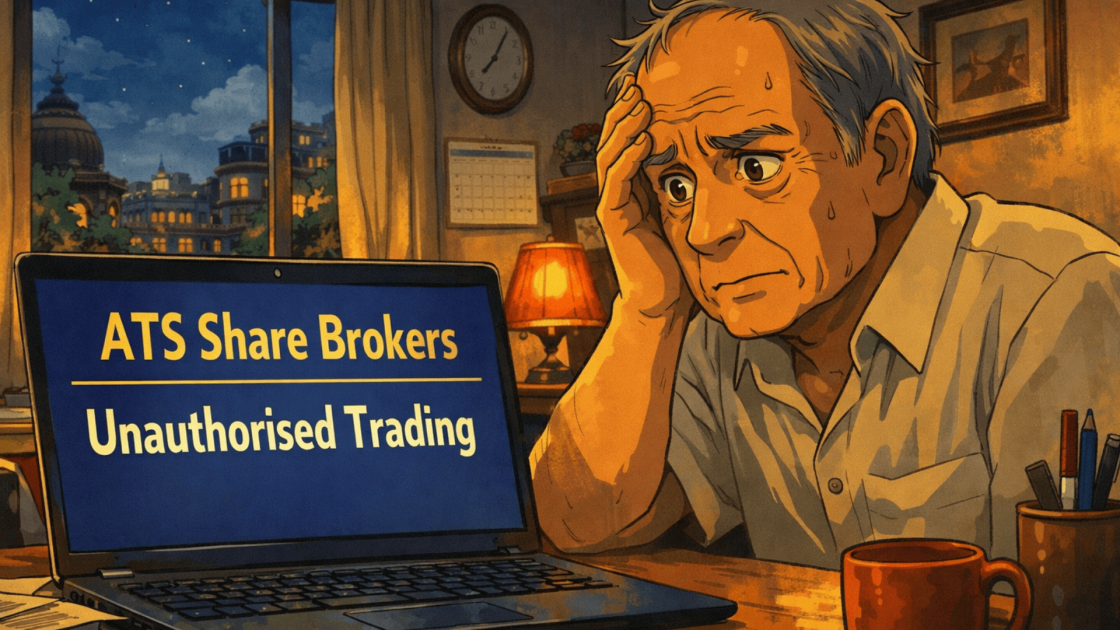
From time to time, some investors have shared their experiences with ATS Share Brokers Unauthorised trading.
Of course, a complaint by itself does not automatically mean wrongdoing happened.
But when investors raise similar concerns, it can help highlight the kinds of situations that sometimes arise between clients and brokers.
In this blog, we look at these concerns in a straightforward way – what ATS Share Brokers does, how disputes around Unauthorised trading can develop, and what investors can do if they ever face something similar.
ATS Share Brokers Overview
ATS Share Brokers is a brokerage firm that offers trading access to retail investors across different financial markets.
Like many traditional brokers, the firm provides services in several segments, including:
- Equity trading
- Derivatives trading
- Commodity trading
- Currency trading
- Depository services through CDSL
Publicly available information shows that the firm holds memberships with exchanges such as NSE, BSE, MCX, and NCDEX. This allows clients to trade in multiple markets using a single broker.
Investors interact with the broker in different ways.
Some place trades directly through online trading platforms. Others prefer speaking with a dealer or relationship manager who executes the orders for them.
However, when trades are placed through phone calls or conversations rather than directly through the platform, clear confirmation and proper records become very important.
ATS Share Brokers Unauthorised Trading Complaints
Unauthorized trading is when a broker or dealer executes trades in an investor’s trading account without the investor’s permission or proper authorisation.
In normal trading, every order placed in an account should come directly from the investor or be clearly approved by them.
When a trade is carried out without such consent, it may be considered unauthorised.
Complaint Data on Unauthorised Trading
Complaint data can sometimes give a broader picture of the issues investors have reported over time.
| Year | Total Complaints | Unauthorised Trading Complaints | Percentage of Unauthorised Trading Complaints |
| 2021–22 | 3 | 0 | 0% |
| 2022–23 | 2 | 0 | 0% |
| 2023–24 | 4 | 2 | 50% |
| 2024–25 | 27 | 12 | 44.4% |
| 2025–26 | 26 | 17 | 65.4% |
Looking at the numbers year by year, the earlier period shows very few complaints overall, and none of them involved Unauthorised trading.
Things begin to change from 2023–24. In that year, two of the four complaints related to trades that investors said they had not authorised.
The following years show a noticeable increase. In 2024–25, 12 out of 27 complaints involved Unauthorised trading.
By 2025–26, that number rose further, with 17 out of 26 complaints falling into the same category.
That means roughly two-thirds of the complaints in 2025–26 were about Unauthorised trades.
This does not necessarily mean every complaint leads to a confirmed violation. However, the numbers do show that concerns about trading activity are becoming more visible among investors.
For investors, this highlights the importance of regularly checking contract notes, SMS alerts, and account statements so that any unusual activity can be spotted early.
Impact of These Complaints on Retail Investors
When complaints about Unauthorised trades increase, the biggest impact is usually on trust.
Investors depend on brokers to execute their instructions accurately. If trades appear in an account that the investor does not recognise, it can quickly damage that confidence.
The data also suggests something else: Investors today are paying closer attention to their accounts than before.
In earlier years, complaints were extremely low. The rise in recent years may partly reflect greater awareness and a willingness to report problems.
For investors, the takeaway is simple: Regularly review trade confirmations and account statements. This can help catch unusual activity before it turns into a larger dispute.
When Can Action Be Taken Against a Broker?
Many investors assume that once a trade appears in their account, they have no choice but to accept it.
In reality, regulations also place responsibilities on brokers.
-
Lack of Clear Authorisation
A broker is expected to execute trades only after receiving instructions from the client.
If a dispute arises and the broker cannot show evidence of those instructions, such as call recordings, written communication, or digital order logs, the trade can be questioned.
-
Failure to Maintain Trading Instruction Records
Brokers are required to maintain order-related records for a minimum period so that disputes can be reviewed later if needed.
If proper records are not maintained or cannot be produced when a complaint arises, it may become a regulatory concern.
-
Inability to Justify Trades During a Dispute
Sometimes brokers may not be able to produce direct order instructions because of technical failures or other issues.
In such situations, they may still be expected to justify the trade using other evidence, such as fund transfers or client acknowledgements.
If no such explanation exists, the trade may remain disputed.
-
Extremely High Trading Activity
Even in active trading accounts, unusually high trading frequency can sometimes attract attention.
If the pattern suggests that trades were executed mainly to generate brokerage rather than to serve the client’s interest, regulators may examine the situation more closely.
How to File a Complaint Against a Stockbroker?
If you notice trades in your account that you did not clearly approve, it is important to handle the situation calmly and step by step.
1. Review Your Trade Records
Start by checking your contract notes, trade history, and ledger statements. These documents help you understand exactly when the trades were executed and what brokerage charges were applied.
2. Contact the Broker
3. File a Complaint on SCORES
If the broker’s response does not resolve the issue, you can raise a complaint through SEBI’s SCORES platform.
SCORES allows investors to submit complaints directly to regulated intermediaries and ensures the broker responds within the regulatory process.
4. Approach the Exchange and Arbitration
When both sides disagree about what happened, the matter can move to arbitration, where an independent panel reviews the evidence and gives a decision.
Need Help?
Situations like these can be confusing, especially if you are not familiar with how the complaint process works.
Many investors are unsure which documents to check, how to interpret their trade history, or what evidence they should request from the broker.
We assist investors in reviewing their trading records, identifying unusual patterns in account activity, and preparing a clear complaint if the matter needs to be raised formally.
If the issue moves further, we also guide investors to file a complaint at SEBI and the exchange’s grievance procedures so the matter can be examined properly.
Register with us if you need assistance understanding your trading records or filing a complaint.
Conclusion
Concerns involving ATS Share Broker Unauthorised trading show that even when a broker is properly registered, disputes can still arise depending on how trading activity is handled.
For investors, the most important step is staying aware of how trades are executed in their accounts and reviewing account activity regularly.
Because at the end of the day, every trade in a trading account should reflect the investor’s decision, not something they discover later and struggle to explain.