
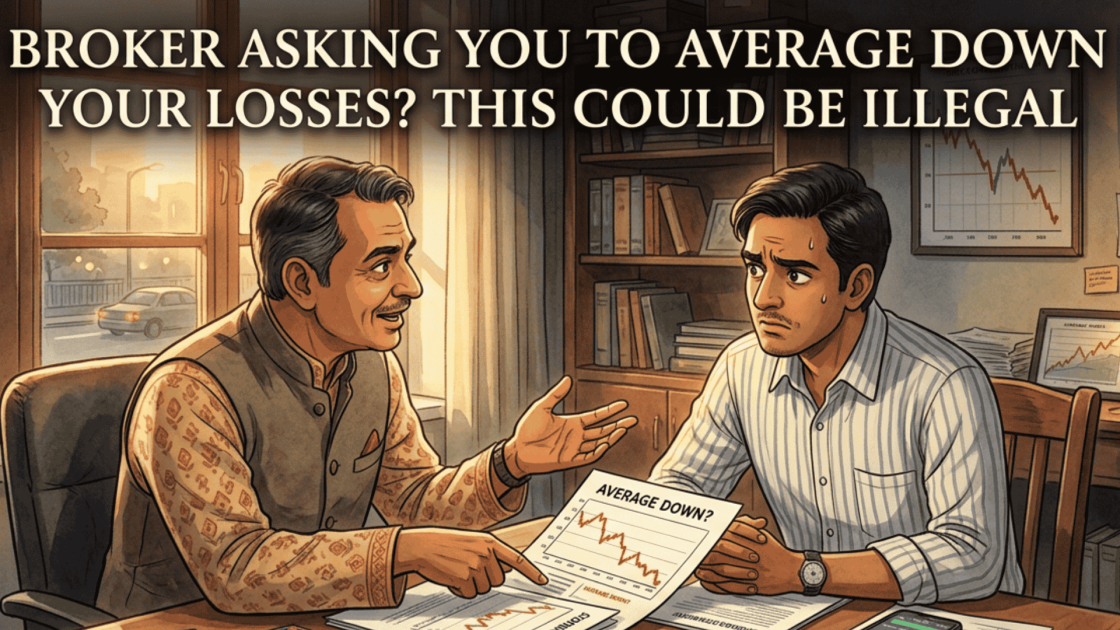
You were already down. The position was bleeding.
Then the broker called. Confident voice. Reassuring tone. “Aur lot lo. Average ho jayega. Ek bounce aaya toh sab recover ho jayega.”
So you bought more. The loss grew.
They called again. You bought more again.
By the time you stopped, your account was unrecognisable. And your broker was still collecting brokerage on every single trade.
You did not make a bad decision. You were pushed into one. And what was done to you may not have been legal.
Stop the Self-Blame: You Didn’t Fail, You Were Manipulated
The first thing most victims do is blame themselves.
“I should have known better. I should have stopped earlier.”
Stop. That guilt is not yours to carry.
Averaging down sounds logical on the surface. Buy more at a lower price. Reduce your average cost. Wait for the bounce.
It makes mathematical sense when you hear it the first time. That is exactly why it works as a pressure tactic. Brokers who push averaging know the logic sounds reasonable.
They rely on that reasonableness to keep you adding funds. Meanwhile, every new lot you buy generates fresh brokerage for them.
You were not irrational. You were trusting. And that trust was used against you deliberately.
What Your Broker Was Actually Allowed to Do and Where They Crossed the Line?
This is the part most traders never learn until it is too late.
A SEBI registered stockbroker has one permitted role: executing your buy and sell orders.
That is it. Nothing more.
They are not your financial advisor. They are not permitted to tell you what to buy, when to buy, or how much to buy, unless they hold a separate SEBI registration as a registered Investment Adviser under the SEBI (Investment Advisers) Regulations, 2013.
Think about that for a moment.
Every time your broker called you and said “buy more” or “average karo” or “don’t worry, I know this market”, they were giving you personalised, securities-specific investment advice.
The person gave investment advice without the registration required to do so. They ignored your risk appetite and financial situation entirely.
SEBI’s own guidance explicitly warns investors not to rely on hot tips for investment decisions and states that disseminating such tips is a reportable illegal activity.
Furthermore, SEBI’s own guidance explicitly warns investors not to rely on hot tips for investment decisions. It also states that disseminating such tips is a reportable illegal activity.
Averaging advice pushed by a broker with a financial stake in your trading falls squarely in that territory.
The line between “executing orders” and “giving investment advice” was crossed the moment your broker started telling you what to do instead of asking what you want to do.
The Hidden Motive Behind the “Buy More” Call
There is something your broker never told you about that phone call.
Every time you added a position, they earned brokerage. Every additional lot you bought, every new trade placed on their advice, generated revenue for them.
They got paid whether you made money or not. They got paid whether the advice was good or not.
This is a fundamental conflict of interest. SEBI separates the role of a broker from the role of an Investment Adviser precisely because of this.
A broker who earns money when you trade has a financial incentive to keep you trading, including averaging down into losing positions.
So when the call came saying “thoda aur lo, recover ho jayega”, ask yourself: who did that call benefit more? You, who was about to lose more money? Or them, who was about to earn more brokerage?
That conflict sits at the heart of every averaging down pressure case. And it is exactly what makes the broker’s conduct regulatory misconduct, not just bad advice.
Red Flags That Prove Your Broker Violated SEBI Rules
Many traders assume these issues are normal. In reality, several of them may amount to serious compliance violations.
Be honest with yourself about what happened.
1. They Promised the Position Would Recover
“Yeh stock zaroor bounce karega.”
“Nifty ₹200 neeche nahi jayega.”
Any statement framing recovery as certain is a prohibited assurance. No broker is legally permitted to guarantee any market outcome.
2. They Gave You Specific Trade Instructions Without You Asking
If the broker called you and told you exactly what to buy, in what quantity, at what price, without you requesting that advice, they gave you unsolicited personalised investment advice.
That requires a registration they did not have.
3. They Never Asked About Your Financial Situation
A legitimate adviser must understand your risk tolerance, your capital base, and your investment goals before making any recommendation.
If your broker jumped straight to “buy more” without asking any of this, they skipped every step the law requires.
4. The Advice Was Only Given Verbally, Nothing in Writing
SEBI-registered Investment Advisers must maintain records of every recommendation they make.
If your broker’s averaging advice only ever came through voice calls with no written trail, that is a compliance red flag, and often a deliberate one.
5. You Kept Losing More After Every Round of Averaging
This alone does not make it illegal. However, when combined with unsuitable advice, undisclosed conflicts of interest, and assured recovery promises, it builds a case.
The advice was not just wrong; it was harmful, and regulatory standards say harmful unsuitable advice carries consequences.
6. They Became Defensive or Dismissive When You Raised Concerns
If you questioned the broker after losses mounted and received deflection, silence, or blame pushed back on you, document that response.
It becomes part of your complaint.
7. Your Margins Were Not Explained Before You Added to the Position
SEBI requires brokers to clearly communicate margin requirements before you add any position.
If margin implications were never discussed and you later faced margin calls or forced liquidation, that is an additional compliance failure.
Can You Recover Losses Caused by Broker Misconduct?
This is the question you came here to answer. So here it is, directly. Yes. Recovery is possible.
However, it depends on your documentation and your speed. Advisory misconduct cases have been won through SEBI SCORES, SMART ODR mediation, and exchange arbitration.
In each case, the investor had preserved their evidence and escalated through the correct channels.
Your case is strongest when you have:
- WhatsApp messages or chat logs where the broker gave trade instructions or recovery assurances.
- Call recordings where averaging advice was given verbally.
- Contract notes showing the pattern of repeated buying into losing positions.
- Your account statement showing how losses grew with every round of averaging.
- Any written or digital communication where recovery was promised or implied.
- A record of broker complaints you raised that the broker dismissed or ignored, implied.
Even two or three pieces of well-preserved evidence can form a valid complaint. The earlier you act, the fresher the evidence.
WhatsApp messages get deleted. Call records expire. Account data becomes harder to pull over time. Your window is open right now. Use it.
How to File a Complaint Against Stock Broker Online?
Do not wait until you finish reading this.
Start with the first step while everything is still fresh.
To raise a complaint, follow these steps:
Step 1: Save Every Piece of Evidence Before Anything Else
Open your phone. Screenshot every WhatsApp conversation with your broker. Export the chat history. Save every email. Note the dates of phone calls and what was said.
Download your complete contract notes and account statements. If you have call recordings, back them up immediately. Do it before you do anything else.
Step 2: Write a Formal Complaint to the Broker’s Compliance Team
This is not a support ticket. This is not a helpline call. Write directly to the broker’s official compliance email.
State the specific dates, the specific instructions you received, and how those instructions led to your losses.
Be factual. Attach everything you saved. Keep the complete thread. They must acknowledge within 24 hours and respond within 30 days.
Their response, or silence, becomes part of your escalation. You can also file an NSE complaint against a broker if it is registered with the National Stock Exchange.
Step 3: Raise a Complaint with SEBI SCORES
If the broker’s response is unsatisfactory, file immediately on SEBI’s SCORES portal. Select “Stock Broker” as the complaint category.
Upload everything: your complaint, the broker’s response, your evidence. Once on SCORES, the complaint carries official regulatory weight.
The broker must respond formally. Unresolved SCORES complaints attract direct SEBI scrutiny.
Step 4: Lodge a Complaint with SMART ODR
If SCORES does not resolve the matter, escalate to SEBI’s SMART ODR platform. A neutral third party reviews your case. The process is structured, digital, and faster than any court.
Most cases receive a decision within 30 days. You do not need a lawyer for SMART ODR. You need organised evidence and a clear account of what happened.
Step 5: Arbitration in Stock Market
For significant losses, formal arbitration through NSE or BSE produces a legally binding decision.
WhatsApp messages, documented assurances, and trading patterns all carry real weight in these proceedings. This is the stage where proper evidence preparation determines the outcome.
Need Help?
You acted on their advice. You trusted their promises. You added more money because they said the next trade would fix everything.
That was not your failure. That was misconduct. And misconduct has a remedy.
Taking action against a firm can feel overwhelming, especially when you are already dealing with the stress of losses.
Knowing where to file, what to attach, and how to frame a complaint makes the difference between a submission that gets ignored and one that demands a response.
That is exactly where we step in. We go through your account activity, chat logs, and trade history and tell you honestly what recovery looks like. No upfront cost, no commitment.
If you have a case, we build a complaint that cannot be dismissed on a technicality and walk with you through every stage, from SEBI SCORES to arbitration if it comes to that.
You figured out their game. Now let us help you fight back.
Register with us today.
Conclusion
It happened because a broker, who earned brokerage every time you traded, gave you personalised investment advice they had no legal authority to give, promised recovery they had no right to promise, and never once asked whether any of it was suitable for your situation.
That is not just bad advice. Under SEBI’s framework, it is regulatory misconduct you can formally challenge. The evidence is still there. The complaint pathway is still open.
The three-year window has not closed. What you do with that is entirely up to you. Document it. Escalate it. Fight for it.
And if you need someone in your corner, reach out to us today.
Frequently Asked Questions
1. My broker never put anything in writing. They only gave averaging advice over the phone. Can I still file a complaint?
Yes. Verbal advice cases are filed and won through SEBI SCORES and arbitration regularly. Your account statement, contract notes, and the trading pattern itself all serve as supporting evidence.
The consistent pattern of buying into losing positions on specific dates can demonstrate the broker’s influence even without a written record.
2. Is averaging down itself illegal? Or is it only the broker’s advice that is the problem?
Averaging down as a trading strategy is not illegal.
The problem is the broker’s conduct around it, giving you personalised buy recommendations without Investment Adviser registration, assuring recovery without any legal basis, and pushing you to trade more while earning brokerage on every additional lot.
Those specific acts cross regulatory boundaries.
3. My broker says I made all the trades myself and they only “suggested” the direction. How do I counter that?
Document the pattern. If your account shows repeated buying into falling positions concentrated around the same time as broker calls, that pattern tells a story.
Additionally, any WhatsApp message, email, or chat that even loosely references their suggestion becomes evidence. “Thoda aur lo” in writing is more powerful than you think.
4. How do I know if my broker is registered as an Investment Adviser?
Check SEBI’s official registered intermediary list at sebi.gov.in. Search under “Investment Advisers.”
If your broker’s name or firm does not appear there, they were not permitted to give personalised investment advice, regardless of what they told you.
5. I averaged down multiple times over several months. Is there a time limit to file a complaint?
For SEBI SCORES, file as early as possible. For exchange arbitration, you generally have three years from the date of the disputed transaction.
If the averaging happened across several months, your timeline likely starts from the most recent transaction in the pattern. Preserve all evidence now and act without further delay.


 Add us as a preferred source on Google »

