

Your broker calls you one fine evening and says, “Sir, don’t worry. Just keep the money with us. We will ensure you get good returns.”
It sounds reassuring, doesn’t it?
Almost like a promise from someone you trust with your hard-earned money.
But here is what nobody tells you at that moment: that single sentence, that one casual assurance, may have just broken the law.
Thousands of retail traders in India receive exactly these kinds of promises every year. Some from registered brokers, some from their sub-brokers, some from “authorised persons” of big brokerage houses.
The language changes, “guaranteed returns,” “assured profits,” “we will recover your losses,” “70-30 profit sharing”, but the story usually ends the same way: with the trader losing money and having nowhere to go.
In this blog, we break down exactly what SEBI says about brokers giving assurance of returns, what the regulations mean in plain language, real cases where this has gone terribly wrong, and what you can do if you have already been on the receiving end of such promises.
What Is a Stock Broker’s Role?
Before we get to the question of assurances, it helps to understand what a stock broker is legally supposed to do.
A SEBI-registered stock broker is an intermediary. Their job, in simple terms, is to execute your buy and sell orders on the stock exchange.
They are not your investment manager. They are not your profit guarantor. They are not your financial partner.
Is SEBI registered broker safe? Generally, yes, but only if they stay within their legal boundaries.
SEBI defines the conduct of stock brokers very clearly. For three decades, this was governed by the SEBI (Stock Brokers and Sub-Brokers) Regulations, 1992.
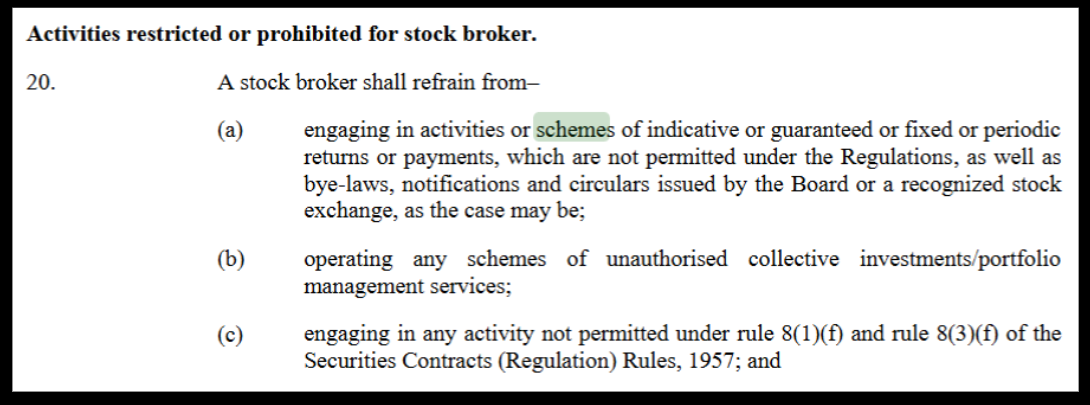
In January 2026, SEBI replaced this with the SEBI (Stock Brokers) Regulations, 2026, a major structural reset of India’s broking framework.
This is not new. Even under the 1992 regulations, assuring returns was considered a violation of the broker’s code of conduct. The 2026 regulations have simply made the prohibition sharper, more explicit, and harder to ignore.
If you are unsure whether your broker falls under this framework, check if your broker is SEBI registered before going any further.
Now that we understand what a broker’s role is, the natural question is: does that mean they are prohibited from giving any assurance of return?
The answer is unambiguous, and the law leaves no room for interpretation.
Can a Broker Give Assurance of Return in India?
No. Absolutely not. Under Indian securities law, it is illegal for a broker, or any of their agents, sub-brokers, or authorised persons, to give any assurance of return to a client.
This is not a grey area or a matter of interpretation. SEBI’s regulations, both the 1992 framework and the new 2026 regulations, explicitly prohibit brokers from making any promise of guaranteed, indicative, or assured returns in any form.
Here is what that prohibition looks like in practice:
- A broker cannot say “we guarantee 20% returns.”
- A broker cannot say, “don’t worry, we will recover your losses.”
- A broker cannot offer a “70:30 profit-sharing” arrangement.
- A broker cannot claim their strategy has a “95% success rate” without SEBI-verified data.
- A broker cannot tell you to “invest more” with the promise of recovering prior losses.
The prohibition extends to every layer of the broker’s ecosystem. If an authorised person or sub-broker makes such a promise while operating under a brokerage’s name, the brokerage itself is held liable.
The Renu vs Angel One arbitration case, covered below, demonstrates exactly this principle in action.
Every broker is also legally required to provide clients with a Risk Disclosure Document that explicitly states profits are not guaranteed in the stock market.
If a broker’s verbal or written communication contradicts what their own Risk Disclosure Document says, that contradiction is itself evidence of a regulatory violation.
The question is not just whether your broker used the word “guarantee.” The question is whether their communication, in any form, on WhatsApp, over a phone call, or in writing, created a reasonable impression in your mind that returns were certain.
If it did, it likely crossed the legal line.
Knowing the rule is one thing. Seeing how SEBI has actually enforced it against real brokers and platforms is what underlines just how seriously the regulator treats this prohibition.
SEBI Show Cause Notice 2022
The Securities and Exchange Board of India (SEBI) has issued show cause notices to over 120 stockbrokers for their ongoing association with the algorithmic trading platform Tradetron.
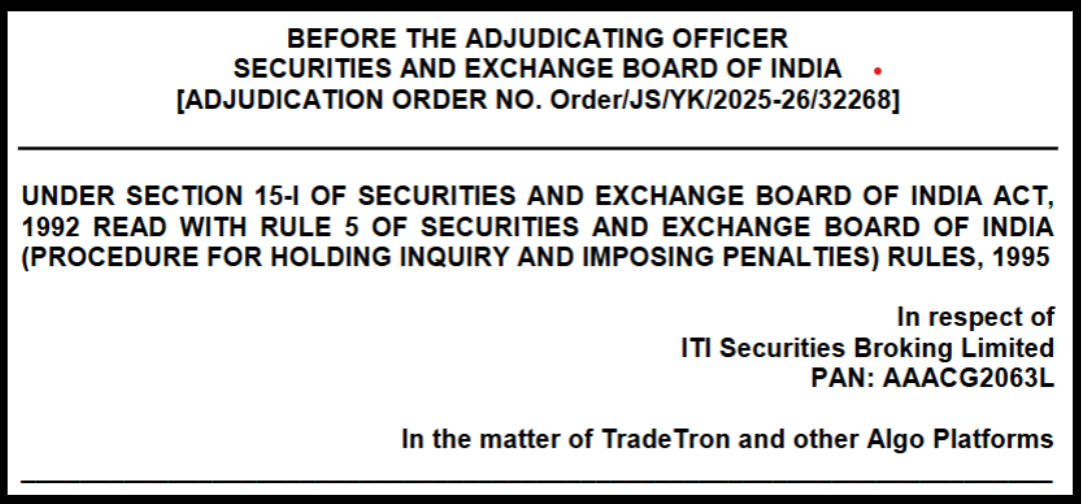
Such a move is part of SEBI’s investigation into suspected regulatory breaches by Tradetron and other algorithmic trading platforms.
Tradetron, which allows users to automate their trading techniques, was claimed to have presented algo trading strategies on its website that promised guaranteed profits, a practice prohibited by SEBI’s circular effective 2022.
SEBI’s Stance: If your name is associated, directly or indirectly, with any platform, scheme, or arrangement that promises guaranteed returns to investors, you are in violation. There are no grey areas here.
This action demonstrated that the prohibition on assured returns is not just a theoretical legal restriction. SEBI actively monitors and enforces it.
SEBI’s enforcement actions are not just limited to notices. In several real cases, traders who received return assurances from brokers and their agents suffered significant losses, and some were able to recover compensation through arbitration.
Here is what those cases looked like.
Real Cases of Broker Giving Assurance of Return
Promises of guaranteed returns have no place in the stock market, yet some brokers still use them to attract clients.
Broker frauds in India often begin with exactly these kinds of assurances, language that sounds helpful but is designed to keep you invested while others profit.
Here are real cases where such assurances led to regulatory action and investor losses.
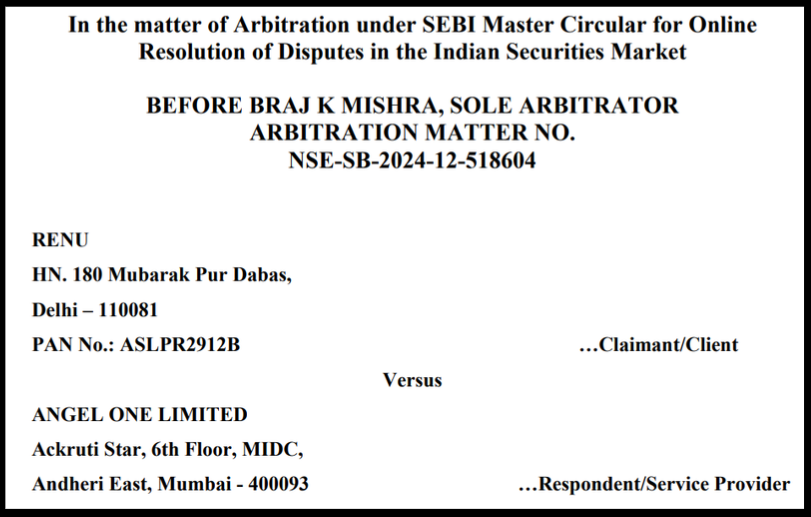
1. Renu vs Angel One, Arbitral Award [NSE-SB-2024-12-518604]
This case reflects a pattern many retail traders in India have experienced: trust built through personal connections, promises of easy profits, followed by heavy losses and delayed accountability.
How was the account opened?
Ms Renu, a resident of Mubarak Pur Dabas, Delhi, opened her demat and trading account with Angel One on November 19, 2023.
She was introduced to the platform by Mr Prikshit and his wife, Poonam Devi, who were associated with the brokerage as authorised persons.
They convinced her with a simple offer:
- Keep funds in the account.
- Let them handle trading.
- Earn steady profits with the flexibility to withdraw anytime.
They also proposed a 70:30 profit-sharing model, where Renu would receive 70% of the profits.
The Trading Arrangement and Initial Investment
Trusting their pitch, Renu invested ₹20 lakhs as initial capital.
However, she was not actively trading.
Instead:
- Trades were executed by Mr. Manish (described as a sub-broker), along with Prikshit and Poonam.
- Renu shared her login credentials and OTP, believing her account would be managed professionally.
This brings up a critical question many investors face: can a stock broker ask for login credentials? The answer is a flat no, but because she shared them voluntarily, it later became a major hurdle in recovering her full losses.
What went wrong?
The trades carried out were, according to Renu:
- Executed without her direct consent.
- Highly risky and poorly managed.
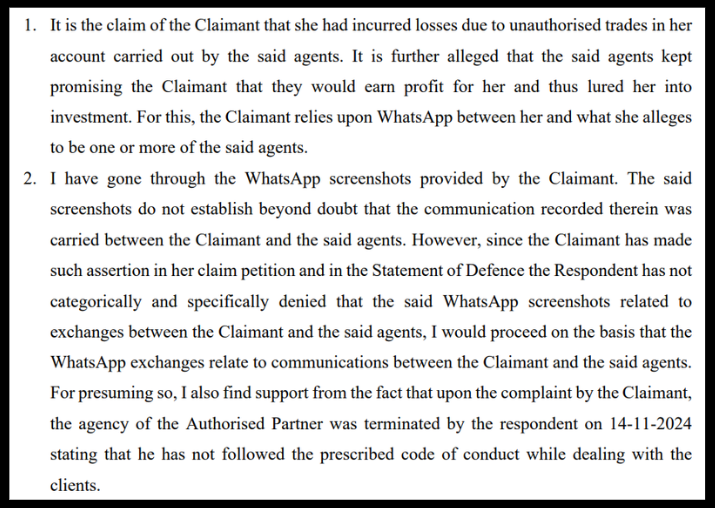
As losses began to rise, she questioned the agents. Their response remained consistent: “Don’t worry, we will recover the losses.”
This reassurance kept her invested longer, leading to:
- Continued trading activity.
- Further financial losses.
Financial Impact
By the time Renu filed a formal complaint in October 2024:
- Total claimed loss: ₹19,82,893
- Brokerage charged: ₹99,775
Meanwhile, Angel One terminated the authorised person’s contract in November 2024 for violating the prescribed code of conduct.
Arbitration Proceedings
The case was heard on May 23, 2025, via video conferencing by Sole Arbitrator Braj K. Mishra. The arbitrator examined multiple aspects of the case, focusing on both responsibility and misconduct.
Key Observations by the Arbitrator
The arbitrator’s analysis covered several important points:
- On the trades: Since Renu had herself provided the OTP to the agents, the arbitrator held that she had effectively authorised them to trade in her account. Trading losses resulting from authorised third-party access could not be fully attributed to Angel One as the broker.
- On the profit assurance: This is the part that matters most for our discussion. The arbitrator noted that the WhatsApp exchanges provided by Renu showed clear promises of profit being made by the agents.
Final Award
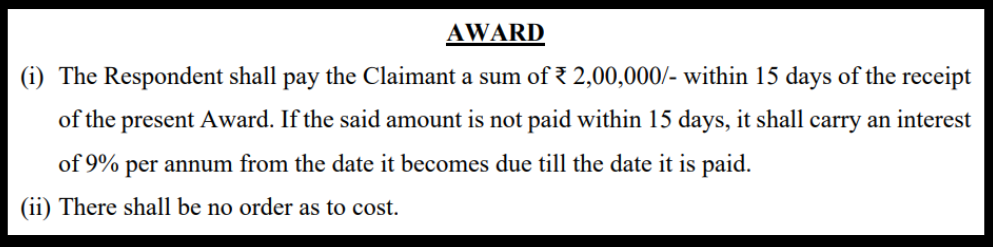
The arbitrator awarded Renu a compensation of ₹2,00,000 for the unfair trade practices adopted by Angel One’s authorised agents.
The claim for the full trading loss was rejected, primarily because she had shared her credentials voluntarily. However, the compensation for the return assurance and resultant unfair practices was upheld.
Key Takeaway for Investors
This case highlights a critical lesson:
- Never share your login credentials or OTP, no matter how trustworthy someone seems.
- Be cautious of profit-sharing or assured return arrangements.
- Always document communication; WhatsApp chats and messages can serve as strong evidence.
Even when losses cannot be fully recovered, unfair practices like guaranteed return promises can still lead to compensation.
2. The “Baap of Chart” Case
SEBI’s crackdown on Mohd Nasiruddin Ansari, popularly known as “Baap of Chart,” showed how return assurances are used as bait on a wider scale.
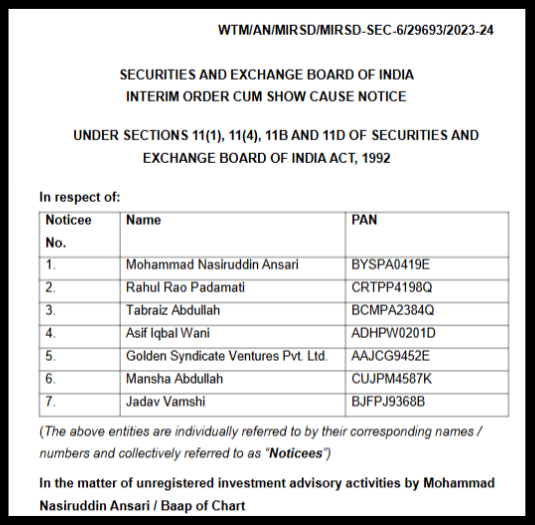
Ansari’s website boasted a proprietary algorithm claiming “95% profit accuracy” and promised profits “day after day, eliminating any chance of overall loss.”
What SEBI found in reality: Ansari had actually incurred personal trading losses of ₹2.89 crore between January 2021 and July 2023, the same period he was marketing these guarantees to investors.
SEBI banned him and seven others for one year and directed a refund of ₹17.2 crore to affected investors. The regulator’s language in this case was unambiguous: investors were misled, assurances were false, and the consequences were severe.


 Add us as a preferred source on Google »

