
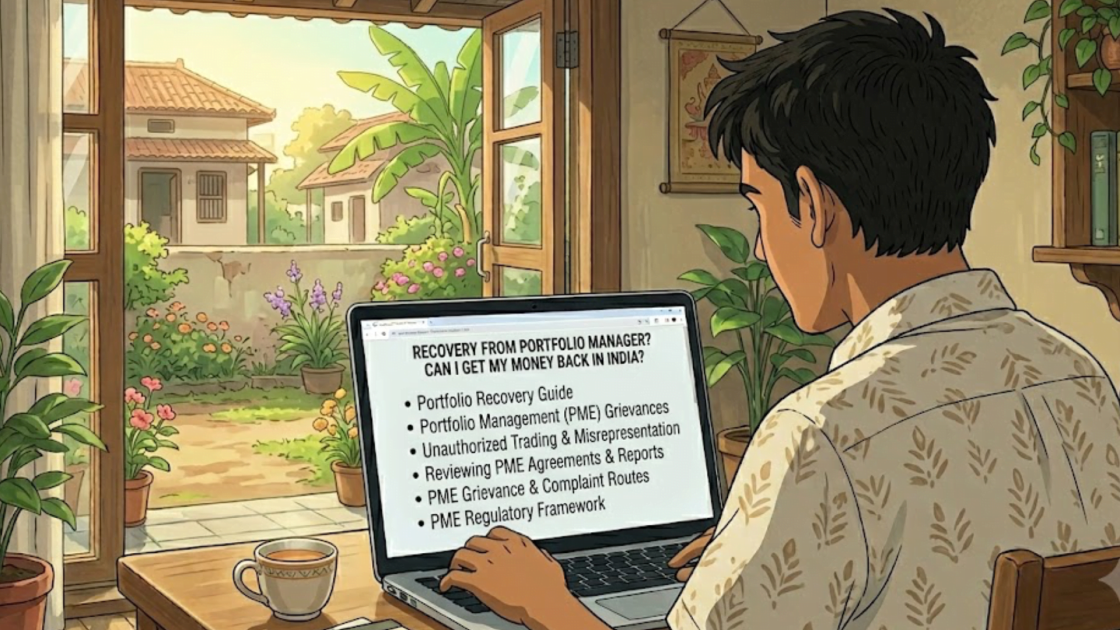
Vikram (name changed) trusted a portfolio manager because the presentation looked professional, the past performance looked attractive, and the relationship manager sounded confident.
But a few months later, his portfolio value fell sharply, the manager deducted fees, and the answers Vikram received confused him.
That is when he searched online: “Can I get my money back from a portfolio manager in India?”
If you are asking the same question, this blog will help you understand when recovery may be possible, what documents matter, and how you can take the next step before your case becomes harder to prove.
Can You Really Get Money Back From a Portfolio Manager?
Yes, recovery may be possible in certain cases, but not simply because your portfolio made losses.
Portfolio Management Services, or PMS, involve market risk. Even a SEBI-registered portfolio manager cannot guarantee profits or prevent every loss.
However, the situation becomes different if the loss or dispute is connected to issues such as misrepresentation, unauthorised trading activity, excessive risk, unclear fees, deviation from mandate, or failure to follow agreed terms.
So, the real question is not just, “Did I lose money?”
The better question is: Did the portfolio manager follow the rules, agreement, risk profile, and disclosures properly?
In India, a portfolio manager cannot impose a forced lock-in period on your capital.
Under the SEBI (Portfolio Managers) Regulations, 2020, the assets, whether held as equity shares, debt instruments, or mutual fund units, are held in a distinct demat account linked directly to your Permanent Account Number (PAN).
You remain the ultimate beneficial owner. However, getting that money back into your bank account involves navigating structural expenses that can erode your core returns if handled incorrectly.
When Can You Formally File a Complaint Against Portfolio Losses?
Let’s make this simple.
A normal market loss and a service-related dispute are not the same thing.
If your PMS portfolio went down because the market corrected, that alone may not be enough for recovery.
But if the portfolio manager acted outside the agreed mandate, failed to explain risks, charged fees differently from what was represented, or made decisions that did not match your risk profile, then the matter may deserve closer review.
This is where many investors make a mistake.
They wait too long, delete messages, ignore statements, and later struggle to prove what was promised.
You should seriously review your PMS documents if:
- The manager explained the investment strategy differently before onboarding.
- The actual portfolio risk was much higher than what you agreed to.
- The representative told you that returns were almost certain.
- The firm did not clearly explain fees, exit charges, or performance charges.
- The manager churned your portfolio frequently without providing clarity.
- The portfolio manager avoided written answers.
- The relationship manager pushed you to add more funds after losses.
- The portfolio manager did not follow your investment mandate.
- The firm did not send you proper reports or disclosures.
If any of these points sound familiar, pause and collect your records before taking the next step.
SCORES to Arbitration: How to Officially Challenge Your Portfolio Manager?
Portfolio managers in India are bound by a fiduciary duty to act in your best interest.
If they demonstrably acted against your interests, you can file a civil suit for damages in addition to regulatory complaints.
Understanding your rights is one thing, but having a clear, sequenced action plan is what actually moves the needle.
Here is the exact path on how to file complaint against portfolio managers:
Step 1: Review Your PMS Agreement and Reports
Start by checking what you signed, what fee structure was agreed upon, what risk category was selected, and what strategy was promised.
This helps separate normal market loss from a possible service-related dispute.
Step 2: Send a Written Complaint to the Portfolio Manager
Contact the portfolio manager through the official grievance email address. Provide a clear explanation of your problem, attach supporting documents, and request a written response from the PMS.
Step 3: File a Complaint with SCORES
If the portfolio manager does not resolve the issue properly, you may file a complaint through SEBI SCORES.
This creates an official complaint record against the registered intermediary.
Step 4: Lodge a Complaint with SMART ODR
If the dispute remains unresolved, investors may explore the SMART ODR mechanism.
This can help in online dispute resolution before moving to further legal or arbitration steps.
Step 5: Arbitration in the Stock Market
If the dispute involves serious financial loss, unresolved claims, or breach of agreed terms, arbitration or legal action may be considered depending on the PMS agreement and the facts of the case.
Case Study: When a ₹50 Lakh PMS Investment Fails Expectations
Let’s consider a case of Vikram, an investor.
A few years back, Vikram reached a significant milestone in his wealth and took the decision to invest ₹50 Lakhs in a Discretionary Portfolio Management Service, as per the regulatory requirement of SEBI.
He would be expecting custom allocations, top-tier risk management and smooth liquidity.
Rather, a fluctuating macroeconomic environment left him with his portfolio lagging behind simple index benchmarks.
At first, Vikram assumed the losses were simply part of investing.
Only later, after reviewing statements and fee disclosures, did he begin questioning whether the service delivered actually matched what had been discussed before onboarding.
So when Vikram decided to move out his money to another, more dynamic and transparent asset management partner, he encountered a thick wall of paperwork, complicated calculations, and unanticipated operational problems.
As with many investors, Vikram was asking the important question: “Is it really my money that I can take out anytime I want?”
Vikram is not alone. And critically, he had rights he never used.
Here is what SEBI mandates that every registered portfolio manager must deliver to you:
- A signed Portfolio Management Agreement before any funds are accepted.
- A detailed Disclosure Document covering fees, strategy, risks, and conflicts of interest.
- Monthly or quarterly performance statements are mandatory by regulation.
- Your assets held in your own Demat account are never pooled with other clients.
- Annual audited reports from a Chartered Accountant.
- A dedicated compliance officer you can directly approach.
- The right to exit at any time (though exit loads may apply).
If any of these obligations were not met, that is not just poor service.
Under SEBI (Portfolio Managers) Regulations 2020, last amended in February 2025, these are enforceable legal duties.
If you are questioning fees, portfolio activity, risk levels, or communication from your portfolio manager, preserve all agreements, statements, emails, and WhatsApp conversations immediately.
Early review of records often makes it easier to understand what options may be available.
Need Help?
Are you someone who invested through a portfolio manager and now feels confused about losses, fees, risk, or unclear communication?
Our team can help you review your PMS agreement, portfolio statements, fee details, WhatsApp chats, emails, and complaint options.
We help investors organise documents, understand grievance routes, prepare complaint drafts, and assess whether escalation through SCORES, SMART ODR, arbitration, or further legal action may be suitable.
Register with us and share your case details. We will respond within 24 hours.
The earlier you review your documents, the stronger your position may become.
Conclusion
You cannot claim money back from a portfolio manager only because the market moved against you.
You have grounds to seek recovery if the portfolio manager misrepresents the service, ignores your risk profile, charges unclear fees, or violates your agreement and mandate.
The first step is not to panic. The first step is documentation.
Collect your records, review the agreement, raise a written complaint, and follow the proper grievance process.
Frequently Asked Questions
1. Can a portfolio manager in India legally lock in my money?
Definitely not. It is against SEBI rules for portfolio managers to impose mandatory lock-in periods on investors’ money.
You always have the liberty to end your contract and ask for your money back; the only condition is that you will have to pay the exit loads as per the first disclosure document.
2. What is the minimum capital required to remain in a PMS during a partial withdrawal?
Under SEBI rules, the minimum investment threshold for a PMS account is ₹50 Lakhs.
If you opt for a partial withdrawal, the total market value of your remaining portfolio assets must not drop below this ₹50 Lakh line item.
3. What if my portfolio manager is not registered with SEBI?
Recovery depends on the facts, documentation, fee disclosures, and the nature of the representations made before onboarding.
Investors should preserve agreements, communications, and account statements for review.
4. Can I get my capital back in the form of shares rather than cash?
It is really called an in-specie transfer.
When you close your account, you give a go-ahead to your account manager to transfer your share certificates in physical form to your personal demat account, rather than the company selling shares in the market and you getting tax effects.





 Add us as a preferred source on Google »

