

Quick Summary
Stock Market Research and Services is a Guna, Madhya Pradesh-based sole proprietorship run by Vikash Sharma, offering intraday and options trading calls to retail traders. The firm states SEBI registration as a Research Analyst, though the exact registration number carries a discrepancy worth independently verifying before subscribing. Multiple online complaints describe delayed trade alerts, selective reporting of wins over losses, promised call volumes that weren’t delivered, and support issues during market hours. This blog covers the firm’s full profile, every documented complaint in detail, the regulatory framework these complaints fall under, and the exact process to file a formal complaint.
If you’ve been looking for stock tips and stumbled across Stock Market Research and Services, you’re definitely not alone.
With so many trading advisory services popping up, it’s easy to get overwhelmed. But before paying any analyst, traders should always ask a few important questions.
Is the entity SEBI registered? What services are actually being offered? And what are other traders saying online?
This blog walks through all three, in full, along with the exact regulatory framework these complaints fall under and how to escalate if you’ve experienced something similar.
Stock Market Research and Services Review
Stock Market Research and Services is a financial advisory firm operating under the sole proprietorship of Vikash Sharma, based in Guna, Madhya Pradesh.
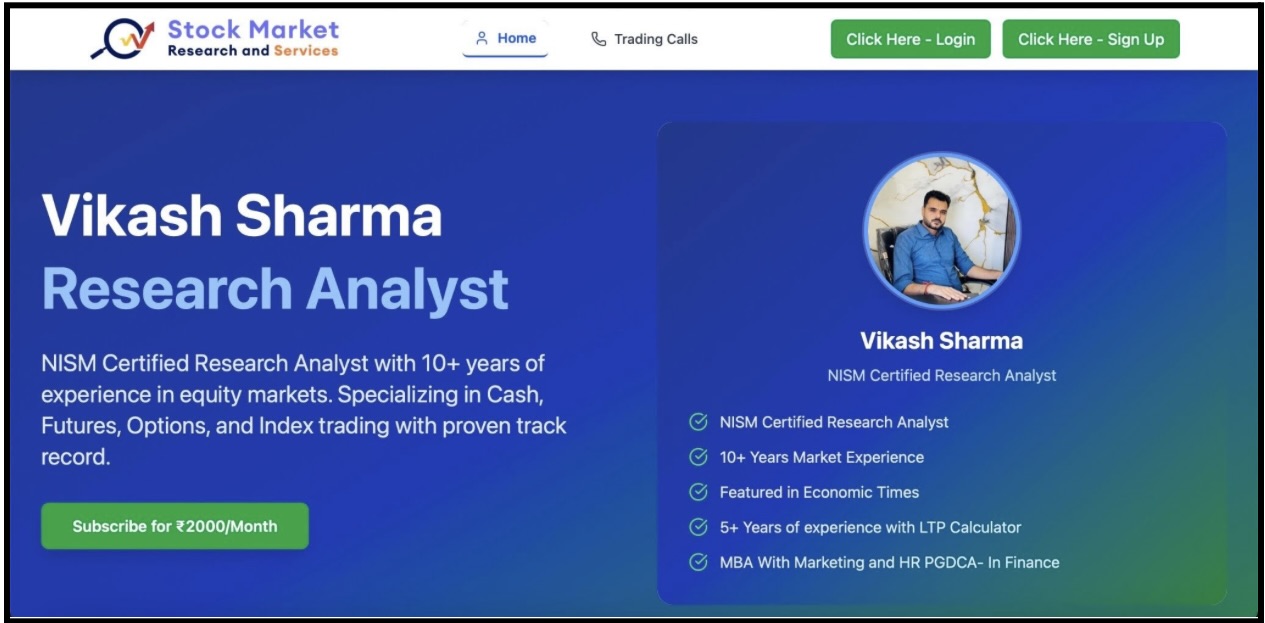
The entity primarily appears to provide market research, trading recommendations, and short-term trading calls for retail traders, with services largely focused on high-activity market segments like intraday trading, options trading, Nifty, and Bank Nifty strategies.
One detail worth understanding upfront: the firm’s grievance section lists Vikash Sharma as the compliance officer, CEO, and principal officer simultaneously.
In a larger, multi-person firm, these roles typically sit with different individuals specifically so the compliance function can check the business independently.
With one person holding all three, that internal separation doesn’t exist here, meaning any escalation you raise ultimately reaches the same person whose conduct the complaint may concern.
Firm Details
| Field | Details |
|---|---|
| Proprietor | Vikash Sharma |
| Entity Name | Stock Market Research & Services |
| Address | H.No. B-1, New Royal Residency, Shukla Colony, Guna, Madhya Pradesh – 473001 |
The firm appears to offer trade alerts, market analysis, and entry-exit recommendations through subscription-based services, targeted mainly at retail traders looking for ready-made market opportunities instead of conducting their own research.
What Services Does Stock Market Research and Services Offer?
The platform’s offerings center almost entirely on short-term, high-frequency trading segments rather than longer-term investment research.
- Intraday trading calls.
- Nifty and Bank Nifty recommendations.
- Options trading calls.
- Entry and exit signals.
- Short-term market analysis.
- Premium subscription plans.
Like many advisory firms in India, the platform is heavily focused on high-activity trading segments where traders are constantly entering and exiting positions during market hours.
This type of trading naturally carries very high risk, especially for beginners or traders operating with limited capital.
Is Stock Market Research and Services SEBI Registered?
Stock Market Research and Services operates under the sole proprietorship of Vikash Sharma, who states registration as a SEBI Research Analyst.

A discrepancy worth flagging directly before anything else: the registration number needs independent verification.
Confirm the exact, current registration number by checking SEBI registered company status directly on the regulator’s own intermediary database, searching by the proprietor’s name, the firm’s name, or the registration number itself, rather than relying on any single published source, including this one.
This should always be the first step before paying even a single rupee to any research or advisory service.
Traders should understand something very clearly: SEBI registration is not a guarantee of profits.
It simply means the entity is expected to follow compliance rules related to disclosures, communication standards, grievance handling, and conduct.
A registered entity can still receive complaints related to service quality, delayed communication, trading losses, or unrealistic expectations created during sales discussions.
Stock Market Research and Services Complaints
Multiple online reviews describe experiences with this platform, and reading them together reveals a consistent pattern rather than isolated, unrelated grievances.
We are reporting what these accounts describe. We have not independently verified these claims.
1. Delayed Trade Alerts and High Capital Requirements
Several reviewers described trading alerts arriving too late, well after the ideal entry window had already passed.
One account specifically stated that only one or two trades were actually received during the day, despite the firm reportedly promising five to six calls daily before payment, and that by the time alerts arrived, the trades were already running, leaving little room for a safe entry.
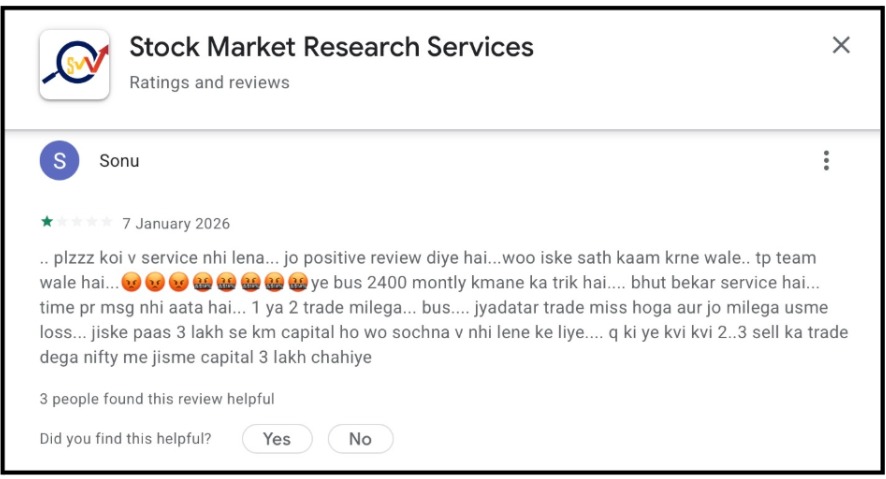
In fast-moving options and intraday trading, even a small delay can turn a potentially profitable setup into a losing trade, since the window for safe execution is extremely narrow.
The same reviews also mentioned that certain sell-side Nifty trades required capital of ₹3 lakh or more, a mismatch for retail traders who joined expecting lower-capital opportunities.
This combination, delayed information paired with capital requirements beyond what many subscribers actually have, compounds the risk considerably.
2. Selective Reporting of Wins Over Losses
Multiple reviewers described stop losses hitting frequently, with a specific communication pattern that made the experience worse: when trades hit their profit target, updates were shared quickly and visibly.
When stop-losses triggered instead, communication reportedly went quiet, with little acknowledgment or explanation afterward.
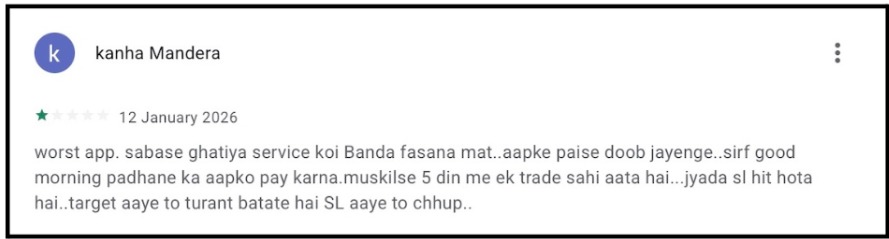
This selective communication is one of the most commonly discussed frustrations among retail traders evaluating advisory platforms in India.
Many traders describe feeling emotionally pressured when only profitable trades are highlighted publicly, while losses receive minimal transparency, creating a skewed impression of the service’s actual track record.
3. Promised Call Volumes Not Delivered
One reviewer specifically stated that the platform promised around five to six trading calls daily before payment was made.
According to the complaint, that promised volume never materialized after the subscription began, with the actual number and quality of calls falling well short of what was described during the sales process.
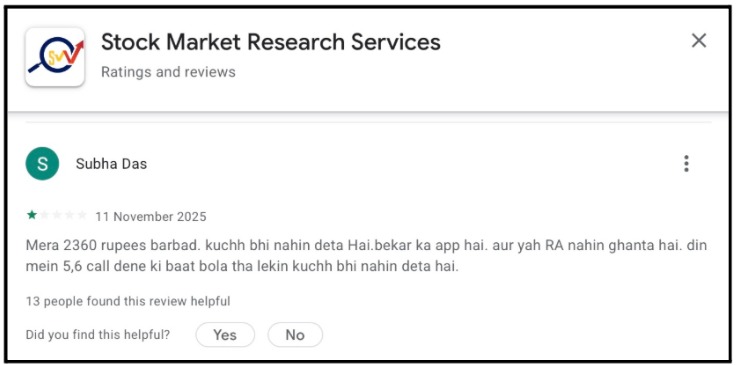
The reviewer also expressed frustration at paying subscription fees for a level of support that didn’t match onboarding expectations.
This gap between what’s promised before payment and what’s delivered afterward is a recurring pattern across the advisory industry generally, and it’s precisely the kind of discrepancy that becomes documentable and actionable in a formal complaint.
4. App and Support Issues During Market Hours
Other reviewers described app instability, repeated login problems requiring users to log back in multiple times, and customer support that became notably weaker precisely when it was needed most, during active market sessions.
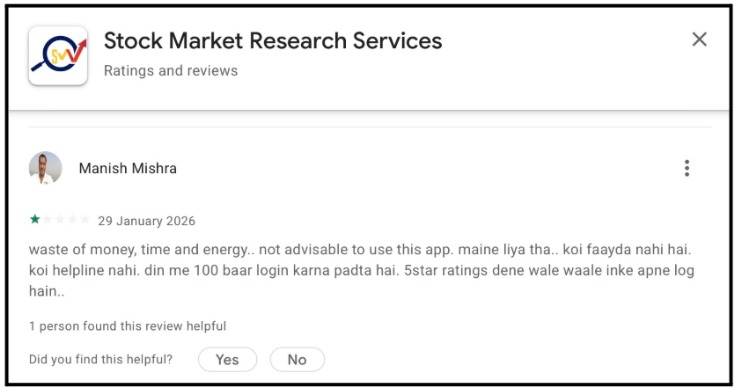
For a trader relying on real-time alerts and support to manage live positions, a support failure during market hours isn’t a minor inconvenience.
It can directly translate into missed exits, positions that can’t be closed in time, and real financial losses that trace directly back to a platform failure rather than a market movement.
Wondering if what happened to you is actually worth reporting?
We review your specific case against these exact regulatory categories and help you build a complaint that holds up.
What Do These Complaints Mean in Regulatory Terms?
The four complaints described above aren’t just negative reviews sitting in isolation. Together, they form a recognisable pattern, and that pattern is exactly what a formal complaint is built on.
- Delayed trade alerts that caused missed trades: When a service sells you on timely signals and consistently delivers them late, the gap between what was promised at subscription and what was actually delivered is documentable. That gap is the basis of a misleading representation complaint.
- Stop losses hitting more often than targets, while only winning trades were highlighted: Selective performance showcasing is a recognised concern under SEBI’s framework. If the platform promoted only profitable calls during marketing while losses were quietly absorbed by subscribers, that one-sided picture created unrealistic expectations before you ever paid.
- Promised call count never delivered after payment: If you were told you would receive five to six calls daily and consistently received fewer, that’s a specific, provable mismatch between what was sold and what was delivered. Subscription receipts, chat records, and daily trade logs together document this clearly.
- Poor support after payment: While this alone may not constitute a standalone regulatory violation, combined with the patterns above, it strengthens the overall picture of a service that prioritised subscription revenue over client outcomes.
None of these issues needs to be proven beyond doubt before you file. You file with what you have. The complaint process exists to examine exactly these kinds of disputes, and a well-organised record of even one of these issues is enough to start.
Red Flags to Watch Before Subscribing
Beyond the specific complaints already documented, several broader patterns are worth watching for with this platform or any similar advisory service.
1. Demo Trades and Profit Screenshots
One common tactic across the advisory industry is showcasing demo profits or selective winning trades to create an illusion of very high accuracy.
Sometimes traders only see the successful calls while losing trades remain invisible entirely.
This creates unrealistic expectations for beginners entering the market, particularly around whether a SEBI registered research analyst can give demo calls the way theirs are presented.
2. Loss Recovery Promises
No research analyst can legally guarantee recovery of trading losses.
Under SEBI regulations, promising fixed returns, assured profits, or guaranteed recovery is prohibited outright.
Still, many retail traders are emotionally influenced when sales teams indirectly suggest that earlier losses can easily be recovered through premium packages or upgraded plans.
3. Profit Assurance
Stock markets do not provide guaranteed outcomes.
Any platform creating expectations of “consistent monthly income,” “fixed daily profit,” or “high accuracy without risk” should immediately raise caution for retail traders.
Even experienced traders face losses regularly, and anyone promising otherwise is not being honest about how markets actually work.
4. Selective Sharing of Past Performance
Another major concern in the advisory industry is the selective display of past performance, where only profitable trades, targets achieved, or successful screenshots are highlighted publicly.
Trading performance should always include the full picture, since a research analyst showing past performance selectively, while leaving out risk, drawdowns, and stop-loss frequency, distorts what the record actually shows.
5. Pushing Clients Toward High-Risk Trading
A very common issue in the advisory space is excessive focus on high-volatility derivatives trading, including Bank Nifty options, Nifty options, option selling, and leveraged intraday trades.
These segments can wipe out small trading accounts very quickly, and retail traders with low capital and low risk tolerance should never be aggressively pushed into strategies this aggressive, particularly where a SEBI research analyst gives trades without stop loss as a standard practice.
How to File a Complaint Against a Research Analyst?
If you face misleading communication, poor service, or heavy losses after joining an advisory platform, proper documentation becomes very important at every stage of the process.
1. Save Every Proof
Keep all payment receipts, WhatsApp chats, Telegram messages, screenshots of recommendations, emails, and bank transaction records safely organised.
These records become very important during complaint proceedings, and gathering them early is far easier than reconstructing them later.
2. Send a Written Complaint to the Company
Before escalating the matter, first send a proper written complaint directly to the company.
Clearly mention the service purchased, the amount paid, the issues faced, and the resolution you expect, and always keep copies of all communication.
3. File a Complaint With SCORES
If the issue remains unresolved, file a complaint through the SEBI SCORES portal.
Attach all supporting documents and explain the issue properly while filing, since a structured complaint with proper proof usually carries more value than emotional allegations without evidence.
4. Lodge a Complaint With SMART ODR
Investors can also use SEBI’s SMART ODR login platform for online dispute resolution, which helps investors and intermediaries resolve disputes through mediation and conciliation in a structured manner.
5. Pursue Share Market Arbitration
If the financial loss is large and proper evidence is available, investors may also explore share market arbitration proceedings where applicable.
Arbitration may become important in cases involving large financial losses or serious disputes related to advisory services, and organising all records properly beforehand matters considerably at this stage.
For the complete process specific to a Research Analyst, our guide on complaint against SEBI registered research analyst covers every stage in additional depth.
Legal Disclaimer: The reviews mentioned in this blog have been collected from publicly available online sources and represent the personal experiences and opinions of individual users. They have not been independently verified, endorsed, or approved by SEBI or any other regulatory authority.
Conclusion
Stock Market Research and Services presents itself as a structured advisory operation with a stated SEBI registration, but the specifics deserve real scrutiny before you pay anything.
The registration number itself carries a discrepancy worth independently verifying, one person holds every accountability role in the firm at once, and multiple documented complaints describe delayed alerts, selective loss reporting, undelivered call promises, and support failures during exactly the moments traders need it most.
If you’ve experienced issues like the ones covered here, delayed trade alerts, unexpected losses, or poor support, remember that you have rights as an investor.
Don’t just sit with frustration or accept bad service.
Your subscription receipt and chat records are enough to start a formal complaint, and that evidence only gets harder to gather the longer you wait.
Report. Recover. Stay Fraud Free.
Frequently Asked Questions
Yes. The number of calls promised before subscription is a specific, verifiable commitment. If your chat records or promotional material show that promise and your actual trade logs show fewer calls delivered, that gap is documentable evidence worth including directly in your complaint.
It does. Selectively showcasing only profitable calls while losses remain undisclosed is a misleading marketing practice. If what you saw before subscribing was a one-sided performance record, and your actual experience was significantly different, that contrast is relevant and worth including.
A SEBI-registered research analyst is expected to understand client suitability. If recommendations were consistently unsuitable for your capital size and that mismatch was never disclosed before subscription, raise it specifically, including your subscription amount, your actual capital, and examples of recommendations requiring capital beyond your capacity.
No. SEBI rules strictly prohibit registered research analysts from charging performance-linked or profit-sharing fees. If any representative demands a cut of your trading profits, that's a major regulatory violation worth reporting on its own.
If your initial written complaint goes ignored or receives an unsatisfactory response, don't delay escalating. Gather all evidence of promised versus actual performance and file a formal grievance on the SEBI SCORES portal or the SMART ODR platform to initiate a structured dispute resolution process.
You can note it as context, but it shouldn't be the centre of your complaint. Focus on what you personally experienced and can document, payment records, chat logs, trade alerts received versus promised, and losses incurred, since your own documented experience carries far more weight than disputing someone else's review.





 Add us as a preferred source on Google »

