
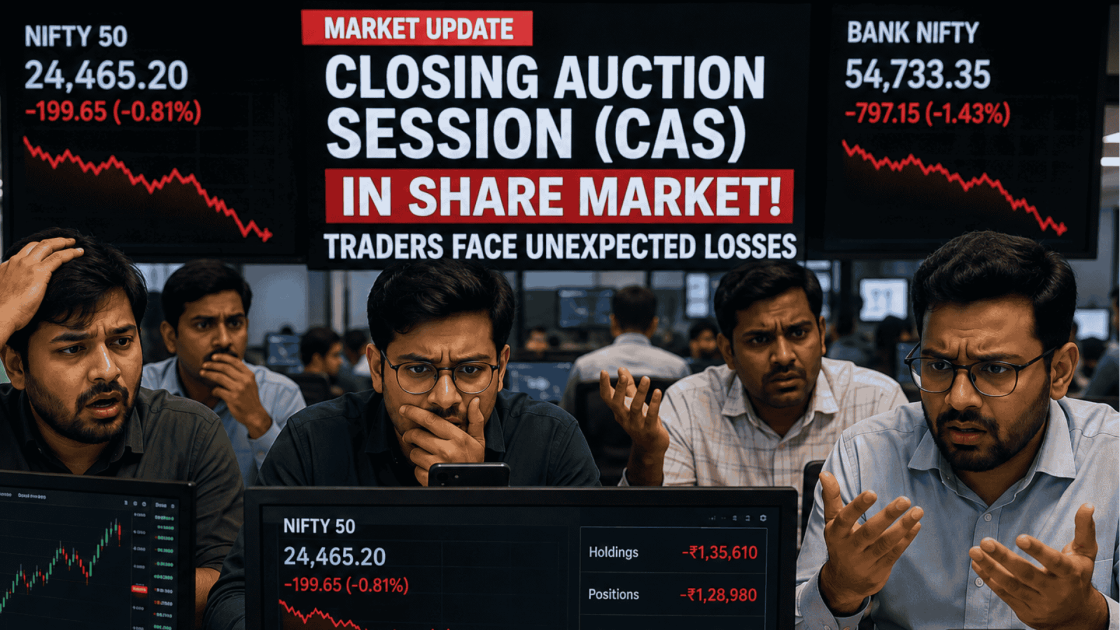
On 3 August 2026, the way India’s stock market closes changed. On 4 August, the second day, there was an expiry.
A trader recorded his screen that afternoon. The market was moving in his favour, and his loss was going up, and he could not work out why. He was not the only one.
That day the Nifty’s final five-minute candle came in at around 200 points, against a daily average of under 14. Zerodha Varsity pulled that data.
None of this was a surprise that arrived from nowhere. The Closing Auction Session went through two consultation papers, a SEBI circular, four NSE circulars and mock trading sessions.
Twenty months of paperwork. The idea itself reached a SEBI board meeting agenda as far back as 8 March 2013, and sat there for eleven years.
So the question is not whether anyone thought about this. Plenty of people thought about it for a long time.
The question is what the public was shown, what actually went live, and who was asked in between.
What Is CAS?
Until 2 August, the closing price of a stock was the volume-weighted average of every trade between 3:00 and 3:30 pm. Half an hour, thousands of trades, all averaged.
If somebody pushed a large trade through at 3:29, the closing price barely moved, because that trade was a small part of a large average.
From 3 August, for every stock that has F&O contracts on it, continuous trading stops at 3:15. Orders then collect for twenty minutes without any trade taking place.
At the end, the exchange finds the single price at which the maximum number of shares can be matched, and that becomes the closing price.
One number, from one order book, at one moment.
This is not a bad idea. Most large markets do it. India was the last major market still using VWAP.
The auction concentrates liquidity, gives index funds a real price to transact at, and reduces the tracking error that eventually comes out of a unit holder’s pocket.
The problem is not the auction. The problem is everything that was left around it.
Also Read: Harikanta Overseas IPO, why post-listing selling pressure so often follows a rushed fill.
Consulted Design Vs LIVE Design of CAS
SEBI’s second consultation paper came out on 22 August 2025. Comments closed on 12 September 2025. The final circular came on 16 January 2026, four months later.
Three things changed in between. All three moved in the same direction.
|
Consultation paper, 22 Aug 2025 |
Final circular, 16 Jan 2026 |
|
|
Index derivatives close |
“The close time of index derivatives i.e., 3:30 pm on all the days, remains unchanged“ |
“The equity derivatives segment shall continue to operate up to 3:40 pm on all trading days” (clause 4.2.3) |
|
Stock derivatives on expiry day |
Near-month contracts to expire at 3:35 pm, so participants could offset sudden price moves and manage physical delivery risk (para 11.7) | No such provision. Everything runs to 3:40 |
| Carried-over limit orders | Not modifiable, only cancellable, on stated market-integrity grounds (para 15) |
Modifiable (clause 4.8.3) |
Read the first row again, because it is the one that matters.
In the design that was put out for public comment, your index option stopped trading at 3:30. The auction produced the closing price at around the same time. You were never holding a live contract against a price you could not see forming.
In the design that went live, your expiring option trades right through the auction, and for five minutes after it.
That is a ten-minute change. It is also the entire problem that traders ran into on 4 August. And it was made after the comment window closed.
PTI reported the 3:30 position on 23 August 2025, so this is not a reading unique to me. It was in the papers at the time.
Behind the Scenes: Who Was Actually Consulted?
Clause 3 of the final circular says the design took into account public comments plus “subsequent feedback received from various stakeholders including the Stock Exchanges, Clearing Corporations, Mutual Funds and FPIs.”
|
Named in the circular as having given feedback |
Not named |
|
Stock Exchanges |
|
|
Clearing Corporations |
Retail Trader: The person holding an expiring index option at 3:20 pm |
| Mutual Funds | |
|
Foreign Portfolio Investors |
The consultation paper carried thirteen proposals. Thirteen questions were put to the public. Not one of them asked how an option would be priced during the auction window.
Proposal 12 did ask whether passive mutual funds should be allowed to borrow overnight, so they could participate in CAS comfortably. A regulation was considered for relaxation, for one constituency.
Worth remembering that when this idea first reached SEBI’s board in 2013, the stated purpose was to stop manipulation of the closing price on expiry day.
Thirteen years later, it arrived with the expiring contract still trading inside the window where that price is formed.
The Blooper: A Number That Exists and Does Not Reach the Trader
This is the part that is still not fixed, and still not in any document.
During CAS, there are two Nifty values, and NSE’s own circular says so.
The one on your screen. Clause 6.5.2.2 of NSE circular 73362: during CAS, the actual index is computed using the last traded price of the continuous session.
That is the 3:15 print. It does not move after that. By design.
The one that matters. Clause 6.5.3.2: the indicative index close is computed from each stock’s live auction equilibrium price. It updates continuously through the twenty minutes, and it is the number that tells you where the settlement is heading.
Both exist. Both are computed. NSE is required to disseminate both.
Now look at where the second one goes. NSE circular 74466, dated 29 May 2026, lists what gets disseminated during CAS. The column heading is NEAT Trading Terminal. Indicative Index: Yes.
NEAT is the dealer terminal at a broker’s desk. It is not the app on your phone.
And in no document, not the consultation paper, not the SEBI circular, not any NSE circular, is there a line requiring the broker to pass that number on to you?
So the chain was complete right up to the broker, and stopped there. Nobody’s written any obligations. Nobody was assigned any job to check before go-live.
It was just allowed to be launched, as is.
On 5 August, BSE asked brokers to prominently display indicative equilibrium prices of stocks and indices on trading platforms and mobile apps.
On 6 August, SEBI called the country’s largest brokers in to ask why those prices were not showing on several apps, and whether investors had been told properly before launch.
Both are the right questions. Both are three days late.
Moneycontrol’s report on that meeting contains the line that sums the whole thing up: exchanges advised participants to track indicative prices on their websites, while most traders rely on broker applications, and limited availability on some platforms made it difficult to understand how the closing price was evolving.
A number that lives on a website is not a number a trader can use while a position is open.
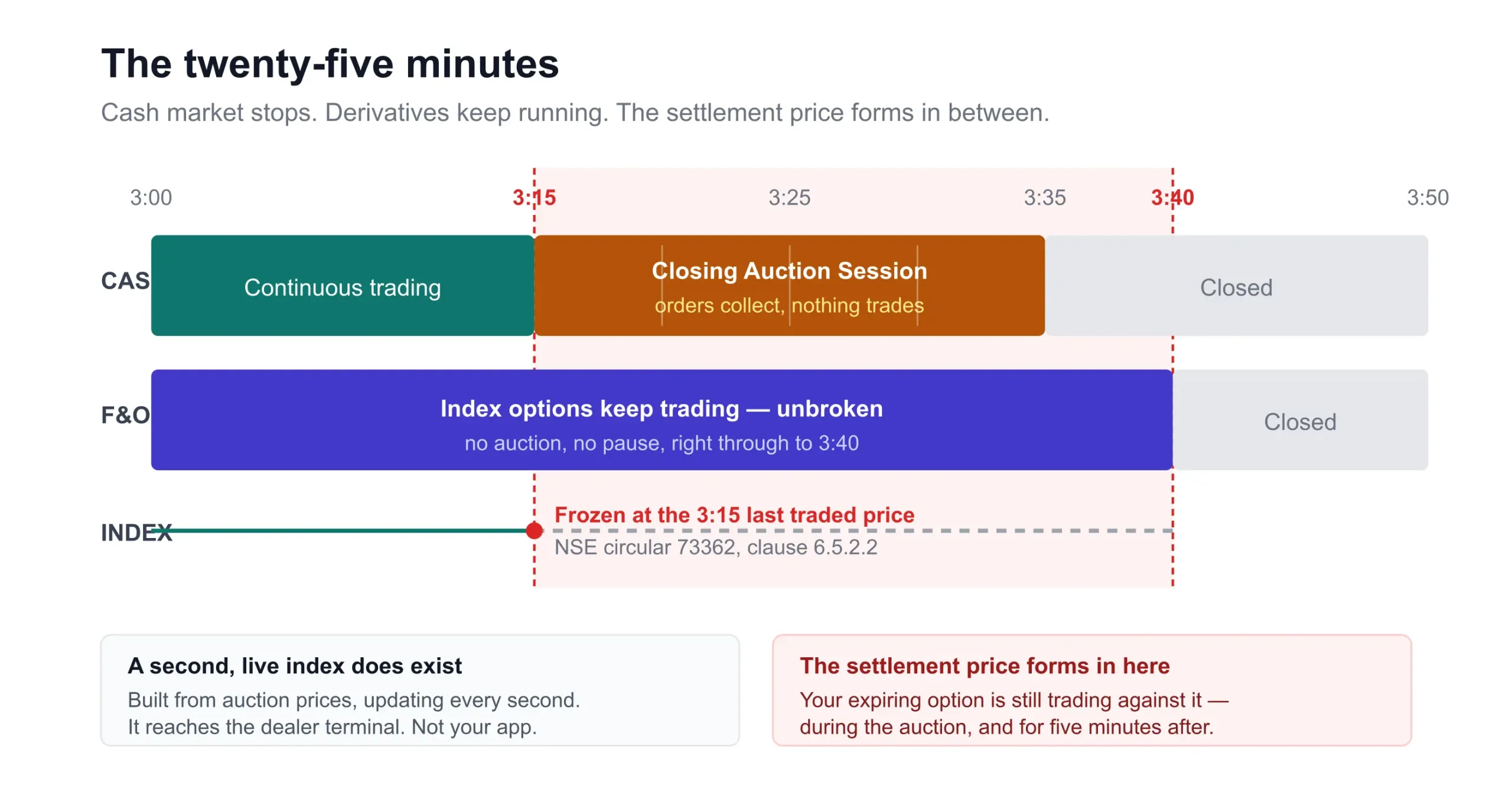
And it is not just the index. Your P&L, your payoff table, your delta, your theta, your IV – all of it is computed off spot. Spot has been stale for twenty minutes.
So every number on your screen in that window is derived from a dead input, with nothing on the screen telling you so.
What Else Gets Turned Off During the Auction?
None of this is hidden. It is all in the circulars. It has just not been discussed much.
|
What |
Status during CAS | Where it says so |
| Market Price Protection – stops your market order filling at an absurd price | Not applicable |
NSE 74466, section K1 |
|
Stop loss orders |
Not carried into the auction. Cancelled | SEBI circular 4.8.1 |
| Price band on stock futures, 3:15 to 3:40 | ±3% applied |
NSE 73362, clause 3.2.1.1 |
|
Price band on options |
No change in methodology | NSE 73362, clause 3.2.2.1 |
| Algo market orders, previously barred by three separate risk circulars | Permitted, no penalty |
NSE 74466, clause 4.4.2 |
|
Order execution priority |
Market orders ahead of limit orders |
SEBI circular 4.7.1 |
Put four of those rows together and look at what they describe.
In a session where market orders execute ahead of limit orders, where algos may now place market orders, where the safeguard against a bad market-order fill has been switched off, and where your stop loss does not exist, that is the window retail is being encouraged to participate in.
Futures were fenced with a price band for exactly that period. Options, the instrument carrying all the settlement uncertainty, were left as they were.
Why Option Premiums Suddenly Stopped Behaving?
Expiry day used to be simple for an option seller. Time passes, premium decays, you keep the difference.
That worked because the old closing price was a thirty-minute average.
By 3:15, half the settlement window was already in the books and locked. Only fifteen minutes of uncertainty remained, and it kept shrinking.
Now nothing is locked at 3:15. The entire closing price will come from an auction that has not started yet.
So the last twenty minutes stopped being time risk and became gap risk. And theta does not price a gap. Theta only prices time.
That is why premiums did not decay the way everyone expected on 4 August. Sellers were being asked to hold auction risk while being paid for time.
Here is what that looked like on the day.
CAS moved the Nifty from around 24,465 to 24,615, and the 24,400 call went from ₹97 to ₹217 purely because its intrinsic value changed.
|
Date |
Nifty at 3:15 | Official close |
Moved in the auction |
|
3 Aug 2026 |
~24,573 | 24,774 | ~200 points |
| 4 Aug 2026 (expiry) | ~24,465 | 24,615 |
~150 points |
Both of those moves happened in twenty minutes during which nothing on a retail screen was updating.
How Do Other Global Markets Handle Expiry Day?
The fair question is whether this is just how closing auctions work. It is not.
Ask every market the same single question: on expiry day, when does the contract that is expiring stop trading?
|
Does continuous trading stop for the auction? |
Expiring contract stops at |
Expiry settlement comes from |
|
|
America |
No. Runs to 4:00, auction executes at 4:00 | 4:00, the moment the close is struck. Non-expiring contracts run to 4:15 | Closing price (weeklies); opening price (monthly SPX) |
| Germany | Yes, intraday auction at 13:00 | At the start of that auction – Eurex’s own wording |
The 13:00 intraday auction, not the close. A separate contract exists for anyone wanting the close |
|
Hong Kong |
Auction runs 16:00–16:10, after continuous trading ends | 16:00 on expiry day. Normal days were extended; expiry days were not | 66 index readings across the day. The auction affects one of them |
| India | Yes, 3:15–3:35 | 3:40, twenty-five minutes after the auction began, five minutes after the close is known |
The auction closes. 100% of it |
Every market on that list stops the expiring contract before, or exactly when, its own settlement price is formed. India is the only one where it keeps trading past the moment.
Hong Kong is the one worth sitting with. They launched a closing auction in 2008.
In March 2009, HSBC fell about 11% in the final seconds of the auction and dragged the Hang Seng with it. The exchange suspended CAS on 23 March 2009.
They brought it back on 25 July 2016. Seven years later. In phases, with a second phase about a year after the first.
They excluded structured products at first. They released market makers from their obligations during the auction. They tightened the price limit in the final minutes rather than keeping it flat.
And there is one more thing they did, which is the sharpest fact in this whole comparison. Hong Kong’s expiry settlement is an average of 66 index readings taken across the trading day.
When CAS came in, they changed exactly one of them – the last. One reading out of 66.
Ours is one out of one.
A Tale of Two Approaches: Adding Time vs. Cutting It Short
| What happened to the trading day | |
| Hong Kong |
Extended by 10 minutes. Continuous trading still ends at 16:00; the auction was added after |
|
America |
Nothing halted. Continuous trading runs to 4:00 alongside the auction |
| India |
Continuous trading cut from 3:30 to 3:15. Fifteen minutes of live trading removed |
There is a design point buried in the American row that was never put to the public here.
Both Indian consultation papers proposed a halt-based auction, a separate session where trading stops. The December 2024 and August 2025 versions differ only on timing and bandwidth.
There is a second architecture.
In the US, the auction is an overlay. On-close orders collect through the day, continuous trading never stops, and the cross executes at the close. Nothing freezes, so there is no window in which the index is stale.
Nobody in India was asked to choose between the two. Only one was ever on the table.
Is CAS Settling Down?
You will have seen the reporting this week that the gap between the pre-CAS and post-CAS closing level has narrowed sharply, and that markets are adapting.
The numbers quoted are roughly 185, 152, 55 and 8 points across 3, 4, 5 and 6 August.
Two things about that.
First, two of those four days were expiry days and the series does not separate them. Four data points that mix structurally different days are not a trend.
Second, and more important: an auction’s failure does not show up on quiet days. Hong Kong’s ran for ten months before HSBC.
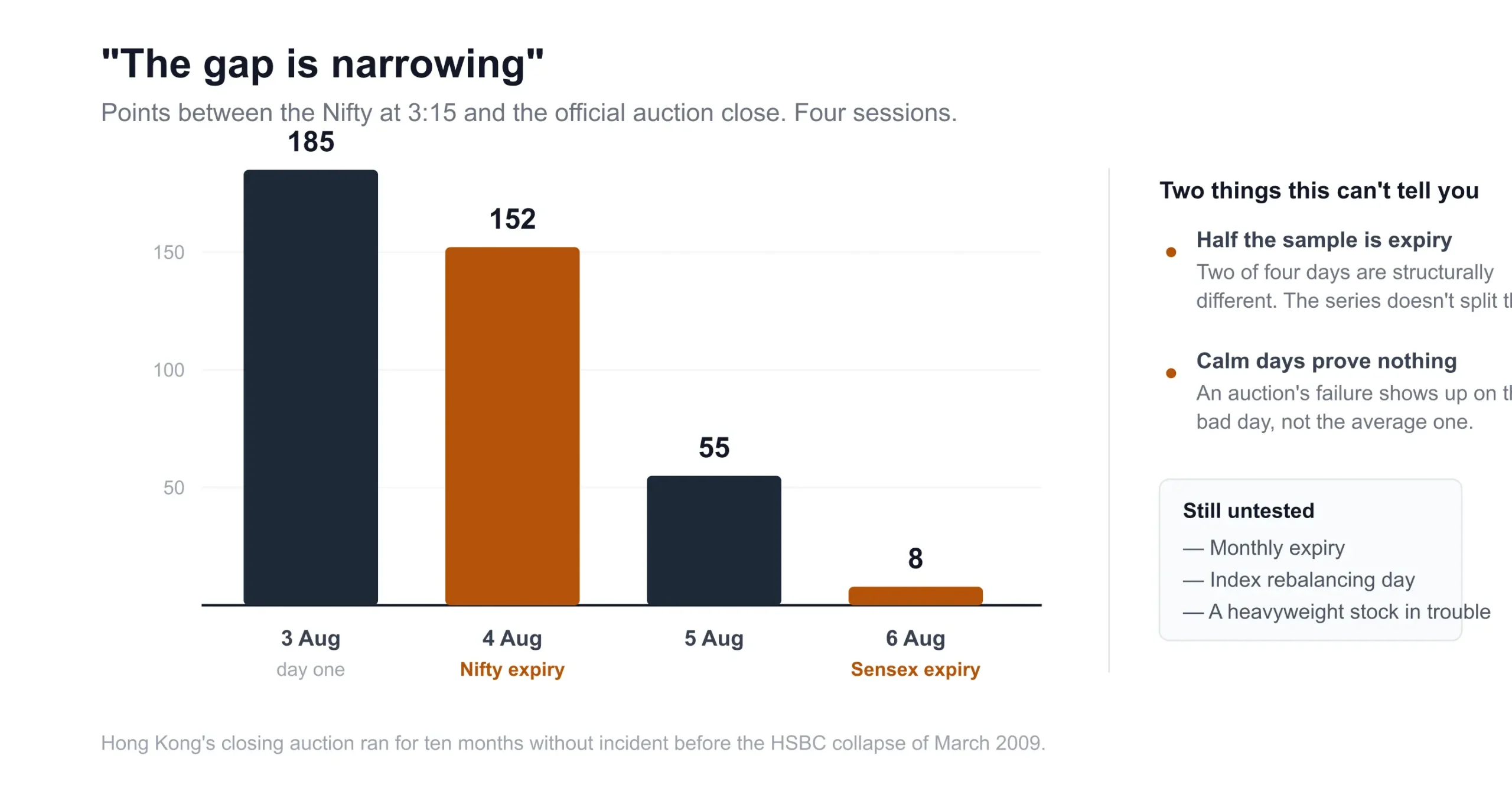
The real test is a monthly expiry, an index rebalancing day, or a day when a heavily weighted stock is in trouble. None of those has happened yet.
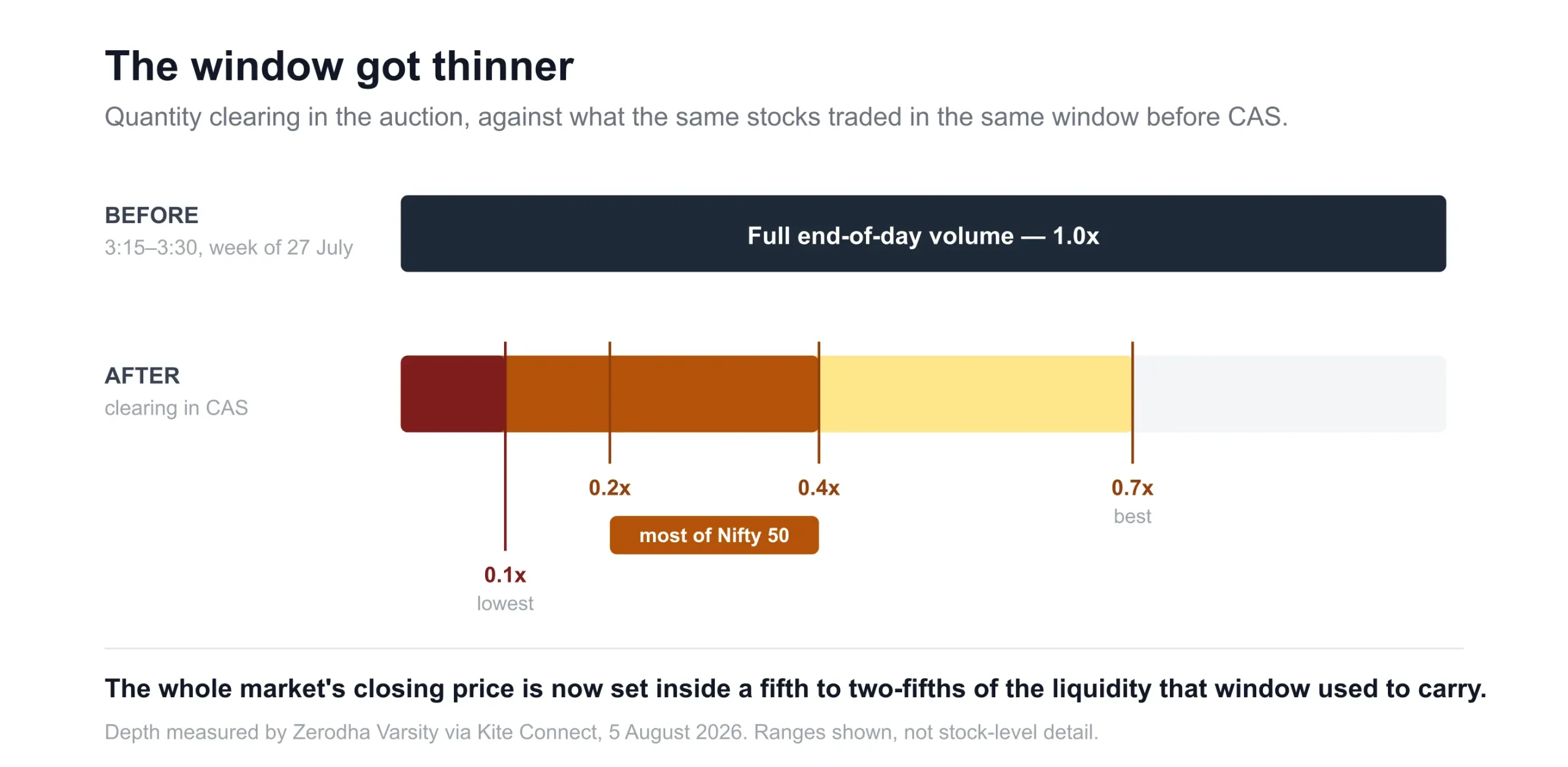
Meanwhile, here is the number nobody is discussing. Zerodha Varsity compared the quantity clearing in CAS against what the same stocks traded between 3:15 and 3:30 in the week before launch.
Grasim came in highest at 0.7x. Most of the Nifty 50 sat between 0.2x and 0.4x. Jio Financial and Eternal were at 0.1x.
So the window that used to carry the full weight of end-of-day trading is now clearing a fifth to two-fifths of it. And the entire market’s closing price is being set inside that.
Why Every Auction Needs Buyers AND Sellers?
An auction only works when both sides show up.
Buyers, sellers, and in between them the people who close gaps for a living, arbitrageurs and market makers.
If cash moves and futures don’t, somebody arrives and flattens the difference. If NSE prints one price and BSE another, somebody arrives and flattens that too.
That is the machinery a closing auction runs on. So look at whether we have it.
A buyer can walk into the auction with nothing but money. A seller needs shares in hand.
Naked short selling is not permitted here; securities lending is neither deep nor easy to use, and anyone who already holds the stock had the whole day to sell it; there is no reason to wait for the auction.
Demand arrives freely. Supply arrives with friction. Which is one reason the auction has a tendency to float upward.
Then there is who is even in the market on a given day. India has 13 crore registered investors.
On any single day, 20 to 30 lakh are actually trading.
And in April 2026, STT on futures went to 0.05% of full contract value while options stayed taxed on premium alone, which made futures arbitrage more expensive at precisely the moment we introduced a mechanism that depends on arbitrage working.
Nithin Kamath’s argument is that CAS did not create these problems. It exposed them.
He is right about all of it. But it stops one step short.
Depth explains why the auction is thin. It does not explain why the expiring contract was left trading inside it. One is a condition of the market
. The other is a decision somebody took, and no amount of participation will undo it.
Every market that runs a healthy closing auction built the prerequisites first: usable short selling, a working securities lending market, and liquidity providers with real obligations inside the auction.
We have none of the three. The roof went on before the walls.
How to Make CAS Actually Work for Traders?
Six things that would not require rolling anything back:
- The expiring contract stops when the auction that settles it begins. Germany does this. America does this. Nothing else about CAS needs to change.
- The indicative index reaches the app, not just the terminal. This number already exists and is already being computed. It just stops one step short.
- When spot is stale, the app says so. P&L, payoff, and Greeks should carry a flag rather than presenting dead numbers as live ones.
- Options get a price band for 3:15 to 3:40, the same way futures did.
- Market Price Protection stays on during the auction.
- Expiry days excluded from CAS for the first quarter.
One thing to be clear about, because the second item is not a solution.
The indicative index is a real number, but look at what it comes out of. A book clearing a fifth to two-fifths of the volume that window used to carry.
Market orders executing ahead of limit orders. Algos now permitted to place them. No Market Price Protection running.
Early in the session it rests on very few orders, and the session ends at a random moment between 3:28 and 3:30, so the last number you saw is not necessarily near the last number that counted.
Putting that on your screen will not make those twenty minutes comfortable. It will make them visible.
And that is exactly the point. If a number that thin is deciding where settlement lands, the answer is not to keep it hidden from the people it settles against.
The answer is to stop asking a retail trader to hold a position against it at all.
Which is why the first item on that list matters more than the second.
And one wider point. A settlement price does not have to be the closing price. Hong Kong spreads it across 66 readings. Europe settles its main index options on a midday average. Germany uses a 13:00 auction and built a separate contract for anyone who wanted the close.
The cash market needed a better closing price.
The derivatives market needed a robust settlement price. Those are two different problems. India solved them with one number, in one clause, and nothing required that.
One suggestion nobody has made. Run CAS in shadow for three to six months.
The auction happens, the equilibrium price is computed and published daily next to the VWAP close, and the VWAP close stays official.
Everyone would see the divergence in real conditions, through a monthly expiry and a rebalancing day, with nothing at stake. Brokers would have a live number to build the display around.
SEBI would have months of data on depth and tracking error before anything became binding.
It costs nothing. It risks nothing. It is ordinary practice when you migrate a system that people’s money runs through. Mock sessions were meant to approximate it, but mock sessions have no real orders in them.
The One Number That Would Settle This
CAS was brought in to reduce tracking error for index funds. That is SEBI’s own stated objective, written in the consultation paper.
Tracking error is measurable. It was measurable before 3 August, and it is measurable now.
So publish it. Before and after.
If it has improved meaningfully, the cost had a purpose, and we will say so publicly in as much detail as this piece.
And if it has not, then the question stands: those twenty minutes are for whom?
Sources:
SEBI consultation paper dated 22 August 2025.
SEBI circular HO/47/11/11(3)2025-MRD-POD2/I/2765/2026 dated 16 January 2026.
NSE circulars NSE/CMTR/73362 dated 18 March 2026 and
NSE/CMTR/74466 dated 29 May 2026.
Cboe SPX Options and Eurex FDAX contract specifications.
HKEX published trading mechanism for CAS.
Every claim above traces to one of these.





 Add us as a preferred source on Google »

