

Quick Summary
Chandel Street Capital is an individual SEBI-registered Research Analyst practice run by proprietor Mayank Singh Chandel, under registration number INH000013350, effective October 12, 2023, from Anuppur, Madhya Pradesh. Its own pricing collects advance fees well beyond the one-quarter cap its own MITC states, and its flagship Elite plan works out to between ₹2,50,000 and ₹3,00,000 a year once annualised, against SEBI’s ₹1,51,000 cap. Its complaint history is genuinely light, but the disclosure table has a real gap around the exact month it is meant to report on. This guide covers the registration, pricing, marketing claims, privacy policy, complaint data, and its Telegram funnel in full.
Mayank Singh Chandel runs Chandel Street Capital as a systematic, technical-analysis-led research practice covering equity, index options, stock options, and commodities, aimed at retail traders, HNIs, and family offices.
The moment you open the website, a Telegram sign-up pop-up appears before you have read a single line of content, and a WhatsApp chat widget sits on every page throughout.
This review works through the registration, the actual pricing against SEBI’s advance-fee and annual-fee rules, the marketing language, the privacy policy, and the complaint disclosures, point by point.
Is Chandel Street Capital SEBI Registered?
Yes. Mayank Singh Chandel operates Chandel Street Capital as its Proprietor, registered with SEBI as an Individual Research Analyst under registration number INH000013350, effective October 12, 2023, on a perpetual validity basis, and also holds BSE Enlistment Number 5886.
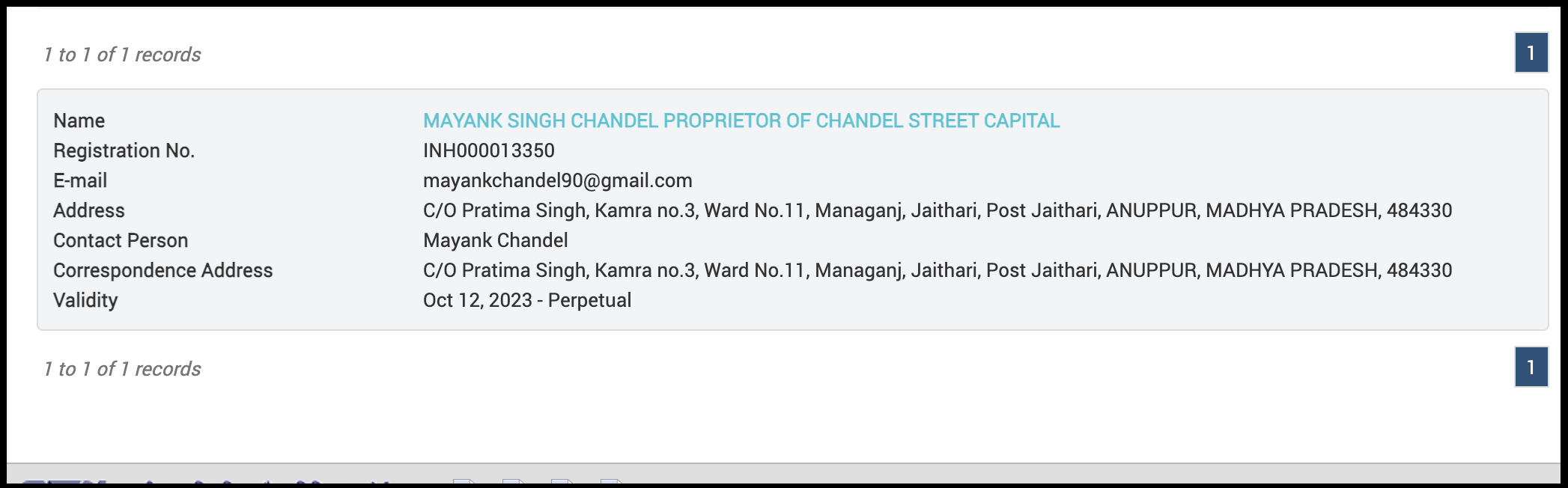
One detail worth flagging directly: SEBI’s own registration record does not carry an explicit “status” label the way some other RA records do, showing only the validity date range.
This is not unusual for an individual registration, but it means confirming active status rests on reading that validity range correctly rather than a single clear status field.
The registered office is listed care of Pratima Singh, which is common for individual RA registrations run from a residential or family address rather than a dedicated commercial office.
Also Read: Gokul Chhabra, a Saharanpur registration, verified against public filings.
What Does Chandel Street Capital Charge, and Does It Exceed SEBI’s Fee Cap?
Chandel Street Capital runs three pricing tiers, each billed monthly, quarterly, or half-yearly, with GST added on top of every listed price.
| Service | Monthly | Quarterly | Half-Yearly |
|---|---|---|---|
| Equity Service | ₹10,000 | ₹25,000 | ₹40,000 |
| Index Option (Derivatives) | ₹10,000 | ₹25,000 | ₹45,000 |
| Elite, All Asset Pro (Equity + Derivatives + Commodity) | ₹25,000 | ₹70,000 | ₹1,25,000 |
SEBI caps Research Analyst advisory fees at ₹1,51,000 per client family per year.
The single-service plans stay under that cap even at the half-yearly rate. Equity or Index Option alone, taken at ₹40,000 to ₹45,000 every six months, annualises to roughly ₹80,000 to ₹90,000, comfortably below the ceiling.
The Elite, All Asset Pro plan is a different picture entirely, and breaches the cap on every single billing cycle once annualised.
- Monthly at ₹25,000 works out to ₹3,00,000 a year.
- Quarterly at ₹70,000 works out to ₹2,80,000 a year.
- Half-Yearly at ₹1,25,000 works out to ₹2,50,000 a year.
Every one of these figures sits well above the ₹1,51,000 cap, in some cases by nearly double.
There is also a second path to the same problem: a client who instead subscribes to Equity, Index Option, and Commodity as three separate single-service plans rather than the combined Elite package would likely cross ₹1,51,000 a year too, since each individual service alone already prices close to or above ₹80,000 to ₹90,000 annually.
Also Read: Financial Sarthis with Pricing Hidden Off-Site and FAQ Answers Hidden On It.
Does Chandel Street Capital’s Pricing Match Its Own Advance-Fee Policy?
This is a separate issue from the annual cap, and worth understanding on its own terms.
Chandel Street Capital’s own MITC states that the advance fee it collects is capped at one quarter. That is the firm’s own stated limit, not an outside standard being applied to it.
Yet Quarterly and Half-Yearly plans are sold across every service tier, meaning the firm collects three to six months of fees upfront, directly beyond the one-quarter limit its own MITC document sets.
A firm’s advance-fee policy exists specifically to limit how much a client can lose if the relationship ends early.
Selling plans that structurally exceed the firm’s own stated cap undermines the purpose of having that cap in the first place.
How Does Chandel Street Capital Market Its Results?
The website’s homepage marketing copy states directly: “We aim for results that repeat, not results that surprise you,” followed by “steady results month after month are what our approach is built for.”

Framing recommendations around repeatable, steady, month-after-month outcomes edges close to implying a level of consistency SEBI does not permit a Research Analyst to promise.
Client testimonials on the site reinforce the same theme with specific profit language. One testimonial, attributed to Dr. Arunesh Singh, states his recommendations “have consistently led to profitable outcomes.”
Another, attributed to Davesh Vaghela, describes advice that “turned into unexpected profits for me.” A third, from Rishabh Agrawal, credits the service with “helping me grow my stock market portfolio.”
One testimonial, attributed to “CA Priyanka Jain, Practicing Chartered Accountant,” refers to him throughout as “CA Mayank Chandel.”

Whether this reflects his own professional credentials or is simply how one client chose to address him is not clarified anywhere on the site, and it is worth confirming directly rather than assuming either way.
These are the firm’s own published testimonials, displayed prominently on its homepage, and the recurring language around consistent, repeatable profit sits close to the promotional boundary SEBI’s Advertisement Code for Research Analysts is meant to enforce.
Also Read: Manikanth Devarakonda, “Verified” PnL Reports You Can’t Actually Verify.
What Does Chandel Street Capital’s Privacy Policy Actually Allow?
The privacy policy contains language broader than what a typical research subscription agreement carries.
One clause states plainly: “Even if your mobile number is registered on the National Do Not Disturb registry, you agree to receive communication from us.”
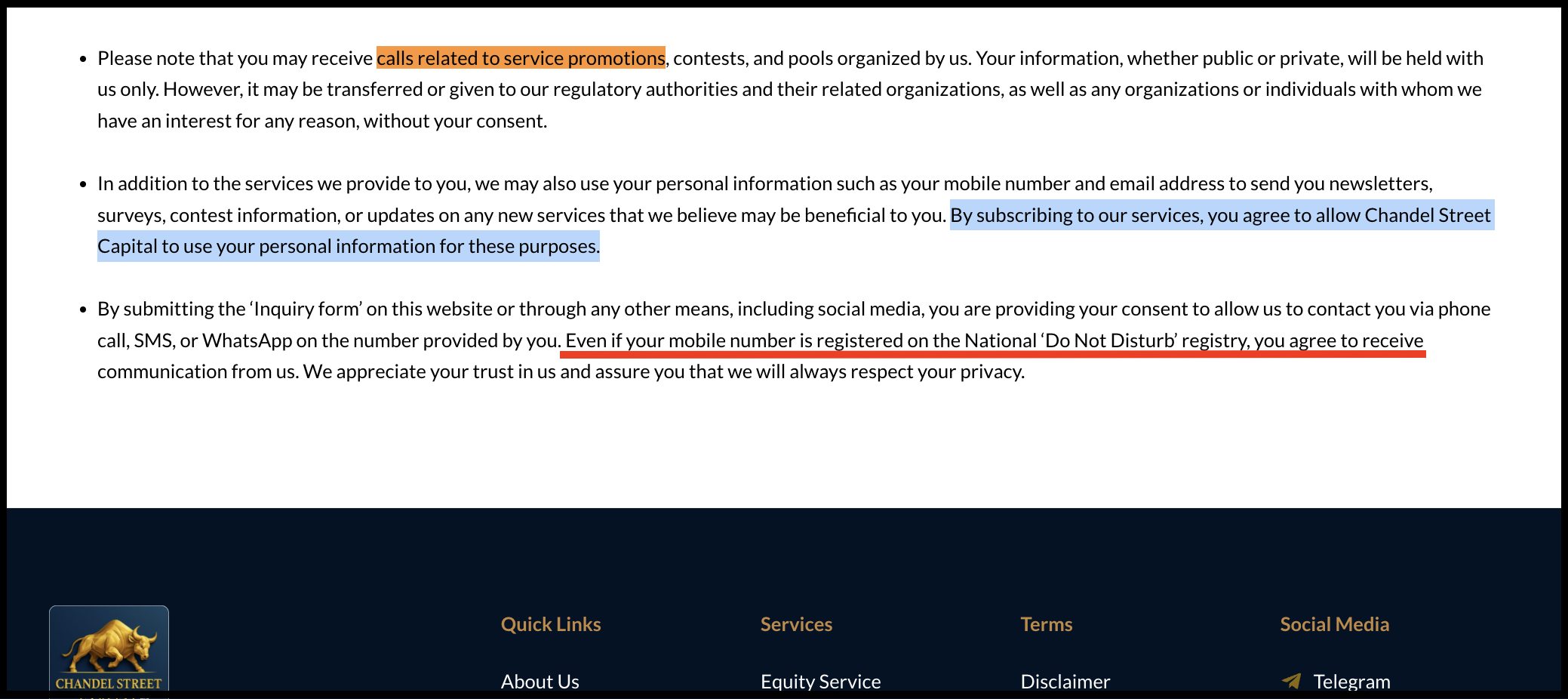
Subscribing to the service is treated as consent to bypass DND registration entirely, for calls, SMS, and WhatsApp alike.
A separate clause bundles marketing consent directly into the service agreement: “By subscribing to our services, you agree to allow Chandel Street Capital to use your personal information” for newsletters, surveys, contest information, and updates on new services, without offering a way to subscribe to the research service while opting out of this broader use.
The policy also states that client information “may be transferred or given to our regulatory authorities and their related organizations, as well as any organizations or individuals with whom we have an interest for any reason, without your consent.”
That is a very broad standard for who can receive a client’s data and why.
One phrase stands out as unclear and worth direct verification: the policy mentions “calls related to service promotions, contests, and pools organized by us.”
What “pools” refers to in the context of a SEBI-registered Research Analyst’s activities is not explained anywhere on the site, and this is the kind of term worth asking the firm to clarify directly before you subscribe.
Chandel Street Capital Complaints: What Does the Data Show?
Read on its own, this is a genuinely light complaint record. Read against its own reporting gaps, it is harder to fully verify.
Monthly Snapshot, Month Ending July 2026
| Received From | Pending at Start | Received | Resolved | Total Pending | Pending Over 3 Months | Avg. Resolution Time |
|---|---|---|---|---|---|---|
| Directly from Investors | Nil | Nil | Nil | Nil | Nil | Nil |
| SEBI (SCORES) | 1 | Nil | 1 | Nil | Nil | 7 days |
| Other Sources | Nil | Nil | Nil | Nil | Nil | Nil |
| Grand Total | 1 | Nil | 1 | Nil | Nil | 7 days |
Monthly Trend, October 2025 to September 2026
| Month | Carried Forward | Received | Resolved | Pending |
|---|---|---|---|---|
| October 2025 to May 2026 | Not shown | Not shown | Not shown | Not shown |
| June 2026 | 0 | 1 | 1 | 0 |
| August 2026 | 0 | 1 | 1 | 0 |
| Grand Total | 0 | 2 | 2 | 0 |
Notice what is missing here: the Monthly Snapshot table above is specifically for the month ending July 2026 and shows one complaint. But the Monthly Trend table has no July 2026 row at all, jumping straight from June to August.
The one complaint the snapshot table reports simply does not appear in the trend table for the month it belongs to.
Annual Trend
| Year | Carried Forward | Received | Resolved | Pending |
|---|---|---|---|---|
| 2023-24 | 0 | 0 | 0 | 0 |
| 2024-25 | 0 | 0 | 0 | 0 |
| 2025-26 | 0 | 0 | 0 | 0 |
| 2026-27 | 0 | 2 | 2 | 0 |
Taken together, the total lifetime complaint count across this firm’s history is 2, both resolved, both routed through SEBI SCORES rather than received directly.
No complaint is currently pending, and none has aged beyond three months, with an average resolution time of 7 days.
That is a genuinely clean record by volume.
But the months from October 2025 through May 2026 are shown as blank dashes in the monthly trend table rather than explicit zeros, and July 2026 is missing outright despite being the specific month the snapshot table reports on.
It is not possible to tell from the disclosure alone whether those blank months mean no complaints occurred, or whether the data simply was not populated for that period.
A clean number is only as reliable as the table reporting it, and this table has a real gap worth the firm clarifying.
How Does Chandel Street Capital Use Telegram?
A free Telegram channel is promoted throughout the website, advertised as a source of free trading calls.

Once inside the channel, the experience does not match that framing.
Subscribers describe constant pressure to purchase the premium plan, with profitable trades from the paid group shared repeatedly as a way to demonstrate what non-paying members are missing out on.
Attempting to screenshot content inside the channel causes the screen to go blank, making it impossible to capture or later verify what was actually shown.
This pattern sits against SEBI’s own rules for Research Analysts.
A registered RA is not permitted to share only selective, profitable past performance to attract subscribers, and is not permitted to pressure paying clients toward a further premium tier after they have already paid for a service.
How to File a Complaint Against Chandel Street Capital?
If your experience with Chandel Street Capital did not match its marketing, its stated advance-fee policy, or what its Telegram channel promised, start by saving everything you can: screenshots taken before any blocking occurs, payment records, and messages exchanged before you subscribed.
Understanding the general complaint against SEBI registered research analyst process first will help you know what to expect at each stage, regardless of which specific firm you are dealing with.
Put your complaint in writing to the firm’s grievance email directly before escalating further, and keep a dated copy of what you sent and any reply received.
If that does not resolve the matter, the SEBI SCORES portal is where you file formally, citing registration number INH000013350 and attaching your documentation.
Keep the acknowledgement SEBI sends once your complaint is registered, since you will need that reference for any further escalation.
Should SCORES not bring resolution, escalate further through the SMART ODR login for structured online conciliation between you and the firm.
This route is generally quicker than a formal hearing, since it focuses on reaching an agreement rather than a contested proceeding.
If conciliation still does not resolve your dispute, formal stock market arbitration remains the final step available to you.
Not sure whether Chandel Street Capital’s pricing, advance-fee terms, or Telegram promotions crossed a line SEBI does not allow?
We review the firm’s public disclosures against your own experience and help you build a complaint SEBI will actually act on. Register with us for a free consultation.
Conclusion
Mayank Singh Chandel holds a genuine SEBI Research Analyst registration for Chandel Street Capital under INH000013350, and is legally permitted to offer systematic, technical research across equity, index options, and commodities.
At the same time, this review found an Elite plan that breaches SEBI’s annual fee cap on every billing cycle, quarterly and half-yearly plans that collect more upfront than the firm’s own advance-fee policy permits, marketing language built around repeatable profit claims, a privacy policy that bypasses DND consent and shares data broadly, and a complaint disclosure table with a genuine gap around its own reporting month.
The complaint volume itself is low, which is a fair point in the firm’s favour, but a Research Analyst’s pricing, advance-fee handling, and disclosure accuracy matter just as much as its complaint count, and several of those points fall short here.
Report. Recover. Stay Fraud Free.
Frequently Asked Questions
Yes, registration number INH000013350 is valid on a perpetual basis from October 12, 2023. Genuine registration does not confirm its pricing, advance-fee handling, or disclosures fully meet SEBI's standards, which this review covers in detail.
Yes. Annualised across all three billing cycles, the Elite, All Asset Pro plan works out to between ₹2,50,000 and ₹3,00,000 a year, against SEBI's ₹1,51,000 per client family annual cap.
Its own MITC states advance fees are capped at one quarter, yet Quarterly and Half-Yearly plans are sold across every service, collecting three to six months upfront, beyond that self-stated limit.
Its total lifetime complaint count is low at 2, both resolved quickly. However, its monthly trend table has no row at all for July 2026, despite that being the specific month its own snapshot table reports on, which is a real gap in the disclosure.





 Add us as a preferred source on Google »

