

Quick Summary
Manikanth Devarakonda is an individual SEBI-registered Research Analyst under registration number INH000015871, effective April 16, 2024, operating from Adilabad, Telangana. He markets himself heavily around personal credibility claims like “IIT Delhi & Stanford alum” and “Retired at 30,” alongside a subscription research service that shows no visible pricing anywhere on his own website. His refund policy is considerably more restrictive than SEBI’s regulatory default, and his complaint disclosures across three separate tables do not reconcile with each other. This guide covers the registration, the fee transparency gaps, the refund terms, the marketing claims, and the complaint data in full.
Manikanth Devarakonda presents himself as an individual SEBI-registered Research Analyst, offering independent equity research, trading recommendations, and market commentary aimed at retail and HNI clients.
He also runs a personal-branding angle built around the “FIRE at 30” identity, and is active across LinkedIn, Twitter, and Instagram, with a combined following well into the tens of thousands.
This review goes through what his own website and social media actually show, section by section, including several points worth reading in full before you consider paying for his subscription research.
Is Manikanth Devarakonda SEBI Registered?
Yes. Manikanth Devarakonda holds a valid SEBI Research Analyst registration under number INH000015871, registered as an Individual, effective from April 16, 2024, and also holds BSE Enlistment Number 6128.
Per SEBI’s own intermediary record, this registration carries perpetual validity from that effective date.
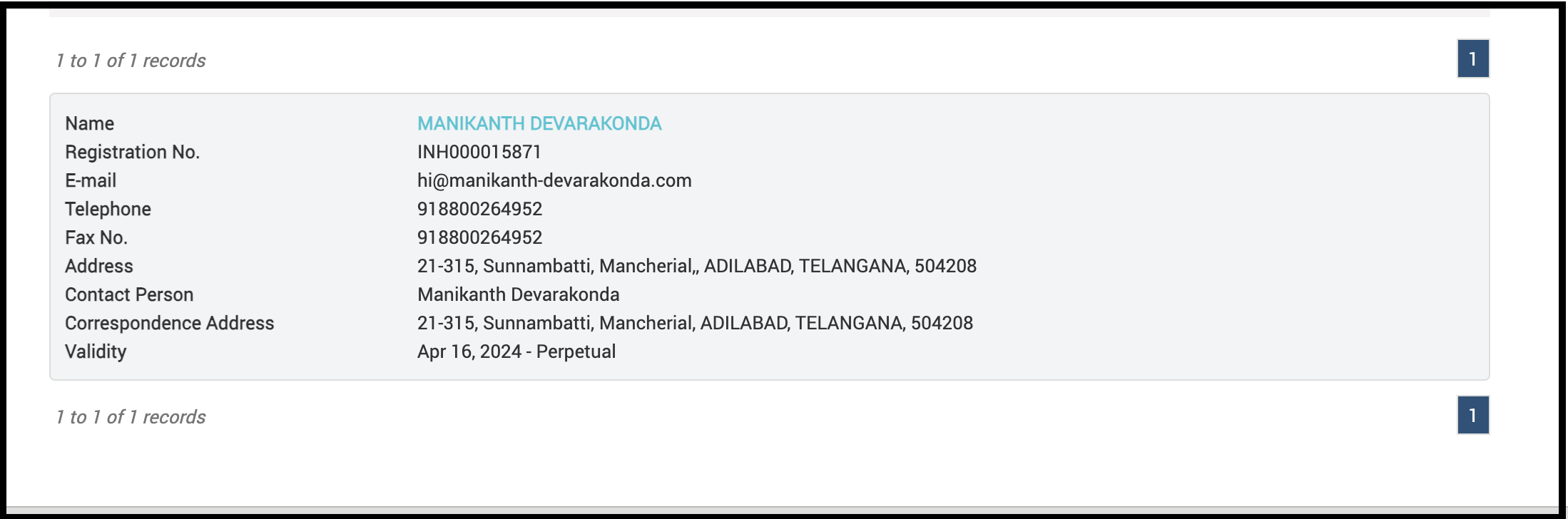
He describes himself as an IIT Delhi and Stanford alum, and states he is NISM Series-XV certified, operating under the SEBI (Research Analysts) Regulations, 2014. Payments for his service are accepted via bank transfer or UPI only.
His social media presence spans LinkedIn (33,808 followers), Twitter (2,279 followers), and Instagram (20 followers, with 0 posts published).
The gap between his Instagram follower count and its complete lack of content is worth noting on its own, since an account with followers but zero posts is an unusual pattern.
Does Manikanth Devarakonda Publish His Fees and Pricing?
No visible price list, subscription tier breakdown, or specific fee amount appears anywhere on his website.
This matters beyond simple transparency.
SEBI’s Most Important Terms and Conditions, or MITC, framework requires a registered RA to disclose the ₹1,51,000 per year, per family fee cap that applies to individual and HUF clients, as a mandatory element of that disclosure. This statement does not appear on the site.
There is also no disclosure of the specific advance-fee period being charged, meaning a prospective client has no way of knowing upfront whether they are being billed quarterly or annually before signing up.
The site carries only a generic “Terms & Conditions” page, not a standalone MITC document. These are not interchangeable.
The MITC is a specific regulatory artifact SEBI requires RAs to maintain, and a general terms page does not fulfil that requirement on its own.
Also Read: Gokul Chhabra trading, one complaint filed in 2024-25, six the very next year.
What Does Manikanth Devarakonda’s Refund Policy Actually Say?
SEBI’s MITC framework entitles a client to a proportionate refund if a service is terminated early. This is the regulatory default every RA is expected to honour.
Manikanth Devarakonda’s own refund policy frames refunds as available “only in exceptional cases,” subject to internal review and third-party approvals, with a stated 20 to 30 working-day timeline.
This is considerably more restrictive than what SEBI’s framework anticipates.
The policy also states that refund calculations are based on the full, undiscounted list price of the service, not the amount actually paid, meaning any discount or promotional pricing a client received is ignored when a refund is calculated.
GST charged and paid is explicitly stated as non-refundable in every case.
The refund process itself runs through ten separate steps, from issuance of a settlement agreement, through signing by both parties, submission to a third-party service provider, that provider’s approval, cancellation of applicable invoices, internal confirmation of eligibility, initiation on the third-party application, a second third-party approval, payment gateway approval, and finally credit back to the client’s original payment method.
A process this long, gated behind a third party at multiple stages, sits well outside what most clients would expect from a simple refund request, and is worth reading in full before you pay, not after you want your money back.
How Does Manikanth Devarakonda Market Himself?
His marketing leans heavily on personal credibility markers: “IIT Delhi & Stanford alum,” and “achieved FIRE at 30” appear prominently across his website and social profiles.
These are not the kind of claims a reader can independently verify from the site itself, and this style of lifestyle and wealth-signaling marketing sits close to the line that SEBI’s Advertisement Code for Research Analysts exists specifically to police, since it builds trust through personal image rather than through disclosed, verifiable research performance.
His website homepage displays this framing directly: “Independent, research-backed market insights from an IIT Delhi & Stanford alum and NISM-certified Research Analyst who achieved FIRE at 30,” alongside prominent buttons to “Enroll for Research” and “View Compliance Center.”
What Is Manikanth Devarakonda’s “Verified PnL” Request Form Really Asking For?
A “Verified PnL / CA-certified performance reports” request form exists on the site, which on its face sounds like a transparency feature.
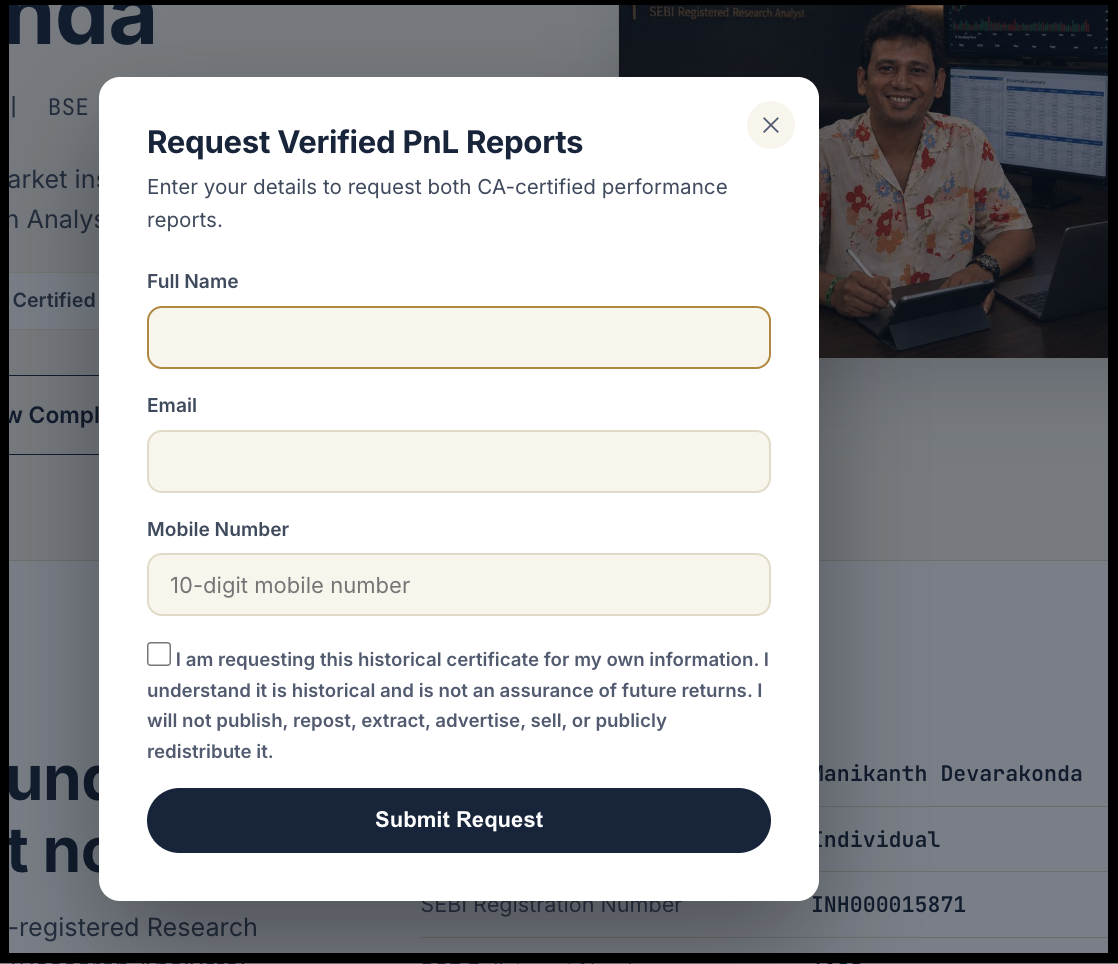
Access to this data is gated behind a checkbox agreeing not to “publish, repost, extract, advertise, sell, or publicly redistribute” the report, and requires submitting a full name, email address, and mobile number before the historical performance data is released.
Selectively controlling who can see performance data, rather than publishing it openly, is an unusual practice for something specifically billed as third-party or CA-certified verification.
Verification that only certain people are allowed to see, and are contractually barred from sharing further, does less to establish public trust than the “verified” label implies.
Manikanth Devarakonda Complaints: Does the Data Add Up?
This is the most detailed and most important section of this review, and it is worth reading every table in full.
The website publishes complaint data only through April 2026, despite SEBI guidelines requiring this data to be updated by the 7th of every month.
Disclosures for May, June, July, and August 2026 do not appear to be available at the time of this review.
Complaint Data for April 2026
| Source | Pending at Start | Received | Resolved | Pending at End | Pending Over 3 Months | Avg. Resolution Time |
|---|---|---|---|---|---|---|
| Direct Investors | 0 | 0 | 0 | 0 | 0 | N.A. |
| SEBI SCORES | 5 | 0 | 5 | 0 | 0 | 2 days |
| Other | 0 | 0 | 0 | 0 | 0 | N.A. |
| Grand Total | 0 | 0 | 0 | 0 | 0 | N.A. |
Read this table closely: the SEBI SCORES row shows 5 complaints pending at the start of the month and 5 resolved during it, yet the Grand Total row, which should sum every row above it, shows zero across every single column.
A total that does not reflect its own line items is a direct internal inconsistency in the firm’s own disclosure.
Monthly Complaint Data
| Month | Received | Resolved | Pending |
|---|---|---|---|
| April 2026 | 0 | 0 | 0 |
| March 2026 | 0 | 0 | 0 |
| February 2026 | 0 | 0 | 0 |
| January 2026 | 0 | 0 | 0 |
| December 2025 | 1 | 1 | 0 |
| November 2025 | 4 | 4 | 0 |
| October 2025 | 0 | 0 | 0 |
| September 2025 | 0 | 0 | 0 |
| August 2025 | 0 | 0 | 0 |
| July 2025 | 0 | 0 | 0 |
| June 2025 | 0 | 0 | 0 |
| May 2025 | 0 | 0 | 0 |
| April 2025 | 0 | 0 | 0 |
This table shows the real activity clearly: 4 complaints in November 2025 and 1 in December 2025, all resolved, nothing pending.
Both months fall inside India’s April to March financial year structure as part of FY 2025-26.
Annual Complaint Trend
| Financial Year | Pending at Start | Received | Resolved | Pending at End |
|---|---|---|---|---|
| 2023-24 | 0 | 0 | 0 | 0 |
| 2024-25 | 0 | 5 | 5 | 0 |
| 2025-26 | 0 | 0 | 0 | 0 |
| Grand Total | 0 | 0 | 0 | 0 |
Here is the second, separate inconsistency: the 5 complaints from November and December 2025 are recorded under FY 2024-25 in this annual table, even though both months fall within FY 2025-26.
The FY 2025-26 row instead shows zero, which does not match the monthly data at all. On top of that, the Grand Total row again shows zero despite the 2024-25 row showing 5 received and 5 resolved directly above it.
As a Research Analyst, providing this data in a clear and transparent way is his responsibility.
Taken together, these three tables do not reconcile with each other on either the monthly total, the annual total, or the fiscal year the underlying complaints belong to, which makes it genuinely difficult for an investor trying to check this record to arrive at a confident answer.
One further gap: the complaint disclosure does not separately report any complaints arising from impersonation, despite the website itself stating elsewhere that impersonation complaints have been filed against people posing as Manikanth Devarakonda.
If such complaints exist, they should be identifiable somewhere in this disclosure, and currently they are not.
Also Read: Financial Sarthis, an RA whose complaint table says zero but another table says two.
Do Manikanth Devarakonda’s Disclaimers Go Too Far?
His Terms & Conditions state plainly that he “bears no responsibility for gains or losses” arising from his recommendations.
The disclaimer language is broad. Under “Market Risk Disclaimer,” the terms state he “shall not be held liable for losses arising due to market fluctuations, delays in receiving recommendations, technical or communication issues, or inaccuracies or omissions in shared information,” with clients assuming full responsibility for their own trading activity.
A disclaimer excluding liability for normal market risk is standard across the industry.
One excluding liability for the RA’s own delays, technical failures, and inaccuracies in what he shares is a broader exclusion, and worth checking closely to confirm it does not attempt to exclude his actual regulatory obligations or any liability arising from his own non-compliance.
Also Read: Chandel Street Capital, another RA with same disclosure gaps and fee cap breached on every cycle.
Are Manikanth Devarakonda’s Twitter Posts SEBI Compliant?
Market outlook posts on his Twitter account lack the disclosures required for regulated research communications.
One example post, titled “NIFTY 50 OUTLOOK TODAY,” gave specific support and resistance levels for the Nifty index along with a stated “Bias: Cautious / Sell-on-rise” directional call, published with no visible RA disclosure attached to the post itself.
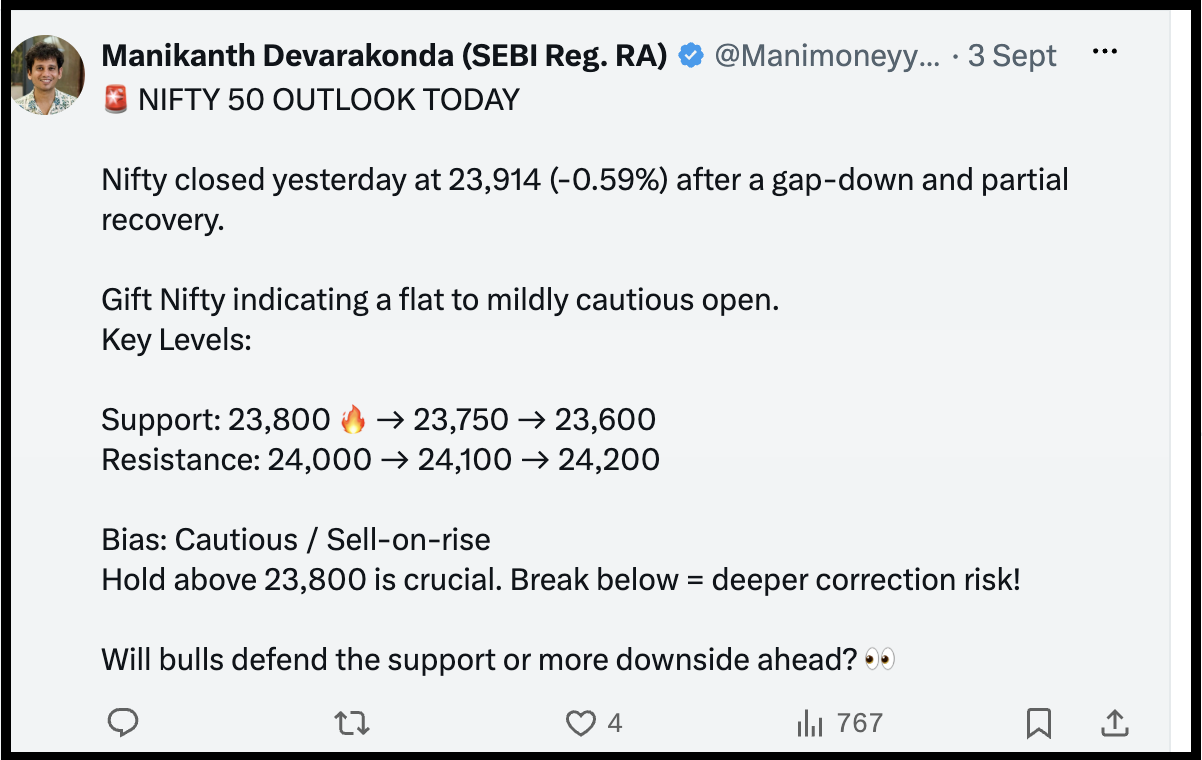
Directional trading calls, even framed as general market commentary, are exactly the kind of content SEBI expects to carry proper disclosure when published by a registered RA.
A “Sell-on-rise” bias is a specific, actionable directional view, not neutral commentary.
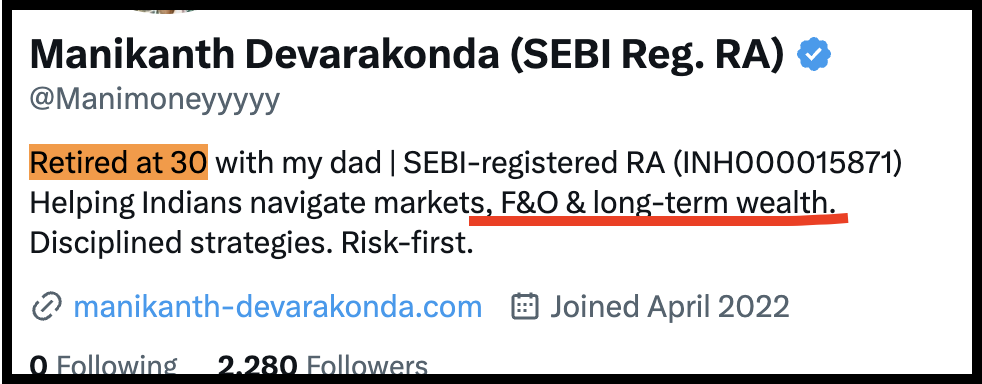
His Twitter bio itself reads: “Retired at 30 with my dad, SEBI-registered RA (INH000015871), helping Indians navigate markets, F&O & long-term wealth. Disciplined strategies. Risk-first.”
Pairing the “Retired at 30” framing directly against the registration number, in the same breath as an offer to help with F&O and long-term wealth, repeats the same lifestyle-marketing pattern flagged earlier on his main website.
How to File a Complaint Against Manikanth Devarakonda?
If your experience did not match what his website or social media promised, especially around fees, refunds, or a specific trading call, start by saving everything: screenshots, payment confirmations, and any messages exchanged before you paid.
Every Research Analyst dispute follows the same regulated path, and reading through the general complaint against SEBI registered research analyst process first will help you understand what to expect at each stage.
Put your complaint in writing to him directly before escalating anywhere else, and keep a dated copy of what you sent.
If that does not resolve the matter, the SEBI SCORES portal is where you file formally, citing registration number INH000015871 and attaching your documentation.
Keep a copy of the confirmation SEBI issues once your complaint is filed, since you will need this reference number for any later escalation.
From there, if SCORES does not bring resolution, the SMART ODR login offers structured online conciliation between you and the firm.
This stage is generally faster than a full hearing, since it is built around reaching an agreement both sides accept rather than a contested proceeding.
If conciliation still does not resolve things, formal stock market arbitration is the final step in the process.
Not sure whether Manikanth Devarakonda’s fees, refund terms, or complaint disclosures hold up in your situation?
We review the firm’s public disclosures against your own experience and help you build a complaint SEBI will actually act on. Register with us for a free consultation.
Conclusion
Manikanth Devarakonda holds a genuine, valid SEBI Research Analyst registration under INH000015871, and is legally permitted to offer research and recommendations within that framework.
At the same time, this review found no visible pricing or fee cap disclosure on his own website, a refund policy considerably more restrictive than SEBI’s regulatory default, marketing built heavily around unverifiable personal credibility claims, a performance report gated behind a no-redistribution agreement, and complaint data that does not reconcile across three separate tables he has published himself.
None of this proves wrongdoing on its own, but a Research Analyst’s job includes providing transparent, reconcilable disclosure, and on several of these points, that standard has not been met.
Report. Recover. Stay Fraud Free.
Frequently Asked Questions
Yes, registration number INH000015871 is valid and active as an Individual registration. Genuine registration does not confirm that his fee disclosure, refund policy, or complaint data meet every standard SEBI expects, which this review covers in detail.
His website does not display a price list, subscription tiers, or specific fee amounts anywhere. It also does not disclose SEBI's ₹1,51,000 per year fee cap for individual or HUF clients, which is a mandatory disclosure element.
His policy states refunds are available "only in exceptional cases" through a ten-step process taking 20 to 30 working days, calculated on the full undiscounted price with GST excluded. This is more restrictive than SEBI's proportionate refund default.
No. His April 2026 table, monthly data, and annual trend table each show different totals for the same underlying complaints, and the 5 complaints from November and December 2025 are recorded under the wrong financial year in the annual table.





 Add us as a preferred source on Google »

