

Quick Summary
DSIJ Wealth Advisory holds both Research Analyst registration INH000006396 and Investment Adviser registration INA000001142. If their service did not match what was promised, refund was refused, or fees exceeded the SEBI annual cap of Rs. 1,51,000, you have formal complaint grounds. Which registration you select on SCORES depends entirely on which service you used. Getting that wrong delays everything. This page tells you exactly what to file, where, and in what order.
You subscribed to a DSIJ Wealth Advisory service. Maybe Micro Marvel. Maybe the Portfolio Advisory Service. Or maybe one of their intraday or options packages.
You paid. The service ran. The results did not match what you were shown before subscribing.
Or you asked for a refund and were told no, regardless of how much of your subscription period remained unused.
Or you subscribed to multiple services and your combined fees crossed Rs. 1,51,000 for the year without anyone at DSIJ telling you that was even a limit.
All these situations have formal grounds to complaint against DSIJ Wealth Advisory under SEBI regulations. This blog covers the exact process.
How to File a Complaint Against DSIJ Wealth Advisory Private Limited?
If you have faced misleading advice, unauthorized charges, or any other grievance, you can raise a formal complaint against DSIJ Wealth Advisory Private Limited through the appropriate regulatory channels.
Acting promptly and keeping proper evidence can significantly improve your chances of a fair resolution.
Step 1: Collect Your Evidence
Before writing to anyone, organise what you have.
- Payment proof: Every bank transfer, UPI transaction, or payment receipt showing the service name, the amount, the date, and the payee. If you subscribed to multiple services, list every payment separately with dates so the annual total is visible.
- What was promised: The marketing email, the website page you relied on, the sales call recording if you made one, or the WhatsApp message from a representative. Screenshots with dates and sender identity visible.
- What was delivered: Your access records, the recommendations you received, the trading outcomes during the subscription period. If delivery failed, screenshot every attempt to access and every support message you sent.
- The refund request and response: If you asked for a refund and were refused, the email exchange documenting that request and refusal is important evidence.
Write a one-page chronological summary before you start filling any form. Date of first contact, what was shown to you, date of payment, what was delivered, where the gap appeared, when you raised it, what response you received.
Step 2: Write to the Compliance Officer
Before SCORES, you must attempt internal resolution. Write a formal email to the firm’s compliance officer.
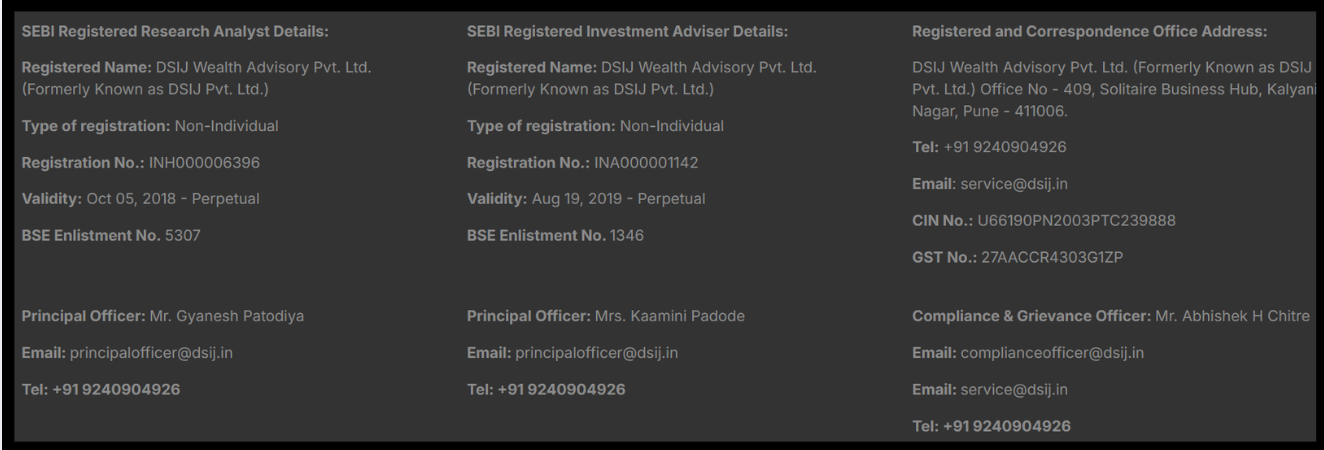
DSIJ Wealth Advisory’s compliance and grievance officer is Mr. Abhishek H Chitre. Their registered office is Office No 409, Solitaire Business Hub, Kalyani Nagar, Pune 411006.
State your complaint specifically. Which service. What you paid, what was promised, what was delivered, and what resolution you want. Give 21 calendar days for a response in writing.
One practical note: DSIJ lists two names simultaneously as Principal Officers, Mr. Gyanesh Patodiya and Mrs. Kaamini Padode, for the same designation.
If you receive a response from either name, that is the firm responding. If you receive no response within 21 days, move to Step 3.
Step 3: File SEBI SCORES Complaint
Go to scores.sebi.gov.in. Register with your PAN and mobile number.
Select the correct intermediary type. Research Analyst for subscription research services. Investment Adviser for the Portfolio Advisory Service. Enter the corresponding registration number.
In the complaint description, paste your chronological summary from Step 1. Reference each attached document by name. State the specific regulation you believe was violated.
Dates, amounts, and exact wording of claims made carry more weight than general dissatisfaction.
After submission you receive a reference number. The firm has 21 days to respond. Log in after 21 days and check the status.
If their response does not address your actual grievance, mark it as unsatisfactory.
For the complete guide on what each SCORES status means and what to do if the complaint stalls, the tracking guide covers every stage.
Read how to track your SEBI SCORES complaint status and what each update means.
For the full explanation of what causes SCORES complaints to be rejected and how to avoid each reason, the rejection guide has the complete picture.
Read why SEBI SCORES complaints get rejected and what to do about it.
Step 4: Escalate to SMART ODR
After the SCORES process is exhausted, the complaint transfers to SMART ODR at smartodr.in. Your SCORES reference number follows the case. You do not start over.
One important rule before escalating. Filing on SMART ODR while your SCORES complaint is still active automatically disposes the SCORES complaint.
Make sure the SCORES process is genuinely exhausted first.
An independent conciliator is assigned from SEBI’s empanelled list. The process runs through pre-conciliation and then formal conciliation if needed.
Most disputes that are clearly documented settle at the pre-conciliation stage.
For the complete guide on how the conciliation process works and what the intermediary is required to do at each stage, the conciliation guide covers everything.
Read how SMART ODR conciliation works and what to expect.
Step 5: Arbitration
If conciliation fails, the matter moves to formal arbitration. An arbitrator reviews all submitted evidence and issues a binding award enforceable as a civil court decree under the Arbitration and Conciliation Act 1996.
For claims below Rs. 10 lakh, the investor pays no arbitration filing fee. The firm bears the cost.
The strength of the arbitration outcome depends on the documentation you assembled in Step 1. An arbitrator cannot award recovery for payments that have no paper trail.
Which Registration Applies to Your Complaint?
This is the most important question to answer before filing anything. DSIJ Wealth Advisory holds two separate SEBI registrations and the correct one depends entirely on which service you used.
- Select Research Analyst – INH000006396 for complaints about any of these services: Micro Marvel, Multibagger Pick, Penny Pick, Pop Options, Pop BTST, POP Stock, TAS, Large Rhino, Mid Bridge, Value Pick, Tiny Treasure, Mispriced Gems, Vriddhi Growth, FNI Newsletter, or the Dalal Street Investment Journal magazine if it was sold as part of a research subscription.
- Select Investment Adviser – INA000001142 for complaints about the Portfolio Advisory Service or any personalised advice built around your individual risk profile, financial goals, and investment horizon.
Filing under the wrong category routes your complaint to the wrong department and can delay resolution by weeks. Check which service your payment receipt references before selecting anything on SCORES.
Also Read: How to complain against Shubh Stocks Capital, what rights an existing client retains once a firm stops onboarding.
Situations That Qualify as Formal Complaint Grounds
Not every investment loss is a complaint basis. But several specific situations are, and several of them apply directly to how DSIJ operates.
1. Refund Refused After Partial Use of Subscription
SEBI’s December 2024 RA Regulations amendment and the January 2025 Guidelines require registered Research Analysts to refund the pro-rata unused portion of any advance fee when a client exits early.
No breakage fee or penalty is permitted. DSIJ’s Terms and Conditions state a blanket no-refund policy.
If you were refused a refund for unused subscription time, that refusal conflicts with SEBI’s current regulations regardless of what the firm’s own T&C says.
2. Combined Fees Exceeded Rs. 1,51,000 in a Year
SEBI caps the aggregate annual fee payable by an individual or HUF client family across all RA services taken from one registered RA at Rs. 1,51,000. DSIJ offers 17 separately-priced services.
Subscribing to Multibagger Pick at Rs. 47,999, TAS at Rs. 50,999, and Pop Options at Rs. 42,999 in one year already totals Rs. 1,41,997. Adding any other service breaches the cap.
If your combined DSIJ subscription fees in any 12-month period exceeded Rs. 1,51,000, the excess was collected in violation of SEBI’s fee cap and is recoverable.
3. 25-Year Magazine Plan Collected More Than One Year’s Fee in Advance
SEBI’s advance fee rules effective from January 2025 cap advance fee collection at one year for RA services. DSIJ’s Terms and Conditions describe a 25-year lifetime magazine plan transferable to one heir.
If the magazine carries stock recommendations, as DSIJ’s own homepage lists it as part of its research service bouquet, that plan cannot legally collect more than one year’s subscription fee in advance under the current regulatory framework.
4. Service Not Delivered After Payment
Complaints about hard copy magazine non-delivery, account access not provided, recommendations not received.
Or customer support not responding after payment are complaint grounds under SEBI’s Code of Conduct which requires fair dealing and effective grievance redressal.
5. Guaranteed Return Promises or Selective Performance Marketing
If any representative made assured return claims before your subscription, or if marketing material you relied on showed only winning recommendations without the full track record.
Those situations qualify under SEBI’s Advertisement Code and Research Analyst Regulations.
For the full analysis of how DSIJ’s website marketing, refund terms, and complaint disclosure compare against SEBI’s current requirements, the SEBI registration page covers every gap in detail.
Read is DSIJ Wealth Advisory SEBI registered and what the regulatory gaps mean.
Our team files your SEBI SCORES complaint, prepares the documentation, and represents you through SMART ODR and arbitration.
Conclusion
DSIJ Wealth Advisory is accountable to SEBI under two separate registrations. The correct one to use on SCORES depends on which service your complaint relates to.
Research services go under INH000006396. Portfolio advisory goes under INA000001142.
Three specific situations have strong complaint grounds: refund refused for unused subscription time, combined annual fees exceeding Rs. 1,51,000, and the 25-year magazine plan collecting more than one year’s fee in advance.
If the magazine carries research content. Evidence collected before you start is what determines how far the process goes.
Frequently Asked Questions
Select Research Analyst and enter INH000006396 for any subscription service including Micro Marvel, Multibagger Pick, Penny Pick, Pop Options, TAS, or the magazine. Select Investment Adviser and enter INA000001142 for the Portfolio Advisory Service or any personalised advice based on your individual financial profile. Using the wrong category routes your complaint incorrectly and delays resolution significantly.
Under SEBI's December 2024 RA Regulations and January 2025 Guidelines, a registered Research Analyst cannot charge a breakage fee or penalty on early termination and must refund the pro-rata unused portion of any advance fee collected. DSIJ's Terms and Conditions state a blanket no-refund policy. If you were refused a refund for unused time, that refusal conflicts with current SEBI regulations and is a specific complaint ground.
SEBI caps the aggregate annual fee for an individual or HUF client family across all RA services from one registered RA at Rs. 1,51,000 per year. DSIJ offers 17 separately-priced services. Subscribing to three or four services simultaneously can breach this cap. If your combined annual DSIJ subscription fees exceeded Rs. 1,51,000, the excess was collected in violation of the fee cap and is recoverable through a formal complaint.
SEBI's advance fee rules effective January 2025 cap advance collection at one year for RA services. If the Dalal Street Investment Journal magazine carries stock recommendations, as DSIJ's own homepage lists it under its research service bouquet, a 25-year prepayment structure is difficult to reconcile with this one-year cap. If you paid a multi-year magazine subscription and want to exit, the unused portion may be refundable under current regulations.
The internal grievance step allows 21 days. SCORES gives the firm another 21 days after filing. SCORES Level 2 Review adds 2 to 4 weeks. SMART ODR conciliation typically runs 6 to 12 weeks. If arbitration is needed, the total timeline from initial SCORES filing to a binding award typically falls between 4 and 9 months.





 Add us as a preferred source on Google »

