

You received a call. The person on the other end sounded confident. They told you about an algo trading software that runs automatically, showed you screenshots of impressive monthly profits, and mentioned a SEBI registration number to make it all sound official.
Sound familiar?
If you’ve been approached by Inspire Algo Research or have already subscribed, you probably came here looking for answers about Devendra Sahu, the Research Analyst behind the firm.
You want to know whether his registration is legitimate, what the complaints are really about, and whether your money is safe.
In this blog, we cover his registration details, what SEBI’s own records say, user complaints, and what you should do before making any financial commitment.
Who Is Devendra Sahu?
Devendra Sahu is the registered proprietor and contact person behind Inspire Algo Research, an algo trading software and research firm operating out of Indore, Madhya Pradesh.
He holds a SEBI Research Analyst (RA) registration under number INH000017824, granted on July 24, 2024, with perpetual validity subject to ongoing SEBI compliance.
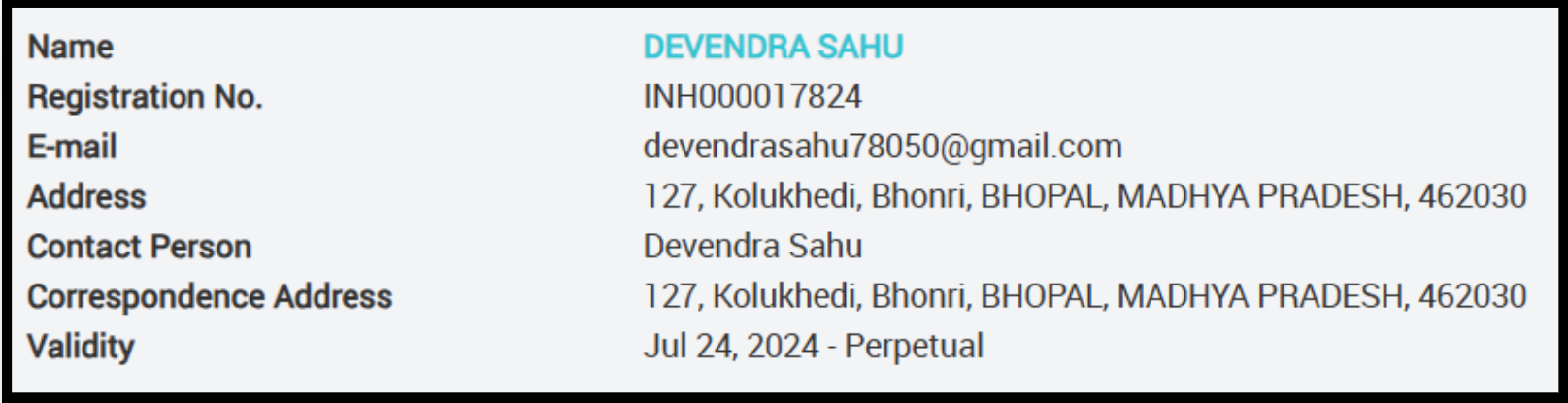
On paper, this registration gives the firm a legitimate face. SEBI’s RA licence is not easy to obtain; it requires meeting eligibility norms, clearing a certification exam, and complying with ongoing regulatory obligations.
But here’s the thing, most traders don’t realise: a SEBI Research Analyst registration is a starting point, not a seal of approval on every service a firm offers.
An RA licence specifically authorises the publication of research recommendations on securities. It does not automatically cover automated trading systems that connect to a client’s broker API and execute trades in their account on their behalf.
Inspire Algo Research markets itself as a technology-driven algo trading solution.
It sells subscription-based automated trading software at multiple price points:
- Basic Plan: ₹11,499 per month
- Premium Plan: ₹24,999 per month
- Longer Plans: ₹70,000 to ₹1,40,000
- API Bridge: ₹1,180 per month
At first glance, these plans seem structured. But look more carefully, and a regulatory concern surfaces immediately.
Devendra Sahu User Complaints
Beyond SEBI’s records, a detailed public thread on Reddit, with over 90 comments, documents user experiences with Devendra Sahu and Inspire Algo Research in considerable detail.
These are individual accounts from traders across India.
They are drawn from publicly visible posts, and no legal conclusions are drawn from them here. But the patterns they describe are too consistent to ignore.
1.”Pay After You Earn”, Promises That Don’t Hold
Multiple users report being offered flexible payment plans, a token amount upfront, and the rest only after profits are generated.
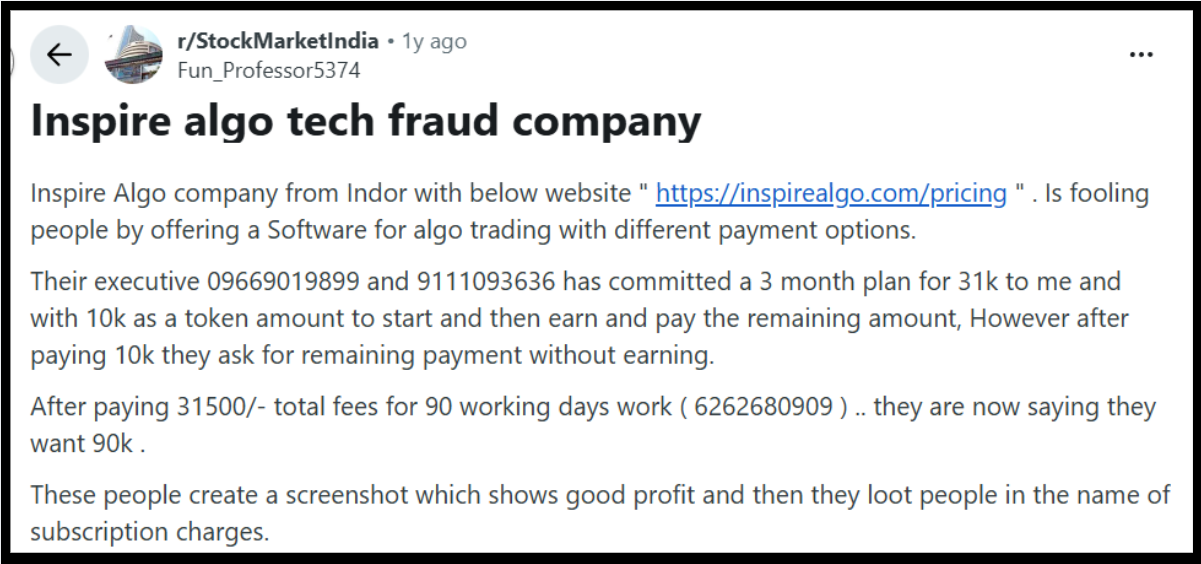
One user was promised a three-month plan for ₹31,000, with ₹10,000 to start and the rest payable from earnings.
After paying the initial amount, they were asked to pay the full remaining balance without any earnings materialising.
The promise of “pay after earning” is a marketing technique. Traders should know that no SEBI-registered Research Analyst can legally guarantee a profit or guarantee that you will earn before paying.
2. API Access Followed by Immediate Heavy Losses
Several users report that once they connected their broker API, essentially giving the software access to trade in their account, large losses followed within a very short time.
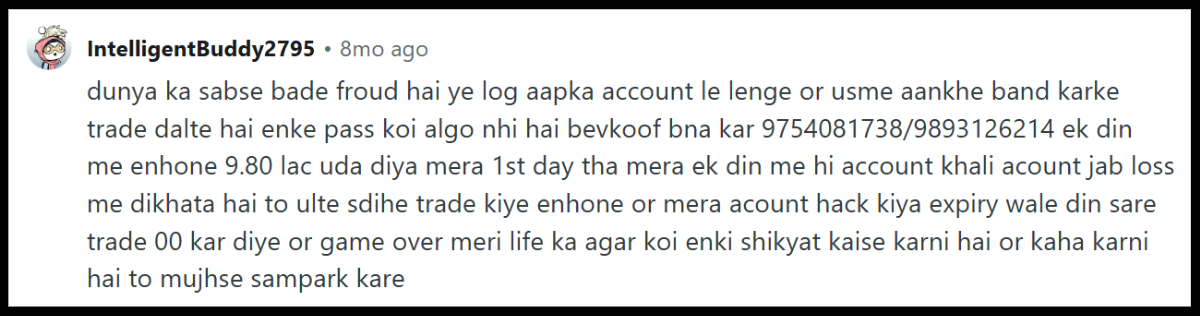
One user reports a loss of ₹9.8 lakh in a single day after granting API access, with trades placed on expiry day without any apparent risk management.
Granting API access to an external party means giving them the ability to place trades directly in your brokerage account.
This is a significant step that should only be taken when you have independently verified the provider’s credentials and regulatory authorisation.
Pattern 3: Upgrade Pressure After Losses
A pattern emerges where users who face early losses are not offered refunds; they are offered upgrades.
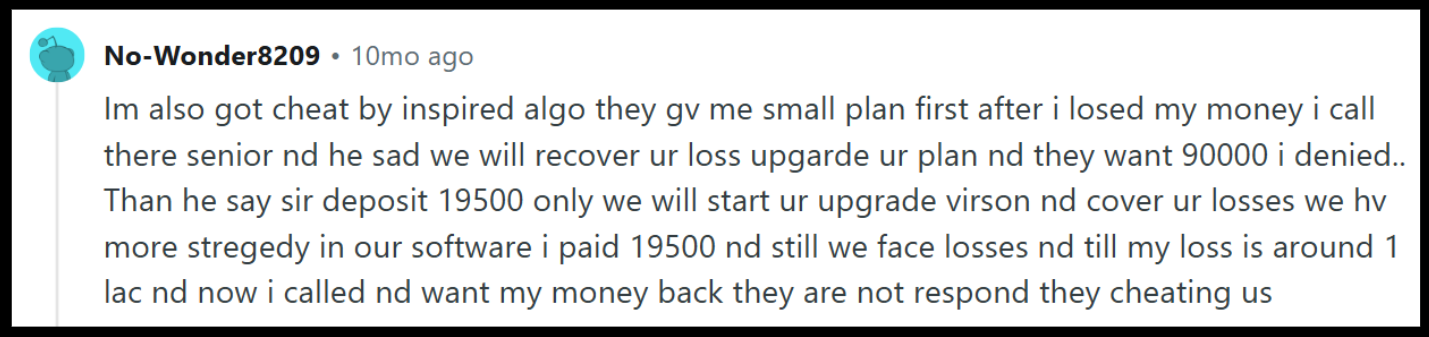
One user lost money on a smaller plan, was then convinced to upgrade for ₹90,000 with recovery promises, paid ₹19,500, and lost another ₹1 lakh before being ignored entirely.
Recovery promises after trading losses are a significant red flag. No SEBI-registered Research Analyst is permitted to promise loss recovery. It is explicitly prohibited under SEBI’s RA regulations.
Pattern 4: Fake Screenshots and Misleading SEBI Claims
Users consistently mention being shown profit screenshots during the sales process that did not reflect real trading outcomes.
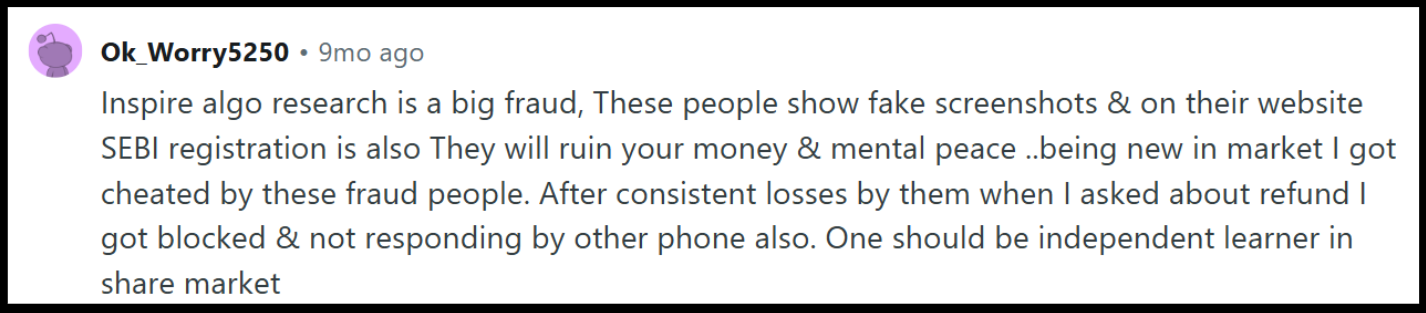
One user states they were misled by fabricated screenshots and a misrepresentation of SEBI registration to create an appearance of legitimacy, and were blocked immediately upon asking for a refund.
Taken together, the user complaints paint a clear pattern. But there are also specific, verifiable regulatory concerns that go beyond individual experiences, red flags rooted in SEBI’s own data and the firm’s publicly available records.
Devendra Sahu Research Analyst Red Flags
While the registration is real, the following concerns are independently verifiable and represent issues that go beyond user opinion.
Every trader should assess these before making any financial commitment.
1. 3 unresolved complaints on SEBI’s watchlist
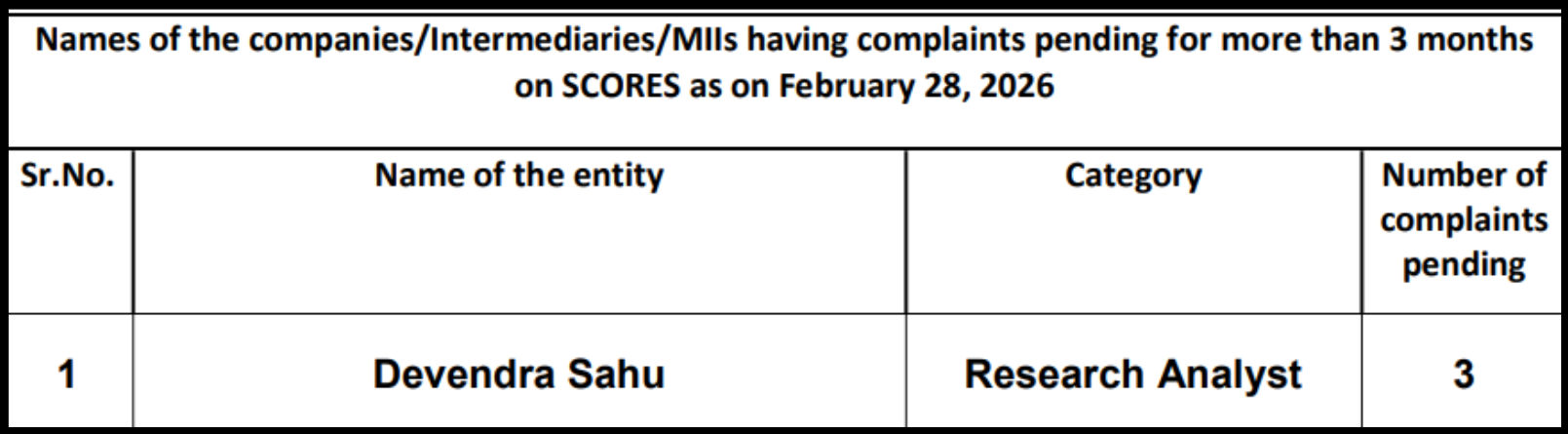
As of February 28, 2026, Devendra Sahu (INH000017824) appears on SEBI’s complaints watchlist with 3 complaints pending for over 3 months.
This is a compliance failure under SEBI’s grievance redressal obligations.
More strikingly, the firm’s own website claims zero complaints received and zero pending, a direct contradiction of SEBI’s published regulatory data.
2. Pricing that appears to exceed SEBI’s annual fee cap
SEBI limits the annual fee a Research Analyst can charge to ₹1,51,000 per family. The premium plan at ₹24,999 per month, if annualised, comes to approximately ₹3 lakh, nearly double the permitted ceiling.
The pricing page carries no disclosure about this limit, and no explanation is provided for how multi-month plans remain compliant.
3. No disclosed exchange empanelment for algo services
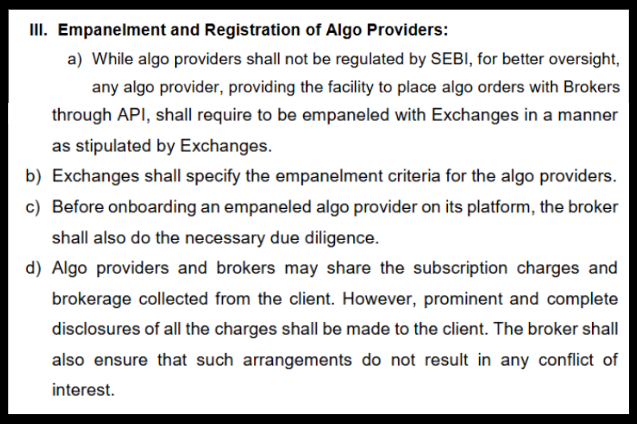
SEBI’s 2025 algo trading circular, which came into full effect on August 1, 2025, requires all algo providers to be empanelled with exchanges. An RA licence alone does not authorise automated trade execution in client accounts.
No such empanelment appears anywhere on the firm’s website or in public regulatory records.
4. Registered address mismatch

The SEBI registration lists an address in Bhopal.
The firm’s own user agreement and job listings reference Scheme 140, Indore. A discrepancy between the regulatory filing address and where the business actually operates is a compliance flag that warrants attention.
Understanding the red flags is the first step. The next step is knowing specifically what to check before ever handing over money or granting API access to any algo trading provider.
What Traders Must Check Before Subscribing?
Whether you are evaluating Devendra Sahu or any other RA, here is what every trader should verify before paying:
- Check SEBI’s Watchlist, Not Just the Registration: RA registration confirms a regulatory threshold was cleared; it does not tell you about ongoing compliance. Always search SEBI’s SCORES watchlist independently to see if the entity has unresolved complaints.
- Never Connect Your Broker API Without Verification: API access gives an external party the ability to place trades directly in your account. Before granting this, verify that the provider holds both RA registration and exchange empanelment under SEBI’s 2026 framework.
- Treat “Pay After Earning” Offers With Caution: Flexible payment tied to profits sounds attractive. But the structure in practice, as documented by multiple users, has involved full payment demands before any earnings materialise. Read every clause of the agreement carefully.
- Loss Recovery Promises Are a Red Flag: Any offer to recover your losses through a higher plan or additional payment is prohibited under SEBI’s RA regulations. Encountering this should make you pause immediately.
- Keep Records of Every Communication: Every message, payment receipt, promise, and agreement should be saved from your very first interaction. If a dispute arises, this documentation is your most important tool.
- Verified Performance, Not Screenshots: Screenshots of trades can be fabricated or selectively chosen. Legitimate advisory services maintain auditable, verifiable performance records. Ask for these, and if they cannot be provided, treat that as your answer.
If you have already paid and experienced losses or unresponsive communication, knowing the formal complaint process is your most important next step.
How to Complaint Against Inspire Algo Research?
Are you facing similar issues with Devendra Sahu or any other SEBI-registered research analyst?
If you are asking can I recover money lost to a research analyst, the answer is yes, but only if you act quickly and follow the right process. You are not alone, and you don’t have to navigate this complex process by yourself.
Our dedicated team specialises in assisting investors like you. We provide end-to-end support to ensure your grievance is documented effectively.
Our Step-by-Step Support Process:
1. Initial Consultation & Case Assessment:
We will arrange a confidential call with a dedicated Case Manager who will listen to your complete experience.
2. Professional Case Documentation & Drafting:
We will help you draft a structured, compelling, and legally coherent complaint letter that clearly outlines the misconduct, the financial loss incurred, and the specific regulatory breaches.
3. Direct Engagement & Escalation:
- Reaching out to the Stockbroker/Research Analyst: Before escalating to regulators, we can guide you in formally communicating your complaint to the concerned entity, often a necessary step for the grievance redressal trail.
- Registering a Complaint in SCORES: We provide detailed guidance on how to file your SEBI complaint on the SCORES portal. We help you track the SEBI complaint status and respond to any queries from SEBI.
- Lodging a complaint in Smart ODR: For certain eligible disputes, we can guide you through the SEBI Smart ODR platform, a faster, online mechanism for resolving conflicts with market intermediaries.
4. Advisory & Strategic Counselling:
Our experts will counsel you on realistic outcomes, potential recovery avenues, and typical timelines for the regulatory process.
5. Guidance on Advanced Recourse
If the response from the entity or initial regulatory action is unsatisfactory, our team will guide you on the next steps, which include arbitration in the share market.
If your agreement with the research analyst/broker has an arbitration clause, we can connect you with resources or legal experts who specialise in securities arbitration to explore this route for recovery.
Your money matters. Your complaint matters.
By taking this step, you are not just seeking accountability for your loss; you are becoming a vital part of a cleaner, more transparent financial market.
Don’t let complexity deter you.
Register with us today to file your case, and let our experienced team help you take the first decisive step toward resolution and accountability.
We have already won an arbitration naming Devendra Sahu’s Inspire Algo Research, recovering ₹1,79,000 for a client. Check the full case on recovery from Inspire Algo Research and report yours now.
Conclusion
Devendra Sahu holds a valid SEBI Research Analyst registration. That is a fact, and it matters. But registration is the minimum requirement; it is not a clean chit on every service offered or every practice followed.
SEBI’s own published data places him on the complaint watchlist with unresolved grievances.
Traders across public forums describe consistent patterns of promise-based selling, rapid losses after API access, upgrade pressure, and communication blackouts.
Pricing exceeds SEBI’s annual fee cap without disclosure. And the firm’s algo software sits in a regulatory grey area without publicly disclosed exchange empanelment.
Every one of these points can be independently verified. That is precisely what due diligence means in a market where the consequences of getting it wrong can run into lakhs.
Before subscribing, verify independently. Before granting API access, confirm exchange empanelment. And if you have already lost money, do not wait, use the formal complaint process and document everything.





 Add us as a preferred source on Google »

