

Quick Summary
Dhansetu Research is a SEBI-registered Research Analyst run by Vivek Singh Rajpoot under registration INH000024550, offering equity, options, and MCX commodity research alongside API-driven trading execution. The firm’s own website lists its registration validity as ending in 2030, while SEBI’s own record shows perpetual validity, a real discrepancy worth understanding. Several pricing plans exceed SEBI’s ₹1.51 lakh annual fee cap when annualised, complaints jumped sharply in July and August 2026, and both the website and Telegram channel use promotional language that stretches past what SEBI’s advertisement code permits. This blog covers all of it in full.
You are looking at a firm that promises “data-driven equity research” and “API trading execution“, backed by an active SEBI registration.
Dhansetu Research does hold that license.
But the pricing structure, a recent spike in complaints, and a validity date that conflicts with SEBI’s official record are worth looking at before you hand over any subscription fees.
This review breaks down the registration details, SEBI fee cap compliance, complaint history, and marketing promises you should check first.
Dhansetu Research Review
Dhansetu Research provides research recommendations for traders in the Indian equity market, alongside equity and options research and MCX commodity research.
It also offers API trading support, promoting rule-based execution using predefined strategies and risk controls.
The website describes itself as both a Research Analyst and an API Services Platform, built on systematic strategies drawn from technical and fundamental research models.
It highlights rule-based execution, consistent strategy logic, order management, and predefined risk controls as core features of its API-driven services.
Customer support runs through two escalation levels, a Level 1 and Level 2 contact number and email, with the office listed at Belmont Park, Niranjanpur, Indore, Madhya Pradesh.
The site links out to its Terms and Conditions, Disclosure, Investor Charter, Grievance Redressal Process, Refund Policy, and Complaint Status pages, and states it communicates only through verified channels on its own domain, explicitly saying it does not request direct fund transfers to personal accounts.
Social presence spans Telegram, Instagram, Facebook, LinkedIn, and X, listed under a “Follow Us” section as additional communication and promotional touchpoints.
Is Dhansetu Research SEBI Registered?
Yes, and the registration itself checks out. But one specific detail on the firm’s own site doesn’t match what SEBI’s own record shows, and it’s worth understanding clearly before anything else.
Vivek Singh Rajpoot holds SEBI Research Analyst registration INH000024550, with the registered email [email protected] and telephone +91 7697722464.
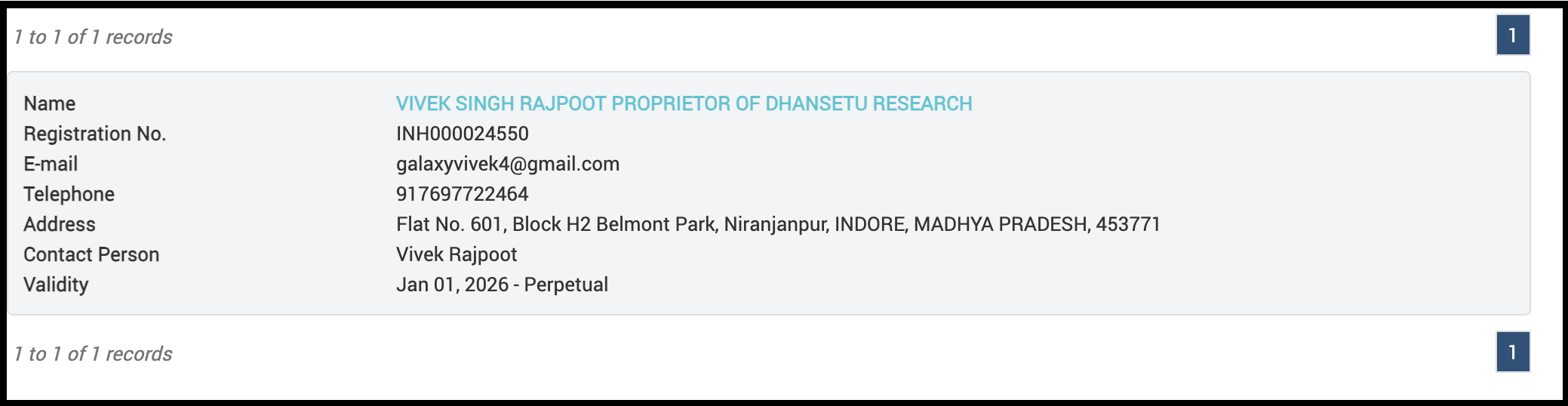
The registered address is Flat No. 601, Block H2, Belmont Park, Niranjanpur, Indore, Madhya Pradesh, 453771.
SEBI’s own record lists this registration’s validity as “Perpetual.”
Dhansetu Research’s own website states something different: validity from January 1, 2026, to December 31, 2030, a fixed five-year window rather than an open-ended one.
That’s a real inconsistency between what SEBI’s official record shows and what the firm tells visitors on its own site, and it’s worth asking Dhansetu Research directly to clarify.
Independently, the firm’s website also confirms BASL membership number 6980, a GST registration number, 23CNLPR6068M2Z8, and a separate Level 1 contact number, +91 9993898621, alongside the Level 2 number already listed.
One small naming inconsistency is also worth noting. SEBI’s record lists the registered name as “Vivek Singh Rajpoot,” but the same record’s Contact Person field lists him simply as “Vivek Rajpoot,” without “Singh.”
Before paying any firm claiming SEBI registration, it’s worth taking two minutes to check SEBI registered research analyst status directly on the regulator’s own database, rather than relying on what a single website states about itself.
Also Read: Vivek Prashant, another RA whose registration got changed but the old registration still lives somewhere on its site.
Dhansetu Research Pricing Details
Most firms bury their pricing in confusing tiers.
Dhansetu Research at least lays it out clearly: nine separate plans across equity and commodity segments, each sold monthly, quarterly, and half-yearly.
The numbers below are what you’d actually pay:
1. Equity Plans
- Basic Index Option runs ₹8,000 a month, ₹16,000 a quarter, or ₹30,000 for half a year.
- Moderate Index Options costs ₹17,000 a month, ₹40,000 a quarter, or ₹75,000 for half a year.
- Advance Index Options is priced at ₹34,000 a month, ₹80,000 a quarter, or ₹1,25,000 for half a year.
- Stock Option costs ₹15,000 a month, ₹40,000 a quarter, or ₹75,000 for half a year.
- Stock Future runs ₹25,000 a month, ₹65,000 a quarter, or ₹1,20,000 for half a year.
- Equity Research is priced at ₹11,000 a month, ₹28,000 a quarter, or ₹52,000 for half a year.
2. Commodity Plans
- MCX Basic costs ₹7,000 a month, ₹18,900 a quarter, or ₹37,800 for half a year.
- MCX Moderate runs ₹15,000 a month, ₹40,000 a quarter, or ₹70,000 for half a year.
- MCX Advance is priced at ₹25,000 a month, ₹65,000 a quarter, or ₹1,00,000 for half a year.
All figures above are listed before GST is added.
Does Dhansetu Research’s Pricing Cross SEBI’s Fee Cap?
SEBI caps total Research Analyst fees at ₹1.51 lakh per client per year.
Checking these plans against that cap turns up four separate issues worth understanding individually.
1. Several Plans Exceed the Cap When Annualised
Equity Moderate, Advance, Stock Option, Stock Future, and Equity Research plans, along with Commodity Moderate and Advance plans, all exceed ₹1.51 lakh per client per year once annualised.
2. Some Half-Yearly Plans Exceed the Cap on Their Own
The Equity Advance plan at ₹1.25 lakh, the Stock Future plan at ₹1.20 lakh, and the Commodity Advance plan at ₹1 lakh are each priced for only six months.
That leaves almost no room within the annual ceiling for a second six-month subscription in the same year.
3. Quarterly and Half-Yearly Pricing Jumps Disproportionately
Equity Basic costs ₹8,000 a month but ₹30,000 for six months, more than triple the monthly rate rather than a proportional six-month total.
MCX Basic follows the same pattern: ₹7,000 monthly against ₹37,800 for six months.
The website should clearly explain this pricing structure and how it stays within SEBI’s fee-limit compliance.
4. API Trading Services Are Bundled Into Research Plans
Equity plans advertise a Stock Option Strategy API and Stock Future Trend API, while the MCX Advance plan includes an MCX Options/Futures API.
The nature and scope of these API services should be clearly distinguished from research recommendations, since bundling execution infrastructure into a research subscription raises questions about what exactly you’re actually paying for.
A similar bundling pattern shows up with Inspire Algo Research, where API-driven execution was also sold alongside standard research recommendations.
Dhansetu Research Complaints
SEBI requires monthly complaint disclosure, and Dhansetu Research’s own published numbers reveal a pattern worth reading in full before you subscribe.
The complaint status for August 2026 shows 3 complaints received directly from investors, all 3 resolved, with an average resolution time of 2 to 3 days.
Zero complaints came through SEBI’s SCORES platform or any other source that month.
The full monthly breakdown across 2026 tells a fuller story.
| Month | Received | Resolved | Pending |
|---|---|---|---|
| Jan 2026 | 0 | 0 | 0 |
| Feb 2026 | 0 | 0 | 0 |
| Mar 2026 | 0 | 0 | 0 |
| Apr 2026 | 1 | 1 | 0 |
| May 2026 | 0 | 0 | 0 |
| Jun 2026 | 0 | 0 | 0 |
| Jul 2026 | 3 | 3 | 0 |
| Aug 2026 | 3 | 3 | 0 |
The annual total for 2025-26 stands at 7 complaints received, 7 resolved, and 0 pending.
Four things stand out once you read the numbers together.
Seven complaints arrived within the first eight months of the registration period. Since registration validity began January 1, 2026, that’s a real volume for a firm still in its first year.
A sharp increase hit in July and August specifically. After only 1 complaint in April and none in January through March or June, the firm received 3 complaints each in July and August, accounting for 6 of the 7 total complaints for the year.
Every one of the seven complaints came from direct investors, with zero routed through SEBI’s SCORES platform or any other channel.
All seven show as resolved with nothing pending. But the repeated back-to-back monthly spike in July and August still warrants monitoring of whatever underlying issue kept generating new complaints for two months running.
Is Dhansetu Research’s Marketing Language a Red Flag?
SEBI’s advertisement code requires every claim a Research Analyst makes to be accurate, true, complete, and unambiguous. Dhansetu Research’s own website doesn’t always stay within that line.
Three specific patterns of language show up repeatedly, each worth checking against what the code actually permits:
1. Broad Confidence Language Across the Website
Phrases like “provide clarity, confidence, and control,” “smarter, data-driven, and emotion-free market decisions,” and “institutional experience” all appear in the firm’s marketing.
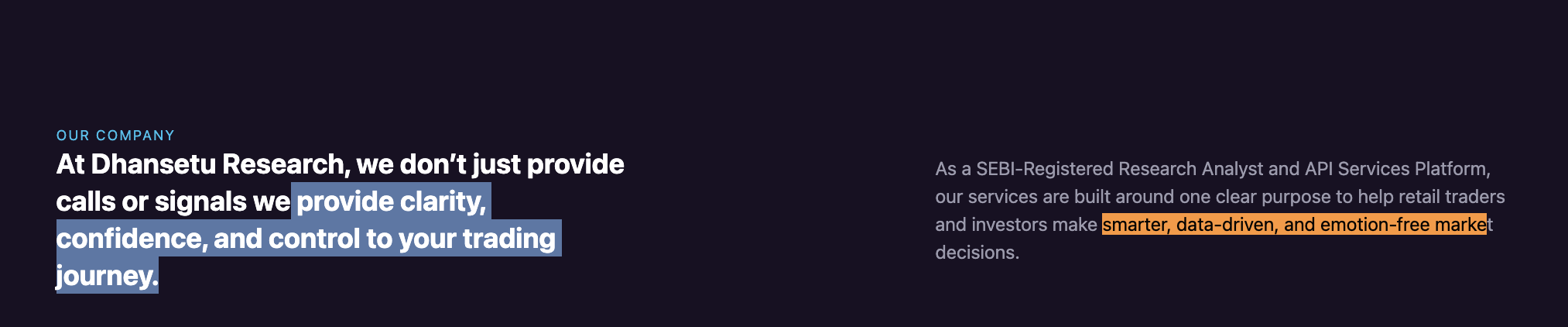
Each of these should be checked for whether it’s factual, substantiated, and genuinely compliant with the RA advertisement code, rather than accepted as marketing flourish.
2. Unsupported Performance Claims for the API Service
The API section uses terms like “high precision,” “rapid broker API execution,” “slippage minimization,” and “consistent strategy logic.”
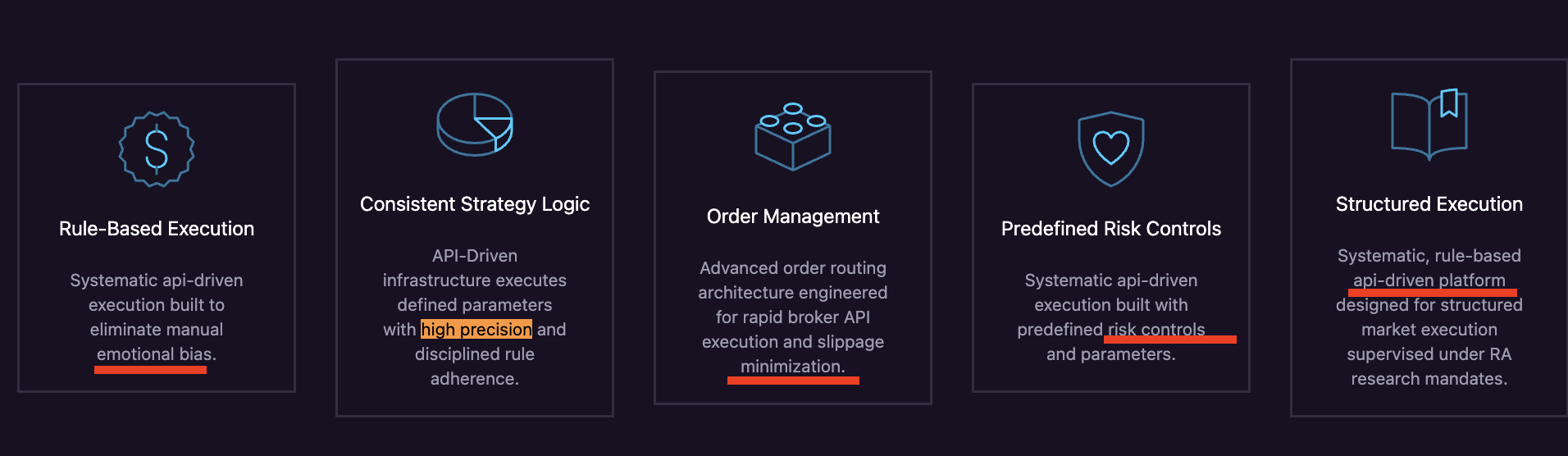
These are execution and performance claims specifically. The website doesn’t appear to provide supporting evidence or defined parameters backing any of them.
3. Broad Superiority Claims With No Backing
The API infrastructure is described as “leading software” that automates trades “effectively & efficiently.”

Claims framed this broadly, “leading,” “effective,” “efficient”, typically require substantiation rather than being presented as simple promotional statements.
Are you facing issues with Dhansetu Research and unsure what to do next?
We will check your specific case against SEBI’s rules and help you file a complaint that actually holds up.
Dhansetu Research Telegram Channel
Beyond the website, Dhansetu Research also runs a Telegram channel, listed as one of its official communication touchpoints under the “Follow Us” section covered earlier.
What gets posted there matters just as much as what’s on the website, since Telegram content from a SEBI-registered entity is still subject to the same advertisement code requirements.
Checking the actual posts turns up three specific patterns worth knowing before you follow along.
Dhansetu Research Telegram Red Flags
Marketing on the website is one thing.
What actually gets posted in the Telegram channel, day to day, tells you more about how this firm really operates.
Three specific patterns show up across the posts:
1. Profit Claims Prominently Promoted
A Telegram post claims ₹7,500 profit on a single lot, followed by the phrase “Jesa Kaha wesa hua” (roughly, “it happened exactly as said”).
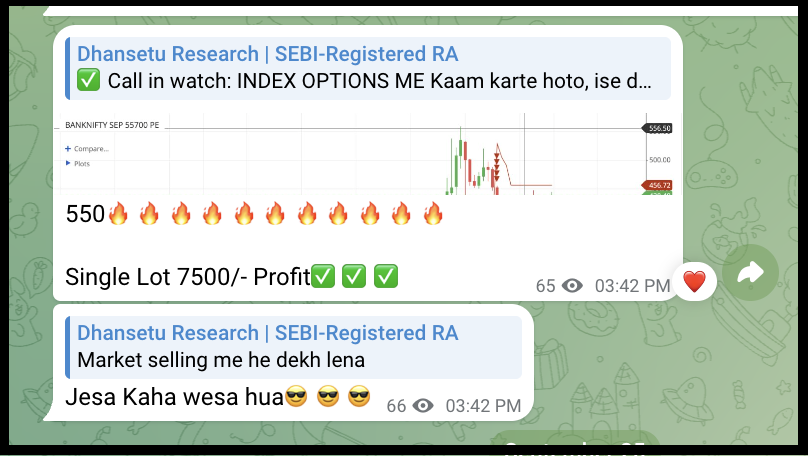
Highlighting one specific profitable outcome this way can create an impression of consistently successful recommendations.
2. Unsubstantiated Return and Safety Claims
Another post pairs “50% Return Running” with “Safe Side trades” and “Book Profit.”
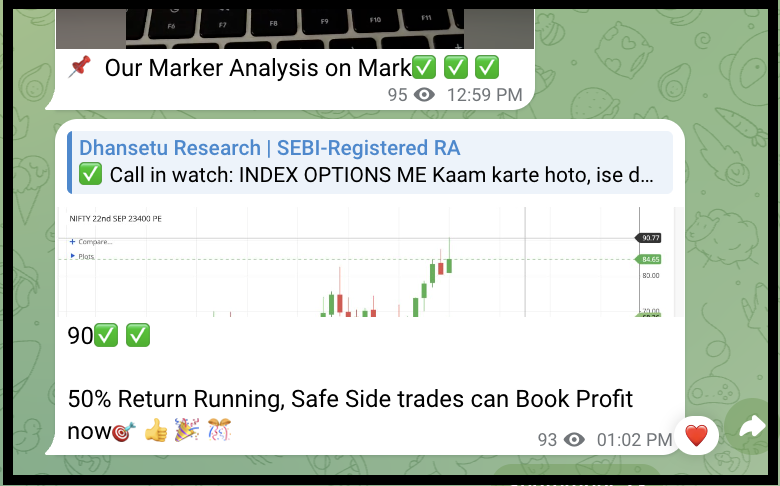
Combining a substantial return figure with language implying safety can give investors the impression of an assured or low-risk outcome, something no research service can actually guarantee.
3. Promotional Presentation of Trading Calls
The channel uses repeated profit, target, and celebratory emojis alongside claims of successful trades.
This gives the posts a strongly promotional character, closer to marketing than the neutral presentation of research SEBI’s framework expects.
How to File a Complaint Against Dhansetu Research?
Every red flag covered above leaves behind its own kind of proof, and knowing which one applies to you decides where your complaint actually starts.
- If the issue is pricing, screenshot the exact plan page showing the fee you were charged, since that’s what proves the gap against SEBI’s cap.
- If it’s the API bundling, save whatever the firm sent you distinguishing, or failing to distinguish, the API service from the research subscription itself.
- If it’s a Telegram claim, screenshot the actual post, timestamp included, before it can be edited or deleted.
Once you have that specific proof, contact Dhansetu Research directly through their Level 1 or Level 2 number and give them a real chance to fix it.
Silence, or a response that doesn’t address the issue, is what moves this from a private dispute into a regulatory one.
At that point, a SCORES SEBI complaint citing registration number INH000024550 puts it on the record.
If unresolved from there, the SMART ODR portal mediates it.
If still unresolved, arbitration in share market settles it for good.
Our guide on SEBI complaint against research analyst walks through each of these stages if you want the fuller version.
Legal Disclaimer: This blog is based on Dhansetu Research’s own published materials and independently verified SEBI records. No SEBI action has been issued against Vivek Singh Rajpoot or Dhansetu Research as of the date of writing
Conclusion
Dhansetu Research’s core registration is genuine. INH000024550 is real, active, and held by Vivek Singh Rajpoot.
What doesn’t sit as cleanly is everything around it. The firm’s own website states a fixed validity date that contradicts SEBI’s perpetual record. Several pricing plans push past SEBI’s annual fee cap once annualised.
Complaints spiked sharply in July and August. And both the website and Telegram channel lean on promotional language that stretches past what SEBI’s advertisement code actually permits.
None of this proves deliberate wrongdoing on its own. Together, it’s a pattern worth asking Dhansetu Research to clarify directly before you commit any subscription fee.
Report. Recover. Stay Fraud Free.
Yes. Registration number INH000024550, held by Vivek Singh Rajpoot, is confirmed active, with SEBI's own record listing perpetual validity. That's unclear, and worth asking the firm directly. SEBI's own record and the firm's own website state two different validity periods for the same registration number. Several plans exceed SEBI's ₹1.51 lakh annual fee cap once annualised, and a few half-yearly plans exceed it on their own. That's worth raising directly before you subscribe. That isn't explained anywhere in the firm's own disclosure. Six of the year's seven total complaints arrived in those two months alone, a pattern worth asking about directly.Frequently Asked Questions





 Add us as a preferred source on Google »

