

Quick Summary
StockBazaari is SEBI registered under INH000018665, so you can file a formal complaint against it. The route has five steps: complain to the firm first, then SEBI SCORES, then SMART ODR, then BSE arbitration. You have strong grounds if a refund was denied on unclear terms, a trade was auto-executed without your say, or your fees crossed the SEBI limit. In one similar case, an investor recovered ₹65,788. This page walks you through each step and what you can realistically get back.
If StockBazaari has denied your refund, auto-executed a trade you never approved, or renewed your Annant plan at a price you did not agree to, a strongly worded WhatsApp message to support will not fix it.
What you need is a paper trail a regulator can act on.
Because the firm holds a live SEBI registration, INH000018665, that trail has somewhere to go.
This page walks through the exact sequence, from the first screenshot you take to an arbitration award you can enforce.
How to Complaint Against StockBazaari in India?
Filing is not one action. It is a sequence, and each stage only works if the one before it was done properly.
Skip the evidence step, and your SCORES filing has nothing to point to.
Skip the direct complaint, and SCORES may send you back to try it first.
The full route runs in five steps, from the first screenshot you take to an arbitration award you can enforce.
Here is the order to follow:
Step 1: Lock Down Your Evidence First
Everything that follows depends on what you can prove, not what you remember.
Before you contact StockBazaari, pull together: The payment confirmation and invoice for whichever plan you bought, showing the exact amount and date.
Every WhatsApp, email, or call recording in which a representative made a specific claim about accuracy, returns, or the user base figure.
Screenshots of the refund policy and the disclosure pages as they appeared on the date you paid, since these can be edited later.
Your broker’s trade log, if you are disputing an auto-executed order, timestamped against when you did or did not give instructions.
A running total of all payments made throughout the year, to check against the SEBI fee ceiling yourself.
Do this before you raise anything with the firm.
Once a dispute is open, support tone changes, and older chat threads get harder to retrieve.
Step 2: Put Your Complaint in Writing to StockBazaari
Send a written complaint through the firm’s official channel, not a chat to a relationship manager. State clearly:
Which plan you bought and what you paid. What was represented before you paid?
What actually happened, and how it differs from what was promised. The specific outcome you want.
Give StockBazaari 30 days to respond in writing.
A phone resolution is not enough. Ask for the outcome in an email so you have a record either way.
Step 3: File With SEBI SCORES
If 30 days pass with no response, or the response does not resolve what you raised, it is time to log a formal complaint on the SEBI SCORES portal.
This is the step most people get wrong by picking the wrong category.
Select Research Analyst as the intermediary type, not Investment Adviser or Stock Broker.
Enter the firm name and registration number INH000018665.
In the complaint text, lay out the sequence factually: what you paid, on what date, what was promised, what happened instead, and which of the firm’s own pages supports your version.
Attach your evidence as clearly labelled files rather than one long screenshot dump.
SCORES complaints move faster when the reviewing officer does not have to reconstruct your timeline.
The complaint must be lodged within one year of the cause of action, or SCORES may reject it.
Once filed, the firm is required to submit an Action Taken Report, after which you can seek a First Level Review within 15 days if you are not satisfied.
StockBazaari SEBI Complaint Email
There is no SEBI complaint email.
SEBI will not act on grievances sent to its email addresses and says so on the SCORES portal.
First, write to StockBazaari’s own grievance or compliance address, listed on its regulatory disclosures page.
Keep that email and its date, because SCORES asks you to show that you approached the firm first.
StockBazaari SEBI Complaint Number
You do not enter one. After you log in to SCORES, the portal issues you a unique complaint registration number on the confirmation screen. Save it.
That number is how you track SEBI complaint status, request a First Level Review, and carry the case into SMART ODR.
It is separate from the firm’s registration number, INH000018665, which you enter when filing.
Step 4: Escalate to SMART ODR
If SCORES closes without a resolution that you accept, the next stage is SEBI’s SMART ODR portal.
The process runs online. You submit your evidence, StockBazaari submits its side, and a neutral conciliator works toward a resolution within a defined timeline.
No physical hearing is required.
This route works especially well for refund disputes and cases with clear financial loss. If conciliation does not settle it, the matter moves to arbitration.
Step 5: File BSE Arbitration
If SMART ODR does not resolve it, arbitration through BSE, where StockBazaari holds enlistment 6590, is the final and binding step.
An independent arbitrator reviews the evidence from both sides and issues a decision with which the firm is required to comply.
For claims under ₹10 lakh, there is no filing fee for the investor.
The longer you wait, the harder it becomes to pull old chat logs and get a straight answer from support.
Do You Actually Have Grounds to File?
You now have the sequence. Before you start it, one honest question decides whether the effort is worth it.
Not every bad trading month is a complaint.
Whether a filing lands depends on your situation matching a real regulatory ground, not just a poor return.
Four situations carry genuine weight. Each maps to something specific.
1. A Refund Denied on Shifting Terms
StockBazaari’s own refund page carries clauses that cannot all be true: a pro-rata refund, a blanket no-refund line, and a one-month delay.
If you were told a different rule applied to your case than the one shown before you paid, that inconsistency is itself part of your complaint.
2. A Trade Executed Without Your Permission
The Options 360 and Trade 360 plans advertise auto-execution through your linked broker account.
A Research Analyst registration covers publishing recommendations, not executing trades for you. An unauthorised or unwanted auto-executed trade is a legitimate ground for escalation.
3. Fees That May Have Crossed the SEBI Cap
SEBI caps what a Research Analyst can charge one client family across all subscriptions at ₹1,51,000 a year.
Stack the tiers across a year and add Annant’s ₹44,999 on top, and you can approach that ceiling quickly.
If your combined billing crosses it, ask for a written breakdown and file if the firm will not explain it.
4. No Straight Answer on What You Are Paying For
If the firm cannot clarify who the research analyst is, or what a plan actually delivers, when you ask, note the date and channel of that non-answer for your file.
The wider pattern of documentation gaps across the firm’s paperwork is set out in our StockBazaari reviews, which are worth reading before you file, so you know which of your own experiences map to a ground.
What Does Recovery Actually Look Like?
Whether you can recover money is not a matter of principle.
It is a matter of what a real case has proved.
Alpha Wealth Research is that case.
It sold subscription-based recommendations without clear upfront terms, then denied a refund citing internal policy, the same pattern behind StockBazaari’s own self-contradicting refund page.
The investor who brought the case had paid ₹1,10,900 across multiple stages after being shown other clients’ profit screenshots.
When his trades lost money, and he asked for a refund, it was denied on internal policy alone.
The violations that decided it: fees collected in stages with no service plan or duration disclosed, no written agreement before payment, other clients’ profit screenshots used to build confidence, and a refund refused with no regulatory basis.
Our team represented that investor through arbitration, building the case on payment records, WhatsApp history, and the missing written agreement.
The arbitrator ordered a refund of 70 percent of the fees collected; ₹65,788 was recovered.
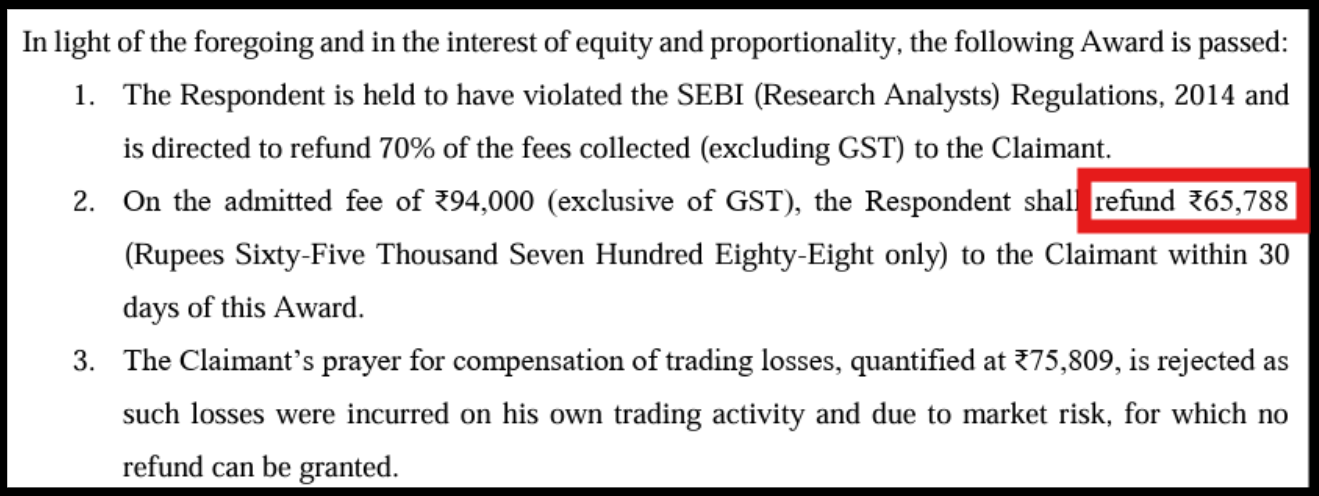
The trading-loss claim itself was rejected, since those losses were tied to market risk, not the fee dispute.
That distinction matters: the complaint framework recovers fees paid to the firm, not market losses from bad calls.
Do you need help filing your complaint against StockBazaari?
We find the exact SEBI rule that was broken in your case, put the evidence together, and handle the filing from SCORES through to arbitration.
Conclusion
A complaint against StockBazaari works best when it follows the sequence in order: evidence, direct grievance, SCORES, SMART ODR, arbitration.
The firm’s registration is genuine, but its refund policy, its mismatched analyst names, and its unclear renewal terms are documented weaknesses you can point to, not assumptions you have to argue from scratch.
The Alpha Wealth Research case shows arbitrators act on exactly this kind of documentation gap.
If your situation matches what is set out here, start collecting your evidence today rather than waiting for support to fix it.
Frequently Asked Questions
Research Analyst, not Investment Adviser or Stock Broker, with registration number INH000018665. Filing under the wrong category is the most common reason SCORES complaints get delayed.
The refund page contradicts itself, including a clause citing a SEBI-mandated pro-rata refund. Do not accept a verbal no. Ask in writing which clause applies and use that document in your SCORES complaint.
Pull your broker's trade log showing the timestamp and compare it against your own instructions. Raise it with the firm first, then include it as a specific ground in your SCORES filing if unresolved.
Fees paid to the firm are recoverable where a violation is documented, as the ₹65,788 Alpha Wealth award shows. Market losses from bad calls generally are not, since those are treated as market risk.
Thirty days for the firm to respond, then SCORES, SMART ODR, and arbitration if needed. Well-documented cases move faster at every stage.





 Add us as a preferred source on Google »

