
Quick Summary
SEBI’s final order of 26 September 2024 found that Investor India Research, a sole proprietorship, gave paid investment advice without registration as an Investment Adviser. SEBI determined that ₹54,49,007 was collected for that advice. It directed a refund, a public notice, asset and bank restrictions and a one year market bar. SEBI later published recovery notices in September and November 2025. This page explains the order, the fees, the complaints and what to do if you paid.
In 2016, three people took calls offering trading tips from a firm called Investor India Research.
Each one later wrote to SEBI, and one said that about six calls had cost a total of ₹1,30,000.
SEBI took years to reach a final order, and it did so on 26 September 2024. Then, in 2025, it moved to recover the money.
Here is what the order says, what happened next and what to do if you paid.
What Is Investor India Research?
Investor India Research was a sole proprietorship that sold stock, commodity and forex market tips.
SEBI’s order says it began in January 2016, and it ran for about a year.
The business had its own website, but that site was inactive when SEBI looked for it.
So the facts below come from the order and from archived pages that SEBI itself reviewed.
What Did Investor India Research’s Website Claim?
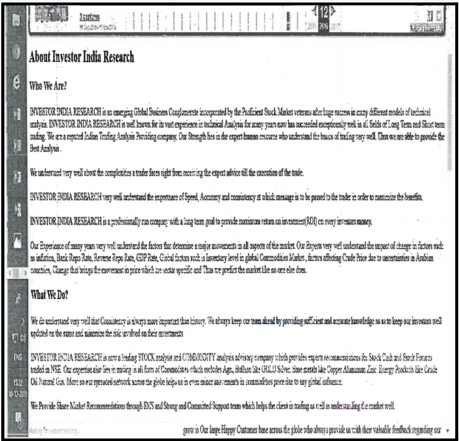
SEBI tried to open investorindiaresearch.com during its examination and found it inactive.
It therefore relied on archived pages from web.archive.org.
Those pages described the business as an emerging global business conglomerate with expertise in stock, commodity and forex markets, including bullion, metals and energy.
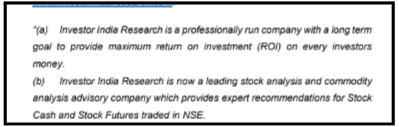
They also said the aim was to provide maximum return on investment, and that recommendations were sent by SMS.
The pages also carried a vision of being the world’s best research house, and a Get a Quick Trial form.
The form listed Stock Cash, Stock Futures, Nifty Futures, Options, Bullion MCX and Agro Pack NCDEX.
These are historical website claims recorded in the order.
However, they are not verified performance results, and the order does not call them a guarantee.
Also Read: Prime Index Trading shares market views while its own profile says the owner is not SEBI registered.
Is Investor India Research SEBI Registered?
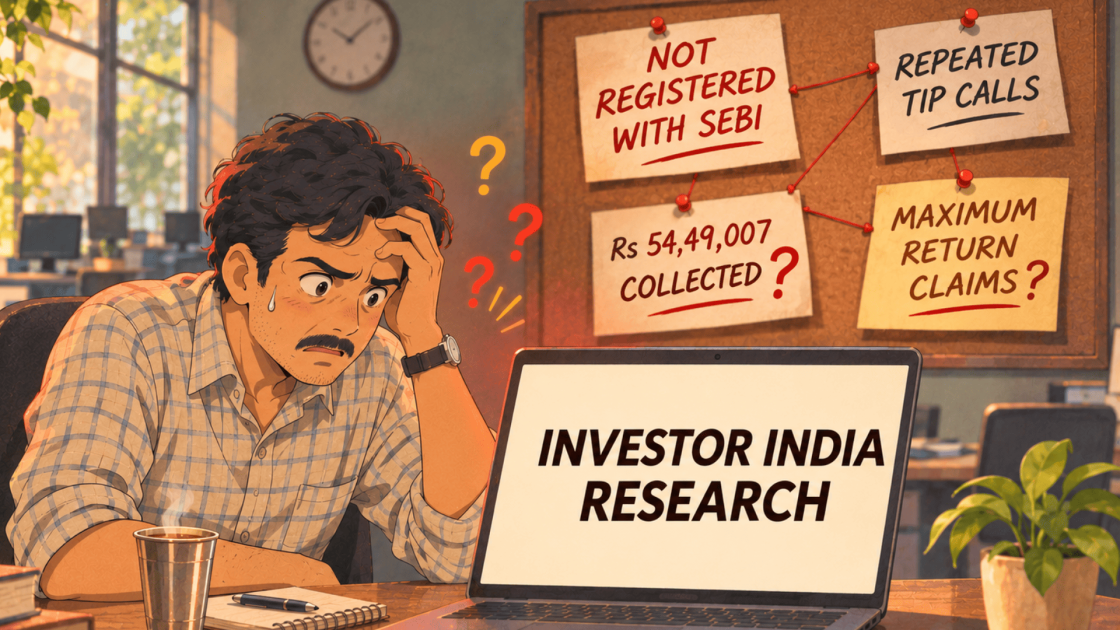
No. SEBI’s order found that the concern and its proprietor were not registered as Investment Advisers, and that is the central finding in the case.
The material reviewed also does not show any Research Analyst, Portfolio Manager or stock broker registration.
So the firm should not be described as any of those.
Investment Adviser Registration And Why It Matters
SEBI treated the activity as investment advice under Regulations 2(1)(l) and 2(1)(m) of the Investment Advisers Regulations, 2013.
Paid advice of that kind needs registration, and that is why the order was passed under Regulation 3(1).
The order explains what registration is meant to ensure.
For example, these include qualification and certification, experience, net worth, conflict disclosures, risk profiling and documented suitability.
Without registration, none of those safeguards apply to the client.
Besides, it helps to know how unregistered advisory firms in India work, since the risk starts with the first payment.
Investor India Research SEBI Order Explained
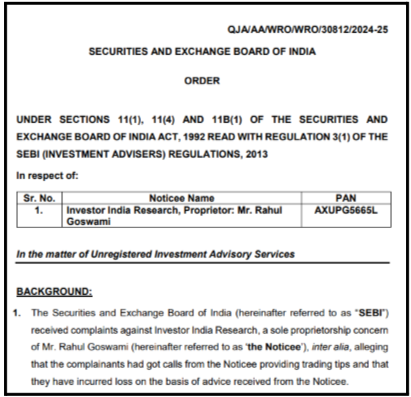
The order is SEBI’s final order No. QJA/AA/WRO/WRO/30812/2024-25, dated 26 September 2024.
It was passed under Sections 11(1), 11(4) and 11B(1) of the SEBI Act, 1992, read with Regulation 3(1) of the Investment Advisers Regulations, 2013.
How The SEBI Proceeding Began
SEBI received three complaints against Investor India Research, a sole proprietorship of Rahul Goswami.
They came in during February to June 2016, and all alleged calls with trading tips followed by losses.
A show cause notice was issued on 19 July 2024 and delivered on 23 July 2024.
Then the proprietor replied on 10 August 2024, and a personal hearing was held through Webex on 27 August 2024.
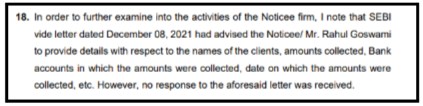
Earlier, SEBI had also written to the proprietor on 8 December 2021, asking for client names, amounts collected, dates and bank account details.
The order records that no reply was received.
What The Proprietor Told SEBI
These are the proprietor’s submissions as recorded in the order, so they are not SEBI’s findings.
He said the firm started in January 2016 and was voluntarily closed after about a year.
He also said he was unaware of the registration requirement.
Yet he admitted giving share market recommendations for a fee, and he said the firm did not promise assured returns or handle clients’ demat accounts.
He asked SEBI to close the case with only a warning.
However, SEBI rejected ignorance of the registration requirement as a defence.
What SEBI Found
SEBI found that the website promoted stock, commodity and forex analysis with paid recommendations, and that the proprietor admitted giving advice for consideration without registration.
Therefore, it held that this activity was investment advice.
SEBI therefore concluded that the concern and its proprietor violated Section 12(1) of the SEBI Act, read with Regulation 3(1) of the Investment Advisers Regulations, 2013.
For readers who want to see how SEBI has acted in similar cases, our page on SEBI action against unregistered advisory is a useful comparison.
Investor India Research Packages And Fees
SEBI recorded that the archived website offered paid packages for specific trading products.
These included Intraday Cash, HNI Cash, Delivery Pack, Future Positional and Option BTST.
The order states that fees on the site ran from ₹5,000 a month up to ₹7.80 lakh a year.
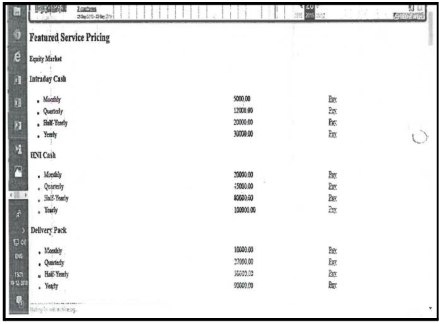
However, the screenshot reproduced in the order shows only three packages, so we list those below.
Investor India Research Package Prices Recorded By SEBI
The table shows the prices as displayed on the archived website. They are 2016 prices, so they are not current ones.
| Package | Monthly | Quarterly | Half Yearly | Yearly |
| Intraday Cash | ₹5,000 | ₹12,000 | ₹20,000 | ₹30,000 |
| HNI Cash | ₹20,000 | ₹50,000 | ₹80,000 | ₹1,00,000 |
| Delivery Pack | ₹10,000 | ₹27,000 | ₹55,000 | ₹90,000 |
The archived page also showed a quick trial form and a list of service categories.
That supports SEBI’s description of a subscription based way of getting customers, but it does not show how many people subscribed.
The ₹7.80 Lakh Maximum Fee
The order separately records a maximum fee of ₹7.80 lakh a year.
Yet the pricing screenshot in the order does not show which package or calculation led to that figure.
SEBI’s fee limits for Investment Advisers came later, in 2020, and came into force from 30 September 2020.
The fixed fee cap then introduced was ₹1,25,000 a year per client.
So the 2016 prices cannot be treated as a breach of those limits, and the decisive finding was unregistered advice.
Investor India Research Bank Accounts And ₹54,49,007
Money is the part of the order that matters most to anyone who paid, so SEBI’s tracing deserves a close look.
SEBI traced where the fees went and worked out a figure.
Three Accounts Shown On The Website
The archived website listed three current accounts under a Payment Options section, all in the name Investor India Research and all at an Indore branch.
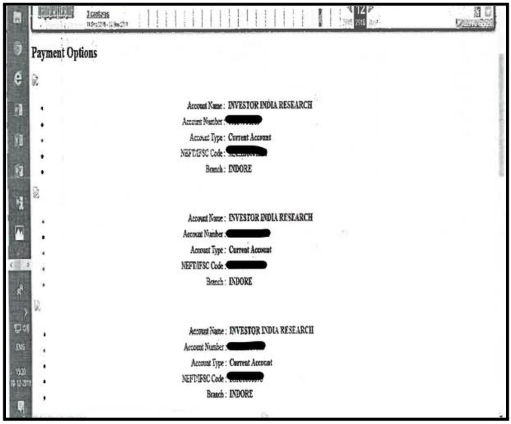
SEBI got the statements, KYC papers and account opening forms from the banks, and they identified the proprietor as the sole owner.
The credits SEBI found in the three accounts are in the table below.
Account numbers and IFSC codes are masked in the order.
| Bank | Credits Identified By SEBI | Period Shown |
| Bank of Maharashtra | ₹25,42,040 | June 2015 to December 2016 |
| HDFC Bank | ₹10,38,705 | January 2016 to February 2017 |
| ICICI Bank | ₹21,33,062 | January 2016 to December 2016 |
| Total | ₹57,13,807 | Across the three accounts |
The total is the amount of credits SEBI examined, and some of the periods shown run outside the January to December 2016 period that the proprietor admitted.
It is not yet the amount of fees, as the next part explains.
How SEBI Reached ₹54,49,007
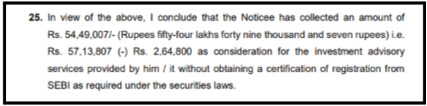
The proprietor said that ₹2,64,800 of the credits were account opening amounts and money returned after failed NEFT transactions.
SEBI accepted that explanation.
Then it deducted ₹2,64,800 from ₹57,13,807.
That left ₹54,49,007, which SEBI determined had been collected as consideration for unregistered investment advisory services.
This is a regulatory calculation based on bank records, not an estimate.
Moreover, SEBI used it as the basis for its refund direction.
What Did Investor India Research Complaints Reveal?
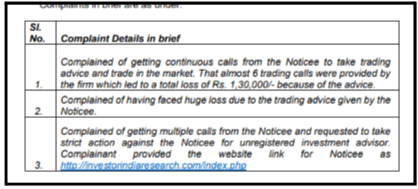
SEBI’s order records three complaints received between February and June 2016.
The order summarises them, and the table below shows what the complainants alleged.
What The Three Complainants Alleged
These are allegations recorded by SEBI, and the order does not say that each loss was separately checked or adjudicated.
| Complaint | What The Complainant Alleged | Loss Stated |
| 1 | Repeated calls to take trading advice, with about six trading calls that allegedly led to a total loss | ₹1,30,000 |
| 2 | A huge loss due to trading advice from the firm | Not specified |
| 3 | Multiple calls, and a request for strict action against the firm as an unregistered adviser, with the website link supplied | Not specified |
Only the first complaint gives a figure. So the order does not give a complete total of what all three complainants lost.
Each complaint is a single user’s account.
Even so, together they started the SEBI examination that led to the final order.
Investor India Research SEBI Directions
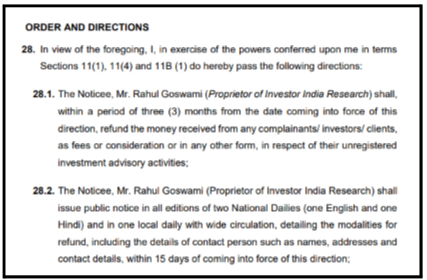
SEBI’s directions are in paragraph 28 of the order, and they came into force immediately.
In short, they cover refunds, public notices, restrictions and reporting, and each one is explained below.
1. Refund And Public Notice Directions
SEBI directed the proprietor to refund, within three months, the money received from complainants, investors and clients for the unregistered advisory activity.
Repayments had to go through a channel with an audit trail, such as a demand draft, pay order or electronic transfer.
It also directed a public notice within 15 days.
The notice had to appear in all editions of two national dailies, one English and one Hindi, and in one widely circulated local daily, with the refund details and contact information.
2. Asset, Bank And Market Restrictions
SEBI restricted the sale of assets, properties and mutual fund, share or securities holdings, except to make the directed refunds.
Banks were told to allow debits only for refunds.
The proprietor was debarred from the securities market for one year from the order date, or until one year after the refunds were completed, whichever was later.
Also, he was barred from advisory services or market activity without registration.
3. Refund Completion Report And Escrow
The proprietor had to submit a refund completion report to SEBI, certified by an independent chartered accountant.
Any balance was to go into an escrow account with SEBI for one year.
If it stayed unclaimed after that, the money would then go to SEBI’s Investor Protection and Education Fund.
The order also says the refund direction does not stop clients from pursuing other legal remedies for refund or deficiency in service.
That matters for anyone who paid.
Investor India Research Recovery Notices In 2025
The matter did not end with the 2024 order. SEBI’s website later carried two recovery records under the same matter.
1. Notice Of Demand On 5 September 2025
SEBI published a Notice of Demand dated 5 September 2025 under Recovery Certificate No. 8890/2025 against the proprietor.
So it shows that recovery proceedings had begun.
A recovery certificate is how SEBI moves to collect money that a person has not paid under an order.
So this was a step beyond the original directions.
2. Notice Of Attachment On 3 November 2025
SEBI then published a Notice of Attachment dated 3 November 2025.
It covered bank accounts and demat accounts, numbered 14988 and 14989, and it identified the proprietor as a defaulter under the same recovery certificate.
That shows SEBI had moved to attachment, and attachment is a further enforcement step.
3. What Is Still Unconfirmed
The records we reviewed do not say how much was recovered.
They also do not say whether every affected investor was repaid, or whether the refund process was completed as of 16 November 2026.
Those points stay open until a later SEBI recovery update or a certified compliance report is found. So this page makes no claim about them.
Investor India Research Red Flags: What Do They Warn About?
These are points taken from the order and the records.
Still, they show what to watch for in any firm that sells tips, and they are not new allegations.
1. Paid Advice Without Registration
SEBI expressly found that the proprietor gave advice for consideration without a certificate of registration.
Indeed, this is the central finding in the order.
2. Repeated Calls With Trading Tips
All three complaints described calls or tips, and one alleged about six calls that led to a ₹1,30,000 loss.
Still, these are complaint allegations recorded by SEBI.
3. Return Maximisation Wording
The archived site said the firm aimed to give maximum return on every investor’s money.
The order does not say this wording was a guarantee, but it is performance minded marketing that deserves caution.
4. Large Sums Through Several Accounts
SEBI identified ₹54,49,007 as advisory fees after reviewing three accounts.
Therefore, a business that collects such sums should be able to show its registration.
5. No Reply To SEBI’s Request
SEBI’s letter of 8 December 2021 asked for client names, amounts and bank details.
Yet the order records no response to it.
How To Check An Advisory Firm Like Investor India Research?
You can do most of this check in a few minutes, and it works for any firm that sells tips.
First, start with the register, and not with the call or message that reached you.
- Registration: Search the exact name on SEBI’s register. An Investment Adviser number starts with INA and a Research Analyst number starts with INH.
- Payment details: Pay only to an account in the registered name, because a personal account or a UPI ID in someone’s name needs a question first.
- Promises: Treat maximum return wording and assured profit claims with caution.
- Calls: Be careful with repeated unsolicited calls offering tips, since several complaints in this case began that way.
- Records: Keep the website pages, chats, call details and payment proof from day one.
What To Do If You Paid Investor India Research?
After paying this firm, the safest start is to act in writing and keep copies of everything.
The order and the recovery notices give you a starting point, but your own records are what show your payment.
Anyone who wants to understand unregistered advisor fraud recovery can start with the steps below, because they begin with your proof and a written report.
1. Collect Your Payment Proof
Save your bank statements, UPI screenshots and receipts, along with any messages or call details that show what you were offered.
Then put the dates and amounts in one sheet.
Also note which of the three bank accounts you paid into, because the order lists all three.
2. Check The SEBI Refund Notice
The order required a public notice on refunds in two national dailies and one local daily.
Look for that notice and for SEBI’s recovery notices on its website, since they name the order and the recovery certificate.
If you find a contact person or refund details, use them, and keep a record of the reply.
3. Investor India Research Complaint: How To Email SEBI?
Since the firm was found to be unregistered, the route is a written email to SEBI.
Quote the order number, state when and how much you paid and attach your proof.
Our steps on how to complaint in SEBI show what to include, and you can draft the email from there.
Then ask SEBI for the status of the refund process in your case.
An email to SEBI reports your payment, but it does not return your money by itself.
The order also leaves clients free to pursue other legal remedies, so a separate recovery plan may still be needed.
Paid an unregistered adviser and unsure what to do next?
Share your payment proof and the order details, and we tell you which route fits your case. Register with us for a free consultation.
Disclaimer: This page is for information only. It is based on SEBI’s final order dated 26 September 2024 and on SEBI’s published recovery notices of 5 September 2025 and 3 November 2025, as of 17 November 2026. It makes no allegation beyond what those records state. The final refund and recovery status is not confirmed. This page is not investment advice. Please confirm all details on SEBI’s website before acting.
Conclusion
SEBI’s order of 26 September 2024 found that Investor India Research gave paid investment advice without registration.
It determined that ₹54,49,007 was collected, and it directed refunds, a public notice, asset and bank restrictions and a market bar.
Meanwhile, SEBI’s recovery notices of September and November 2025 show that the matter moved to enforcement.
The final refund status is still not confirmed in the records we reviewed.
A website that talks about maximum returns is not a licence to advise.
So check the register before you pay and, if you already paid, collect your proof and write to SEBI.
Report. Recover. Stay Fraud Free.
Frequently Asked Questions
No. SEBI's order of 26 September 2024 found that Investor India Research and its proprietor were not registered as Investment Advisers while giving paid advice. The material does not show any Research Analyst, Portfolio Manager or stock broker registration for the firm.
SEBI found that the firm gave paid investment advice without registration, violating Section 12(1) of the SEBI Act. It directed a refund within three months, a public notice, asset and bank restrictions, and a one year market bar for the proprietor.
SEBI examined bank credits of ₹57,13,807 across three accounts. It excluded ₹2,64,800 of account opening and failed transfer amounts. It determined that ₹54,49,007 was collected as consideration for unregistered investment advisory services.
SEBI directed a refund of client money, and it later issued recovery notices in 2025. The records do not confirm how much was repaid. Keep your payment proof, write to SEBI, and note that the order lets clients pursue other legal remedies.
SEBI's order found that it carried on investment advice without the registration that law requires. The order does not use labels such as fraud. So the safe statement is that SEBI found unregistered advisory activity and directed refunds.
Write an email to SEBI with the firm name, website, payment proof, amount paid and what you were promised. Attach documents in date order. Keep a copy of the email and of any reply you receive from SEBI.





 Add us as a preferred source on Google »