

Quick Summary
Is Acumen Capital Market genuine? Yes, it holds a valid SEBI registration, along with NSE, BSE, MCX, and NCDEX memberships. But a December 2020 SEBI adjudication order found compliance failures including fund segregation issues, margin reporting gaps, and missing call recording systems, resulting in a ₹5 lakh penalty. This guide covers what SEBI found, what real users report, and how to complain against Acumen Capital Market if your own experience raises similar concerns.
If you’ve been searching for how to complain against Acumen Capital Market, you’re in the right place.
Acumen Capital Market (India) Limited is a full-service stock brokerage firm incorporated in 1995.
The company describes itself as one of Kerala’s leading stock brokers and operates under SEBI registration number INZ000170434.
This guide walks through everything: whether Acumen Capital Market is genuine based on its registration and regulatory history, what SEBI found when it examined the firm, and exactly how to raise a formal complaint if you believe your rights have been violated.
Is Acumen Capital Market Genuine?
Acumen Capital Market (India) Limited is a legitimately incorporated and SEBI registered entity. It is not a shell company or an unregistered operator.
It holds valid memberships with NSE, BSE, MCX, and NCDEX, and is registered with both CDSL and NSDL for depository services. Its current status under the Ministry of Corporate Affairs is Active.

But here is the distinction that matters for cautious investors: regulatory registration and a long operating history confirm that a firm exists within the system.
They do not tell you how client money was handled, whether trade authorisations were properly documented, or whether internal compliance systems met the standards SEBI requires.
The 2020 adjudication order answers those questions.
Unauthorised Trading by Acumen Capital
Unauthorised trading means a trade was executed in your account without your permission, or without a record the broker can produce if you dispute it later. Every legitimate order should trace back to you directly, or to an instruction you clearly and verifiably approved.
This is worth understanding on its own, since it is one of the most common reasons investors end up filing a formal complaint against Acumen.
Warning signs worth watching for include:
- Trades appearing in your account with no clear recollection of approving them.
- A sudden increase in F&O exposure that does not match your stated risk appetite.
- Verbal trading instructions from a dealer with no written or recorded confirmation afterward.
- Pressure to “trust the dealer” instead of confirming instructions in writing.
- Delayed or vague explanations once losses start showing up.
If you notice even one or two of these patterns, it is worth reviewing your contract notes and trade history closely rather than assuming it is normal market movement.
What you should do: download your transaction history immediately, save any trade confirmations for the disputed period, and raise a written complaint with Acumen’s compliance team naming the specific trades in question.
The broker, not you, carries the burden of proving the trade was authorised, and that is exactly the kind of situation the next section walks through in more detail.
Also Read: ACML Capital Markets complaints, why technical glitches still deserve real documentation when they happen.
When Should You Complain Against Acumen Capital Market?
Not every frustration warrants a formal complaint, but some situations genuinely do. Knowing the difference saves your time and helps the regulatory system work efficiently for everyone.
You should consider raising a formal complaint when your broker shows any of the following.
- Unauthorised Trades: If trades appear in your account without your approval or understanding, this may point to unauthorised trading by Acumen Capital. Raise the issue immediately in writing, and always review trade alerts and contract notes carefully.
- Fund Settlement Delays: If withdrawal requests remain pending for unusually long periods without proper clarification.
- Incorrect Charges: Concerns regarding brokerage charges, penalties, margin calculations, or unexplained deductions.
- Poor Complaint Handling: Support teams that stop responding or fail to provide proper written clarification.
- Account Access Issues: Login restrictions, account freezing concerns, or operational access problems.
- Documentation Problems: Missing statements, incomplete records, or inconsistent transaction communication.
Before escalating any complaint, maintain written evidence of all communication.
How To File a Complaint Against Acumen Capital?
Once you have a genuine grievance, the process is not something you have to figure out on your own. SEBI and the exchanges have built a specific sequence for this, and following it in order matters more than rushing to the end.
Here is exactly how to work through it, step by step.
Step 1: Organise All Documents
Collect and organise all available records properly: contract notes, ledger statements, bank records, screenshots, email communication, WhatsApp chats, account opening documents, and other trade-related records.
Proper documentation makes it easier to explain your concerns.
Step 2: Contact the Broker Officially
Always try to resolve the issue directly with the broker first. Contact through official support channels and clearly explain your client ID, the issue faced, the relevant dates, the financial impact involved, and the resolution you expect.
Communicate through email so written records remain available.
Step 3: Register a Complaint with SCORES
If the broker does not resolve the issue, file through the SEBI SCORES complaint portal.
The process involves creating an account, selecting the intermediary details, uploading supporting documents, clearly describing the grievance, and tracking the complaint status through the platform.
This creates a formal regulatory grievance record connected with the matter.
Step 4: File Complaint in Smart ODR
For larger financial disputes, a SMART ODR portal filing moves your case into structured online conciliation.
If conciliation does not resolve the issue, arbitration may become relevant depending on the facts and nature of the dispute.
Step 5: Share Market Arbitration
If your complaint relates to a specific monetary loss or claim, arbitration in stock exchange through NSE or BSE is the next step.
You must file within three years of the dispute. The process is faster and less expensive than civil litigation, and the outcome is binding.
If you want to see the full process laid out end to end before starting, our guide on complaint against broker to SEBI walks through every stage in one place.
In many situations, people who take timely action and maintain proper documentation improve their chances of pursuing recovery through available regulatory and dispute resolution mechanisms.
Also Read: Fortune Capital complaints, covering how to keep copies of every email and chat with the broker.
SEBI Order Against Acumen Capital Market
On 10 December 2020, SEBI issued an adjudication order against Acumen Capital Market (India) Limited. The order reference is Order/KS/AE/2020-21/9770, publicly available on SEBI’s official website under the Enforcement section.
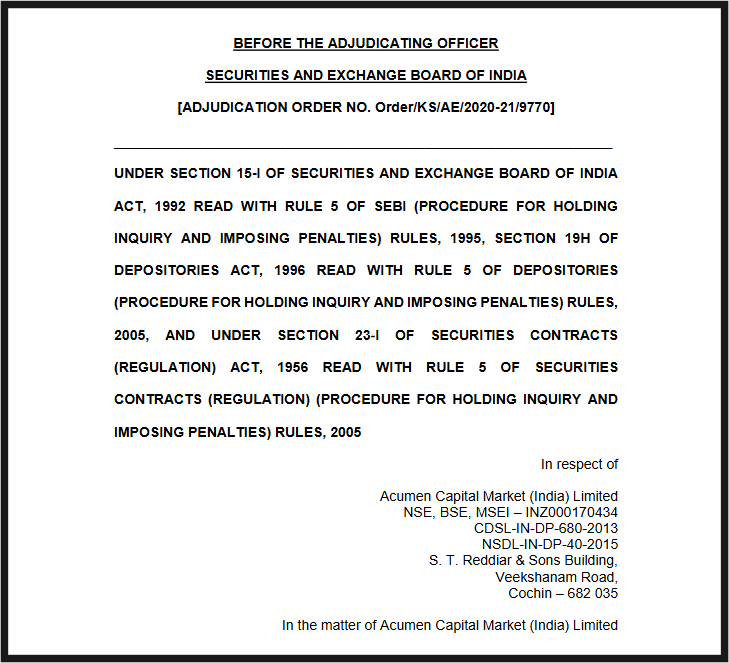
SEBI’s Adjudication Officer initiated proceedings after a regulatory review of the company’s operations, governed by the SEBI (Procedure for Holding Inquiry and Imposing Penalties by Adjudicating Officer) Rules, 1995.
A Show Cause Notice was issued, and the company had the right to respond before any final order was passed.
The order addressed six distinct areas of concern, ranging from trading conduct to basic record keeping. Each one matters differently depending on what actually happened in your own account
1. Alleged Synchronised and Circular Trading
SEBI observed alleged synchronised trading and circular trading patterns among certain parties involved in the investigation, along with alleged violations connected to the broker code of conduct.
Synchronised trading happens when the same quantity of shares is bought and sold by the same broker in a coordinated manner, creating volume on screen without any real change in beneficial ownership.
Circular trading works similarly, moving the same security between related parties to create the appearance of active, genuine trading interest.
The regulator noted that such trading activity could create a misleading market appearance and affect market integrity.
For an ordinary investor, this matters because synchronised or circular activity can distort the price signals you rely on when deciding whether a stock looks genuinely in demand.
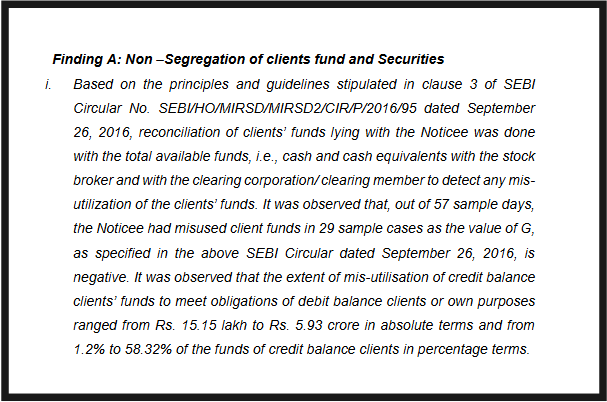
2. Non-Segregation of Client Funds and Securities
SEBI observed that client funds and securities were not maintained separately in the manner required under regulatory norms.
Proper segregation exists specifically to stop a broker from using client money for its own operational needs or proprietary trades.
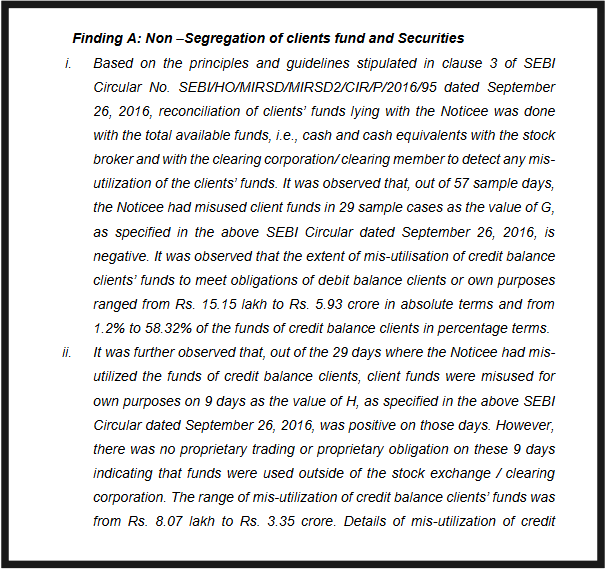
When funds are not segregated, the wall between what belongs to you and what the broker can freely use starts to disappear.
This is not a paperwork gap. It is a failure of the core protection investors assume is automatically in place the moment they deposit money with a registered broker.
3. Incorrect Margin Reporting
SEBI found incorrect margin reporting in the Futures and Options segment, with four instances identified carrying a cumulative shortfall of ₹73.44 lakh.
After reviewing Acumen’s explanation, SEBI accepted one instance but upheld violations in the remaining three.
Margin reporting exists to show regulators, and indirectly investors, how much real risk exposure a broker is carrying on behalf of its clients at any given time.
Incorrect reporting means the true risk picture was not accurately visible, which undermines the entire purpose of margin rules in the first place.
4. No Call Recording System at All Locations
Call recording for client orders became mandatory from April 1, 2018, but Acumen had not fully implemented the system across all locations by the inspection period.
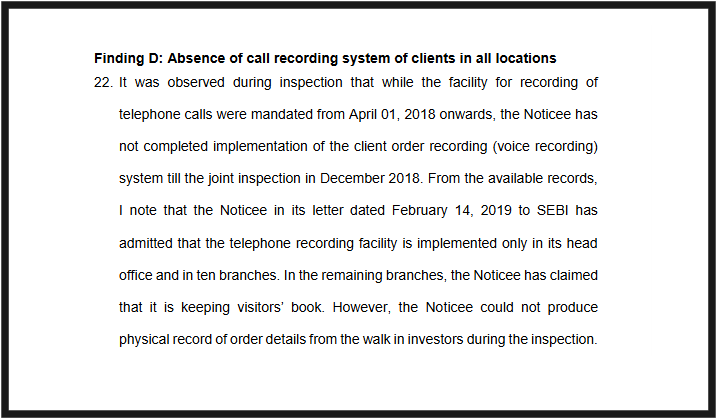
The company admitted the system existed only at the head office and ten branches.
This gap matters more than it might first appear. Call recordings are often the single strongest piece of evidence in a dispute over whether a trade was actually authorised.
Without a recording, a disagreement between an investor and a dealer over what was said on a call becomes almost impossible to resolve with certainty, and the branches without the system were operating with none of that protection at all.
5. Incomplete Income Details and Delayed CKYC Uploads
SEBI found that Acumen had not collected income details for 35 clients who opted for F&O trading, and their running account authorisations were also undated.
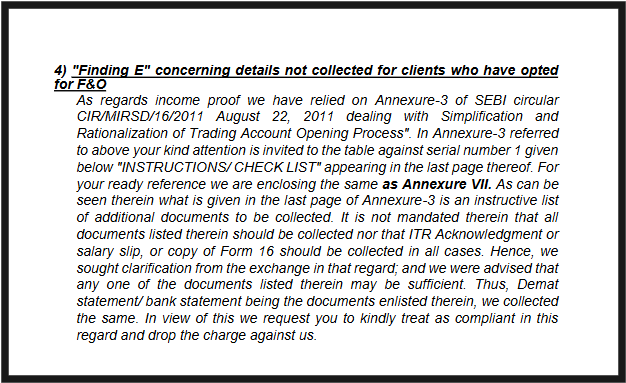
Income proof exists so a broker can genuinely assess whether a client has the financial capacity to handle the higher risk of derivatives trading.
Undated authorisations create a separate problem: ambiguity over exactly when a client’s consent for running account settlement was actually given, which matters significantly if that consent is ever disputed later.
Separately, SEBI found delays in uploading client details to the CKYC system in 55 out of 92 sampled clients, ranging from 1 day to 338 days. Acumen stated the process was later automated.
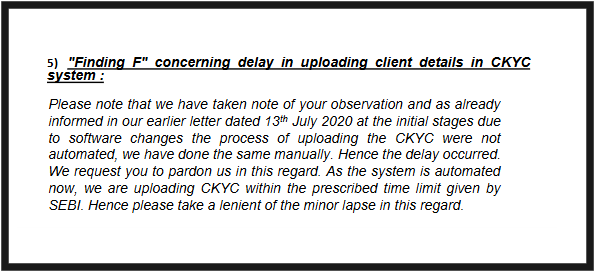
CKYC delays affect how reliably a client’s identity and records can be verified across the financial system, which matters for both fraud prevention and dispute resolution.
6. DP Operation and KRA Deficiencies
SEBI also found issues in demat account opening and KRA-related compliance, including missing second holder KYC details, delayed KRA uploads, non-dispatch of account opening letters, and errors in maker-checker controls.
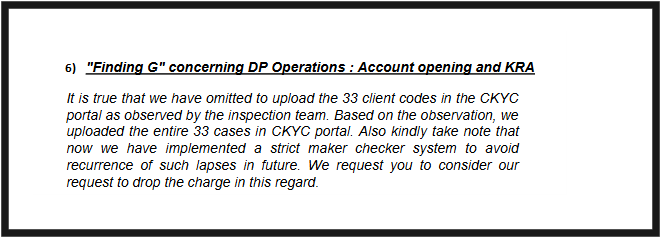
Maker-checker controls exist as a basic internal safeguard; one person initiates an action and a separate person verifies it before it takes effect.
Errors here suggest the internal review process meant to catch mistakes before they reach a client’s account was not functioning as intended.
Also Read: Order rejected in Nuvama, a trade blocked, with no clear reason given at all.
Penalty Imposed on Acumen Capital Market
Violations across six separate categories do not necessarily result in six separate fines. SEBI consolidates its assessment and imposes penalties under the specific legal provisions each violation falls under, which is exactly what happened here.
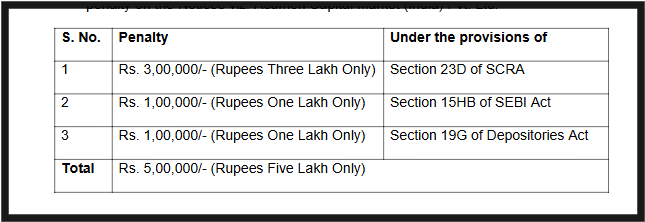
SEBI imposed a total monetary penalty of ₹5,00,000 on Acumen Capital Market, split across three provisions: ₹3,00,000 under Section 23D of SCRA, ₹1,00,000 under Section 15HB of the SEBI Act, and ₹1,00,000 under Section 19G of the Depositories Act.
Under SEBI’s framework, penalties for stockbroker regulation violations under Section 15HB can go up to ₹1 crore depending on severity, so the amount imposed here reflects the adjudicating officer’s specific assessment of these facts rather than the maximum available.
The order does not mean every investor who had an Acumen account during the inspection period suffered direct financial harm.
It does mean the compliance failures documented created conditions in which investor protection mechanisms were not fully functioning as required.
Still dealing with a brokerage issue nobody at Acumen will properly explain?
Our team reviews your ledger statements and contract notes, maps the exact SEBI rule the broker may have broken, and structures a complaint built to get a real response instead of silence.
Acumen Capital Market Complaints
Most investors do not leave reviews when everything works smoothly. Reviews usually appear when expectations and experiences do not match.

A segment of reviewers expresses dissatisfaction with the advisory services. Complaints suggest that investment recommendations did not always align with the client’s stated risk profile or financial goals.
Online reviews may not represent the complete picture, but repeated themes can still help investors identify possible areas of concern.
Conclusion
Choosing a stockbroker is one of the most consequential financial decisions you make. Your money, your securities, and your trading activity all pass through that relationship.
Acumen Capital Market operates within the regulated securities ecosystem and has functioned as a recognised market intermediary.
However, publicly available regulatory records and user reviews also show that the company has faced compliance scrutiny and investor dissatisfaction in certain situations.
If you are already a client and something doesn’t feel right, don’t let it sit. Keep your documents, know your complaint escalation path, and don’t hesitate to use it when you need to.
Report. Recover. Stay Fraud Free.
Yes. It holds valid registrations with NSE, BSE, MCX, NCDEX, CDSL, and NSDL, and has operated since 1995 under registration number INZ000170434. The SEBI order documented that client funds and collateral were not fully segregated as required. This does not mean every client suffered a direct financial loss. ₹5,00,000 total, split as ₹3,00,000 under Section 23D of SCRA, ₹1,00,000 under Section 15HB of the SEBI Act, and ₹1,00,000 under Section 19G of the Depositories Act. If your dispute involved trades placed during a period when your branch lacked a functioning recording system, your personal records become the primary evidence available. File a formal written complaint with Acumen first, then escalate through SEBI SCORES. SEBI publishes all adjudication and enforcement orders on its website, searchable by firm name or registration number. NSE and BSE investor portals also publish member level disciplinary actions.Frequently Asked Questions




 Add us as a preferred source on Google »

