

A research subscription often starts with a phone call.
The representative sounds confident, discusses market opportunities, and explains how professional research may help improve your trading decisions.
Before making any payment, however, most investors search for one important question: Is NA Supreme Research SEBI registered?
If you are searching for the same answer, you are already taking a step that many investors, unfortunately, skip.
NA Supreme Research SEBI Registered or Not?
Yes, NA Supreme Research Private Limited is registered with SEBI as a Research Analyst under registration number INH000017745.
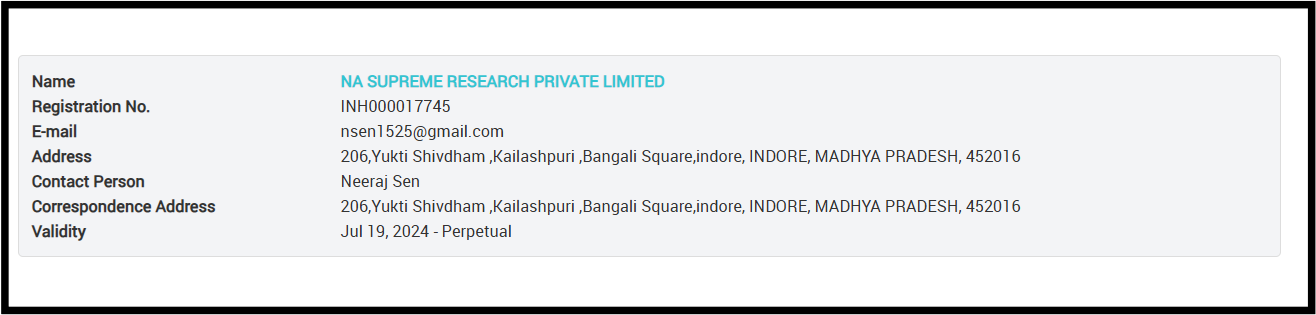
According to SEBI’s records, the registration became effective on July 19, 2024, and currently carries perpetual validity, meaning it remains active unless suspended, cancelled, or otherwise acted upon by the regulator.
The firm’s registered office is 206, Yukti Shidham, Kailashpuri, Bangali Square, Indore, Madhya Pradesh – 452016.
For many investors, finding a valid SEBI registration provides confidence because it confirms that the firm is authorised to offer research services under the SEBI (Research Analyst) Regulations.
At the same time, it is important to understand what this registration actually represents.
It confirms regulatory authorisation, but it does not guarantee profits, ensure successful recommendations, or remove the risks involved in stock market investing.
For investors looking closely into the firm’s background, like NA Supreme Research owner name, SEBI records list Neeraj Sen as the primary contact, while corporate filings note Vedant Nagar’s involvement in key management.
The registration details provide useful information about the firm’s regulatory status, but investors should always verify the registration themselves instead of relying solely on promotional material or social media claims.
Also Read: Vibhor Varshney SEBI registered, a two-minute check most people never actually run.
How to Verify NA Supreme Research’s SEBI Registration Yourself?
Many stock market advisory firms showcase their regulatory status on social media or pitch calls, but the safest approach is always independent verification.
Cross-checking a company’s claims directly through official channels ensures you are dealing with a legitimate entity rather than an impersonator.
You can easily verify the firm’s status on your own by following these steps:
- Step 1: Go to sebi.gov.in
- Step 2: Click Intermediaries in the top navigation menu.
- Step 3: Select Registered Intermediaries and choose Research Analyst from the category list
- Step 4: Search for NA Supreme Research or enter registration number INH000017745
What you will find:
- Entity name: NA Supreme Research Private Limited
- Registration number: INH000017745
- Category: Research Analyst
- Status: Registered and active
- Contact person: Neeraj Sen
What you will not find:
- Any SEBI adjudication order or penalty notice against the firm.
- Any suspension or debarment record.
- Individual registrations for Neeraj Sen or Vedant Nagar.
The registration is real. The question this page answers is what that registration permits the firm to do, and where the legal boundary sits.
What Does NA Supreme Research’s SEBI Research Analyst Registration Permit?
SEBI’s Research Analyst Regulations 2014 set out the exact scope of what a registered RA can do.
These are the activities NA Supreme Research is authorised to conduct under INH000017745.
1. Formal research reports with recommendations
The core permitted activity. A research report includes a buy, sell, or hold recommendation, the analysis behind it, the assumptions made, the risk factors identified, and a disclaimer.
This is the product that a SEBI RA is registered to provide.
2. Market education and general commentary
General views on market conditions, sector analysis, and educational content about trading approaches are within scope.
This includes webinars, newsletters, and educational sessions about trading concepts.
3. Research alerts with entry, target, and stop-loss levels
Alerts that specify an entry price range, a target, and a stop-loss level are permitted research communications.
They must be based on actual, documented research, never just random, off-the-cuff guesses.
4. Delivery via SMS
NA Supreme Research specifies SMS as a delivery channel for its research alerts. Delivery via SMS is a permitted format under SEBI’s RA framework.
An SMS alert saying the research recommendation is to buy a specific stock within a stated price range, with a target and a stop-loss, is within the scope of what a registered RA can deliver.
5. Fixed pre-disclosed fees
Research analyst fees must be fixed, disclosed in writing before services begin, and not linked to trading performance or profits.
What Does the NA Supreme Research Licence Not Permit?
While a valid registration gives a firm the legal authority to operate, it also comes with strict regulatory boundaries.
Understanding what a Research Analyst is legally forbidden from doing is the easiest way to spot whether an adviser is crossing the line and violating compliance rules.
Here is exactly what the NA Supreme Research licence does not permit:
1. WhatsApp live calls are not the same as SMS alerts
There is a clear difference between an SMS alert that says a research recommendation is to buy a specific security within a price range, with a target and stop-loss, and a WhatsApp message that says buy now at the current price, maximum quantity, sent during live market hours.
The first is a research communication. The second is a live execution instruction.
Live execution instructions require a separate SEBI registration as an Investment Adviser.
An RA licence does not cover real-time WhatsApp calls that tell you to act immediately during trading hours.
If the messages you received from NA Supreme Research were live calls sent during market hours rather than formal research alerts, the delivery method was outside the permitted scope of their registration.
2. Guaranteed return promises are prohibited in any format
SEBI Research Analyst Regulation 15(9) explicitly prohibits guaranteed or assured return promises. This applies to SMS, WhatsApp, email, phone calls, and marketing material.
There are no exceptions.
If any NA Supreme Research representative told you that losses would be recovered, that returns were guaranteed, or that the next set of calls would definitely make up for your losses, that statement violated SEBI regulations in the moment it was made.
3. Recommending trades outside the subscribed service is not permitted:
If you paid for an index options plan and the representative began recommending stock options or equity trades, they were delivering services outside your contracted scope.
An RA is authorised to provide the research described in the service agreement.
Recommendations outside that scope are not covered by the registration.
4. Profit-sharing or performance-linked fees are prohibited
All RA fees must be fixed and pre-disclosed.
If NA Supreme Research or any representative asked for a share of your profits or linked any additional fee to your trading performance, that fee structure is prohibited under SEBI’s RA Regulations, regardless of how it was described.
5. Loss recovery upgrades sold on the back of incurred losses:
Specifically offering a premium upgrade as a solution to losses already incurred, with the implication that the upgrade will recover those losses, is a prohibited form of guaranteed return representation.
This is the exact pattern documented in the ₹65,000 case study, which you can read about in detail on our NA Supreme Research reviews page.
What Should I Check Before Paying for a Subscription?
Handing over your hard-earned money to an advisory firm is a major decision that shouldn’t be rushed based on a convincing sales pitch.
Taking a few minutes to clarify the exact terms of your engagement protects you from hidden clauses and unexpected upgrades later on.
Make sure you review these four critical areas before making any payment:
- Confirm the delivery format in writing: Ask specifically whether recommendations will be delivered as formal research reports or as WhatsApp messages during trading hours.
The answer determines whether the service sits within the RA scope. - Get the complete fee agreement in writing before paying: The service agreement should specify the fee amount, the service duration, what is included, and the refund policy.
If any of these are communicated only verbally, do not pay until they are confirmed in writing. - Ask directly about guaranteed returns: The correct answer from any SEBI-registered entity is that no returns can be guaranteed.
If the representative says anything other than a clear no, document it. That statement is a SEBI violation and the starting point of a complaint if you pay and lose money. - Confirm which trading segment the service covers: If you are paying for an index options service, get written confirmation that recommendations will be limited to index options trades.
Recommendations in other segments without prior disclosure and agreement are outside the contracted scope.
How Does SEBI Registration Protect Us?
A SEBI registration doesn’t just authorise a firm to provide research services. It also gives investors access to a formal grievance redressal system if they believe the firm has failed to meet its regulatory obligations.
Since NA Supreme Research Private Limited is registered as a Research Analyst, investors are not limited to contacting the company directly.
If a dispute remains unresolved, several regulatory channels are available to help escalate the matter.
These include:
- SEBI SCORES to submit complaints against registered Research Analysts and seek regulatory intervention when required.
- SMART ODR, SEBI’s online dispute resolution platform, which helps resolve eligible disputes through a structured mediation process.
- Stock Exchange Arbitration, where eligible monetary disputes can be decided through a legally binding arbitration process under the applicable exchange rules.
These mechanisms are available because the firm operates within SEBI’s regulatory framework.
They provide investors with recognised channels to pursue a complaint if they believe there has been a violation of the applicable regulations or a dispute that remains unresolved.
Every complaint is different, and the appropriate channel depends on the nature of the issue and the evidence available.
If you want to understand which complaint route applies to your case, what documents you’ll need, and the complete filing process, read our detailed guide: how to file a complaint against NA Supreme Research →
Need help taking the next step?
If you’ve already paid for the service and believe it didn’t match what was promised, our team reviews your case, identifies the applicable regulatory issues, and helps you file your complaint correctly from the very beginning.
Conclusion
NA Supreme Research Private Limited is registered with SEBI as a Research Analyst under registration number INH000017745, and the registration is currently active.
This authorises the firm to provide research services in accordance with the SEBI (Research Analyst) Regulations.
However, a SEBI registration should not be viewed as a guarantee of profits or investment success.
It defines what a registered Research Analyst is permitted to do and sets clear boundaries on practices that are prohibited under the regulations.
Before subscribing to any research service, investors should verify the registration, understand the scope of the service being offered, review the fee structure, and ensure that all representations made by the firm comply with SEBI’s regulatory framework.
Frequently Asked Questions
1. Is NA Supreme Research registered with SEBI?
Yes. NA Supreme Research Private Limited holds SEBI Research Analyst registration INH000017745.
The registration is active. You can verify this on SEBI’s intermediary portal at sebi.gov.in by searching the registration number or the entity name.
2. What does SEBI registration INH000017745 actually cover?
It covers formal research reports with buy, sell, or hold recommendations, general market education, SMS-based research alerts with entry, target, and stop-loss levels, and fixed pre-disclosed subscription fees.
It does not cover live WhatsApp execution calls, guaranteed return promises, or recommendations outside the subscribed service scope.
3. Can NA Supreme Research legally send WhatsApp trade calls during market hours?
If the WhatsApp messages are research alerts in the same format as an SMS alert, they may be within scope.
If they are live execution instructions sent during market hours telling you to buy or sell immediately at current prices, that constitutes execution guidance that requires a separate SEBI Investment Adviser registration.
The format and timing of the message determine whether it is within the RA licence scope.
4. Is SMS delivery of research alerts permitted under the SEBI RA licence?
Yes. SEBI’s Research Analyst Regulations permit delivery of research communications via SMS. NA Supreme Research specifically mentions SMS as a delivery channel.
An SMS alert specifying a research recommendation with entry range, target, and stop-loss is within the permitted scope.
5. What services does NA Supreme Research offer?
Under its SEBI registration, the firm is authorized to provide formal research reports, general market commentary, and SMS-based research alerts with clear entry, target, and stop-loss levels.
However, it cannot legally offer live WhatsApp execution calls, guaranteed returns, or trades outside your subscribed segment.
6. What if NA Supreme Research recommended trades outside my subscribed plan?
That constitutes delivery of services outside the contracted scope, which is a basis for complaint.
Document the original service agreement specifying what was included, and document the trades recommended that were outside that scope.
File on SEBI SCORES citing the service scope violation alongside any other violations present in your case.
7. Can I still complain if I signed a no-refund agreement?
Yes. A no-refund clause cannot override SEBI regulatory obligations. If NA Supreme Research violated the boundaries of its Research Analyst licence during your engagement, the clause does not protect them.
SEBI adjudicators and arbitration tribunals have upheld investor complaints in these circumstances.





 Add us as a preferred source on Google »

