

So you have been hearing about Yash Garg Academy and wondering whether it is the real deal.
Maybe a friend mentioned it, or you came across one of its Telegram channels promising big returns.
Either way, you are right to do your research before spending any money.
Here is what you need to know upfront: SEBI passed a formal enforcement order against Mr. Yash Garg and Yash Trading Academy in March 2026.
This blog walks you through exactly what SEBI found, what it means for investors, and what you should watch out for.
Yash Garg Academy Details
Yash Trading Academy, also referred to as YTA, was a proprietary business run by Mr. Yash Garg, operating primarily through YTA Premium Telegram channel and a website (yashtradingacademy.com).
Mr. Yash Garg is the proprietor of Yash Trading Academy.
He managed multiple Telegram channels under names including “Yash Trading Academy,” “YTA,” “YTA Premium,” “YTA Premium Calls,” and “Intraday Blaster.”
Some of these channels had subscriber counts ranging from under 100 to over 211,000.
Because Yash Trading Academy was a proprietorship, there is no legal separation between the business and the individual.
Under Indian law, Mr. Yash Garg is personally liable for everything done in the name of Yash Trading Academy.
He later confirmed to SEBI, via emails in June and July 2024, that he ran these channels, that the mobile numbers appearing on the channels belonged to him, and that he had collected fees and profit shares from clients directly into his personal bank accounts.
What Services Did Yash Garg Academy Offer?
This is where you need to pay close attention because there is a significant gap between what was promised and what was legally permitted.
Based on the Telegram channels examined by SEBI, Yash Trading Academy was offering these types of services:
1. Trading Calls and Investment Tips
Subscribers were offered specific buy and sell recommendations on stocks and derivatives, including Bank Nifty calls, stock options, futures, and intraday tips, for a fee.
Pricing included monthly plans at ₹1,000 to ₹10,000 and yearly plans up to ₹15,000.
2. Account Handling Services
This went several steps further. Clients were invited to either hand over access to their demat accounts or entrust Yash Garg with trading capital.
He would then trade on their behalf and keep a share of the profits.
Profit-sharing arrangements ranged from 50:50 to 90:10 in the client’s favour, with minimum investment requirements starting at ₹20,000.
3. Learning Programmes
A learning programme was also offered for a fee of ₹5,000.
On the surface, this might sound like a trading education business.
But under Indian securities law, the first two services are regulated activities that require mandatory SEBI registration.
Mr. Yash Garg had neither.
Is Yash Garg Academy Legit?
This is a question worth examining carefully, and the answer is not as simple as it might first appear.
Here is what the record shows: On the surface, Yash Garg built something that clearly resonated with a large number of people.
His primary Telegram channel, “Yash Trading Academy,” accumulated over 211,000 subscribers. A scale that does not happen without some degree of genuine engagement.
He offered structured service tiers, learning programmes, and intraday calls, and by his own account to SEBI, he discontinued operations voluntarily once he became aware of the regulatory requirements that applied to what he was doing.
He did not attempt to evade SEBI’s examination and responded to its queries during the investigation.
That said, the regulatory record raises serious concerns that any prospective client should weigh carefully.
Mr. Yash Garg was not registered with SEBI as an Investment Adviser or Portfolio Manager at any point while offering these services.
His channels falsely claimed to be “OWNED AND CONTROLLED BY NISM AND SEBI REGD. TEAM.” SEBI’s own intermediary database confirms no such registration existed.
His channels also made promises of guaranteed returns, like 100% profit guarantees, 0% risk, fixed monthly returns of 20% on capital.
These are claims that are not only factually unsupportable in any market environment but are specifically prohibited under Indian securities law.
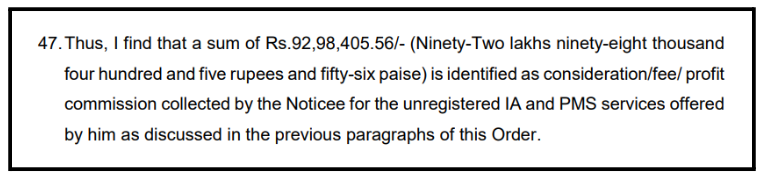
SEBI’s examination of four of his bank accounts found that approximately ₹92.98 lakhs was collected from clients for services he was not authorised to offer.
He has since been penalised ₹16 lakhs and directed to refund the full amount to investors.
The facts above are drawn directly from SEBI’s enforcement order dated March 27, 2026. What you make of them is your call.
But remember: it is important to consider all the facts before making a decision. Let us take a look at the SEBI order against Yash Garg.
Also Read: Harikanta Overseas IPO risk, why a book crossing 100% isn’t automatically a good sign.
Yash Garg SEBI Order
The case was between the Securities and Exchange Board of India (SEBI) and Yash Garg, proprietor of Yash Trading Academy.
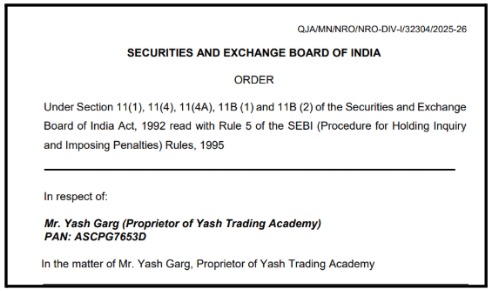
SEBI investigated allegations that he was offering unregistered investment advisory and portfolio management services through Telegram and social media channels, while falsely claiming to be SEBI-registered and promising guaranteed returns to investors in exchange for fees and profit-sharing commissions.
What Was the Case?
SEBI found that Yash Garg operated multiple Telegram channels offering stock tips, premium trading calls, account handling, and portfolio management services without SEBI registration.
The investigation revealed that clients paid fees and shared trading profits under various plans. SEBI also observed misleading claims such as “100% guaranteed profit” and false representations that the business was SEBI-registered.
Bank account analysis showed that around ₹92.98 lakh was collected from investors through these activities between 2019 and 2023.
Despite repeated notices and hearing opportunities, the noticee neither replied to the show-cause notice nor appeared before SEBI.
What Penalty Did SEBI Impose?
SEBI’s order, dated March 27, 2026, imposed a sixteen lakh penalty for Fraudulent and unfair trade practices, Unregistered portfolio management services and Unregistered investment advisory services.

SEBI also instructed Mr. Yash Garg to refund the entire ₹92,98,405.56 to investors within three months and to publish a public notice in two national dailies and one regional newspaper within 15 days, detailing how investors can claim refunds.
He has also been barred from accessing the securities market for a minimum of two years, or until the refund compliance report is filed, whichever is later.
Even after the debarment ends, he cannot offer investment advisory or portfolio management services without first obtaining proper SEBI registration.
Red Flags This Case Highlights
Whether you are looking at Yash Garg Academy or any other trading education platform, the Yash Garg case is a useful checklist of warning signs.
- Guaranteed return promises: Any platform promising fixed or guaranteed profits from stock trading is making a claim that is both factually false and legally prohibited.
- False SEBI registration claims: Always verify on SEBI’s official website. Never rely on what a Telegram channel or website says about itself.
- Account handling offers: If someone asks for access to your demat account or trading capital in exchange for profit sharing, that is Portfolio Management. It requires a SEBI licence. Anyone offering it without one is operating illegally.
- Urgency and discount tactics: The SEBI order documents several “limited time” offers and fee waivers used to push investors into quick decisions. Legitimate advisers do not work this way.
- No verifiable track record: Claims like “₹3,50,182 profit earned by our subscribers in one month” or “15 lakh booked for paid clients” with no audited, verifiable evidence are red flags, not reassurances.
How to Claim Refund from Yash Trading Academy?
Time matters. The sooner you act after spotting a problem, the better your chances of protecting your money and building a solid case.
1. Document Everything
Before you do anything else, start pulling together your evidence.
Go through everything carefully, like trade confirmations, contract notes, call recordings, emails, screenshots and lay it all out in the sequence it happened.
2. File a Complaint with SCORES
The next step is to submit your complaint through SEBI’s SCORES platform.
Filing a complaint on SCORES places the matter under formal regulatory monitoring, sets a response timeline for the concerned entity, and allows SEBI to oversee the resolution process to ensure accountability from both sides.
3. File a Complaint in SMART ODR
If investors are dissatisfied with the response received through SCORES, they can further escalate the issue through SEBI’s SMART Online Dispute Resolution (ODR) system.
The SMART ODR mechanism offers a structured dispute resolution process where disputes between investors and market intermediaries may proceed through conciliation and, if required, formal arbitration within a legally recognised framework.
4. Stock Market Arbitration
If the dispute remains unresolved after earlier steps, investors may proceed with formal arbitration under SEBI’s dispute resolution framework.
In this process, an independent arbitrator reviews the evidence presented by both parties and delivers a legally binding decision on the matter.
Need Help?
Discovering something is off in your trading account is unsettling.
There is a fair amount involved in getting it right:
- Reviewing your transaction history for anything that does not add up.
- Spotting unauthorised or suspicious trades.
- Drafting a clear, well-structured complaint.
- Collecting and organising the right supporting documents.
- Preparing submissions for SEBI or arbitration.
One misstep can set your case back or weaken it when it matters most. You do not have to handle this alone.
Register with us today, and we will take it forward from here.
Conclusion
Yash Trading Academy operated without SEBI registration while offering services that legally required it.
It made false claims of being SEBI registered. It promised guaranteed returns to investors.
SEBI found that the conduct violated provisions relating to fraudulent and unfair trade practices under Indian securities law.
Mr. Yash Garg himself admitted to SEBI that he provided these services without registration.
He has been penalised ₹16 lakhs, directed to refund approximately ₹93 lakhs to investors, and barred from the securities market for a minimum of two years.
This is not a review based on opinion. These are the findings of India’s securities regulator, documented in a formal legal order.
If you were a client of Yash Trading Academy and paid fees for any of its services, you have the right to claim a refund.





 Add us as a preferred source on Google »

