
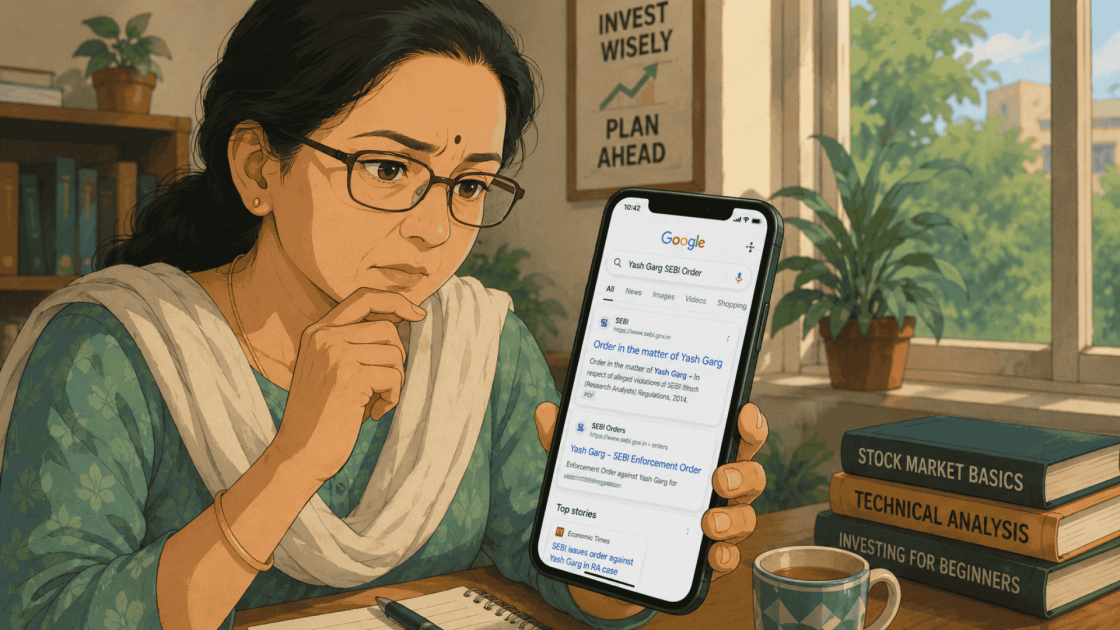
If you have ever followed a stock tip on Telegram or paid someone to “handle” your trading account, this case is going to feel uncomfortably familiar.
SEBI recently passed an order against Mr. Yash Garg, the proprietor of Yash Trading Academy and the details are a textbook lesson in how unregistered operators work, and what happens when SEBI catches up with them.
Let’s walk through it together, simply and honestly.
Who Is Yash Garg?
Yash Garg is the proprietor of an outfit called Yash Trading Academy (YTA), which operated primarily through multiple Telegram channels and a website at www.yashtradingacademy.com.
Many investors who came across his channels first searched online, asking: Is Yash Garg Academy genuine? What SEBI uncovered gives a definitive answer to that question.
During SEBI proceedings, he stated that he had started the business in 2020 and later came under regulatory scrutiny regarding the services being offered.
He ran several Telegram channels, including “Yash Trading Academy,” “YTA Premium,” “YTA Premium Calls,” and “Intraday Blaster“, which reportedly accumulated a large subscriber base.
In his own words, submitted to SEBI during examination, he acknowledged starting the channels to provide portfolio services and collecting fees and profit shares from clients directly into his personal bank accounts.
At this stage, a common question arises: can investment advisors charge fees without registrations?
Generally, no. SEBI’s regulatory framework requires advisors to obtain valid registration before offering regulated advisory services for consideration.
Why Did SEBI Investigate Yash Garg?
It started with a complaint.
Someone who had paid Yash Trading Academy ₹25,000 for a one-month plan which included a 50% profit-sharing agreement came forward and flagged the operation to SEBI.
The complainant alleged that YTA was claiming to be a SEBI-registered intermediary while offering investment calls and demat account handling, both of which require a SEBI licence to offer commercially.
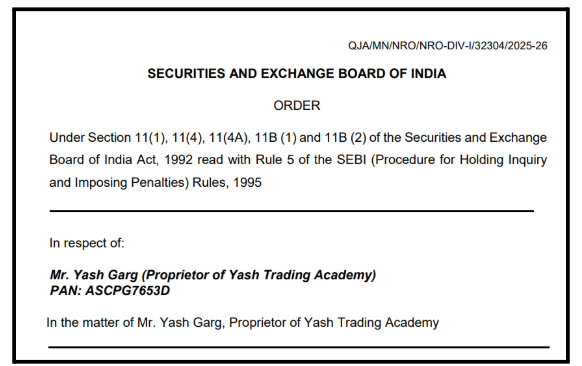
SEBI then did what it does: it examined the YTA Premium Telegram channels linked to the operation and scrutinised the bank accounts of Yash Garg.
What they found was enough to issue a Show Cause Notice on November 14, 2025.
Yash Garg was notified through email, speed post, and eventually through newspaper publications in two national dailies.
Despite all this, he neither replied to the notice nor showed up for the personal hearing scheduled for March 16, 2026.
SEBI proceeded on the basis of the evidence already on record which included, importantly, admissions Yash Garg himself had made in earlier correspondence.
Major Reasons SEBI Took Action Against Yash Garg
This isn’t a case of a grey area or a technicality. There were multiple, clearly documented violations.
Here is what SEBI found:
1. Running an Unregistered Investment Advisory Service
Yash Garg was offering paid trading calls, specific buy/sell recommendations on stocks and derivatives, to subscribers across his Telegram channels.
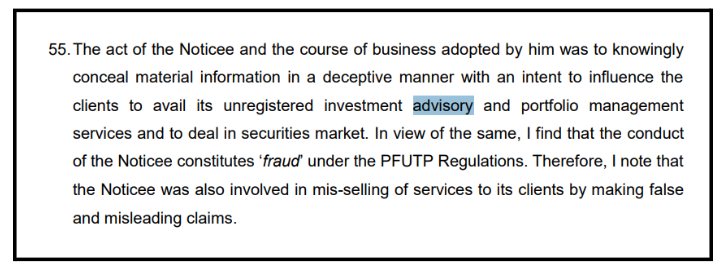
He charged fees ranging from ₹1,000 to ₹10,000 per month and up to ₹15,000 per year for these calls.
Under Indian law, anyone providing such advice commercially, for a fee, must be registered with SEBI as an Investment Adviser (IA). He was not.
This violates Section 12(1) of the SEBI Act read with Regulation 3(1) of the SEBI (Investment Advisers) Regulations, 2013.
2. Running an Unregistered Portfolio Management Service
Beyond just giving tips, Yash Garg offered what he called “account handling services”: clients would either hand over access to their demat account or entrust him with trading capital, and he would trade on their behalf, keeping a share of the profits.
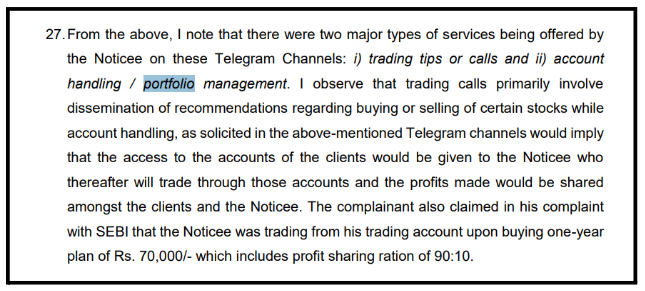
These arrangements had profit-sharing ratios ranging from 50:50 to 90:10 in favour of the client, with minimum investment requirements of ₹20,000 to ₹1,00,000, and one-day charges of ₹1,000 going up to ₹75,000 per year.
This is, by definition, Portfolio Management. And providing Portfolio Management Services commercially requires a separate SEBI registration as a Portfolio Manager.
He did not have that either.
3. Falsely Claiming to Be SEBI Registered
Several of his Telegram channels openly stated things like:
“THIS CHANNEL IS OWNED AND CONTROLLED BY NISM AND SEBI REGD. TEAM”
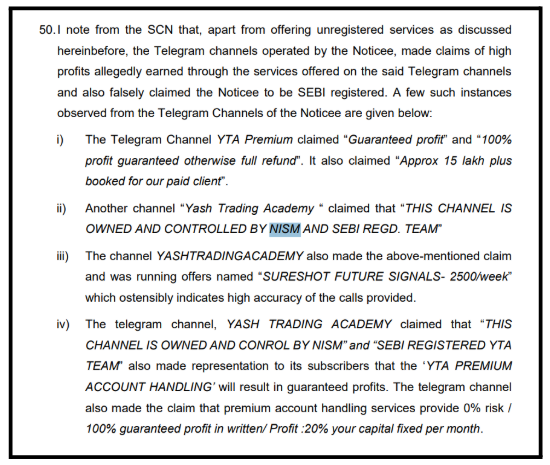
This was factually false.
He was not registered with SEBI in any capacity, as confirmed by SEBI’s own intermediary database. Making this claim to attract clients is considered fraud under securities law.
4. Promising Guaranteed Returns
His channels were full of claims like:
- “100% profit guaranteed, otherwise full refund”.
- “0% risk / 100% guaranteed profit”.
- “Assured handsome returns daily with 100% consistency”.
Here is the truth: no one can guarantee returns in stock markets. Securities investments carry market risk.
Making such claims to attract clients when you know the reality is different is classified as fraudulent and misleading conduct under SEBI’s PFUTP Regulations.
5. Collecting Nearly ₹93 Lakhs in Illegal Fees
SEBI examined four of Yash Garg’s bank accounts with Axis Bank, IDFC Bank, Yes Bank, and AU Bank covering the period from November 2019 to April 2023.
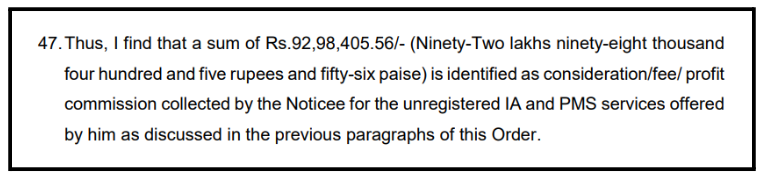
After filtering out unrelated credits such as self-transfers, Zerodha payouts, Dream11 winnings, and cashbacks, SEBI identified ₹92,98,405.56 (approximately ₹93 lakhs) as fees, advisory charges, and profit commissions collected for unregistered services.
This money was collected from real investors who believed they were dealing with a legitimate, regulated entity.
Penalty on Yash Garg
SEBI’s order, passed on March 27, 2026, came with both financial penalties and operational restrictions.
A total monetary penalty of sixteen lakhs was imposed for Fraudulent and unfair trade practices (Section 15HA), Unregistered portfolio management services (Section 15HB) and Unregistered investment advisory services (Section 15EB).
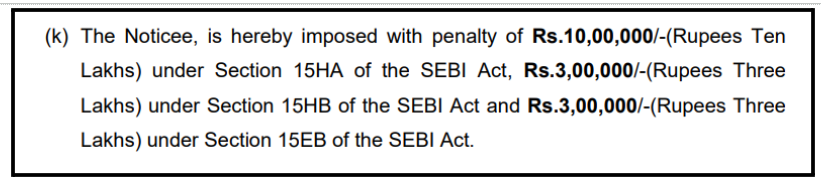
This penalty must be paid within 45 days of receiving the order.
-
Refund Order
Yash Garg has been directed to refund the entire ₹92,98,405.56 to investors within three months.
He must also publish a public notice in two national dailies (English and Hindi) and one vernacular newspaper within 15 days, detailing how investors can claim their refunds.
Refunds must happen through traceable electronic channels only, no cash.
-
Market Debarment
He is barred from accessing the securities market, directly or indirectly, for a minimum of two years, or until the refund compliance report is filed, whichever is later.
He is also prohibited from selling his own assets and securities (except to fund refunds), and his banks and depositories have been directed to ensure this.
-
Permanent Prohibition on Unregistered Activity
Even after the debarment period ends, he cannot offer investment advisory or portfolio management services without obtaining proper SEBI registration. This is a permanent condition.
Any failure to comply with the refund directions gives SEBI the authority to recover the amounts directly under Section 28A of the SEBI Act.
What Should Investors Learn From This?
This case has a few honest lessons and they are worth taking seriously before you follow the next tip on a Telegram channel.
-
Always Verify SEBI Registration Before Paying Anyone
Before you pay a single rupee to any “trading academy,” adviser, or account manager, check if they are registered with SEBI.
Registration is not optional for commercial advisers, it is mandatory under Indian law.
-
“SEBI Registered” Claims on Telegram Mean Nothing Without Verification
Anyone can type those words on a social media channel.
The only way to confirm it is to check SEBI’s official intermediary database yourself. Do not take a Telegram bio as proof.
-
Guaranteed Returns Are a Red Flag, Not a Selling Point
If someone promises you guaranteed profits in the stock market, that is your cue to walk away.
No legitimate, registered adviser makes such promises. SEBI regulations specifically prohibit it for a reason.
-
“Account Handling” Is a Serious Matter
Handing your demat account credentials to someone you met on Telegram is extremely risky.
Beyond the legal issue of the service being unregistered, you have no control over what trades are placed, and you may have limited recourse if things go wrong.
What Can You Do In Such Cases?
Move quickly to safeguard your money and build a stronger case.
The actions you take right after spotting a problem can make a real difference to how things turn out.
If the Channel or Advisor is registered with SEBI, you can follow these steps:
1. Document Everything
Start by building a solid evidence base.
Go through your account carefully and gather everything that matters, like trade confirmations, contract notes, call recordings, emails, screenshots and then arrange it all in the order events occurred.
A well-organised, chronological record does more than support your complaint; it often makes your case more convincing than any explanation could.
2. File a Complaint with SCORES
The next step is to raise the matter on SEBI’s SCORES platform.
Doing so brings them under formal regulatory oversight, triggers a defined response deadline, and keeps SEBI actively involved to ensure both parties are held accountable.
3. File Complaint in SMART ODR
If investors are not satisfied with the response or outcome received through the SCORES platform, they may further escalate the dispute through SEBI’s SMART Online Dispute Resolution (ODR) mechanism.
The SMART ODR framework provides a more structured dispute resolution process where matters between investors and market intermediaries can proceed toward conciliation and, where necessary, formal arbitration under a legally recognised system.
4. Stock Market Arbitration
If earlier resolution efforts fail, investors may escalate the matter to formal arbitration under SEBI’s dispute resolution mechanism, where an independent authority examines the evidence and issues a legally binding decision.
If you are a victim of unregistered advisory Like Yash Garg, you can follow these steps:
Step 1: Gather and Organise Your Evidence
Before taking any action, collect all relevant records connected to your interaction with the advisory service.
This may include payment receipts, bank transfer records, WhatsApp chats, emails, advisory messages, screenshots, agreements, and call recordings, if available.
Step 2: Raise the Issue Directly in Writing
Send a formal written complaint by email and clearly explain the issue you have experienced. Include important details such as payment information, dates, and the resolution you are seeking.
Keep copies of all communications and provide a reasonable timeframe for a response. Written correspondence creates an important record if the matter needs to be escalated.
Step 3: Escalate the Matter Through SEBI
If the issue remains unresolved, investors can raise a complaint through SEBI’s investor grievance mechanisms.
When submitting your complaint, include a clear timeline of events, details of the services purchased, payment records, supporting evidence, and the outcome you are seeking.
Step 4: Consider Filing a Police Complaint
In cases involving significant financial loss, disappearance of the operator, or other serious concerns, investors may also consider approaching their local police station and filing a formal complaint.
Provide all available evidence, including payment records, communications, and any other supporting documents.
Need Help?
Having to navigate the entire complaints process is not an easy task.
Getting it right involves quite a bit:
- Reviewing your transaction history for discrepancies.
- Identifying unauthorised or suspicious trades.
- Drafting a clear, well-structured complaint.
- Gathering and organising the right supporting documents.
- Preparing submissions for SEBI or arbitration proceedings.
One wrong step can delay your case or undermine it at a critical moment. You do not have to manage this on your own.
Register with us today, and we will take it from here.
Conclusion
The Yash Garg case is not an isolated incident involving entities where brokers give personalized trading calls through Telegram, YouTube, and WhatsApp groups.
Someone promises guaranteed profits, claims a SEBI badge they do not have, collects your money, and disappears or gets caught.
SEBI catching up with them is good. But by then, your money is already gone.
The smartest thing you can do as an investor is simple: verify before you pay.
One search on SEBI’s website takes sixty seconds. Those sixty seconds could save you everything.
Protect yourself because no regulator can do that part for you.





 Add us as a preferred source on Google »

