
Why SEBI Took Action Against Trade Nexa Research became a major question after SEBI’s Adjudicating Officer passed an order against Trade Nexa Research Investment Advisor in August 2025.
Trade Nexa Research had built an image as a reliable investment advisor for investors across India.
However, SEBI identified multiple compliance failures under the SEBI Investment Advisers Regulations, 2013, the PFUTP Regulations, 2003, and the SEBI Act, 1992.
This article explains what happened, the violations found by SEBI, why action was taken against Trade Nexa Research, and what retail investors should learn from this case.
What Is Trade Nexa Research?
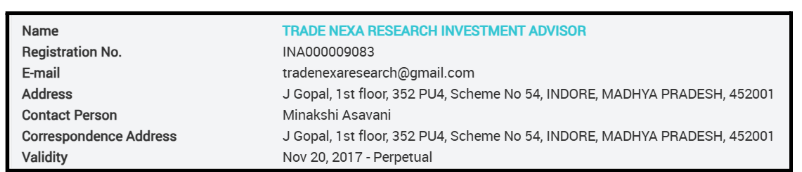
Trade Nexa Research Investment Advisor is a proprietorship concern operated by Minakshi Asavani, headquartered in Rajasthan, India.
Many traders searching online often ask: is Trade Nexa Research SEBI registered? The answer lies in its registration details, which we have covered below.
Trade Nexa Research Profile:
- Proprietor: Minakshi Asavani
- Firm Name: Trade Nexa Research Investment Advisor
- SEBI Registration No.: INA000009083
- Category: SEBI-Registered Investment Advisor
The firm provided stock market advisory services, including intraday, equity, options, and commodity trading tips.
It mainly communicated with clients through SMS and messaging platforms.
Its public-facing materials described a team of technical analysts offering research-backed recommendations.
At first glance, the firm’s registration status may appear reassuring. However, to properly answer can you trust Trade Nexa Research, it is important to examine the regulatory action that followed.
Why Did SEBI Investigate Trade Nexa Research?
SEBI initiated a formal inspection of Trade Nexa Research Investment Advisor beginning March 5, 2024.
The inspection covered a review period of nearly four years of the firm’s operations from April 1, 2020 to December 31, 2023.
The inspection was triggered by concerns about possible non-compliances with the SEBI (Investment Advisers) Regulations 2013 and the PFUTP Regulations 2003.
This case is a significant example of how stock advisors promising loss recovery can mislead investors and attract serious regulatory scrutiny.
A complaint was also filed against the firm on SEBI’s official grievance platform, SCORES, by a client (Complaint No. SEBIE/MP23/0000275/1, received April 26, 2023).
Based on the inspection findings and the firm’s own response submitted on April 20, 2024, SEBI concluded that several non-compliances had occurred.
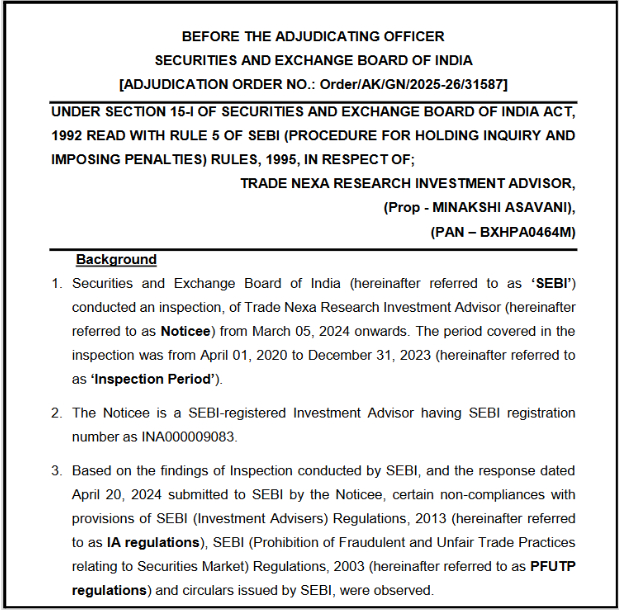
This led to the appointment of Adjudicating Officer Amit Kapoor on December 19, 2024 and the issuance of a Show Cause Notice (SCN) on January 16, 2025.
The firm later attempted to resolve the matter through a settlement application filed in March 2025, which was rejected on June 25, 2025.
A personal hearing was conducted on July 18, 2025, after which the final order was passed on August 12, 2025.
Violations by Trade Nexa Research
SEBI established four specific violations during its inspection.
Each is detailed below, based on the actual adjudication order:
Violation 1: Charging Fees Without Signed Agreements
Under SEBI regulations, every investment advisor is legally required to maintain signed client agreements before charging any fee or providing any advice.
SEBI’s inspection revealed that Trade Nexa Research violated this fundamental rule at scale.
During inspection, 90 total instances were found where fees were charged without a properly executed agreement.
Of these, 74 involved agreements that were either unsigned by the client, unsigned by the IA, or not provided at all.
In a further 15 instances, payment was collected before the agreement was even dated.
Notably, SEBI found that the complainant agreement was not signed by the client at all, yet fees were collected, and investment recommendations were made.
The firm’s defence was that clients confirmed agreements via email rather than a physical signature, and was rejected by the AO, as no documentary evidence of such email confirmations was produced.
The firm itself admitted to a few/minimal instances where the clients have made the payment prior to the signing of the agreement. This admission was taken on record by SEBI.
Violation 2: Not Maintaining Call Recordings or Interaction Records
SEBI regulations require every investment advisor to maintain records of all client interactions, including telephone calls where any investment-related advice was discussed.
During the onsite inspection on March 5, 2024, the SEBI team specifically requested call records. None were provided.
The firm’s own proprietor, Minakshi Asavani, submitted a written confirmation stating: “In general, Trade Nexa Research Investment Adviser is not maintaining call records/record of interaction with its clients/investors.”
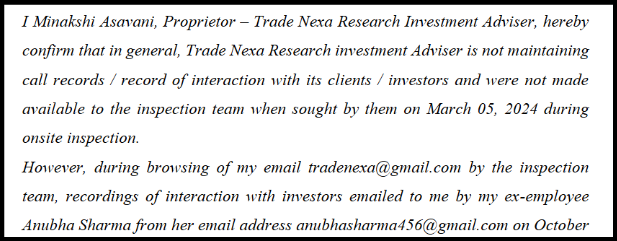
The only call recordings found were a handful of files sent by a former employee, Anubha Sharma, to the firm’s email in October 2023.
These were uncovered incidentally while inspectors browsed the firm’s email account.
Violation 3: Offering a Free Trial Service
SEBI explicitly prohibits investment advisors from providing free trials to prospective clients.
SEBI’s inspection found WhatsApp chat evidence showing that Trade Nexa Research offered a one-day free trial to a complainant on January 16, 2023.
A trading recommendation was then sent at 2:02 PM the same day, and payment was collected on January 20, 2023.
The firm’s defense was that the complaint was false and was rejected.
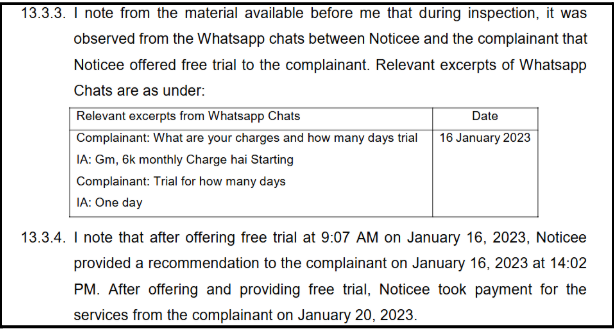
The AO noted that the WhatsApp chats independently established the violation regardless of the complaint’s status.
Violation 4: Assuring Returns and Mis-Selling Services
Call recordings retrieved from the firm’s own email account revealed that employees were explicitly promising clients fixed daily profits, specific monthly returns, and guaranteed loss recovery.
SEBI reviewed five sample call recordings.
The following is what was found in those calls:
- Recording 1: Advisor told a client she would generate profit from the market and deliver good results.
- Recording 2: Assured the client of Rs 10,000 in gains the same day, along with Rs 5,000-7,000 daily, and easy loss recovery.
- Recording 3: Quoted specific monthly return figures Rs 30,000-40,000 for basic service and Rs 80,000-90,000 for premium service.
- Recording 4: Promised good returns and daily profits of Rs 2,000-3,000.
- Recording 5: Assured the client of profits and loss recovery.
WhatsApp messages from January to March 2023 discussed the recovery of losses worth Rs 5 lakhs.
The IA assured the client not to worry and promised recovery within specific timeframes.
The firm’s defence was that these were “marketing gimmicks,” that statements were taken out of context, and that the firm had website risk disclaimers was rejected.
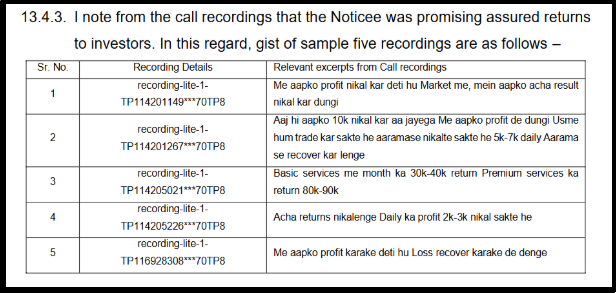
The AO noted that the call recordings were obtained directly from the firm’s own email and confirmed by the firm’s own written submission, making the evidence fully attributable.
Crucially, specific rupee amounts were promised, which go well beyond general accuracy claims.
Penalty On Trade Nexa Research
After establishing all four violations and considering the factors, Adjudicating Officer Amit Kapoor passed the order on August 12, 2025, with a total penalty of seven lakh rupees.
Penalty Breakdown:
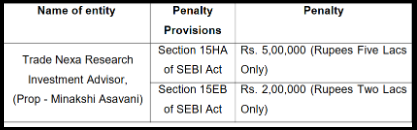
The penalty was payable within 45 days of receipt of the order through SEBI’s online portal.
What Should Investors Learn From This Case?
The Trade Nexa Research case carries important lessons for every retail investor in India:
- Never trust guaranteed return claims. No SEBI-registered advisor is allowed to promise fixed profits, daily returns, or loss recovery. If an advisor makes such a promise, it is a regulatory violation and a major red flag.
- Read and sign your agreement before paying any fees. Every legitimate investment advisor must have a signed client agreement before collecting fees. If you are asked to pay before signing, refuse and report it.
- Verify SEBI registration before engaging any advisory service. Registration is necessary but not sufficient. Also check the advisor’s SCORES complaint history.
- Keep a record of all communications. Save WhatsApp messages, SMS tips, emails, and payment receipts. These are your evidence if something goes wrong.
- Beware of free trial tactics. SEBI has banned free trials for investment advisory services. A free trial offer is itself a regulatory violation.
How To File a Complaint Against an Investment Advisor?
If you’ve faced similar issues with any investment advisor, it’s important to act quickly and methodically.
Here’s what you should do:
1. Gather All Evidence
Begin by collecting every relevant document and communication connected to your case.
This may include screenshots, WhatsApp chats, emails, payment receipts, advisory messages, call recordings, account statements, and agreement copies.
Arrange everything in date order so the sequence of events is clear.
Strong documentation often makes the difference between a weak complaint and a successful one.
2. File a Complaint in SCORES
If the advisor or intermediary does not resolve the matter properly, file a formal complaint through SCORES (SEBI Complaints Redress System), the official investor grievance platform of the Securities and Exchange Board of India.
This creates an official record, requires a response from the concerned entity, and brings the issue under regulatory review.
3. Lodge a Complaint in SMART ODR
If the dispute still remains unresolved, you may escalate the matter through SEBI’s Online Dispute Resolution (ODR) mechanism, which includes mediation and arbitration.
An independent body reviews the evidence submitted by both sides and can issue a formal decision based on the merits of the case.
4. Arbitration in Share Market
If earlier resolution attempts do not work, investors can proceed with formal arbitration under SEBI’s dispute resolution framework, where an independent panel reviews the evidence and delivers a binding decision.
An arbitration award carries legal enforceability similar to a court decree, and failure to comply may result in further regulatory consequences through SEBI or the concerned stock exchange.
Need Help?
Facing problems with an investment advisor can be stressful, especially when your money, time, and trust are involved.
Many people delay action simply because they don’t know where to begin. Register with us.
We help victims navigate the process by assisting with:
- Identifying suspicious or potentially non-compliant conduct.
- Reviewing account activity, communications, and supporting records.
- Organizing evidence and documentation properly.
- Drafting clear and persuasive complaints and representations.
- Preparing responses and submissions at different stages of the process.
Even small mistakes or missing evidence can weaken a valid case.
You don’t have to handle it alone. If the situation feels overwhelming, getting experienced guidance early can save time and improve your chances of resolution.
Conclusion
The SEBI adjudication order against Trade Nexa Research Investment Advisor exposes common practices in unregulated advisory markets: upfront fee collection, poor record-keeping, and misleading client claims.
For Indian retail investors, the lesson is straightforward: treat any advisor who promises guaranteed profits, fixed returns, or assured loss recovery with extreme caution and report them to SEBI immediately.
The SCORES platform exists precisely for this purpose, and as this case demonstrates, SEBI does act on complaints.
Before paying for any stock market advisory service, always verify registration, read agreements in full, and never act on the promise of guaranteed returns. Your financial safety begins with informed decisions.





 Add us as a preferred source on Google »

