

Quick Summary
Investor paid Stocksence Research ₹3,00,000, split between advisory fees and an unrecognised “mentorship fee” designed to bypass SEBI’s ₹1,51,000 annual cap. Personalised trading instructions led to ₹3,38,000 in losses. After an initial ₹6,00,000 conciliation claim was rejected, our team helped rebuild the case to ₹6,38,000. The Sole Arbitrator found multiple SEBI violations and awarded ₹4,31,500, payable within 15 days with 9% annual interest on delay, proof that proper documentation and the right regulatory process can produce a binding result.
Have you ever paid for premium advisory services, only to find your fees split into confusing categories you never agreed to?
That exact confusion sits at the heart of one investor’s fight against StocksenceResearch.
Mr. Nakul Kumar, an investor from Korba, Chhattisgarh, trusted a SEBI registered research analyst with his money.
What followed was a pattern of pressure, speculative trades, and fees disguised under unfamiliar labels.
This blog covers the recovery of ₹4,31,500 from Stocksence Research, a case that moved through conciliation and arbitration before ending in a binding award.
How Did This Investor Get Pulled Into a Premium Advisory Plan?
It began with a representative named Mr. Rudra, an employee of Stocksence Research Private Limited, a firm registered with SEBI under the Research Analyst category.
According to the arbitration record, Mr. Rudra shared misleading and unverified records of past profitable trades to build the investor’s confidence.
The pitch carried a familiar promise: higher and guaranteed returns.
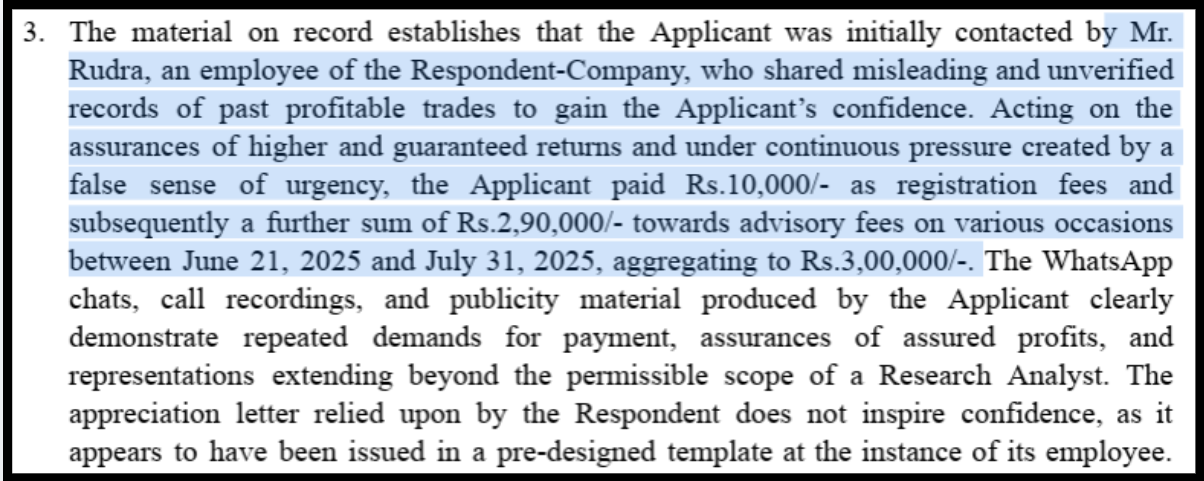
Under continuous pressure and a manufactured sense of urgency, Mr. Nakul Kumar paid ₹10,000 as a registration fee. This was just the beginning.
Between June 21 and July 31, 2025, further payments followed in stages, eventually totaling ₹3,00,000.
WhatsApp chats, call recordings, and promotional material later submitted as evidence showed a consistent pattern: repeated payment demands paired with assurances of assured profits.
The arbitrator specifically noted that an appreciation letter the firm relied upon appeared to follow a pre-designed template, raising doubts about its authenticity.
That detail alone hinted at a larger, more systemic issue worth examining.
Why Was the ₹3,00,000 Fee Split Into Two Confusing Categories?
This is where the case takes a sharper regulatory turn, and it is something every investor evaluating an advisory firm should understand.
SEBI’s Research Analyst Regulations, 2014, cap the maximum annual advisory fee at ₹1,51,000 per individual or HUF client.
Fees can be collected in advance, but only for a period not exceeding one year, with a proportionate refund required if the service ends early.
Stocksence Research collected ₹3,00,000 from Mr. Nakul Kumar, but split it into two separate categories: ₹1,50,000 labeled as advisory fees, and another ₹1,50,000 labeled as “mentorship fees.”
Here is the problem. The term “mentorship fee” has no recognition under SEBI’s Research Analyst Regulations. No documented agreement existed authorising the firm to charge this separately.
The arbitrator described this bifurcation as a device used to work around the statutory fee cap.
Since Mr. Nakul Kumar used the advisory service for only three months, the firm could charge only ₹37,500 on a pro-rata basis.
Therefore, he became entitled to a refund of ₹1,12,500 in excess advisory charges, along with a full refund of the ₹1,50,000 mentorship fee.
That alone accounted for ₹2,62,500 of the final award. But the fee structure was only part of the story.
The trading recommendations themselves told an even bigger story.
What Happened When the Trading Recommendations Started?
Beyond the fee structure, the arbitrator examined how the firm actually guided Mr. Nakul Kumar’s trades, and this is where the case moved into more serious territory.
According to the evidence, the firm’s representative gave direct and customised trading instructions. This included specific scripts, quantities, expiry dates, averaging strategies, and exact exit decisions.
The representative also reportedly encouraged overtrading and discouraged the use of stop-loss mechanisms, a basic risk-management tool every trader relies on.
These recommendations led to trading losses of ₹3,38,000 during July 2025 alone.
The arbitrator’s findings were direct on this point. Providing this level of customised, individual-level trading direction goes beyond what a Research Analyst is permitted to do under SEBI regulations.
It resembles the role of a Portfolio Manager or Investment Adviser, categories under which the firm was not registered.
At the same time, the arbitrator noted that Mr. Nakul Kumar was not entirely without responsibility.
He executed these trades without exercising independent judgment, driven by expectations of assured returns. This shared responsibility shaped how the final compensation was calculated.
With both the fee violation and the trading conduct established, the next step was to understand how this case reached a binding decision.
How Did This Case Move From Conciliation to a Binding Award?
This dispute did not jump straight into a successful arbitration.
It followed a challenging, structured path through India’s securities dispute resolution framework, and at first, the odds were heavily stacked against the investor.
Mr. Nakul Kumar initially took the fight on by himself, raising a claim of ₹6,00,000 before a Conciliator. Hearings were held on October 7 and October 23, 2025.
However, without a heavily regulation-backed presentation, the conciliation failed. The Learned Conciliator’s report, dated November 4, 2025, held his entire claim inadmissible.
Hit by a massive setback and unsure of how to fight a SEBI-registered firm’s legal arguments, Mr. Nakul Kumar reached out to our team.
We stepped in immediately to audit his case, organize his chaotic WhatsApp trails, and build an ironclad strategy rooted deeply in SEBI’s Research Analyst Regulations.
Recognizing that his actual financial damages were higher, we helped him structure and enhance his claim to ₹6,38,000, properly splitting the ₹3,00,000 in illegal advisory/mentorship fees and ₹3,38,000 in documented trading losses.
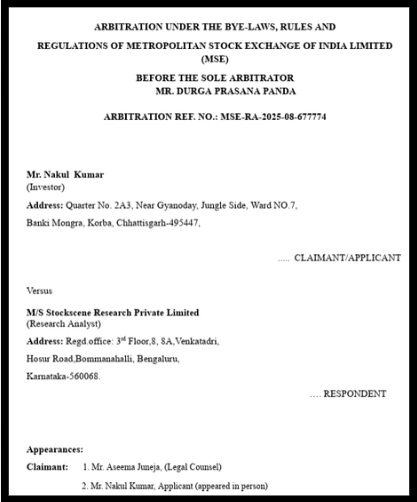
With the groundwork securely laid by our team, the formal arbitration was conducted under the Metropolitan Stock Exchange of India’s Bye-Laws and Rules, presided over by the Sole Arbitrator, Mr. Durga Prasana Panda.
During the proceedings, Stocksence Research expressed an outright unwillingness to settle, forcing the matter to proceed strictly on the merits.
However, because we had meticulously compiled every piece of evidence, from the unauthorized “mentorship” labels to the exact trade screenshots, the stage was perfectly set for a detailed, evidence-based examination.
So, after weighing both the clear fee violations and the erratic trading conduct we brought to light, what did the arbitrator finally decide?
The Final Verdict: Inside the ₹4,31,500 Arbitration Award Against Stocksence
The final award reflects a careful, evidence-based balancing of both parties’ responsibilities.
On inducement, the arbitrator found that Stocksence Research persuaded Mr. Nakul Kumar to subscribe by giving assurances of guaranteed returns.
The arbitrator held that Stocksence Research breached the SEBI Research Analyst Regulations by charging above the permitted fee limit and presenting part of the amount as an unrecognised “mentorship fee.”
As for the trading conduct, the arbitrator found that the firm encouraged highly speculative derivatives trading.
However, the arbitrator also held Mr. Nakul Kumar partly responsible for executing those trades without exercising independent judgment.
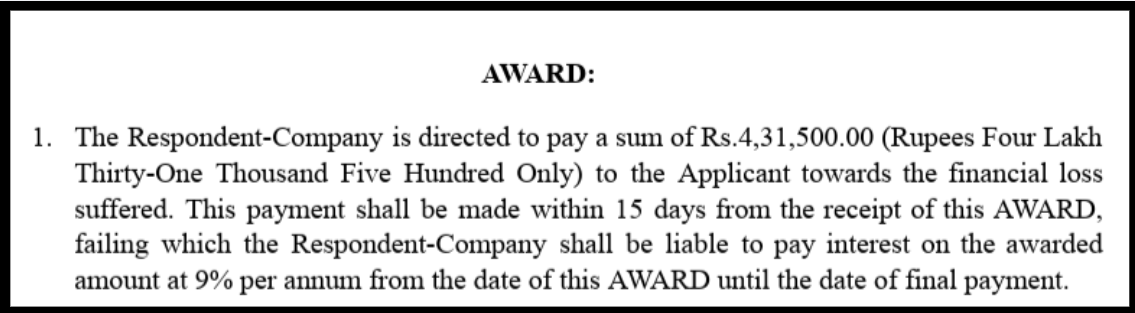
The total compensation awarded was ₹4,31,500, combining the excess advisory fee refund, the full mentorship fee refund, and a portion attributed to the trading conduct violations.
The Respondent was directed to pay this amount within 15 days of the award, with 9 percent annual interest applicable if payment was delayed.
Notably, the arbitrator dismissed the request to cancel or suspend Stocksence Research’s SEBI registration, and the earlier conciliation report was formally set aside.
This case is a clear example of what proper documentation and a structured regulatory process can achieve, even when a firm denies every allegation outright.
Would fighting this alone feel like an uneven fight?
Our team will review your documents, identifies the specific SEBI violations in your case, and guides you through the complaint process from start to finish.
Conclusion
The recovery of ₹4,31,500 from Stocksence Research shows how arbitration can help when investors properly document fee violations and trading misconduct.
In this case, the firm used a “mentorship” label to collect fees, gave personalised trading advice beyond a Research Analyst’s permitted role, and made return assurances that failed to materialise.
However, the arbitrator also considered the investor’s role in taking high-risk trades. As a result, instead of the full ₹6,38,000 claim, the investor received a documented award of ₹4,31,500.
If your situation feels familiar, know that India’s securities dispute resolution framework does offer a real path forward, provided you act early and document everything carefully.
Report. Recover. Stay Fraud Free.
Stocksence Research bypassed SEBI’s maximum annual fee cap of ₹1,51,000 by collecting an illegal total of ₹3,00,000 from the investor. To hide this breach, they bifurcated the payment into standard advisory fees and an unauthorized, separate charge. The term "mentorship fee" has absolutely no legal recognition or standing under SEBI's Research Analyst Regulations, 2014. The arbitrator ruled that the firm used this arbitrary label purely as a deceptive device to work around statutory fee limits. Instead of publishing standard research, the firm gave personalized trading directions, including specific scripts, quantities, and exact exit decisions. This individual-level execution crossed the boundary into services only registered Portfolio Managers or Investment Advisers can provide. The representative actively pushed the investor into heavy overtrading of highly speculative derivative instruments within a short timeframe. They also explicitly discouraged the use of stop-loss mechanisms, directly resulting in a trading loss of ₹3,38,000 for the client. No, the arbitrator dismissed the investor's specific request to cancel or suspend the firm's SEBI registration. However, the firm was still held strictly liable and ordered to pay a heavy compensation award of ₹4,31,500 to the victim.Frequently Asked Questions





 Add us as a preferred source on Google »

