

Quick Summary
Eight independent Google reviewers describe their experience with Moneyplant Research after paying for subscriptions. The four patterns that repeat across multiple accounts are: profitable demo trades used to build trust before payment, subscription pressure followed by upselling after losses, loss recovery promises that SEBI explicitly prohibits, and refund requests that went unanswered despite SEBI’s mandatory pro-rata refund rule. One reviewer’s capital fell from Rs 50,000 to Rs 9,000 in eight days. Another lost Rs 1.5 lakh across a series of escalating payments. These are public accounts from named reviewers on Google. We have not independently verified the specific transactions. No SEBI order confirming this specific conduct exists as of the date of this review.
One investor’s capital fell from Rs 50,000 to Rs 9,000 in eight days after subscribing.
Another paid Rs 20,000, then Rs 60,000 more under pressure, and lost Rs 1.5 lakh in total.
A third requested a refund for unused subscription days. Nobody answered.
These are not isolated accounts from unconnected investors.
Across eight separate Google reviews, four patterns repeat under different names and different amounts.
This page covers each account in full, maps each pattern to the specific SEBI rule it appears to violate, and explains what to do if your experience looks familiar.
Moneyplant Research Reviews And Complaints
These reviews are from named users on Google’s public review platform.
We are reporting what they wrote. No SEBI order confirming these specific allegations has been issued as of the date of this review.
Review 1: Loss Recovery Promises After Losses Started
A reviewer describes being told explicitly that the team was there to help recover their losses through future calls.
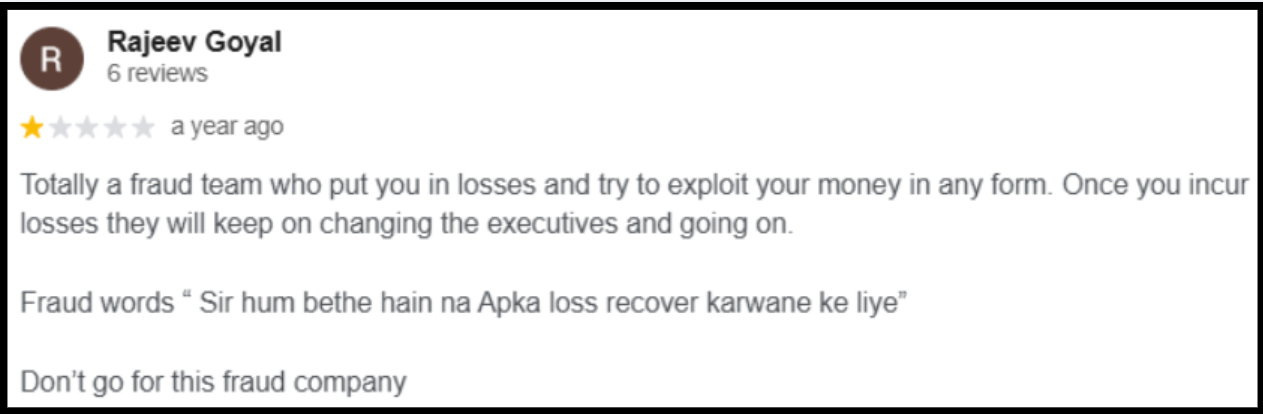
SEBI Research Analyst Regulations explicitly prohibit promising that future recommendations will recover money already lost.
No registered Research Analyst can guarantee outcomes on future calls. A recovery promise is not reassurance. It is a prohibited representation under SEBI’s framework.
The reviewer also describes representatives changing after losses began, a pattern used to reset the relationship and keep a subscriber paying rather than letting them exit and reconsider.
Review 2: Sales Promises That Stopped After Payment
A second reviewer describes specific commitments made during the sales call about what the subscription would teach and deliver.
Once payment cleared, the representative stopped responding.

This describes two separate violations.
A misleading representation at the point of sale, which falls under Regulation 18 of SEBI’s Research Analyst Regulations. And a plain service delivery failure, where the firm did not honour what it promised before payment.
Verbal promises during a sales call are extremely difficult to prove later. Ask for written confirmation of every commitment before any payment is made.
Review 3: Demo Trades Built to Show Only Profits, and Alleged Review Manipulation
A third reviewer alleges that demo trades shown before payment were designed to display only profitable outcomes, building false confidence before the subscription decision.
The same reviewer alleges the firm writes its own positive reviews.
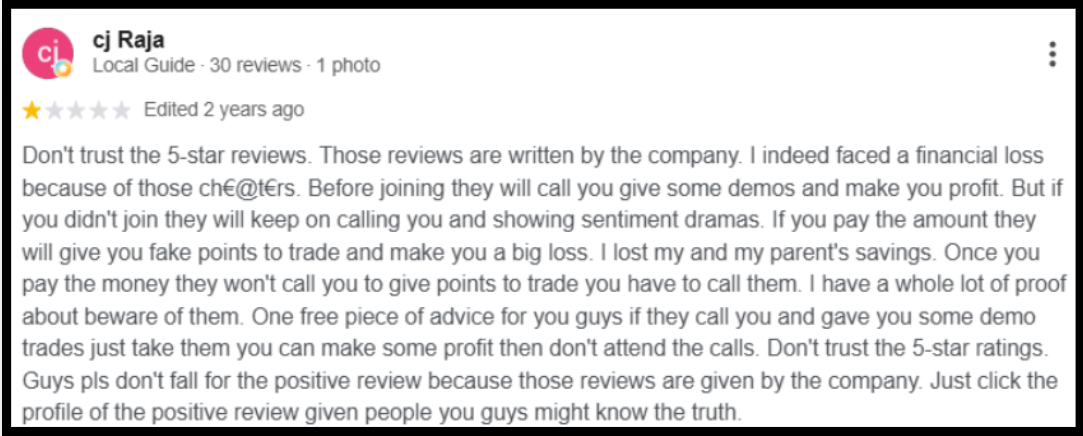
Showing only winning demo trades while excluding losses creates a misleading impression of research accuracy, which conflicts with SEBI’s Advertisement Code for Research Analysts.
Writing or arranging positive reviews to create a false credibility impression falls under SEBI’s prohibition on fraudulent and unfair trade practices.
A single winning demo trade proves very little about ongoing performance. Ask for a documented track record covering a full quarter, wins and losses included, before subscribing.
Review 4: Capital Fell From Rs 50,000 to Rs 9,000 in Eight Days
A fourth reviewer describes being pushed into a quarterly subscription and then, after losses started, being pushed toward additional paid services rather than having the research approach reviewed.
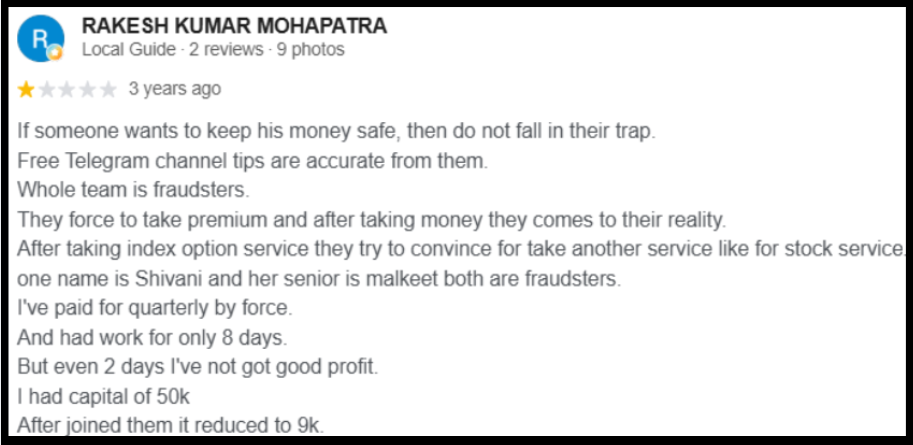
Capital fell from Rs 50,000 to Rs 9,000 in eight days.
SEBI requires a Research Analyst to act in the client’s best interest. Pushing more paid services onto a client who is already experiencing significant losses from the current service runs directly against this requirement.
If a firm offers an upgrade immediately after a losing streak, that is not a service improvement. It is an escalation of the same dynamic.
Review 5: Refund Request for Unused Days That Went Unanswered
A fifth reviewer tried to cancel mid-subscription and requested a refund covering the unused portion of the plan.
No response came.
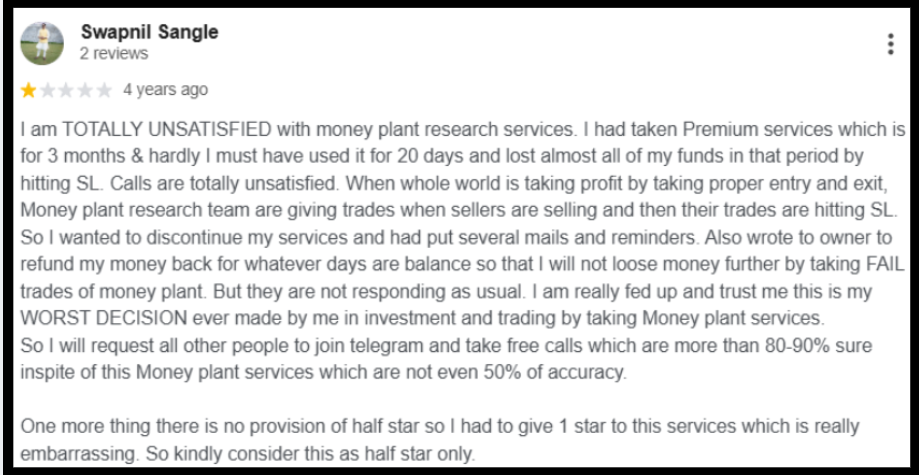
SEBI’s Research Analyst Regulations require a proportionate refund for the unused part of any subscription regardless of what the firm’s own terms page states.
Moneyplant Research’s Terms of Use carry a blanket “Absolutely No Refunds” clause. That clause does not override SEBI’s regulation.
Ignoring a refund request outright is a direct breach of the mandatory refund rule.
If you request a refund, send it in writing to the firm’s official business email, attach your subscription start and end dates, and reference SEBI’s mandatory pro-rata refund requirement directly.
This creates the paper trail you will need if the matter needs to go to SEBI SCORES.
Review 6: Rs 60,000 More Demanded Under Threat of Losing Support
A sixth reviewer paid Rs 20,000 initially. The firm then pushed for an additional Rs 60,000 under threat of withdrawing support entirely.
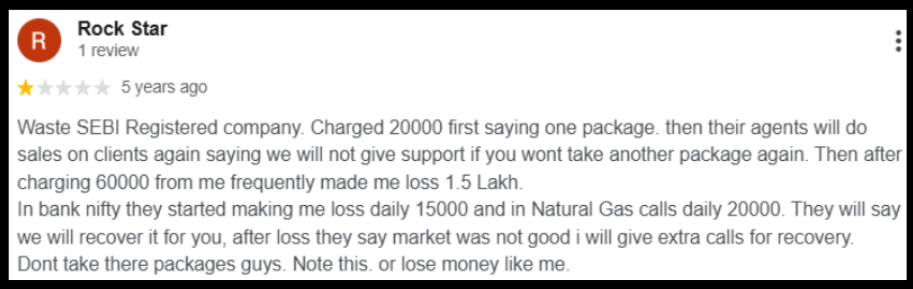
Total losses across the relationship reached Rs 1.5 lakh.
After the losses, the firm explained that market conditions were unfavourable, followed by an offer of extra calls for recovery.
Withholding existing support to extract a further payment is coercion rather than a service offering. Promising recovery through more calls after losses have already occurred is a prohibited representation under the same SEBI rule cited in Review 1.
Review 7: Pressure to Move a Demat Account to Another Broker
A seventh reviewer describes a demo call that appeared positive, followed by subscription pressure and then persistent losses, with approximately 80 percent of calls resulting in losses according to the reviewer.
Beyond the subscription pressure, the reviewer was pushed to move their Demat account to a specific different broker.
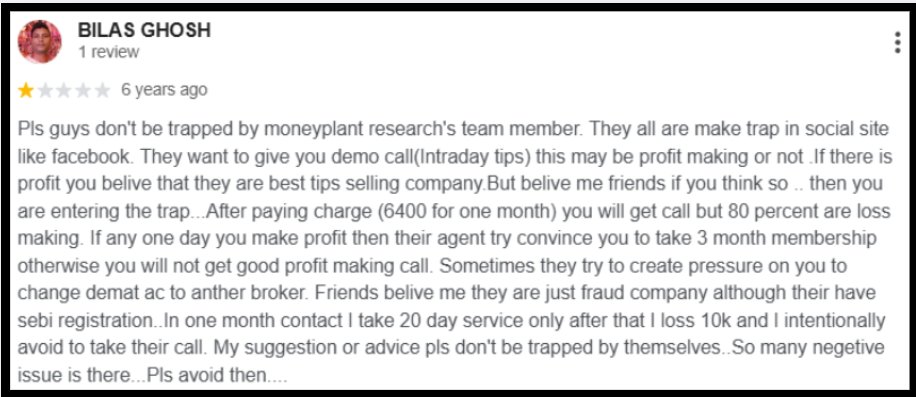
Recommending a specific broker for commercial benefit is not permitted for a Research Analyst under SEBI’s conflict of interest rules.
A Research Analyst’s compensation must come from fixed research fees, not from directing clients toward specific brokers or financial products.
Any firm that asks you to change your demat account or broker should be asked directly what commercial relationship it has with the broker being recommended.
Review 8: A Track Record That Left Out Losing Trades
An eighth reviewer states that the firm’s published performance record does not include losing trades, presenting only the successful calls.
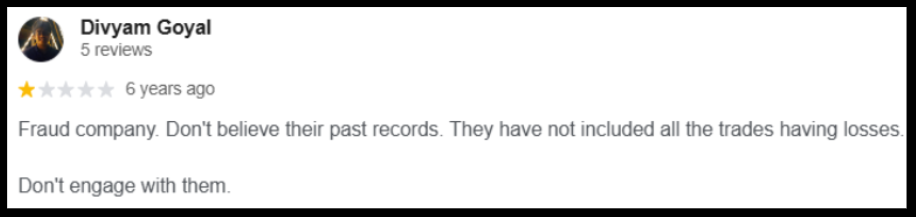
SEBI’s Master Circular restricts the use of selective past performance as a promotional tool and requires complete, accurate reporting of research outcomes.
Showing only winning calls while omitting losing ones conflicts with this requirement directly.
Before subscribing to any research service, ask specifically for the full win-to-loss ratio across a defined recent period, not just the headline calls.
A firm that declines to share this data is presenting an incomplete picture.
Also Read: Trading With Karol reviews, a Reddit thread that calls the operation a scammer directly.
Moneyplant Research: The 4-Stage Complaint Pattern
Across all eight accounts, four stages recur in the same order. A profitable demo trade or early call builds initial trust.
A subscription payment follows, often accompanied by pressure to upgrade to a costlier plan.
Losses appear, and the firm blames market conditions rather than its own research.
Then a promise of extra calls or a recovery plan keeps the subscriber from exiting.
Understanding this sequence before reading each account helps you recognise which stage you are at if any part of this looks familiar.
What Moneyplant Research’s Complaint Track Record Reveals
Eight public reviews and thirteen formal SEBI complaints across six consecutive financial years point in the same direction.
| Financial Year | Received | Resolved | Pending |
| 2018-19 | 1 | 0 | 0 |
| 2019-20 | 2 | 3 | 0 |
| 2020-21 | 1 | 1 | 0 |
| 2021-22 | 3 | 3 | 0 |
| 2022-23 | 4 | 4 | 0 |
| 2023-24 | 1 | 1 | 0 |
| 2024-25 | 1 | 1 | 0 |
| Grand Total | 13 | 13 | 0 |
A 100 percent resolution rate looks clean. But resolved only means the intermediary responded and closed the file inside a deadline.
It says nothing about whether the investor who filed was satisfied.
The reviewer in Account 5 above describes a refund request that went unanswered. A similar case would likely still show as resolved in SEBI’s data if the firm submitted any response within the deadline period.
Thirteen complaints across six consecutive financial years is not a random distribution.
One complaint can reflect one misunderstanding. Complaints in every year from 2018 through 2024 reflect a pattern that persists over time.
Also Read: Dealwise Pro complaints, a “pending” column showing zero, while cases sat open.
Does Your Experience Match These Moneyplant Research Reviews?
The formal complaint process is available and free.
Write to the firm first with a specific written request and give 21 days.
If unresolved, file on SEBI SCORES.
The complete step-by-step complaint process covering exactly what to attach, which registration number to use, what valid grounds to cite, and how to escalate from SCORES through the SMART ODR portal to arbitration is in our guide: how to complaint against Moneyplant Research?
For the full analysis of the firm’s pricing cap violations, the dual registration confusion, and the no-refund policy conflict, the Moneyplant Research review page on this site covers all the pre-subscription concerns in detail.
Does your own experience match any of the patterns described above?
We review your case, identify every applicable SEBI violation, draft the SEBI SCORES complaint, and represent you through SMART ODR and arbitration.
Disclaimer: This page reflects publicly available Google reviews and the firm’s own SEBI-mandated complaint disclosures at the time of writing. No SEBI adjudication order or enforcement action has been identified against Moneyplant Research or Amit Malviya as of this writing.
Conclusion
Eight independent reviewers. Thirteen formal SEBI complaints across six years. Four patterns repeating under different names and different amounts.
No SEBI order confirming these specific allegations has been issued as of this writing. We are reporting what reviewers wrote on a public platform.
What the combination of public accounts and official complaint data tells you is that the gap between what Moneyplant Research appears to offer on its homepage and what multiple paying subscribers describe experiencing has been documented consistently and independently for six consecutive years.
Report. Recover. Stay Fraud Free.
Frequently Asked Questions
The reviews are from named users on Google's public review platform. We have reported what they wrote. We have not independently verified the specific transaction details described. No SEBI order confirming these specific conduct allegations exists as of the date of this review.
No. Resolved in SEBI's disclosure data means the intermediary responded and closed the complaint file within a deadline. It does not confirm the investor was satisfied with the outcome. Reviews and complaint data measure different things and both are worth examining.
Reviews help you recognise a pattern. They do not substitute for your own documented evidence. SEBI SCORES and arbitration panels weigh your own payment receipts, written correspondence, and call records far more heavily than public reviews from other investors.
Payment receipts and bank records for every subscription payment. Screenshots of every recommendation received with dates. Any written communication containing promises, recovery assurances, or upgrade pressure. The specific written refund request and any response or non-response received.
SEBI complaints have a three-year limitation period from the date the issue occurred. If your experience happened within the last three years, you are within the window. Do not wait as evidence like WhatsApp messages and bank records is not preserved indefinitely.





 Add us as a preferred source on Google »

