

If your broker’s representative has ever made trading decisions in your account, placing positions, rolling over trades, or managing exposure, without your explicit, documented approval before each transaction, you may already be in the middle of an account handling dispute without realising it.
Most investors do not start searching for “Motilal Oswal account handling” after a profitable trade.
They start searching when something inside their account stops making sense.
And eventually the investor starts asking a difficult question: “Was I really in control of my own account?”
This blog examines a significant NSE arbitration matter, the warning signs investors often overlook, and the complaint options available when account-handling concerns arise.
Why Some Investors Raise Concerns About Motilal Oswal Account Handling?
Most investors only encounter the phrase “account handling” after a dispute has already taken shape.
By then, the losses have accumulated, the records are scattered, and the situation feels too complex to untangle.
But account handling refers to something far more everyday: the ongoing way in which your trading account is operated, managed, and controlled.
Any of the following can become an account handling concern if done without proper authorisation or documentation:
- Dealer-assisted trading, where your role in approving each trade is unclear.
- F&O exposure and position rollovers you did not specifically instruct.
- Margin usage that grew beyond what you understood you had agreed to.
- Intraday trading activity directed by a dealer or relationship manager.
- Liquidation of positions or shares without adequate prior notice.
- Debit balances and interest charges that were never clearly explained.
These are not rare complaints from uninformed investors. They appear across arbitration records, SEBI SCORES filings, and investor forums, and they follow a recognisable pattern: a trusted representative, early confidence, and then losses that arrive faster than explanations do.
The Motilal Oswal arbitration matter discussed below is one of the clearest documented examples of how this pattern can unfold.
When Trading Assistance Allegedly Turned Into A Major Dispute
Like many retail investors, the applicant did not enter the market expecting to challenge a broker.
According to the case records, she was introduced to F&O trading through an Authorised Person who reportedly assured her that the positions would be managed carefully and that the risks would remain under control.
At first, the arrangement appeared manageable.
But as trading activity increased and losses started mounting, questions began emerging about how the account was being operated and whether all positions were being taken with proper understanding and consent.
-
How the Dispute Began?
The arbitration matter, NSEWRO/0021529/21-22/ISC/IGRP/ARB, was filed by Huzan Minoo Bhaya (the Applicant), a Mumbai-based investor, against Motilal Oswal Financial Services Limited (the Respondent). 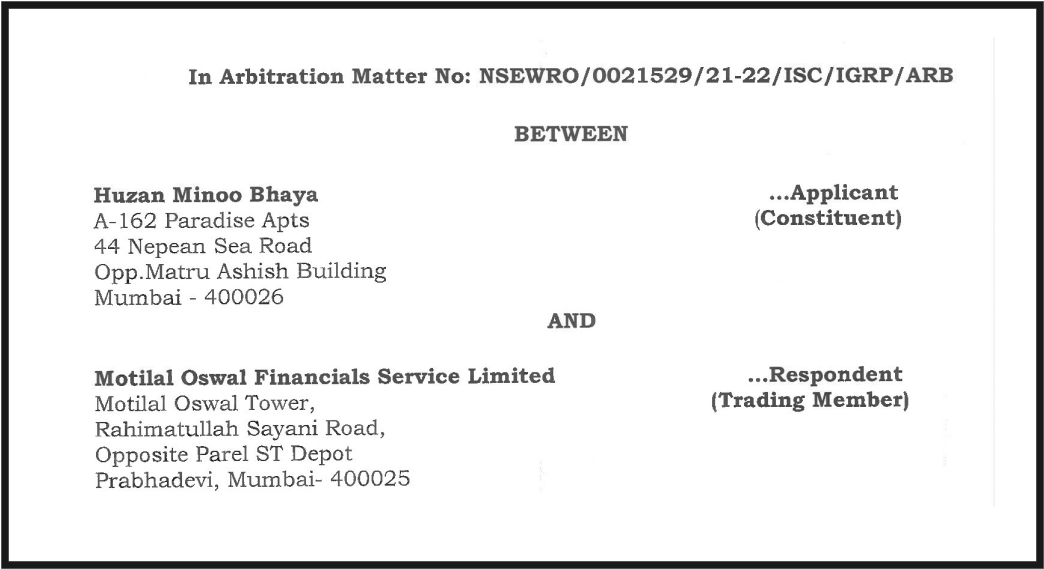 According to the statement of claim, the Applicant was introduced to Futures and Options (F&O) trading by the broker’s Authorised Person (AP), who assured her that the investments would be personally managed in a safe manner.
She agreed, trusting that the AP was backed by a reputable firm.
The Applicant alleged that the AP then took her signatures on blank forms, filled in details contrary to her instructions, and executed trades without any pre-trade confirmation, operating what she described as a backdoor, unauthorised Portfolio Management Scheme.
-
What the Tribunal Observed During the Proceedings?
The Tribunal noted that the Respondent “totally disregarded the SEBI circular dated 22.03.2018 on compulsory obtaining pre-trade confirmation before executing a transaction” and that the Respondent had “belied and misled the NSE” by initially claiming pre-trade confirmation existed, then later denying it. 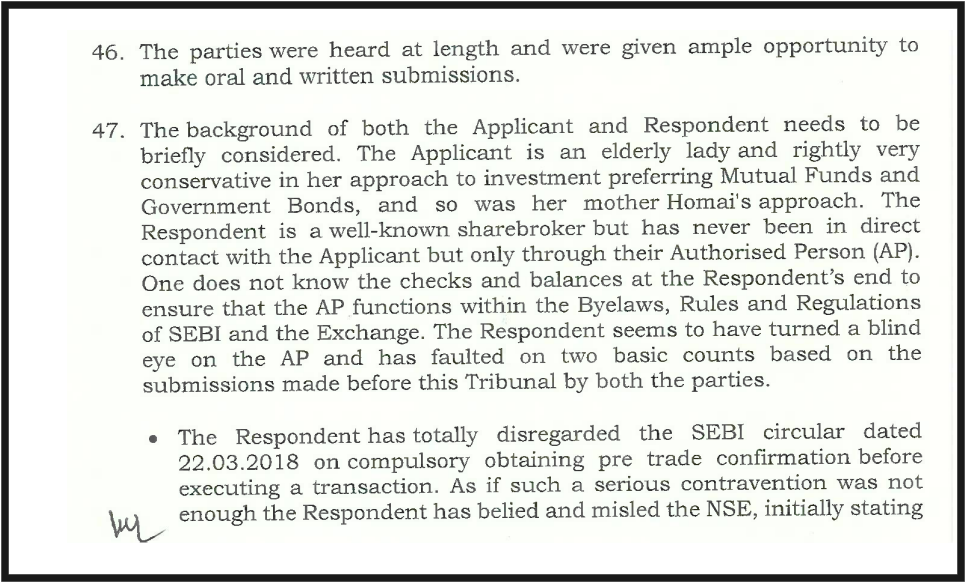 The Tribunal also observed that the AP was “overwhelmed by the market situation, was not forthright and misguided and misled the Applicant.”
Rather than being transparent about mounting losses, the AP kept assuring the Applicant she had nothing to worry about.
The Tribunal also flagged a broader concern: suggesting F&O trading to conservative, unsuspecting investors of modest means, and operating an arrangement outside the regulatory PMS framework, raises serious questions about the broker’s practices.
-
Final Award Passed by the Tribunal
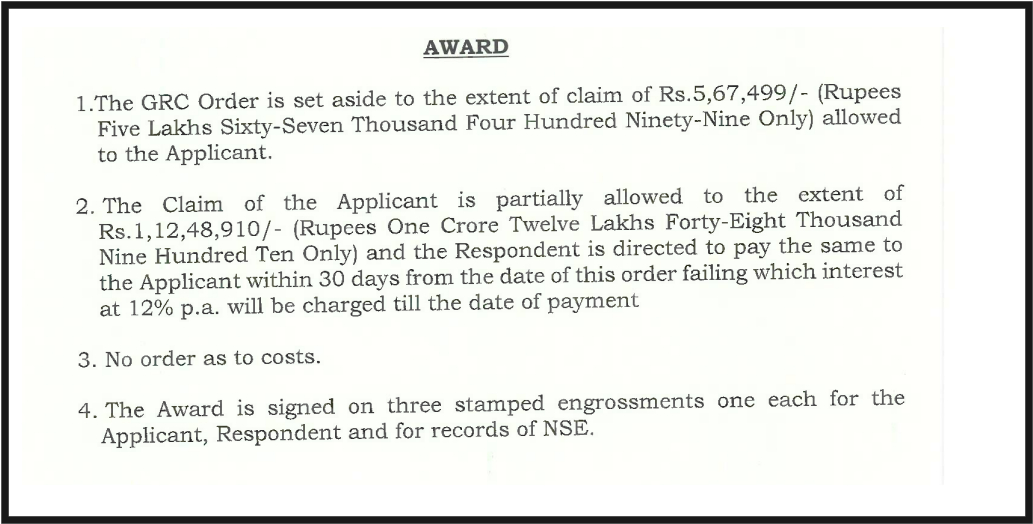
The Tribunal partially allowed the Applicant’s claim.
The core F&O loss of ₹1,22,11,366 was reduced to ₹1,12,48,910, calculated as the total loss minus the amount that would have been lost even if positions had been squared off on 03.03.2020 (₹9,62,456).
The GRC order allowing ₹5,67,499 in brokerage write-back was also set aside. The award was signed on 3 April 2023 in Mumbai.
This is not a hypothetical outcome.
It is a documented arbitration award, and it demonstrates that when account handling concerns are supported by evidence, formal dispute resolution does produce results.
If any part of what Huzan Minoo Bhaya experienced, such as blank forms, unconfirmed trades, or assurances that masked losses, sounds familiar to your own situation, the next section explains exactly what rights you have and what your broker is actually permitted to do.
What Your Broker Can and Cannot Do With Your Account?
This is where many investors carry a dangerous misconception, and it is one that brokers and their representatives rarely correct proactively.
When you open a trading account, you sign agreements that authorise certain actions.
You may grant a Power of Attorney, allow running account adjustments, and consent to margin trading. But that authorisation has defined boundaries.
A broker’s Authorised Person is the broker’s agent, not yours.
Their regulatory obligation is to execute your instructions, not to replace them with their own judgment.
SEBI mandates pre-trade confirmation before executing client transactions.
This is not an optional procedure; it is a compliance requirement. The tribunal in the Bhaya case flagged its violation explicitly.
One of the most important points the tribunal made deserves to be stated clearly: having access to your back-office data online does not mean you understood or authorised the positions being taken in your account. Online access is not informed consent.
If your dealer has been making decisions, or strongly directing decisions- without your documented, trade-by-trade approval, that is a legitimate concern worth examining formally.
How To File A Complaint Against Account Handling?
Recognising a potential account handling issue is one thing.
Knowing the correct path forward is what actually creates an opportunity for resolution.
Here is the structured escalation process available to every investor in India:
Step 1: Preserve Every Record
Throughout this process, preserve every piece of evidence: account statements, contract notes, WhatsApp messages, emails, margin statements, and any written communication with the broker or AP.
These form the backbone of your claim.
Step 2: Raise a Written Complaint With the Broker
Raise it internally first.
Write to the broker’s compliance or grievance team. Document everything: your complaint, the date you sent it, and any acknowledgement you receive.
Step 3: File a Complaint with SCORES
If you don’t receive a satisfactory response within 30 days, file SCORES SEBI complaint.
SCORES (SEBI Complaint Redress System) tracks and monitors grievances against registered entities.
Step 4: File a Complaint in SMART ODR
If your complaint remains unresolved after going through SCORES, the next step is to approach the SMART ODR platform.
Through this platform, trained conciliators will try to help both parties reach a mutual settlement in a time-bound manner.
Step 5: Stock Market Arbitration
If the GRC process does not resolve the matter, you can escalate to arbitration under the exchange’s rules.
This is a formal, binding process, as demonstrated by the Bhaya case, where the arbitral tribunal issued an award with a payment deadline and interest clause.
Need Help?
By the time most investors seek help, they have already spent weeks, sometimes months, trying to make sense of what happened in their account. Confusing ledger entries. Unexpected F&O positions.
Dealer calls they didn’t initiate. Shares liquidated without a clear warning. And a growing sense that asking questions isn’t producing straight answers.
That situation does not have to stay unresolved.
If you have experienced any of the following, your account deserves a proper review:
- Trades placed without your pre-trade confirmation or clear approval.
- F&O exposure or margin accumulation you did not understand or authorise.
- A dealer or AP who appeared to be directing trades independently.
- Losses that continued despite your concerns or written objections.
- Difficulty obtaining clear explanations from the broker’s support team.
Our team helps investors organise their records into a structured timeline, identify the specific concerns that matter most for a formal complaint, prepare SEBI SCORES and Smart ODR filings, and understand whether arbitration is a viable next step based on the documents available.
If you dealt with Motilal Oswal or any broker and believe your account was not handled with proper authorisation and transparency, register with us for a confidential case review.
Conclusion
The Motilal Oswal arbitration matter highlights how account-handling disputes often involve much more than market losses alone.
Questions regarding dealer involvement, F&O exposure, communication, authorisation, and account control can become central issues once losses begin mounting.
The case also demonstrates why investors should regularly review contract notes, understand every position being taken, and question activity they do not fully understand.
Most importantly, no investor should ever become completely disconnected from what is happening inside their own trading account.
Frequently Asked Questions
1. My dealer was placing trades regularly. How do I know if they were authorised?
Check whether you gave clear instructions for those trades and whether there is a proper record of your approval. Contract notes, call recordings, emails, WhatsApp chats, SMS alerts, and trade confirmations can help establish whether the transactions were genuinely authorised.
2. Can Motilal Oswal liquidate my shares without informing me?
Liquidation may occur under certain circumstances, such as margin shortfalls. However, investors should review the applicable agreements, communications, and account records carefully if concerns arise.
3. Can a Motilal Oswal dealer place trades without my approval?
No broker representative should independently make trading decisions on behalf of a client without proper authorisation and documented instructions. Investors should maintain records of all trade-related communications.




 Add us as a preferred source on Google »

