

Have you ever received a WhatsApp message promising the “next multibagger” that could 10x your money in just a few years, and paused to wonder if the person behind it is actually credible?
In today’s stock market, where tips, signals, and advisory calls are just a message away, it’s becoming harder to separate genuine research from clever marketing.
Many traders, especially those new to the market, find themselves tempted by these bold claims. After all, the idea of catching the next big winner early is hard to ignore.
But behind the excitement often lies a bigger question: who is really managing your expectations, and your money?
If you’ve come across Multibagger Securities Research & Advisory Pvt. Ltd. and are considering their services, it’s important to look beyond the promises.
In this blog, we break down who they are, what they offer, and, most importantly, every SEBI order ever passed against them, including the penalties.
Multibagger Securities Research & Advisory Details
Somewhere between flashy tip providers and large, impersonal brokerage houses, there’s a space for smaller, independent firms that focus on serious, long-term investors in India.
These firms may not make the loudest noise, but they often aim to provide more focused and research-driven guidance.
One name that frequently comes up in this category is Multibagger Securities Research & Advisory Pvt. Ltd., which has gained noticeable attention among investors online.

The company was incorporated in February 2017 in Pitampura, New Delhi. It holds a SEBI registration as an Investment Advisor (IA) under registration number INA100007736, not to be confused with a Research Analyst or Portfolio Manager, which are separate categories under SEBI’s framework.
As an Investment Advisor, the firm is authorised to give personalised investment advice to clients against a fixed fee.
The company also holds an ISO 9001 certification, and its stated mission from the very beginning has been simple: identify undervalued small-cap stocks with the potential to multiply investors’ wealth several times over, the so-called “multibaggers.”
Multibagger Securities Research & Advisory grew from Manish Goel’s personal journey.
A Chartered Accountant, he left Ranbaxy Laboratories in 2010 to follow his passion for stock investing.
He built a loyal following by sharing ideas and later launched his firm in 2017. Inspired by Warren Buffett–style value investing, he focuses on long-term wealth, not trading.
Multibagger Securities keeps things simple with a single, focused advisory plan for long-term investors. The process is structured and transparent:
- Complete KYC and risk profiling first
- Sign an advisory agreement before payment
- Get 5 well-researched stock picks with detailed reports
- Receive updates, exit calls, and replacements if needed
The service is designed for 3-7-year investors. As a SEBI-registered advisor, the firm follows strict rules, no guaranteed returns and no free trials.
To better understand how such advisory practices are regulated and enforced, let’s now look at key SEBI orders and what they reveal.
Multibagger Securities SEBI Order
Multibagger Securities and its founder, Manish Goel, have faced multiple SEBI enforcement actions and court‑linked proceedings over the years, which together paint a picture of tight regulatory scrutiny around how advice is packaged, sold, and recorded.
As a responsible investor, you deserve to know exactly what happened, how the regulator responded, and what those decisions mean for a firm that still positions itself as a SEBI‑registered investment‑advisory platform.
1. SEBI rejection of Portfolio Manager registration
Before the high‑profile penalties came into the public eye, Multibagger Securities Research & Advisory Pvt. Ltd. had tried to broaden its regulatory footprint by applying for registration as a Portfolio Manager with SEBI.
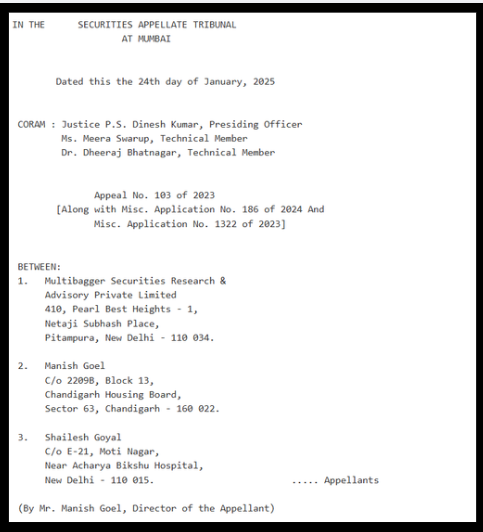
A Portfolio Manager is a significantly higher‑tier category that allows a firm to directly manage client money and securities, carry out discretionary trading, and charge fees linked to assets under management; it requires a minimum net worth of ₹5 crore, strict fit‑and‑proper criteria for key personnel, and a robust compliance and risk‑management setup.
In November 2022, SEBI passed an order rejecting Multibagger Securities’ application for Portfolio Manager registration under the SEBI (Portfolio Managers) Regulations, 2020.
A corrigendum to this order was issued in January 2023, clarifying certain procedural aspects but leaving the core decision intact: the firm did not meet the eligibility conditions SEBI expected for a Portfolio Manager role.
This rejection meant that Multibagger Securities would remain confined to its existing Investment Advisor (IA) status, where it can advise clients on securities but cannot on‑direct manage their portfolios as a PMS.
For investors, this is a critical reminder: no matter how aggressively a firm markets itself, its actual regulatory authority is only what SEBI has formally granted, and in this case, the regulator drew a clear line at Portfolio‑Manager‑type fund‑management.
Why SEBI deny the Portfolio Manager application?
SEBI’s November 2022 order explains that the rejection was based on several eligibility and suitability issues, not just on paperwork alone.
The regulator examined factors such as the professional background, experience, and fit‑and‑proper status of the principal officer and key management, and found that the firm did not convincingly meet the standards required for a high‑trust, high‑responsibility category like Portfolio Manager.
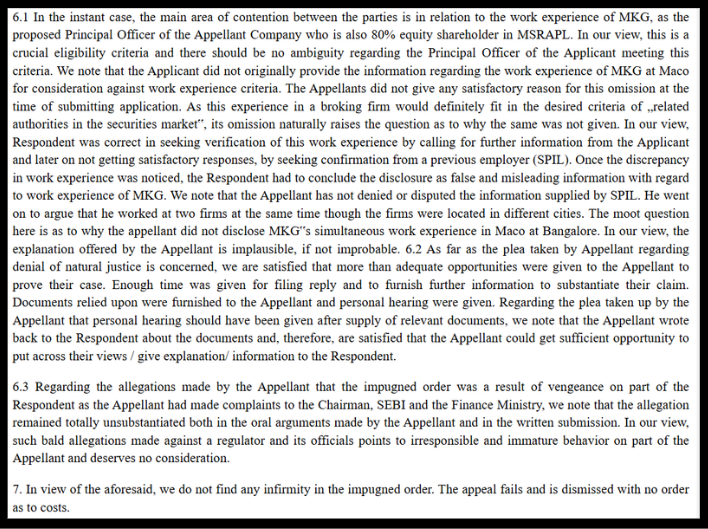
Later appellate and court‑linked filings indicate that SEBI also questioned aspects of the employment history and experience claims submitted by the principal officer, viewing some of the information as misleading or inadequately supported.
This led the appellate authority to agree with SEBI’s view that Multibagger Securities was not “fit and proper” for Portfolio Manager status at that time, and upheld the five‑year bar SEBI had effectively imposed on the firm seeking such registration.
For you as an investor, that five‑year bar is a strong signal: SEBI did not just “pause” the application; it treated the case as serious enough to restrict the firm’s expansion into fund management altogether for a defined period.
Understanding SEBI’s strict standards for PMS providers is essential for investors. If you ever face issues with a PMS provider, knowing how to file complaint against portfolio managers through SEBI’s SCORES portal or Smart ODR is crucial for protecting your capital.
What Investors & Traders Can Learn From This?
From a SEBI‑order‑aware mindset, the key takeaway is that Multibagger Securities is an Investment Advisor, not a Portfolio Manager, and that SEBI has explicitly blocked its attempt to move into a richer, higher‑control category.
This does not mean the IA cannot exist or offer advice, but it does mean you should:
- Verify on SEBI’s portal that the firm is still registered as an Investment Advisor and that no fresh adverse actions have altered that status.
- Separate the brand story (“multibagger” long‑term ideas) from the regulatory reality: the firm cannot legally manage client money as a PMS, and seeking to do so was formally rejected by SEBI.
- Read the Portfolio‑Manager‑rejection order for yourself to see the exact reasoning SEBI applies when judging whether a firm is fit to handle higher levels of financial responsibility.
Before trusting any service with deeper control over your capital, always cross‑check what SEBI has allowed versus what the firm is marketing, and treat denied applications and regulatory set‑backs as part of your due‑diligence story, not just as background noise.
How to File a Complaint Against an Investment Advisor?
Are you facing similar issues with Multibagger Securities Research & Advisory or any other SEBI‑registered Investment Advisor?
You are not alone, and you don’t have to navigate this complex process by yourself.
Our dedicated team specialises in assisting investors like you. We provide end‑to‑end support to ensure your grievance is documented effectively.
Our Step‑by‑Step Support Process:
1. Initial Consultation & Case Assessment
We will arrange a confidential call with a dedicated Case Manager who will listen to your complete experience with your Investment Advisor.
We’ll help you identify key issues such as misleading promises, unsuitable advice, missing disclosures, or failure to act in your best interest, and assess whether there are clear regulatory violations.
2. Professional Case Documentation & Drafting
We will help you draft a structured, compelling, and legally coherent complaint letter that clearly outlines the misconduct, the financial loss incurred, and the specific breaches of SEBI Investment Advisers Regulations, 2013.
This includes documenting WhatsApp/Telegram advice, sales‑force communication, and any guarantees or exaggerated claims that may have influenced your investment decisions.
3. Direct Engagement & Escalation
-
Reaching out to the Investment Advisor: Before escalating to regulators, we can guide you in formally communicating your complaint to the concerned Investment Advisor or intermediary, often a necessary step to complete the grievance redressal trail.
-
File a Complaint in SCORES: We provide detailed guidance on how to lodge your SEBI complaint on the SCORES portal. We help you track the SEBI complaint status and respond to any queries from SEBI, ensuring your case does not get delayed or lost in the system.
-
Lodging a Complaint with Smart ODR: For certain eligible disputes, we can guide you through the SEBI Smart ODR platform, a faster, online mechanism for resolving conflicts with Investment Advisors and other market intermediaries, where you can upload documents and participate in the resolution process digitally.
4. Advisory & Strategic Counselling
Our experts will counsel you on realistic outcomes, possible recovery avenues, and the typical timelines involved in the regulatory process.
We’ll help you understand whether your case is more suited for regulatory action, mediation, or a combination of approaches, depending on the nature and severity of the misconduct.
5. Guidance on Advanced Recourse
If the response from the Investment Advisor or initial regulatory action is unsatisfactory, our team will guide you on the next steps, which include exploring stock market arbitration or other dispute‑resolution mechanisms.
If your agreement with the Investment Advisor has an arbitration clause, we can connect you with resources or legal experts who specialise in securities arbitration to explore this route for recovery and accountability.
Your money matters. Your complaint matters.
By taking this step, you are not just seeking accountability for your loss; you are becoming a vital part of a cleaner, more transparent financial market.
Register with us today to file your case, and let our experienced team help you take the first decisive step toward resolution and accountability.
Conclusion
The story of Multibagger Securities is ultimately the story of a firm that walked a fine line.
On one side: a genuine belief in long-term, research-driven investing, and a structured advisory model that is, in principle, aligned with SEBI’s framework for registered Investment Advisors.
On the other side: a regulatory record that includes a High Court dismissal, a rejected portfolio management application, and years of active litigation at the SAT, all of which paint a picture of a firm that has been under consistent regulatory scrutiny.
None of this makes the firm fraudulent. SEBI’s investigation process is, as the High Court itself noted, inquisitorial; being investigated does not mean wrongdoing is established.
The firm contested every order it disagreed with, as is its right. But for an investor parting with a substantial subscription fee, these facts deserve careful thought.
The smartest thing any prospective subscriber can do is to check the firm’s current status on SEBI’s intermediary portal.
Verify its registration is active and in good standing, read any advisory service agreement carefully, and ensure that all communications, especially stock recommendations, are backed by written research rationale and carry appropriate risk disclosures.
That is, ultimately, what SEBI’s entire regulatory framework for Investment Advisors is designed to protect.
Table of Contents
Toggle




 Add us as a preferred source on Google »

