

Quick Summary
Nova NFT is not registered with SEBI or RBI, and its Play Store listing names a different developer (TREASUREMETA) than its App Store listing (Ozone Networks, Inc), a mismatch that alone should stop most people from depositing. The platform also traces back through a chain of earlier names, Treasure NFT, Magic NFT, Treasurefun, each of which reportedly stopped paying users before rebranding. Real user reviews describe locked balances, blocked withdrawals, and demands for extra fees before funds are “released.” This page checks every one of those claims so you can decide if Nova NFT is real or fake before you put any money in.
Have you come across Nova NFT through a Telegram forward or an Instagram post promising steady daily returns just for depositing?
Maybe someone told you it’s connected to a platform you’d already heard of, and that made it feel a little more legitimate.
Before you trust that feeling, the real question worth asking is simple: is Nova NFT real or fake?
This page goes through the company details, the app store listings, the rebrand history, and what actual users are saying, so you’re deciding based on facts, not on how polished the marketing looks.
Nova NFT Review
Nova NFT presents itself as an NFT trading platform, one that lets users buy, sell, and earn through what it calls automated trading. It also promotes referral and agent-level income on top of that.
On paper, this sounds like a fairly standard Web3 product. A wallet, a trading dashboard, a referral layer.
But here’s a question worth sitting with before you go any further: if this is genuinely a trading platform, why does almost everything promoted about it focus on deposits, referral codes, and daily returns, rather than the NFTs themselves?
That’s not a rhetorical trick. It’s the same question that comes up again and again once you start digging into how the platform actually operates.
Is Nova NFT Real Or Fake?
Here’s where it gets interesting: Nova NFT is real in the sense that it’s a downloadable app with an active listing and a functioning sign-up flow. It is not a fake, non-existent app.
But real and trustworthy aren’t the same thing, and that gap is exactly where the problems start.
Nova NFT is not registered or regulated in India. It has no approval from SEBI or the RBI, and there is no confirmed legal presence in the country.
That means it’s operating with zero regulatory oversight on a product that asks you to deposit real money.
On top of that, Nova NFT promotes claimed high daily returns and a referral structure that pays more the more people you bring in.
That’s a growth pattern that depends on new deposits rather than any actual trading activity, which is worth asking yourself about directly: if the platform’s income model depends on recruitment, what happens to your money once new deposits slow down?
Nova NFT Company Details
If you go looking for who’s actually behind Nova NFT, the trail runs cold fast.
There’s no clear company registration, no verified team information, no publicly listed office address, and no audited proof of real NFT trading activity anywhere in the platform’s public materials.
For comparison, a legitimate fintech or trading platform in India typically has a visible corporate entity, a registered address, and regulatory filings you can independently check. Nova NFT has none of that on offer.
Ask yourself this: if a platform is confident enough to ask for your money, why isn’t it confident enough to tell you who’s running it?
Nova NFT Owner
There’s no verified individual owner information publicly available for Nova NFT.
What we do have is a clear operational thread connecting it to previous platforms.
Multiple users, independently, describe the same sequence: an app called Treasure NFT operated in 2024 and took in real user investment.
After user complaints and stalled withdrawals, the operation reportedly shifted its data and user base into a new app called Magic NFT.
That one closed too, and things moved again to a platform called Treasurefun. Roughly eight months later, the same data resurfaced under the name Nova NFT.
One reviewer, Rishabh Koushik, laid out this exact chain in detail, describing how the platform moved from Treasure NFT, to Magic NFT, to Treasurefun, and now Nova NFT, without ever paying out the funds from the original round.

If ownership can’t be verified, but the operational pattern keeps repeating under new names, that itself answers the ownership question about as clearly as anything else could.
Nova NFT vs Treasure NFT: The Name-Change Pattern
This rebrand history isn’t just one user’s theory; it shows up in the platform’s own Telegram presence too.
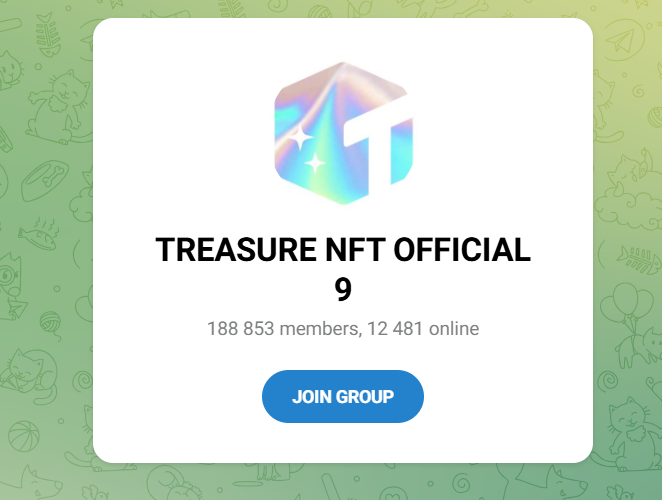
Nova NFT’s official-looking Telegram community is still branded “Treasure NFT Official,” with over 188,000 members and more than 12,000 online at any given time.
If Nova NFT were genuinely a distinct, new platform, why would its main community channel still carry its predecessor’s name?
A domain registration check adds another layer here.
The domain novanft.xyz was only registered in August 2025, a relatively new registration for a platform that markets itself as an established, multi-year opportunity.
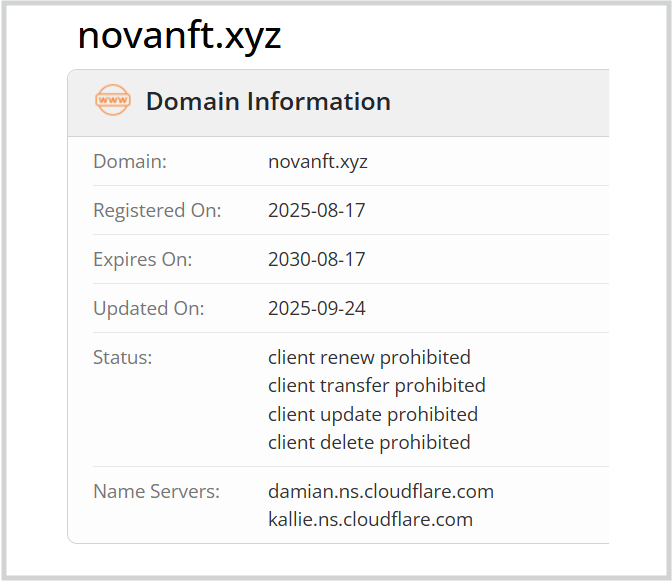
None of this proves anything by itself. But a young domain, a rebrand chain with three prior names, and a Telegram channel still wearing the old brand’s identity all point in the same direction.
Nova NFT App Store Details Don’t Match
This is one of the clearest, most verifiable red flags available, and it doesn’t require trusting anyone’s opinion. It just requires comparing two official app store listings side by side.
On the Google Play Store, NovaNFT’s listed developer is TREASUREMETA. On Apple’s App Store, the same app is listed under a completely different developer name: Ozone Networks, Inc.
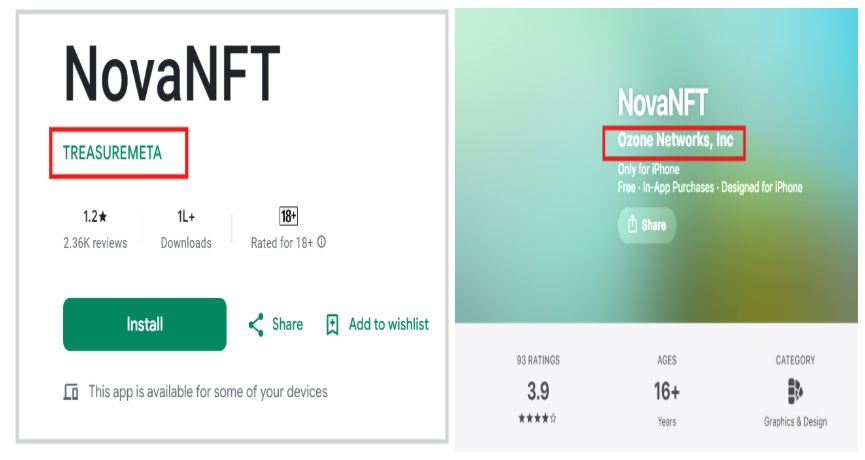
Two official storefronts, listing the same app, under two different company names.
If you were the one running a legitimate financial product, would you let your own developer identity contradict itself between the two largest app marketplaces in the world?
There’s a second detail worth noting on the Apple listing specifically: the App Store categorizes NovaNFT under Graphics & Design, not Finance.
For an app that’s asking people to deposit money and earn daily returns, that’s an unusual place to be filed.
Whether that’s a deliberate choice to avoid stricter financial-app review requirements or simple negligence, either explanation is worth being cautious about.
The Play Store listing also shows a 1.2-star rating out of roughly 2,360 reviews, despite the app reportedly having crossed 100,000 downloads. A rating that low, at that download volume, is itself a signal worth pausing on.
Also Read: Is the Finsol app real or fake? A registered company with that name exists, yet a website carrying it says WhatsApp groups using its name are unauthorised.
Is Nova NFT a Scam?
Pulling every thread above together, here’s the full pattern in one place.
- No regulatory registration with SEBI or RBI, despite handling user deposits.
- No verifiable company details, ownership, or office address anywhere in the platform’s public materials.
- A rebrand chain running from Treasure NFT, to Magic NFT, to Treasurefun, to Nova NFT, each stop reportedly ending with stalled withdrawals.
- A Telegram community still branded under the old name, despite the platform presenting itself as new.
- A newly registered domain for a platform marketed as an established opportunity.
- Contradictory developer identities between the Play Store and App Store listings for the same app.
- An app store category (Graphics & Design) that doesn’t match what the app actually does.
- A referral structure that rewards recruitment as heavily as, or more than, actual platform use.
- Widespread user complaints about locked balances, blocked withdrawals, and demands for extra fees.
None of these points alone proves fraud with certainty.
But when this many independent, verifiable details all point the same direction, at what point does asking “is this a scam” stop being cautious and start being simply accurate?
Nova NFT Telegram Channel
Telegram plays a central role in how Nova NFT is promoted and how its users are managed, and that’s worth its own look.
Nova NFT’s Telegram presence, still branded under the “Treasure NFT Official” name as shown above, is used to post platform updates, withdrawal announcements, and direct messages from people presenting themselves as support agents or “technical assistants.”
Common patterns reported inside these channels include manufactured urgency (“last chance,” “account will freeze”), admins sliding into private messages to walk users through additional payments, and negative comments getting deleted or disabled to preserve the appearance of a healthy, thriving community.
A promotional post from an account called nova_nft22 illustrates how this promotion actually reads in practice: it announces the platform’s “successful” launch, invites people to join with a minimum investment, and lists specific figures, including amounts in Pakistani Rupees alongside dollar amounts, plus a stated withdrawal window and a personal referral link for new signups.
If a platform’s main promotional activity is recruitment posts with referral links rather than any actual proof of NFT trading volume, ask yourself what you’re really being invited to join.
Nova NFT User Complaints
Beyond the structural red flags, actual user reviews describe consistent, specific problems. These are real reviews left on public platforms.
1. Locked Balances and Blocked Withdrawals
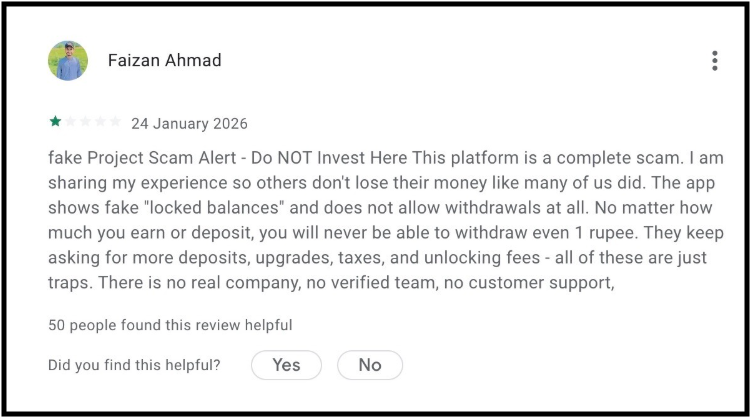
Faizan Ahmad described the platform as showing fake “locked balances” that never become withdrawable, no matter how much is deposited or earned.
According to this review, the platform instead keeps requesting more deposits, upgrades, taxes, and unlocking fees, framed as necessary steps to release funds that never actually get released.
The reviewer also noted there’s no real company, no verified team, and no customer support behind any of it.
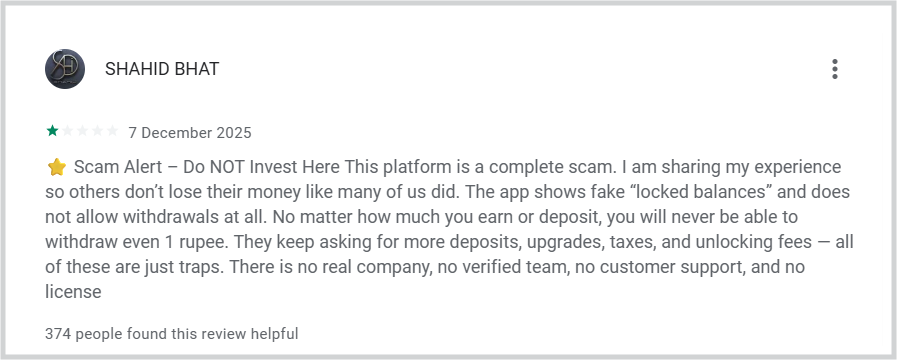
Shahid Bhat’s review describes nearly the same experience in almost identical terms, titled directly as a “Scam Alert,” reinforcing that this isn’t an isolated account.
It’s a pattern that multiple separate users are independently describing the same way.
2. No Transparency, Poor Support
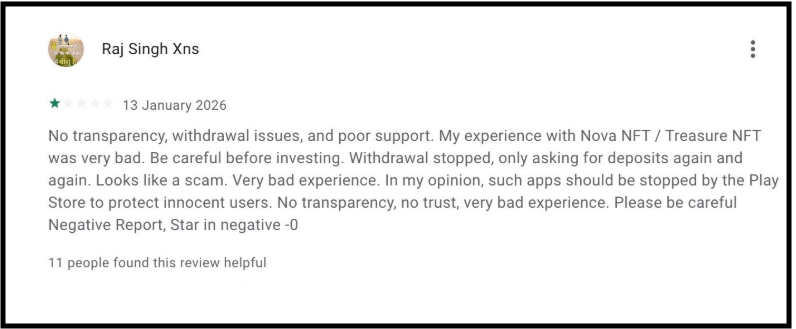
Raj Singh Xns described the overall experience with both Nova NFT and Treasure NFT as lacking transparency, with withdrawals stopped and support offering nothing beyond requests for further deposits.
The reviewer specifically called for app stores to intervene and remove apps like this to protect users.
3. Registration Blocked without a Referral Code
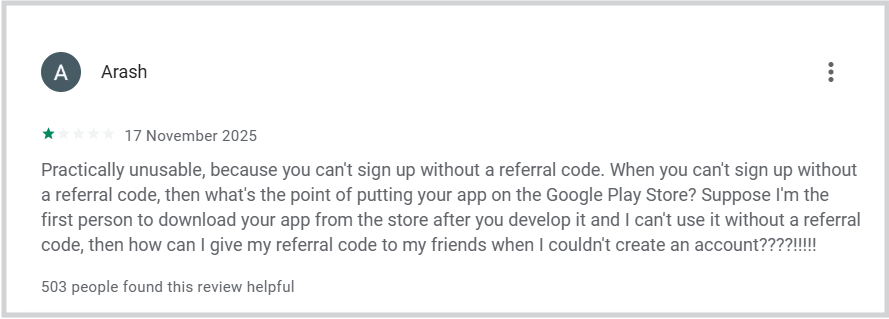
Arash’s review raises a logical problem baked directly into how signup works: the app reportedly can’t be used at all without entering a referral code, which raises an obvious question the reviewer states directly: if no one can sign up without a code from someone else, how did the very first user ever get one?
A structure that requires recruitment before use is functioning less like a product and more like a chain that only works if it keeps expanding.
4. Reported Directly as Fraud on the App Store
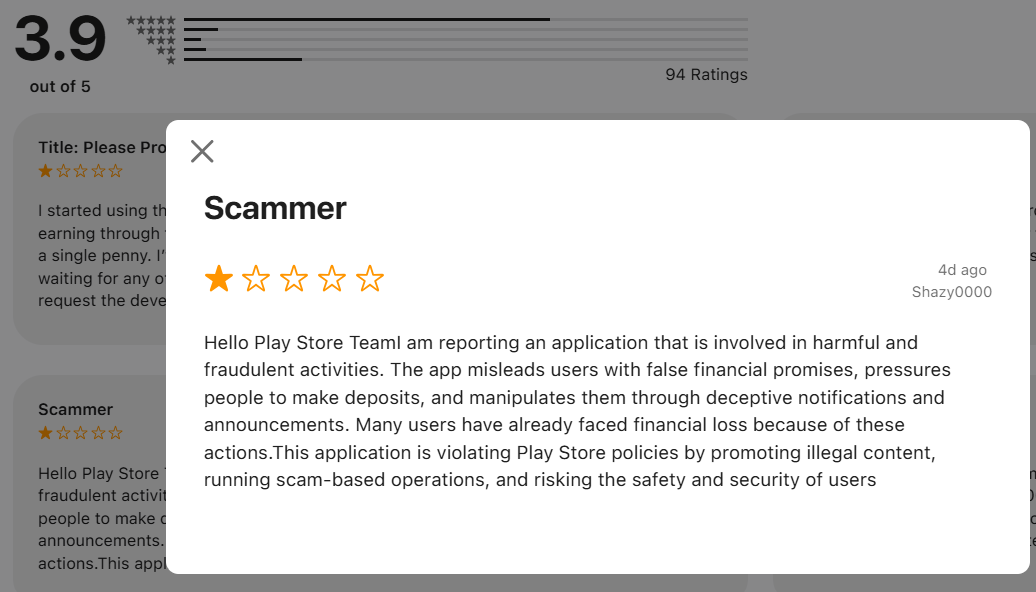
A reviewer using the handle Shazy0000 filed a direct fraud report through Apple’s App Store review system, describing the app as misleading users with false financial promises, pressuring deposits, and manipulating people through deceptive notifications.
The reviewer explicitly asked Apple to review the app for violating store policy around scam-based operations.
Nova NFT Withdrawal Problems
Withdrawal issues sit at the center of nearly every complaint above, and they deserve their own closer look given how central this problem is to the entire pattern.
Users consistently describe the same sequence: deposits go in smoothly, small early balances or profits may even appear to grow, but the moment a larger withdrawal is attempted, the process stalls.
Common excuses reported include “verification pending,” technical upgrades, or a requirement to pay additional fees before funds are released, fees that, once paid, still don’t result in an actual withdrawal.
For a complete breakdown of exactly what’s happening with Nova NFT withdrawals, current user reports, and what to expect if you try to withdraw, our dedicated guide on Nova NFT withdrawal covers this specifically.
How to Report Nova NFT?
If you’ve already deposited money into Nova NFT and are running into any of the issues described above, acting quickly matters more than waiting to see if things resolve on their own.
Start by saving every piece of evidence you have: screenshots of deposits, balances, chat logs with support or admins, and any withdrawal attempts along with the error messages they returned.
This documentation is what makes a formal complaint actually actionable.
From there, contact your bank or the payment method you used to flag the transaction and ask about your dispute options.
You should also report the app directly through Google Play or the App Store’s fraud reporting tools, flagging it for the same deceptive practices described throughout this page.
Filing a formal cybercrime complaint is also worth doing even though NFT trading itself isn’t a regulated activity in India, since the underlying financial fraud absolutely is something authorities can act on.
Our guide on how to file a cyber crime complaint walks through exactly what information you’ll need and how the process works from start to finish.
Feeling unsure whether your situation even qualifies as something worth reporting?
That uncertainty is common, and it shouldn’t stop you from taking the first step. Register with us and our team will help you understand your options and prepare your complaint properly.
Conclusion
So, is Nova NFT real or fake? The app itself is real and downloadable, but the platform behind it shows almost every marker of a repeat rebrand operation rather than a genuine, transparent trading product.
No regulatory registration, no verifiable company or ownership details, a documented chain of prior names each ending in stalled withdrawals, contradictory app store developer identities, and a steady stream of user complaints describing the same locked-balance pattern.
None of that is speculation; it’s all independently verifiable.
If you’re currently holding funds inside Nova NFT, or considering depositing for the first time, weigh everything above against whatever return or opportunity first caught your attention.
And if you’ve already run into trouble, don’t wait it out. Document everything and start reporting sooner rather than later.
Report. Recover. Stay Fraud Free.
Frequently Asked Questions
Yes. Multiple independent user reports describe the same operational chain, from Treasure NFT, to Magic NFT, to Treasurefun, and now Nova NFT, with each prior version reportedly stalling withdrawals before the platform rebranded again. Nova NFT's own Telegram channel is still branded "Treasure NFT Official."
Based on available evidence, no. The platform is unregulated in India, has no verified company details, and has a consistent pattern of user complaints describing locked balances and blocked withdrawals after deposits are made.
Users report that withdrawal requests get stuck as "pending," balances suddenly show as locked, or the platform demands extra fees, taxes, or "unlocking charges" before funds are supposedly released, payments that reportedly still don't result in a successful withdrawal.
Save all your evidence (deposits, chats, withdrawal attempts), contact your bank or payment provider, report the app through Google Play or the App Store, and file a cybercrime complaint. You can also reach out through our contact page for help navigating the process.




 Add us as a preferred source on Google »

