
Quick Summary
NSE arbitration is a quasi judicial process for disputes between investors and trading members.
A sole arbitrator hears claims below Rs 25 lakh, a three member panel hears larger claims.
Applications generally must be filed within six months of the dispute or the exchange’s final response.
This checklist covers what to prepare before you file an NSE arbitration application against a broker.
Conciliation failed. The case moved to arbitration. The hearing ran online on a single day.
Weeks later, a retired district judge ordered the broker to refund Rs 4,65,000, plus bear their own legal costs.
That’s what a properly prepared NSE arbitration case can achieve.
Before you file your own, run this checklist.
Claim Value and Arbitrator Panel Size
| Claim Value | Panel Structure | Filing Fee (approx.) |
| Below Rs 10 lakh | Sole arbitrator | Around Rs 10,000, often subsidised |
| Rs 10 lakh to Rs 25 lakh | Sole arbitrator | Slab based, tied to claim amount |
| Above Rs 25 lakh | Three member panel | Higher slab, subsidies more limited |
The Pre Filing Checklist
Confirm each point below before submitting your NSE arbitration application.
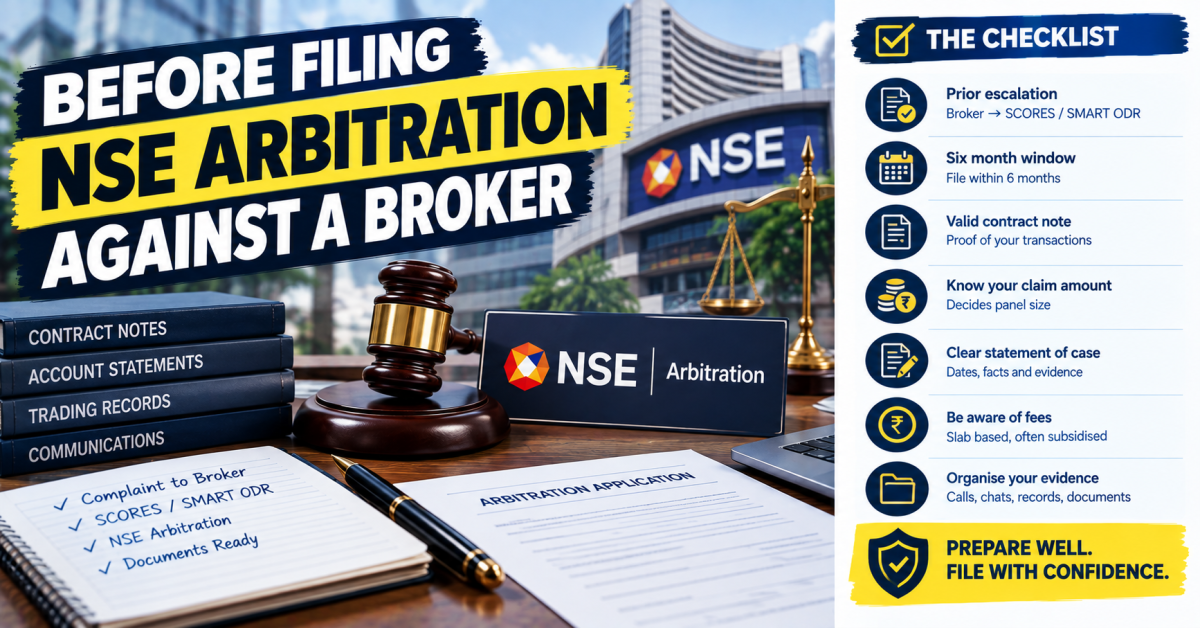
- Exhaust prior steps: Complaint to the broker, then SCORES or SMART ODR, should generally come before arbitration.
- Check the six month window: Applications must generally be filed within six months of the dispute or its closure.
- Valid contract note: You need documentary proof of your dealings, such as contract notes or account statements.
- Claim value clarity: Know your exact claim amount, since it determines a sole arbitrator versus a three member panel.
- Statement of case: Prepare a clear, factual account of what happened, with dates and supporting evidence.
- Fee awareness: Arbitration fees are generally nominal and often subsidised for smaller retail claims.
- Evidence organisation: Call recordings, chats, and transaction records carry real weight, as several cases have shown.
Filing Your Application, Step by Step
Arbitration is a formal, structured process specifically designed for unresolved complaints, explained in NSE complaint against broker.
1. Confirm prior escalation is complete: since arbitration is generally the final step after other channels fail.
2. Prepare your Statement of Case: in Form No. I, covering all relevant details and the relief sought.
3. Attach supporting documents: including contract notes, bills, and any relevant correspondence.
4. Submit within the filing window: generally within six months of the dispute or the exchange’s final response.
5. Await arbitrator assignment: from NSE’s approved regional list of judges, legal experts, or finance professionals.
What Strong Evidence Actually Looks Like
One arbitration panel requested call recordings alongside documents in a disputed margin case, revealing details that changed the outcome entirely.
Documented evidence, not just your account of events, is what arbitrators weigh most heavily.
Start organising your records the moment a dispute begins, not after months have already passed.
Bottom Line
A well documented, timely filed arbitration application gives you a real shot at a binding, enforceable outcome.
You can check SEBI registered company status and explore checklists for the full complaint process on Fraud Free.
Ready to file? You can start NSE arbitration directly.
Report. Recover. Stay Fraud Free.
Frequently Asked Questions
Applications generally must be filed within six months from the date of the dispute or the exchange's final response, though the exact window can vary. Filing promptly protects your claim.
Yes. Claims below a certain threshold are typically heard by a sole arbitrator, while larger claims are heard by a panel of three arbitrators, which can affect timelines and complexity.
Contract notes, account statements, chat records, and call recordings all carry weight. One documented case turned on call recordings that revealed details different from the initial claims made.
Generally yes. Arbitration is typically the final step after direct complaints and other grievance mechanisms haven't resolved the matter satisfactorily.
Awards are generally binding, though a dissatisfied party can file an appeal to a three member appellate panel within the allowed time, typically 30 days from the original award.
Generally no. Fees are slab based and tied to your claim amount, with many retail claims below certain thresholds receiving subsidised costs, especially when the case is decided in the investor's favour.





 Add us as a preferred source on Google »

