Most investors enter the stock market with one simple understanding that a trade happens only when they decide to place it.
You log into your account, choose the stock, confirm the quantity, and execute the order yourself. That feeling of control is what makes people comfortable trading online.
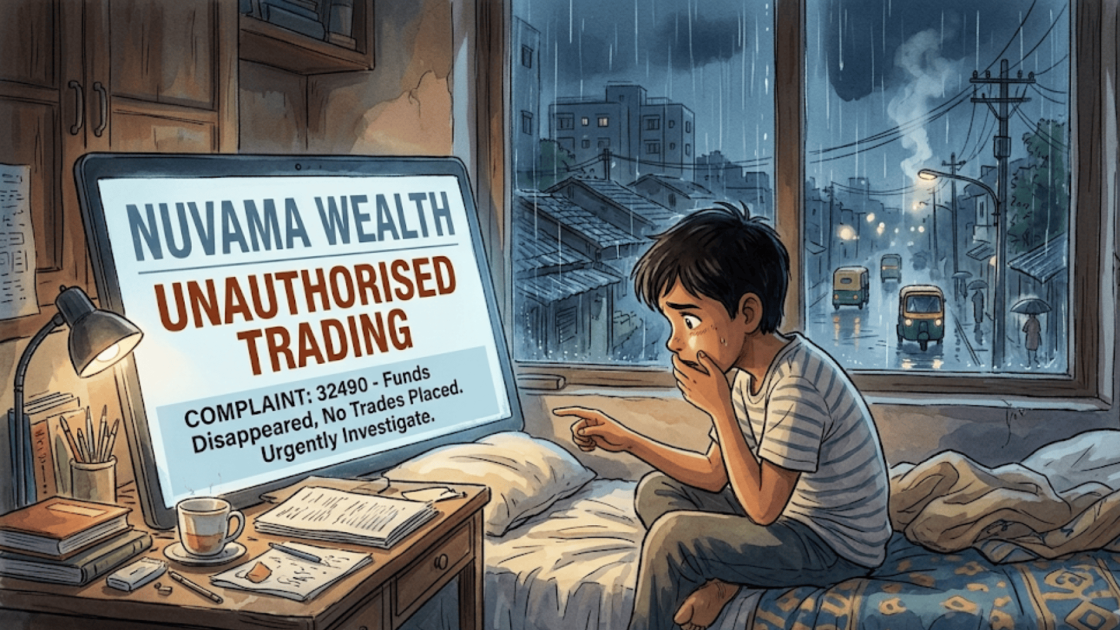
So when someone opens their trading account and suddenly sees trades they do not remember placing, it can feel unsettling. The first reaction is usually confusion.
Many investors start doubting themselves: Did I approve this earlier? Did I miss something on the app? Or did someone else place the trade?
Over the years, some investors have raised concerns about Nuvama Wealth unauthorised trading.
When complaints keep appearing over different years, it naturally raises questions about how such situations develop.
This blog takes a closer look at how unauthorised trading disputes can happen, what complaint numbers suggest, and what options investors have if they ever face something similar.
Nuvama Wealth Overview
Nuvama Wealth Management Ltd. is a well-known financial services firm in India that provides brokerage, investment, and wealth management solutions.
The company operates across several areas of the financial market and offers services such as equity trading in cash and derivatives, portfolio management services (PMS) and mutual funds and other investment products.
Investors can usually access the markets through Nuvama’s trading platforms, which include:
- The Nuvama mobile trading app
- A web-based trading platform
- Dealer or relationship-manager assisted trading for certain clients.
Because many investors use Nuvama for long-term portfolios and active trading, their accounts often contain significant investments.
That is why even a few unexpected trades can make investors uncomfortable.
When something appears in the account that they did not plan for, it can quickly turn into a serious concern.
Nuvama Wealth Unauthorised Trading Complaints
Unauthorised trading occurs when a broker, dealer, or any other financial professional executes a trade in a client’s investment account without obtaining the client’s explicit permission or consent to do so.
Looking at complaint data can give a general idea of whether investors have raised similar concerns in the past.
You can refer to the Nuvama Wealth complaints for unauthorised trading for the past 5 years below:
| Year | Total Complaints | Unauthorised Trading Complaints | Percentage of Unauthorised Trading Complaints |
| 2021–22 | 171 | 23 | 13.45% |
| 2022–23 | 149 | 22 | 14.77% |
| 2023–24 | 115 | 15 | 13.04% |
| 2024–25 | 204 | 46 | 22.55% |
| 2025–26 | 104 | 31 | 29.81% |
One thing the data shows is that unauthorised trading complaints appear consistently across several years.
The percentages also increased in the more recent years, particularly in 2024–25 and 2025–26.
While complaint numbers alone do not prove that every claim was valid, they do show that a noticeable portion of investor grievances are related to trades being executed without clear approval.
For investors, this highlights the importance of staying aware of account activity and raising questions whenever something seems unfamiliar.
Impact of These Complaints on Retail Traders
For retail investors, the effects of such situations are not limited to financial losses.
Unexpected trades can lead to losses, margin calls, or forced exits from positions the investor never intended to take.
In some cases, these losses occur before the investor even realises what has happened.
But the emotional impact can be even stronger.
Some investors even reduce their trading activity, while some stop trading altogether because they no longer feel fully in control.
Nuvama Wealth Arbitration Case
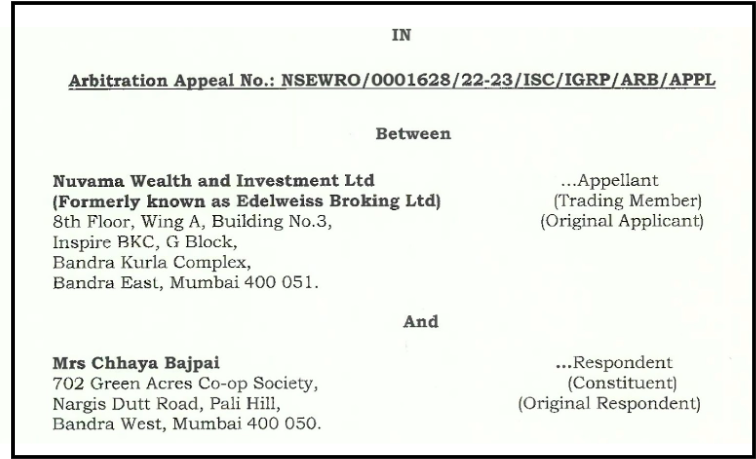
Nuvama Wealth and Investment Ltd. (formerly Edelweiss Broking Ltd.) filed an appeal in a dispute involving Mrs Chhaya Bajpai, who had initially raised concerns about losses totalling ₹41,66,000 in her trading account.
-
Background of the Case
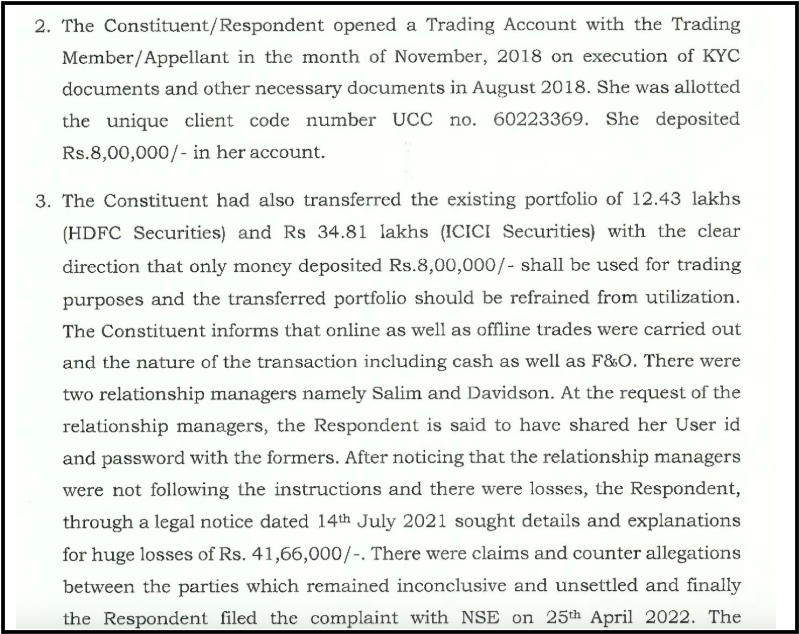
The investor claimed that two relationship managers working with the brokerage had executed unauthorised trades in her account after she shared her login credentials with them for what she believed were smoother operations.
The broker argued that it should not be held responsible because the client had violated the agreement by sharing her password and because the trades appeared to have been executed through the online system.
However, the Tribunal observed that the firm had earned significant brokerage and interest from the trades.
It also noted that the broker could not provide clear evidence which shows that the client had authorised those transactions beforehand.
The dispute, therefore, focused on whether a brokerage firm could be held responsible for the actions of its employees.
-
Award
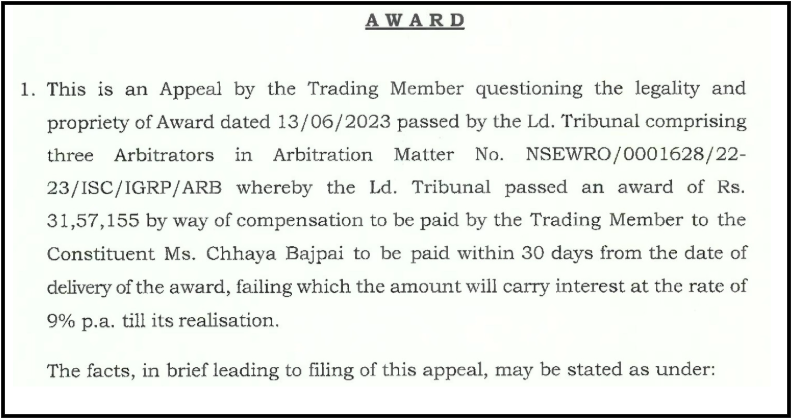
The Appellate Panel rejected the broker’s appeal and upheld the earlier decision.
The brokerage firm was directed to pay ₹31,57,155 to the investor, along with interest if the amount was not paid within the specified time.
The panel concluded that the broker could be held liable for the actions of its employees, especially when the firm had benefited financially from those trades.
-
Key Takeaways
- Brokers Are Responsible for Employee Actions: A firm cannot avoid liability simply by dismissing employees if those employees executed trades that benefited the brokerage.
- Proof of Authorisation Is Important: If a dispute arises, brokers must be able to show clear evidence that the client approved the trades.
- Sharing Passwords Does Not Automatically Justify Trades: Although clients are advised not to share credentials, that alone does not give brokers or employees the freedom to execute trades that the client never intended.
- Client Instructions Must Be Respected: Brokers must follow client instructions carefully when using their portfolio or collateral for trading.
When Can Action Be Taken Against a Broker?
Many investors assume that if a trade appears in their account, they must automatically accept it. In reality, brokers also have certain responsibilities under regulatory rules.
-
When There Is No Proof of Order Placement
Brokers are expected to keep records showing that the client actually placed or approved the trade.
This proof could include:
- Recorded phone calls
- Email confirmations
- Online order logs
- Messages from the registered mobile number
If the broker cannot produce such records during a dispute, the trade can be questioned.
-
When Trades Go Beyond What Was Agreed
Even if the investor gave permission for a specific trade, that does not mean the broker can execute additional trades without further approval.
If the broker places extra trades or larger quantities than what was discussed, those transactions may still be challenged.
-
When Employee or Dealer Actions Are Misused
Relationship managers or dealers must act strictly on client instructions. If trades are placed without proper approval, the brokerage firm may still be responsible for those actions.
-
When Records Are Missing During a Complaint
Once a complaint reaches regulators or stock exchanges, documentation becomes very important.
If the broker cannot provide proper records explaining how the trades were authorised, the investor’s claim can become stronger.
How To Complaint Against a Stock Broker?
If you suspect unauthorised trades in your account, acting quickly and carefully can help protect your position.
1. Review Your Trading Records
Start by checking your contract notes, trade history, and account statements. Identify which trades you believe were not authorised.
Note the dates, quantities, and order details.
2. Save All Relevant Evidence
Keep records of everything related to your account, such as:
- Emails
- SMS alerts
- App notifications
- Screenshots of trade history
These details can become useful if the matter escalates.
3. File a Written Complaint With the Broker
Send a formal complaint explaining the issue and asking the broker to provide proof of authorisation for the trades.
It is always better to communicate in writing so there is a clear record.
4. Raise a complaint on SCORES
If the broker does not respond properly, you can file a complaint through SEBI SCORES, the regulator’s grievance redress system.
This creates an official record and requires the broker to respond within a certain timeframe.
5. Approach the Stock Exchange
If the issue remains unresolved, you can approach the stock exchange grievance cell where the trade was executed.
The exchange may attempt to resolve the matter between the investor and the broker.
6. Stock Exchange Arbitration
If the dispute still continues, the final step is arbitration through the stock exchange.
Here, an independent arbitrator reviews the evidence from both sides and gives a binding decision.
Need Help?
Many investors feel something is wrong but are unsure how to present their complaint effectively.
We help investors by:
- Reviewing trade records carefully
- Identifying possible unauthorised transactions
- Organising evidence and documents clearly
- Drafting complaints and escalation responses
- Assisting with SEBI SCORES filings and arbitration procedures
Having guidance can make the process much easier and less stressful. So, reach out to us now.
Conclusion
Nuvama Wealth Unauthorised trading complaints do not represent every investor’s experience.
However, the presence of similar complaints across different years shows why awareness is important.
For investors, the best protection is staying involved with their own accounts, checking contract notes regularly, understanding what trades are being executed, and questioning anything that seems unfamiliar.
Investing should feel transparent and under your control.
And if that sense of control ever feels uncertain, it is always better to investigate early rather than ignore the warning signs.
If you notice suspicious activity in your ledger, you should immediately raise a complaint with the broker and escalate the matter through the investor grievance mechanisms.