
If you’ve attended or even just seen promotions for SpringPad AI seminars, you’ve probably come across Pratik Chakraborty.
He’s positioned as the trader in the room; the co-founder with hands-on market experience, hedge fund exposure, and years of trading across global markets.
The bio sounds impressive: proprietary trading, ₹25 crore+ capital exposure, futures trading at a London-based hedge fund, deep focus on Indian equities and F&O.
For someone exploring AI-based trading or algorithmic systems like BullsAI, that kind of background naturally builds confidence.
But in financial markets, there’s always a second layer to look at.
Experience is powerful. Regulatory permission is powerful, too.
And the two are not the same thing.
SpringPad Wealth Solutions Pvt. Ltd. holds a SEBI Research Analyst registration.
But Pratik Chakraborty is publicly positioned as a co-founder and trainer, not necessarily as the registered Research Analyst himself.
So the real question isn’t whether he has trading experience.
The real question is:
What does SEBI registration mean in this context?
And what should investors understand when attending SpringPad AI seminars or BullsAI training sessions?
Let’s break this down calmly and clearly.
Pratik Chakraborty Review
If you look at Pratik Chakraborty’s profile on the website, the positioning is very clear. He is presented as a trader first, mentor second.
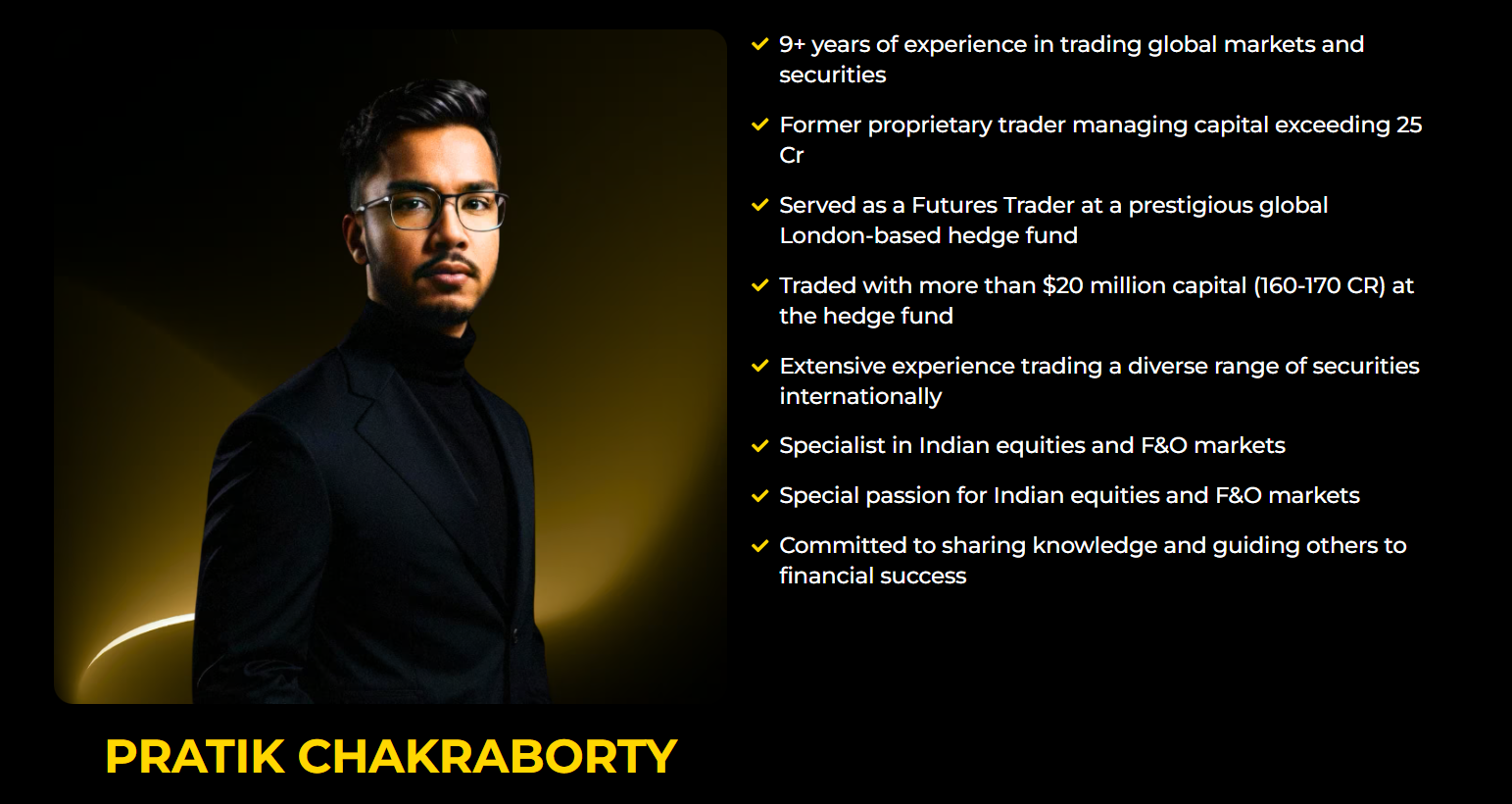
The bio mentions:
- 9+ years of experience trading global markets
- Former proprietary trader managing capital exceeding ₹25 crore
- Futures trader at a London-based hedge fund
- Specialist in Indian equities and F&O markets
- A strong focus on guiding others toward financial success
For someone interested in derivatives and structured trading systems, that kind of background sounds reassuring.
And to be fair, professional trading exposure does add weight to a trainer’s credibility.
But here’s where the distinction becomes important. Trading experience is not the same as regulatory authorization.
You can be an experienced trader or have managed large capital.
But when you begin conducting public seminars, offering structured trading frameworks, and training participants on algorithmic tools like BullsAI, the regulatory lens changes.
That’s where the question naturally arises:
Is Pratik Chakraborty individually registered with SEBI? Or does he operate under SpringPad’s entity-level registration?
Is Pratik Chakraborty SEBI Registered?
SpringPad Wealth Solutions Pvt. Ltd. holds a SEBI Research Analyst (RA) registration- INH000022950.
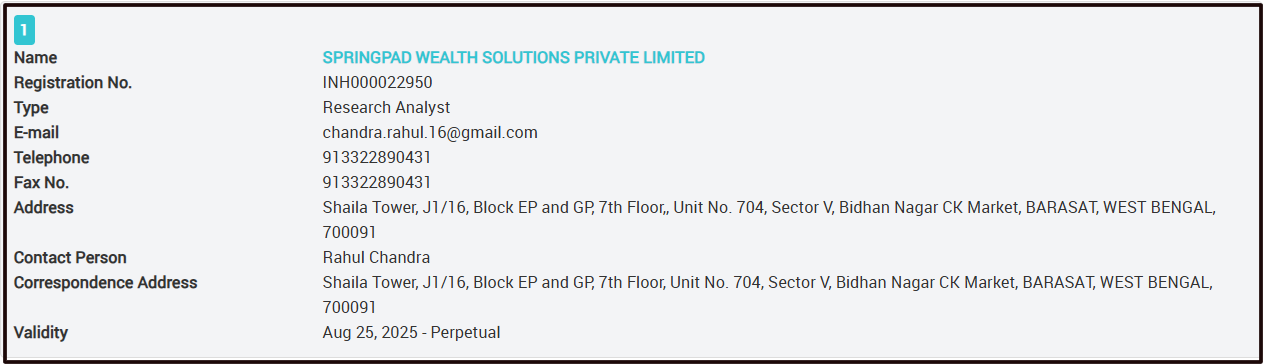
Rahul Chandra is directly linked to this registration through the entity. That much is publicly visible.
Now here’s where clarity becomes important.
Based on available public records, there is no separate SEBI Research Analyst registration in Pratik Chakraborty’s individual name.
The registration belongs to the company, not automatically to every co-founder.
This doesn’t imply wrongdoing. Many firms operate under entity-level registration where designated individuals are responsible for compliance.
But from an investor’s perspective, the distinction matters.
Entity registration means:
- The company is regulated.
- Research activities must follow SEBI RA norms.
- Disclosures, fee structures, and conduct are governed by regulation.
It does not automatically mean that every trainer or presenter is individually licensed.
SpringPad Courses
Now let’s connect this with marketing language.

When phrases like “30% return on your capital” appear in seminars or promotional material and both Rahul Chandra and Pratik Chakraborty are presenting the framework investors naturally associate that with regulatory credibility.
But under SEBI regulations, a Research Analyst:
- Cannot guarantee returns.
- Cannot create assured-profit impressions.
- Must avoid misleading performance projections.
So the key question becomes:
Is the 30% figure presented as a hypothetical backtested example or as a realistic expectation?
And more importantly:
Is it being delivered under structured research guidelines or in a way that may create performance expectations?
If Pratik conducts seminars under SpringPad’s registered structure, discussions must remain within the permitted scope of research and education.
If personalised advice or return assurances are implied, regulatory classification changes.
This is why the distinction between:
- Rahul’s role as linked to the RA registration, and
- Pratik’s role as co-founder and trainer
becomes important for investor understanding.
SEBI registration provides credibility.
But it also imposes boundaries.
The real question isn’t just “Is there a registration?”
It’s: Are all representations, including return figures, aligned with what the registration legally allows?
SpringPad AI User Complaints
SpringPad AI seminars are actively conducted by Rahul Chandra and Pratik Chakraborty.
In these sessions, participants are introduced to structured trading frameworks, F&O strategies, and the use of BullsAI as an AI-supported trading system.
The positioning is clear; combine trading experience with automation and structured execution.
For many retail traders, especially those interested in derivatives, that sounds compelling.
However, expectations can rise quickly in such environments. And that’s where public feedback becomes relevant.

The review above raises serious allegations regarding course effectiveness, refund commitments, pricing concerns, and dissatisfaction with BullsAI outcomes. It specifically names both Rahul and Pratik.
It is important to state clearly: These are user allegations and not regulatory findings.
But when a co-founder who conducts seminars and training is directly mentioned in complaints, investors naturally begin asking questions.
Were expectations clearly defined during the seminar?
Were performance outcomes presented as illustrations or realistic expectations?
Was the service structured purely as education, or did it feel like advisory?
Now let’s separate the risks.
1. Regulatory Risk
SpringPad holds a SEBI Research Analyst registration as an entity.
Under that framework:
- Educational sessions are permitted.
- Research-based discussions are permitted.
- Model portfolio discussions may be permitted within compliance norms.
However:
If personalized stock tips are given to individuals, especially tailored recommendations based on someone’s capital, risk profile, or goals that moves closer to Investment Adviser territory, which requires separate registration.
Similarly, if trading guidance resembles discretionary decision-making or structured advisory beyond general research, regulatory classification changes.
So the key distinction becomes: Is the seminar purely educational? Or are individualized recommendations being provided?
Entity registration does not automatically authorize personalized advisory unless structured under appropriate regulatory norms.
2. Financial Risk
Even if everything is structured within permissible limits, trading risk remains.
F&O trading involves leverage. Algorithmic systems can underperform in volatile markets.
Backtested strategies can fail in live conditions. AI reduces manual effort, it does not eliminate losses.
If someone pays a significant program fee and then deploys capital based on expectations built during training, their total financial exposure includes:
- The course fee
- Brokerage costs
- Trading losses
- Opportunity cost
That’s why investors must separate three things- Experience, education and regulatory authorisation.
When those lines blur, expectations rise, and that’s where both regulatory and financial risks increase.
The real issue is not whether Pratik Chakraborty has trading experience.
The real issue is whether the service being delivered remains clearly within the boundaries of research and education and not personalised advisory.
How to Report a Research Analyst?
If your concern relates to activities conducted under SpringPad’s SEBI Research Analyst registration, the complaint must be filed against the entity, not an individual trainer.
Here’s how to proceed calmly and methodically.
Step 1: Gather Your Evidence First
Before you file any complaint, make sure your paperwork is ready. This includes:
- Proof of payment, such as invoices or receipts
- Screenshots of seminars or course promotions, especially those mentioning claims like “30% returns”
- Any written refund assurances or guarantees
- Email or WhatsApp conversations with the entity
- The SEBI registration number
Without solid evidence, complaints usually don’t go very far.
Step 2: File the Complaint on the SEBI SCORES Portal
Once your documents are in place, head to the official SEBI SCORES platform and:
- Register yourself as a complainant
- Choose “Research Analyst” as the intermediary category
- Enter the entity’s SEBI registration number
- Upload all relevant supporting documents
SEBI will forward your complaint to the registered entity and keep track of how they respond.
Step 3: Escalate if the Response Is Unsatisfactory
If the response provided by the Research Analyst does not resolve your concern, you can escalate the matter within the SCORES system.
Step 4: Approach the Consumer Court for Refund Issues
If your dispute is mainly about course fees, seminar charges, or unfulfilled refund promises, you also have the option to approach the Consumer Disputes Redressal Commission for legal relief.
Step 5: File Arbitration in the Stock Market
In case no resolution is provided to you by SEBI, or you are unsatisfied with the judgment, then you can escalate it further and file an arbitration in the stock market.
Need Help?
Dealing with a dispute involving a research analyst can feel intimidating, especially when the firm is SEBI-registered.
That registration often creates a sense of safety, and when things go wrong, the confusion hits even harder.
If you’re feeling stuck or second-guessing yourself, that reaction is completely understandable.
We help you get everything in order, from organising payment proofs and screenshots to drafting a complaint that is clear, structured, and aligned with regulatory expectations. We will also help you in tracking SEBI complaint status.
We stay with you through the follow-up process and explain what each stage means, so you’re never left guessing or navigating the system alone.
Conclusion
Pratik Chakraborty is positioned as a trader-mentor and co-founder of SpringPad, while the SEBI Research Analyst registration belongs to the entity.
That distinction matters.
When AI-driven trading systems, BullsAI training, and return figures like “30% on your capital” are discussed, investors should pause and ask:
Is this education or advisory? Who is authorised under SEBI norms? What are the real risks involved?
Experience builds confidence. Regulatory clarity protects capital.