

Quick Summary
Quickly Investment App sits on Google Play under the developer Quickly Platforms from Indore. Here’s the worrying part. Several investors tell us fake IPO groups on WhatsApp pushed them to take a loan through this app, and that borrowed money then went into “IPO allotments” that never showed up in their demat accounts. The app’s own reviews also mention profits on hold and slow capital refunds. Let’s walk through what victims describe and what you should check before borrowing.
So a WhatsApp group told you to grab a loan on the Quickly Investment App to pay for an IPO, and something about it feels off. Trust that feeling.
Honestly, no real IPO ever needs a loan that a stranger arranges for you in a chat group. Still, we keep hearing this exact story, and this app’s name keeps popping up in it.
This pattern sits squarely inside the broader dangers of cyber crime investors face today, where a trusted-looking app becomes the final step in a much longer con.
Let’s go through it together: what the app says about itself, how the loan push usually plays out, and where the money ends up.
And if you’ve already paid and want to report financial fraud India, the checklist further down will help you get started.
Quickly Investment App Overview
Before we get to the complaints, let’s look at how the app describes itself. Everything here comes straight from its public Google Play page, so you can check it yourself.
You’ll find the app under the developer name Quickly Platforms. Its one-line pitch invites you to invest your money and earn the “best yearly return.”
Scroll down, and the description talks about wealth management, retirement planning, insurance, and connecting companies that need capital with big institutional investors.
It shows over 1,000 downloads, a 3.3 star rating, and a last update on 29 August 2025.
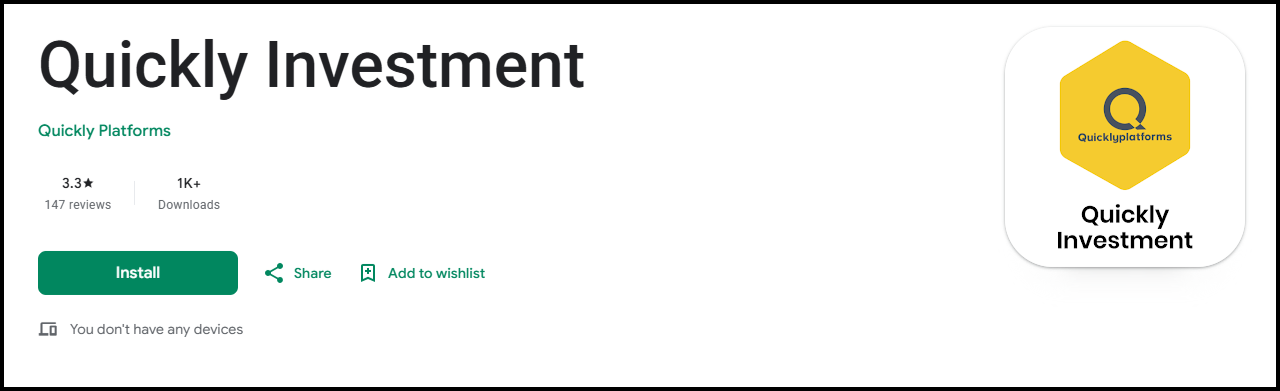
The developer section gives an Indore address, a support phone number, and two Gmail addresses.
Now here’s something worth noticing.
The listing talks about investing for a yearly return, and it says nothing about loans. So if the app showed you a loan offer, screenshot that screen right away.
It’s a feature the store page never mentions.
Also Read: Upstox WhatsApp group, and the 80% to 120% listing gains promised inside the chat.
How Victims Say the Loan Push Begins
In every story we’ve heard, the app shows up quite late.
Things start in a WhatsApp group, and the loan only comes in once the pressure is already on.
1. A Fake IPO Group and an Allotment Bigger Than Your Balance
It usually starts with a WhatsApp group full of IPO tips, “institutional quotas,” or shares at a discount.
Before long, an admin walks you onto a trading app or website that the group controls.
Our full breakdown of IPO scams covers this exact “institutional quota” pitch and the allotment pressure that follows it.
You see a few small wins on screen and start to relax. Then a message lands saying you’ve won a big IPO allotment, way bigger than what’s in your account.
Along with it comes a tight deadline and a warning that your account will freeze if you don’t pay in time.
2. The Suggestion to Borrow Through Quickly Investment
Naturally, you tell them you don’t have that kind of money lying around. That’s when the group offers a “solution.”
Victims tell us the admin or an “assistant” pointed them to the Quickly Investment app to take a loan and fill the gap.
And the group doesn’t leave you alone with it. They tell you what to fill in, which documents to upload, and how fast the money will come.
With the clock ticking, hardly anyone stops to read the loan terms.
3. Where the Borrowed Money Goes?
This is the part that hurts the most. Once the loan lands in your account, the group asks you to send it on to their “IPO” account to clear the allotment.
Your trading screen then shows the allotment as paid, but the shares never reach your demat account.
A few days later, there’s a fresh demand, maybe a tax, a fee, or a brand new allotment. And all this while, you’re also paying off a loan.
Also Read: A Finsol-named WhatsApp group showed ₹1.75 lakh as ₹9.75 lakh on a trading app screen; read the Finsol app case from Bengaluru.
What Do Public Reviews of Quickly Investment Say?
You don’t have to rely only on what victims tell us.
The app’s own review section already has people talking about trouble getting their money back.
Four reviews, each dated, each flagged as helpful by a real number of other users, lay this pattern out in detail.
1. A Six-Month Wait Nobody Was Told About Upfront
This reviewer describes the platform putting their profits on hold for two full months, with no clear update on when the capital itself would actually come back.
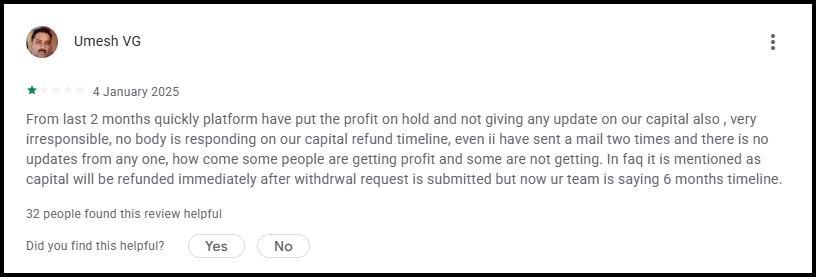
Multiple emails were reportedly sent asking for a timeline, and none of them got a real response.
What stands out most is the direct contradiction between what the app’s own FAQ states and what actually happened.
The FAQ reportedly promises an immediate refund once a withdrawal request is submitted, but when this reviewer actually tried to withdraw, the team instead quoted a six-month timeline, a gap between stated policy and real practice that’s hard to explain away as a one-off technical issue.
2. ₹55,000 In, Then Silence
This reviewer put ₹55,000 into the platform and initially received returns as expected, which is exactly the kind of early trust-building pattern that makes a platform feel legitimate.
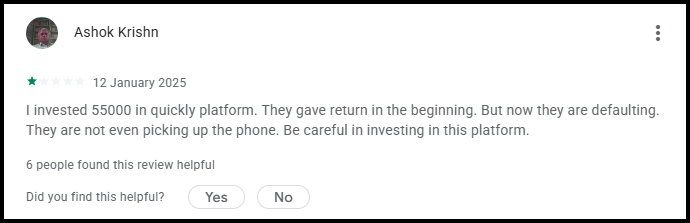
But the payments reportedly stopped without warning or explanation.
When the reviewer tried calling to understand what happened, nobody picked up the phone, no voicemail, no callback, no written update either.
3. “Initially Sweet, Then a Big Zero”
This review uses unusually direct language, calling the platform “fake finance” outright and stating plainly that both the invested capital and the promised interest were lost entirely.
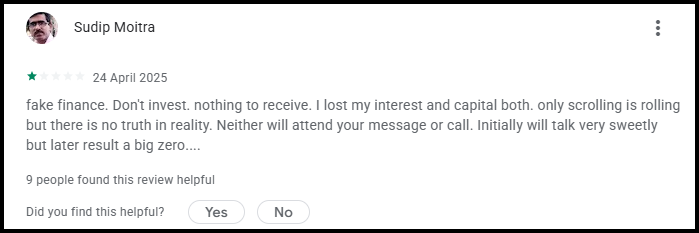
The reviewer specifically describes the communication pattern worth noting: the platform spoke “very sweetly” in early interactions, building comfort and trust, but once real money was on the line, and a resolution was actually needed, neither messages nor calls received any response at all.
4. Four Months Past the Lock-In Period, Still No Capital Returned
This reviewer describes a specific, time-bound commitment, a defined lock-in period, that the platform itself set as the condition for returning capital.
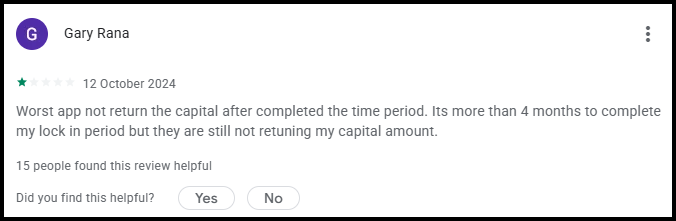
That lock-in period reportedly ended more than four months before this review was written, and as of the review date, the capital still hadn’t been returned, well past any reasonable interpretation of the platform’s own stated terms.
This exact pattern, early trust followed by vanishing support, is a big part of why cyber crime is increasing in India, where scammers rely on initial credibility to delay suspicion.
Funnily enough, older reviews from 2022 praise the quick credits and smooth withdrawals.
That contrast is worth paying attention to. Early payouts followed by stuck withdrawals is a pattern to be careful with, whatever the platform.
यह भी पढ़ें: Finsol App kya hai, जानिए कि अहमदाबाद की रजिस्टर्ड कंपनी Finsol Securities और WhatsApp ग्रुपों में चल रहे Finsol नाम के बीच फर्क कहां पड़ता है।
Why a Loan for an IPO Pushed Through a Quickly Investment WhatsApp Group Is a Major Red Flag?
Even if you set the screenshots aside, a few basic rules show why this setup can’t be real.
Our step-by-step guide on the IPO process in India walks through exactly how a genuine allotment and payment actually work, start to finish.
Here’s what that process actually looks like, and how far this one strayed from it:
- A real IPO never sends you a bill after allotment. When you apply through your broker or bank with UPI or ASBA, the money just sits blocked in your own account. If you get shares, only that blocked amount gets debited, and nobody can allot you more than you applied for.
- A real IPO payment never goes to some stranger’s account. The money moves from your bank through the exchange system, never through a WhatsApp admin or a “customer support” chat.
- A proper digital loan comes with clear paperwork. Under RBI’s digital lending rules, the lender has to give you a Key Fact Statement before you sign. The loan has to land in your own bank account, and the actual lender, whether a bank or an NBFC, has to be clearly named.
Did a WhatsApp group make you borrow money to clear an IPO you never even applied for through your own broker?
You’re not the only one, and you don’t have to sort it out alone. We help victims trace the loan and every payment that followed, and take the complaint to the right place.
How to Check Any Lending or Investment App Before You Borrow?
A few minutes of checking now can save you months of EMIs later.
Run through this list for any app a chat group sends you to, not just this one.
- Find out who’s actually lending. A loan app has to name the bank or RBI-registered NBFC behind the money. Look that name up on the RBI website’s NBFC list.
- Ask for the Key Fact Statement. It should spell out the interest rate, every charge, the total you’ll repay, and who to contact with a complaint.
- Check the investment side on its own. Anyone offering stock market or IPO access needs SEBI registration. A quick search on the SEBI website will tell you.
- Compare the app with its store listing. If the Play Store page describes one thing and the app offers another, that gap alone is reason enough to stop.
- Never pass borrowed money on because someone told you to. If a group needs your loan money sent to them, the loan is really for them, not for you.
Also Read: IndusInd Securities DMA Account exposes how fake apps and WhatsApp groups turn IPOs into payment traps.
What to Do If You Took a Loan for a Fake IPO?
If this already happened to you, you’re dealing with two problems at once: the money you sent and the loan still in your name.
Let’s take them one at a time, starting with what might still be recoverable:
1. Protect the Money First
Speed really matters here.
Banks can only hold money while it’s still sitting in the receiving accounts, so try to do these today.
- Stop paying. Don’t send any tax, fee, or penalty the group asks for to “release” your funds.
- Call 1930, the cyber crime helpline, and file a report on the National Cyber Crime Reporting Portal.
- Write to your bank with every UTR number and ask them to request a freeze on the receiving accounts.
- Keep the apps on your phone and screenshot everything, the loan page, the allotment, and your payment history.
A lot of people lose those first few hours just wondering where to begin.
Our guide on what to do if online scam happens takes you through the whole sequence, from the helpline call to bank follow ups, in the right order.
2. Deal With the Loan in Your Name
Even a loan taken under pressure needs careful handling, because simply ignoring it can damage your credit score.
Gather the paperwork first, and then raise it formally:
- Download the loan agreement and Key Fact Statement, or make a note if the app never gave you one.
- Figure out the actual lender from the agreement or the credit entry in your bank statement.
- Write to the lender’s grievance officer, explain that the loan was part of a reported fraud, and attach your cyber complaint number.
- Take it to the RBI complaint system if a regulated lender doesn’t reply in time.
Your police complaint gets much stronger when it ties the loan, the transfers, and the group chats into one clear story.
Our article on how to file a complaint in cyber crime shows you how to put the proofs together and what to write so your case keeps moving.
Disclaimer: This article reflects complaints shared with us by investors, along with the public Google Play listing and reviews of the app. It does not claim that Quickly Platforms or its developer runs or knowingly supports any IPO fraud, so please verify all facts independently.
Conclusion
What makes this pattern so cruel is the double hit. You lose the money you sent, and you’re still left holding the loan.
In the stories reaching us from a Quickly Investment WhatsApp Group, the app name shows up right at that turning point.
If you remember just one thing, let it be this.
No real IPO asks you to borrow after allotment, and no genuine lender needs a chat group to tell you where the money goes next.
If any of this sounds familiar, stop paying, report the transfers, and save every screenshot before the group vanishes.
Report. Recover. Stay Fraud Free.
Its Play Store page promises yearly returns, while several 2025 reviews talk about profits on hold and slow refunds. Investors also tell us fake IPO groups pushed loans through it. Check the lender with RBI and any investment offer with SEBI first.
The app's Play Store description talks about investing for yearly returns and doesn't mention loans at all. Victims who reached us say they were told to borrow through it, so screenshot any loan screen you see. Fake IPO groups often show you an allotment bigger than your balance and give you a tight deadline. A loan helps them collect more from you, fast. A genuine IPO only debits money already blocked in your own account.
Start by getting the loan agreement, finding the lender, and writing to its grievance officer with your cyber complaint number. Get proper advice before you stop paying, since missed EMIs can hurt your credit score.
Call 1930 and file on the National Cyber Crime Reporting Portal with all your chats and transfer records. Write to the lender's grievance officer about the loan, and go to the RBI complaint system if they don't respond.Frequently Asked Questions





 Add us as a preferred source on Google »

