

Quick Summary
Rajiv Sharma is the proprietor behind Capital Life Research and its earlier entity, Capital Life Market Research. He has operated under two separate SEBI registrations: Investment Adviser INA000001365 and, more recently, Research Analyst INH000022163. A SEBI adjudication order dated May 27 2026 imposed a Rs. 5 lakh penalty for continuing to provide investment advisory services after his mandatory NISM certifications had expired, while collecting approximately Rs. 1.20 crore in fees during that period. The order also cited failures in KYC updates, record maintenance, and mandatory regulatory reporting. A separate, earlier order from January 2018 examined unresolved investor complaints and closed without any monetary penalty. Both orders are covered here in full.
In May 2026, SEBI imposed a Rs. 5 lakh monetary penalty on Rajiv Sharma, proprietor of Capital Life Market Research, for operating without valid mandatory certifications and multiple compliance failures.
This is not the only regulatory action on record for this individual. A separate, earlier SEBI order from 2018 also exists.
But the 2026 order is more recent, carries a real monetary penalty, and is the single most important document any prospective investor should read in full before subscribing to any service connected to his name.
This page breaks down both orders, what SEBI found, what Rajiv Sharma argued in his defence, and what was accepted or rejected.
Who Is Rajiv Sharma?
Rajiv Sharma is the founder and proprietor of Capital Life Research, operating out of Indore, Madhya Pradesh, and has been active in financial advisory since at least 2013-14.
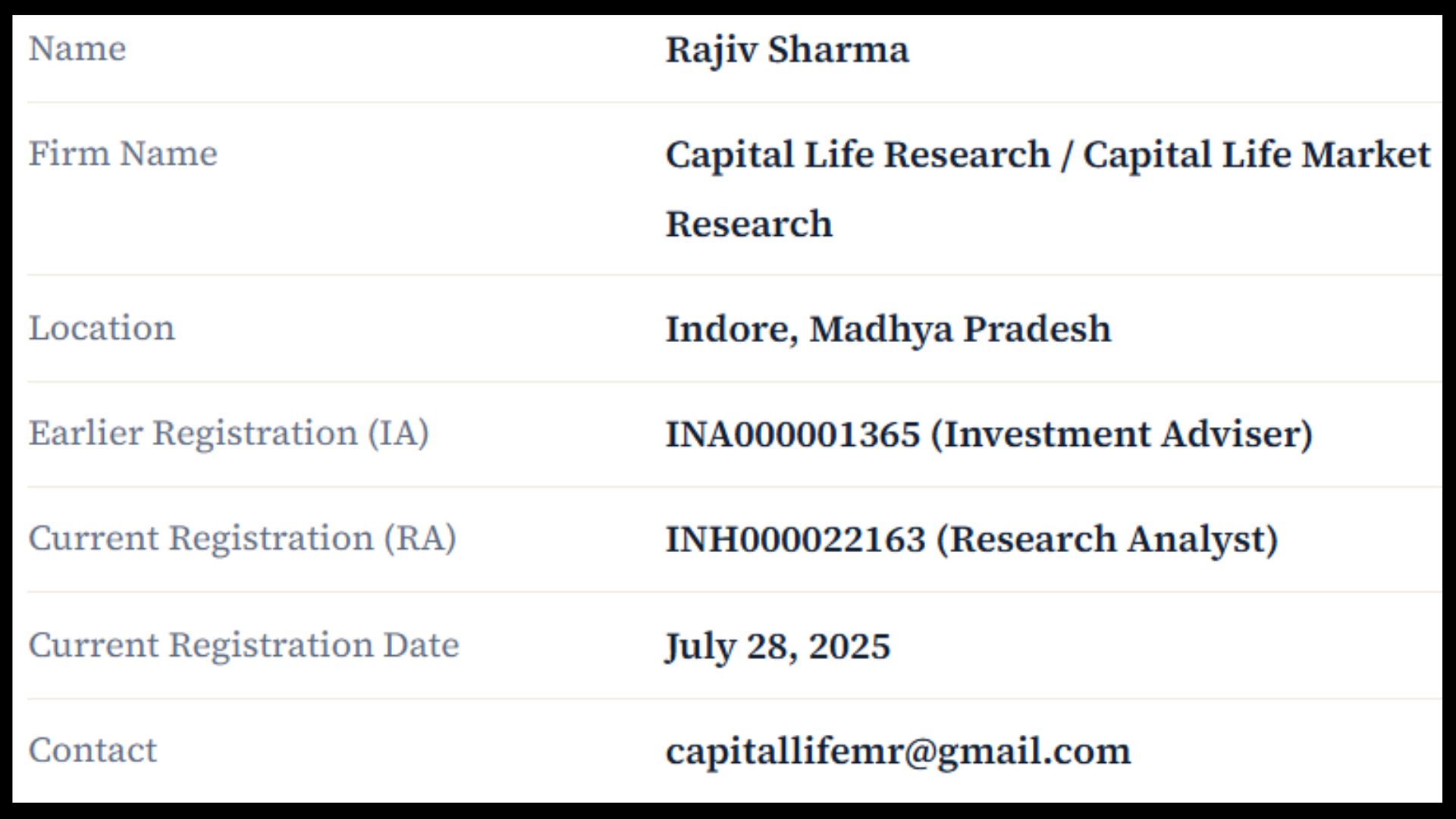
His LinkedIn profile identifies him as proprietor of Capital Life Market Research, based in Indore.
The firm’s own website describes “over a decade of technical analysis expertise” across equity, commodity, and currency segments.
He has operated under two separate SEBI registrations across his career.
For the full explanation of how the older brand name connects to the current one, and what services the firm presently offers, the Capital Life Research hub page on this site covers that background in detail.
This page focuses specifically on the regulatory history behind those two registrations, which carries significant weight and that every prospective subscriber should read in full before paying anything.
SEBI’s May 2026 Order Against Rajiv Sharma
On May 27 2026, SEBI issued a formal adjudication order against Rajiv Sharma, Proprietor of Capital Life Market Research, following a thematic inspection.
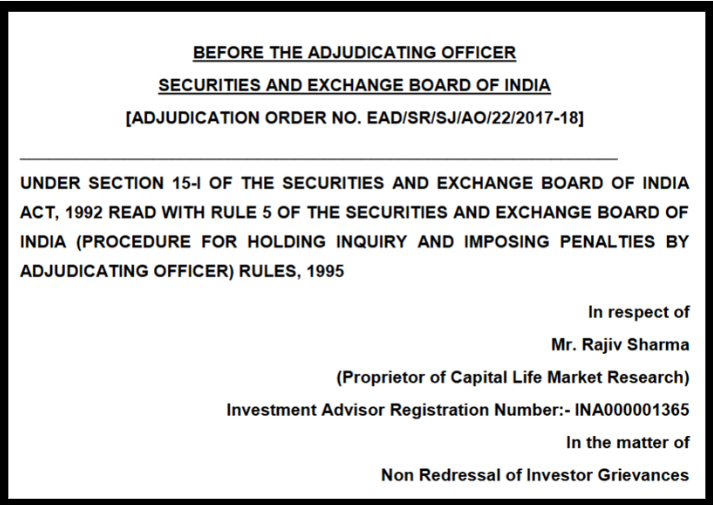
The order was passed by SEBI Adjudicating Officer Jai Sebastian.
The proceedings arose from a thematic inspection covering the period from April 2023 to January 2025, examining compliance around advisory fees, NISM certifications, record maintenance, and grievance redressal.
What SEBI Found: Operating Without Valid Certification
SEBI’s central finding was that Rajiv Sharma continued providing investment advisory services after his mandatory NISM Series X-A and X-B certifications had expired in April 2024.
The certifications were not renewed until February 16, 2026 (Level 2) and April 13, 2026 (Level 1), meaning he operated without valid certification for close to two years.
During this exact window, SEBI found that he collected fees of approximately Rs. 1.20 crore during FY24-25 alone, while providing advisory services without the certification the law requires him to hold.
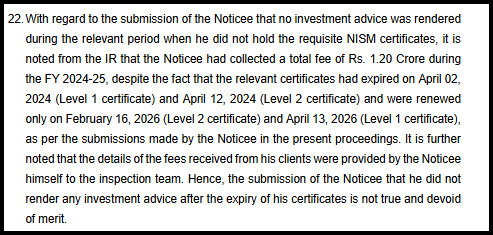
SEBI also noted he had failed to appear for certification examinations several times and had also failed multiple attempts before eventually renewing.
Also Read: Money Treasure Research Disclosed ₹4.84 Lakh Annualized Fees And Contradictory Complaint Records.
Additional Compliance Failures Cited in the Order
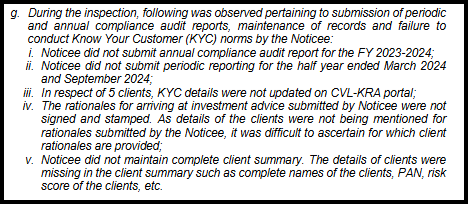
Beyond the certification lapse, the order identified several further deficiencies:
- Failure to submit the annual compliance audit report for FY23-24.
- Failure to submit half-yearly periodic reports for March 2024 and September 2024.
- Failure to update KYC details for five clients on the CVL-KRA platform.
- Serious record maintenance failures, including reliance on a single external hard drive with no secondary backup, which the order described as a “clear and serious failure” of record maintenance obligations.
What Rajiv Sharma Argued in His Defence?
Sharma denied the allegations and offered several explanations.
He attributed the record-keeping lapses to failure of an external hard drive containing client data, technical issues with the KRA platform, and temporary misplacement of physical records during office relocation.
He also argued that no investor had suffered any loss and that no client had lodged any complaint during the period in question.
He specifically stated that his son was undergoing severe mental health issues requiring continuous emergency care, following the untimely death of the Noticee’s daughter-in-law, which he said prevented him from appearing for the certification exams.
SEBI rejected these explanations. The order notes that NISM’s own records showed he failed to appear for the Level 1 exam three times and failed the exam itself four times over roughly a year, undermining the claim that he was consistently trying but unable to attend.
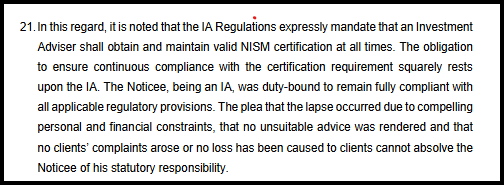
The Adjudicating Officer stated directly: “The Noticee, being an IA, was duty-bound to remain fully compliant with all applicable regulatory provisions.
The plea that the lapse occurred due to compelling personal and financial constraints, that no unsuitable advice was rendered, and that no clients’ complaints arose or no loss has been caused to clients cannot absolve the Noticee of his statutory responsibility.”
Why SEBI Cleared Rajiv Sharma on the Arm’s-Length Business Charge?
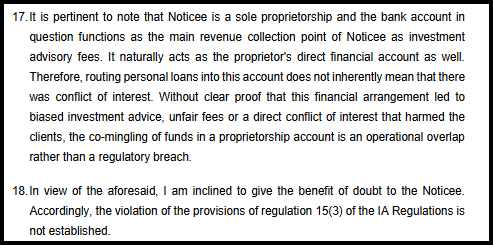
Not every allegation in the order resulted in a finding against him. SEBI had also alleged a failure to maintain an arm’s-length relationship between his advisory business and personal financial dealings, specifically that he received loans from certain clients through the same bank account used for advisory services.
Sharma explained these were personal loans from friends, relatives, and persons known to him, unrelated to any advisory services rendered, with no quid pro quo involved.
SEBI accepted this explanation and dropped the charge, stating: “Without clear proof that this financial arrangement led to biased investment advice, unfair fees or a direct conflict of interest that harmed the clients, the co-mingling of funds in a proprietorship account is an operational overlap rather than a regulatory breach.”
Final Penalty on Rajiv Sharma
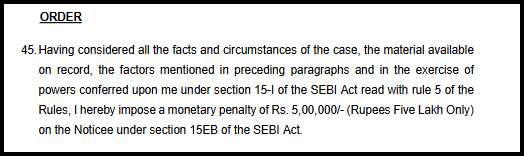
After considering the full record, SEBI imposed a monetary penalty of Rs. 5 lakh on Rajiv Sharma, payable within 45 days of receipt of the order, with recovery proceedings available under Section 28A of the SEBI Act in case of non-payment.
This is a materially different outcome from his earlier 2018 order, covered below, which closed without any monetary penalty at all.
The Earlier 2018 SEBI Order: A Different Outcome
Before the 2026 penalty order, SEBI issued a separate adjudication order against Rajiv Sharma in January 2018, examining a different set of facts entirely.
That order found that as of August 30 2016, seven investor complaints were pending against him on SEBI SCORES, and that he had failed to resolve them within SEBI’s mandated 30-day window under a December 2014 circular, a violation of Section 15C of the SEBI Act, 1992.
Unlike the 2026 order, this earlier proceeding closed without any monetary penalty. The Adjudicating Officer at the time took what she described as a “lenient view,” citing personal circumstances including judicial custody and the death of both of Sharma’s parents in quick succession during the relevant period.
Four of the seven complaints had already been resolved before the Adjudicating Officer was formally appointed, and none remained pending by the time of the final order.
Read together, the two orders tell a fuller story than either one alone. The 2018 order shows a compliance gap during a documented period of personal crisis, resolved leniently.
The 2026 order shows a much longer certification lapse, nearly two years, during which substantial fees continued to be collected, and this time SEBI imposed a real financial penalty.
Also Read: Max Pro Capital, An RA Listing Four Different Contact Numbers For The Basic Need Of Reaching Him.
Why Both SEBI Orders Are Critical for Evaluating Rajiv Sharma
Investors researching Rajiv Sharma or Capital Life Research for the first time often encounter only one of these two orders, usually the older 2018 case, since it has circulated online for longer.
The 2026 order is significantly more recent and carries a real financial consequence, which makes it the more important document for anyone evaluating this proprietor today.
Reading only the older order without knowing about the 2026 penalty gives an incomplete and outdated picture. A firm’s regulatory history is cumulative. Each order reflects SEBI’s assessment of conduct during a specific period, and later findings carry more weight for evaluating current trustworthiness than older ones that may have already been addressed.
This is also a useful reminder for evaluating any SEBI-registered entity: always check the enforcement orders section directly on SEBI’s website for the most current filings, rather than relying only on older third-party summaries that may not reflect recent developments.
What Investors Should Take From Both Orders?
Reading both orders together reveals patterns that matter far more than either finding on its own.
Four lessons stand out for anyone evaluating this proprietor or any SEBI-registered advisor.
- A SEBI registration confirms legal permission to operate. It does not confirm ongoing compliance. Both orders show gaps between registration and actual conduct over time.
- Certification lapses are not just paperwork. SEBI treated nearly two years of operating without valid NISM certification, while collecting significant fees, as serious enough to warrant a monetary penalty.
- “No client complained” is not a defence SEBI accepts. The 2026 order explicitly states that the absence of complaints does not absolve a registered adviser of statutory compliance obligations.
- Not every allegation survives scrutiny. The arm’s-length charge was dropped once Sharma provided a credible explanation, showing SEBI’s process does distinguish between genuine violations and operational overlaps.
Before subscribing to any service connected to Rajiv Sharma or Capital Life Research, verify both registration numbers independently and read both orders in full.
Did a recent SEBI order or your own experience raise questions about a service you already paid for?
Our team reviews your documentation and helps you understand whether your situation qualifies for formal escalation.
How to Escalate a Concern Involving Rajiv Sharma or Capital Life Research?
If you have subscribed to Capital Life Research and have an unresolved concern, a structured escalation path is available.
- Raise the issue directly with the firm’s official grievance channel, in writing, and allow a reasonable window for response.
- File on SEBI SCORES, selecting Research Analyst and entering INH000022163 for current service concerns. The complete filing process is on the SEBI SCORES complaint portal page on this site.
- Escalate to SMART ODR if the matter involves a monetary claim that remains unresolved after SCORES. The full process is on the SMART ODR complaint portal page on this site.
- Formal arbitration through the relevant exchange remains available as a final step for unresolved disputes. The process is on the arbitration in stock market page on this site.
Conclusion
Rajiv Sharma holds a valid SEBI Research Analyst registration through Capital Life Research. That registration is current and verifiable.
What the public record shows alongside it is significant. A 2018 order found unresolved complaints during a documented period of personal crisis, closed without penalty.
A May 2026 order found nearly two years of operating without valid mandatory certification, while collecting approximately Rs. 1.20 crore in fees, alongside multiple record-keeping and reporting failures, resulting in a Rs. 5 lakh monetary penalty.
Neither order alone tells the complete story. Together, they are exactly the kind of regulatory history that deserves a careful read before any subscription decision.
Report. Recover. Stay Fraud Free.
Frequently Asked Questions
SEBI found he continued providing investment advisory services after his mandatory NISM certifications expired in April 2024, not renewing them until February and April 2026, while collecting approximately Rs. 1.20 crore in fees during FY24-25. The order also cited KYC update failures, missing compliance reports, and serious record maintenance lapses.
SEBI imposed a monetary penalty of Rs. 5 lakh, passed by Adjudicating Officer Jai Sebastian following a thematic inspection covering April 2023 to January 2025.
No. These are two separate, distinct adjudication orders. The January 2018 order examined unresolved investor complaints and closed without any monetary penalty. The May 2026 order examined a completely different set of compliance failures and resulted in a Rs. 5 lakh penalty.
No. SEBI dropped one allegation relating to an alleged arm's-length relationship violation after accepting his explanation that certain bank transactions were personal loans from friends and relatives unrelated to his advisory business.
The May 2026 order relates specifically to his conduct as an Investment Adviser under registration INA000001365. His current Research Analyst registration, INH000022163, is a separate registration. For details on what the current registration covers and the firm's present-day services, the Capital Life Research page on this site covers the complete picture.





 Add us as a preferred source on Google »

