

Quick Summary
Two investors trusted Aurostar Investment Advisory with their money, and both were pushed into the same trap: guaranteed-return promises, demands for cash and profit-sharing outside their contracts, and trades far riskier than they had signed up for. One won ₹15,57,000 in NSE arbitration. The other recovered ₹3,00,000 through a SEBI complaint, with more still being pursued. Their stories matter because the pattern is identical, and it may match yours. This page walks through both cases in full, what Aurostar did, why it broke SEBI’s rules, and exactly how each investor got their money back.
Instead, you were promised guaranteed profits, pushed into bigger and bigger payments, and watched your money disappear while the advisor kept asking for more.
If that sounds familiar, you are not imagining it, and you are not alone.
Two investors went through exactly this with Aurostar Investment Advisory, and both fought back and won.
One secured a ₹15.57 lakh arbitration award.
The other recovered ₹3 lakh through a SEBI complaint.
This page tells both their stories in full, because the pattern they faced is one you may recognise, and the way they beat it is one you can follow.
What Is Aurostar Investment Advisory?
Before the cases, it helps to know who this firm is, because on paper, nothing looks wrong.
Aurostar Investment Advisory Private Limited is a SEBI-registered investment advisory firm, operating under the proprietorship of Umesh Kumar Pandey, based in Prayagraj.
It offers stock market trading tips, commodity advisory on MCX and NCDEX, futures and options strategies, and investment planning, and it reaches clients the way most such firms do, through digital marketing, phone calls, and online ads.
That registration is exactly why its conduct is worth examining.
A SEBI licence means the firm operates inside a regulatory framework, but it does not guarantee ethical behaviour, and beyond the two cases below, the firm carries a documented history of unresolved investor grievances on SEBI’s SCORES platform.
In other words, the badge was real. What happened to these two investors was not what the badge promised.
For the fuller picture of the firm, its services, and its background, see our guide: Aurostar Investment Advisory review.
The First Case: A ₹15.57 Lakh Arbitration Win
This is the story of Md Tousif Uddin, an investor from Bolpur, Birbhum, in West Bengal, and how a low-risk monthly package turned into a loss that nearly wiped out his capital, before an NSE tribunal ordered Aurostar to pay him back in full.
He took advisory services from Aurostar expecting steady guidance.
What he got instead was a slow escalation: assured returns, cash demands, and eventually a proposed 40% profit-sharing arrangement that pushed him into a single BANKNIFTY options trade.
He ended up holding 6,120 quantities of a BANKNIFTY Call Option that expired worthless, a loss of ₹14,10,000 on that one trade alone.
He took the matter to NSE arbitration, limiting his claim to that single trade plus his subscription fee.
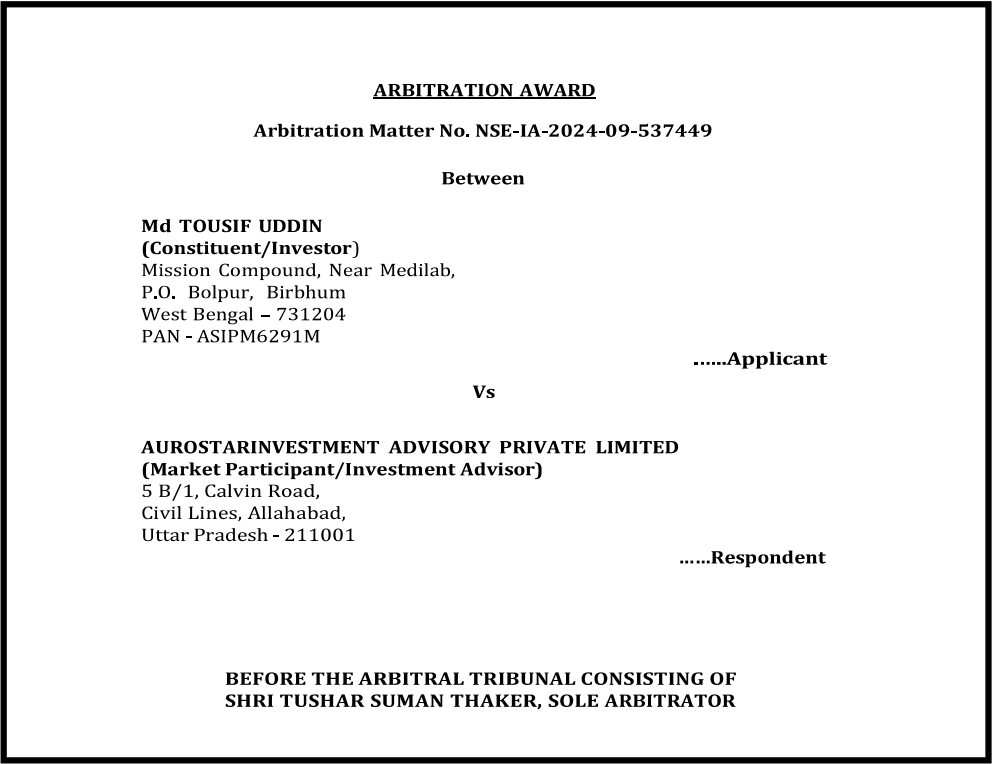
The award was signed on 14 January 2025, and it went entirely in his favour.
What the Arbitrator Found
The arbitrator, Shri Tushar Suman Thaker, went through the call recordings, the WhatsApp exchanges, and the disputed risk-profiling document.
What he found was not one mistake, but a connected pattern of misconduct, five distinct failures that, taken together, left the firm no defence.
1. No Valid Risk Profiling Existed
Aurostar’s own representative admitted at the hearing that they may never have conducted risk profiling at all.
The firm later produced an unsigned, uncountersigned document, with no proof it had ever been sent to the investor.
The tribunal held that advice given without valid risk profiling, under the SEBI (Investment Advisers) Regulations, 2013, was neither valid nor sustainable.
2. The Trade Contradicted His Own Risk Profile
Even taking Aurostar’s disputed profile at face value, it capped his proposed investment at ₹1 to 3 lakh over a one-to-three-year horizon.
Pushing him into a 6,120-quantity weekly-expiry options position was, in the tribunal’s own words, reckless and dangerous, with no rational basis.
3. A Profit-Sharing Scheme Was Proposed Outside Any Agreement
Voice recordings caught an executive first asking for a flat ₹5,00,000 cash payment to chase ₹25,00,000 in profit, then pivoting to a 50% profit-share offer, negotiated down to 40%.
No such structure existed anywhere in his actual agreement.
4. Payments Were Routed to Dodge the Fee Cap
His signed agreement capped annual charges at ₹1,47,500, which he had already paid in full.
To collect more without appearing to breach that cap, the executive suggested cash payments, or transfers from a third party’s account, his wife, his manager, or “anyone else.”
A fresh contract was even issued in another person’s name, while his own email and phone number stayed on the account.
5. Assured Returns and Manipulation Claims Were Made
Executives told him that recommending the same trade to other clients would push up the contract’s market price, and assured him they would recover his losses if he kept paying.
Both are prohibited inducements under SEBI’s rules.
Why the Profit-Sharing Demand Mattered So Much
The 40% profit-sharing offer did more than add another complaint. It exposed the entire pattern.
A SEBI-registered investment adviser has exactly one legitimate fee structure: whatever is written in the client agreement, capped by the regulatory ceiling.
The moment an executive asks you to pay a profit share in cash, or into someone else’s bank account, the arrangement has left SEBI’s rules behind, no matter what returns are dangled in front of you.
That is what made this case so hard for Aurostar to defend. Its own agreement set the fee cap. The investor paid it.
Every rupee demanded after that, whether dressed up as a profit share, a “special offer,” or a recovery fee, sat outside the contract, and the recordings proved it.
The Award in Full
The tribunal passed a clear award in the investor’s favour.
| Detail | Value |
|---|---|
| Matter number | NSE-IA-2024-09-537449 |
| Respondent | Aurostar Investment Advisory Private Limited |
| Compensation for trade loss | ₹14,10,000 |
| Refund of service charges | ₹1,47,000 |
| Total awarded | ₹15,57,000 |
| Interest (till date of award) | 15% per annum from 07-Aug-2024 |
| Default interest (if unpaid within 15 days) | 18% per annum |
| Arbitration cost | Reimbursable to the complainant |
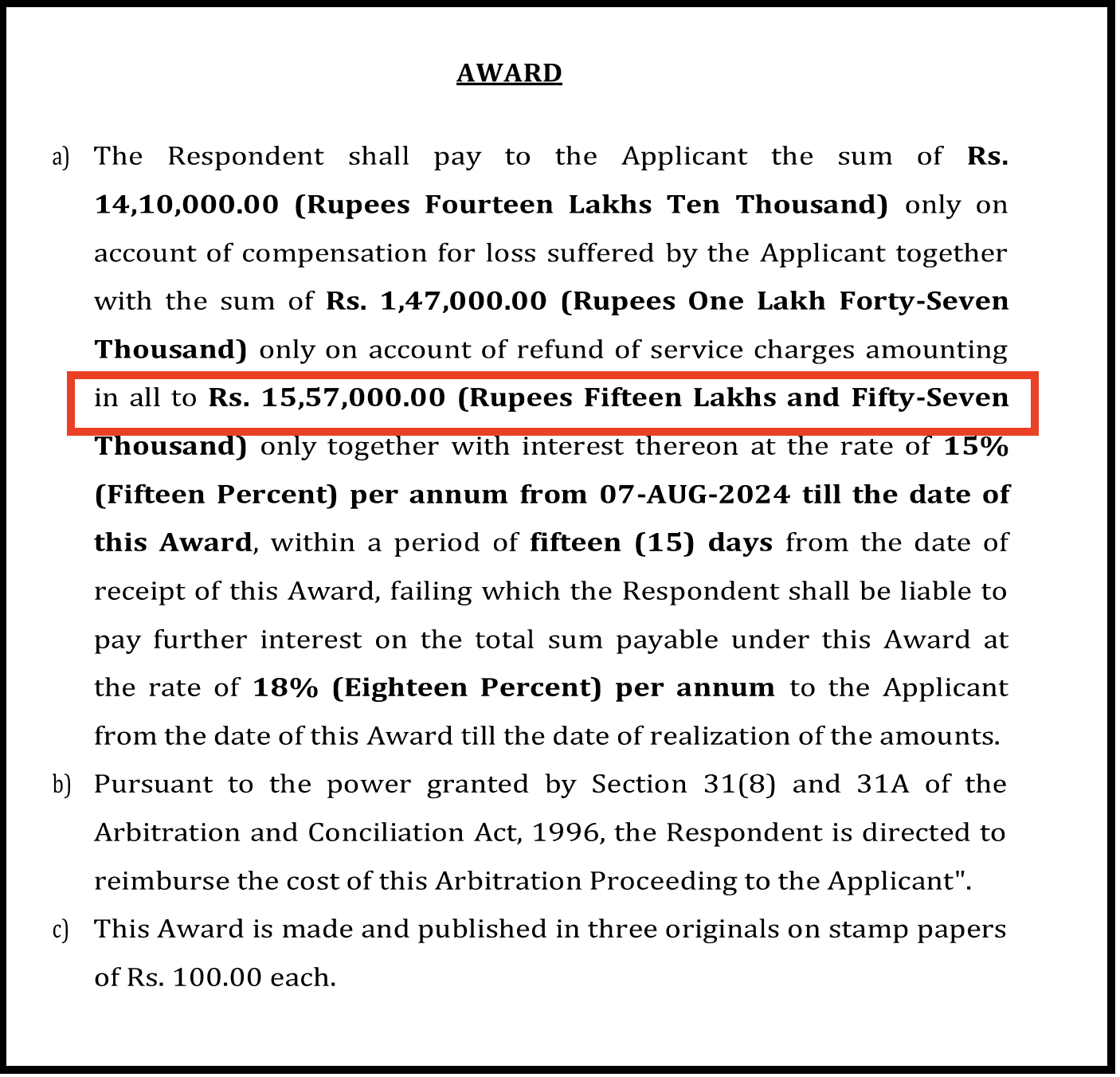
The award is a public arbitral record. The firm is named in it, and the finding stands on record.
Also Read: SEBI action against Ayushi Chauksey Investment Advisor, advisory services offered with no valid NISM certification.
The Second Case: A ₹3 Lakh Recovery Through SEBI
The first case ended in a tribunal. This one shows that you do not always need arbitration to get your money back; sometimes a well-built SEBI complaint is enough.
This is the story of Shabir (name changed), a retail investor who paid nearly ₹3 lakh chasing the same kind of promises, and recovered ₹3,00,000 through the SEBI complaint route.
His case did not begin with anything obviously wrong. It began the way most of these do, with a small, reasonable-looking first payment.
Then a quick profit of around ₹59,000 appeared in his account, and that early win built exactly the trust the firm needed.
Believing he had found people who understood the market, he paid more, expected more, and exposed himself far more deeply than he ever intended.
By the end, documents showed he had paid nearly ₹2,95,000 in fees, chasing projected returns the firm suggested could reach ₹22 lakh.
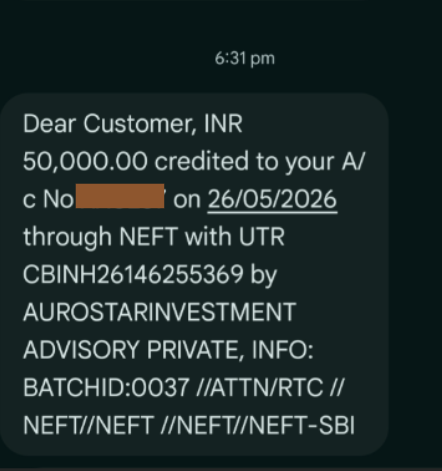
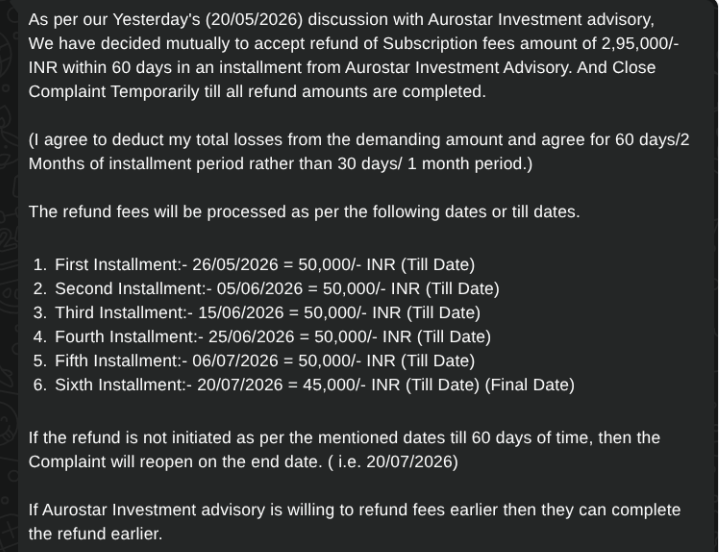
The reality was the opposite: heavy trading losses on top of everything he had already handed over in charges.
The Warning Signs in Shabir’s Case
Once his call recordings, WhatsApp chats, and payment records were reviewed together, the losses stopped looking like bad luck and started looking like a pattern.
Seven warning signs stood out, and each one is worth recognising in your own dealings:
- Guaranteed Return Promises: He was repeatedly told profits were assured and his losses would be recovered, promises no advisor can legally make.
- A Demo Profit to Build Trust: That early ₹59,000 gain was the hook, engineered to make him confident enough to pay more.
- Profits Quietly Taken as Charges: At one stage, the profits generated in his account were collected almost entirely as fees, leaving him to wonder whether the trading was ever really for his benefit.
- Payments That Kept Escalating: The demands climbed steadily: an initial ₹2,500, then ₹1,47,500, then another ₹1,47,500, and finally a demand for ₹3,00,000 that he refused. Each jump was tied to a bigger projected profit and a new promise.
- Personalised Trade Instructions: Aurostar’s representatives dictated exact trade quantities and positions to him, well beyond general advice.
- Instructions to Hold Losing Positions: He was told to keep holding trades that were sinking, which only deepened the damage.
- Screenshots of “Successful Clients”: He was shown examples of others supposedly profiting, the classic technique for silencing doubt.
How the ₹3 Lakh Was Recovered?
When Shabir came to our team, he felt what most investors in his position feel: financially drained, confused about where to even start, and unsure whether recovery was possible at all.
It was. But it took a structured, documented approach, not just an angry complaint.
His case moved through four clear stages:
1. Evidence Review and Case Assessment
We went through the entire paper trail, the call recordings where guaranteed returns and upgrade pressure were discussed, the WhatsApp chats showing repeated fee demands, and the trade logs and account statements tied to the disputed activity.
2. Formal Complaint Preparation
We built a detailed complaint mapping each concern against the relevant SEBI advisory and conduct rules, documenting the roughly ₹2,95,000 he had paid, and sent it to Aurostar’s management and compliance contacts.
The step-by-step tailored to this firm is laid out in our guide on the complaint against Aurostar Investment Advisory.
3. Escalation Through SEBI SCORES
When no satisfactory response came back, we escalated through the SCORES portal, submitting the full evidence, a date-wise timeline of how the fee demands grew, and every payment mapped against the promise made to justify it.
4. Recovery Achieved
Against a total claim of about ₹4,22,000, the investor recovered ₹3,00,000 as the first instalment, nearly 71% of the claim, with efforts still ongoing for the rest.
For Shabir, that first recovery was a breakthrough after months of stress, and proof that documentation and timely escalation can turn what feels like a total loss into something you can fight for.
Were you pushed into a profit-sharing deal, or asked to pay from someone else’s account?
We will check every payment against your actual agreement, match the advice you were given to your documented risk profile, and build your complaint on what SEBI rules genuinely allow.
Is Profit Sharing Even Legal for an Investment Adviser?
Both cases turn on the same question, and it is one of the most misunderstood areas of advisory regulation in India.
The answer is clear.
Under SEBI’s Investment Adviser Regulations, 2013, an investment adviser cannot promise, assure, or guarantee any specific return.
They cannot enter into profit-sharing arrangements with clients. And they cannot use performance claims, real or fabricated, to lure you into paying.
The reason is simple: the market carries risk by its very nature, and any adviser claiming certainty is either mistaken or misleading you.
This rule exists precisely to protect retail investors from being pulled into high-risk bets on the strength of promises no one can keep.
In both Aurostar cases, the firm’s representatives promised high profits and assured returns before recommending trades.
That single practice sits at the heart of everything the arbitrator and the complaint process found wrong.
Where Aurostar Crossed the Line?
Across both cases, the same prohibited conduct appears again and again.
Knowing this list helps you recognise the moment an advisory service crosses from legitimate into something you can act on.
A registered investment adviser cannot do any of the following:
- Propose a profit-sharing arrangement instead of a documented, capped advisory fee.
- Ask for payment in cash, or from an account that is not your own.
- Skip risk profiling, or push you into trades that ignore the risk profile you stated.
- Guarantee profits, or promise that your losses will be “recovered.”
- Claim that pooling client trades will move market prices in your favour.
- Issue a fresh contract in someone else’s name to slip around fee limits.
- Dictate exact trade quantities and positions as if managing your account.
- Tell you to keep holding losing trades while demanding more money to “recover” them.
Each of these, on its own, strengthens a complaint. In the Aurostar cases, they came bundled together, which is exactly why both investors were able to win.
The Red Flags You Should Never Ignore
The patterns in these two cases are not unusual. They surface across advisory complaints all over India, and none of them alone is proof, but together they are worth stopping for.
Watch for unsolicited trading calls, guaranteed-return promises, and “low risk, high return” claims.
Be wary of pressure to upgrade packages quickly, large upfront fees, and a demo profit shown suspiciously early.
And treat repeated requests for more money, and personalised trade instructions given without any proper process, as serious signals.
If something feels rushed, or too convincing, pause before you transfer a single rupee.
The investors above did not lose money because they were careless. They lost it because the pitch was designed to feel trustworthy at every step.
Before trusting any firm, it is worth reading what other clients report, and our roundup of Aurostar Investment Advisory services reviews gathers exactly that.
How to Act If This Happened to You?
If your experience resembles either case, there is a clear, proven path forward, and both Aurostar investors are proof it leads somewhere.
Start by lining up every payment against your signed agreement, because any profit-share, cash demand, or third-party transfer outside that agreement is a strong point on its own.
Save every call recording, WhatsApp chat, and offer you received, especially anything proposing cash or a profit-share, since both these cases were won on exactly that kind of ordinary evidence.
And ask for your risk-profiling document; if you were never shown a signed one, or the trades pushed on you never matched the risk you stated, that gap sits at the centre of a strong complaint.
From there, the route is straightforward.
You raise a written complaint with the firm first, then complete your SEBI SCORES login and lodge the matter formally.
If that does not resolve it, SMART ODR opens a conciliation stage, and arbitration remains the final step, the one that produced the ₹15.57 lakh award.
The complete arbitration path, and what it can realistically win back, is laid out in our guide on arbitration in share market proceedings.
Conclusion
The Aurostar Investment Advisory cases matter not because they are rare, but because they are documented, and because they ended in the investors’ favour.
Two people were promised guaranteed profits, pushed into payments and trades far beyond what they agreed to, and told their losses would be recovered if they just kept paying.
One walked away with a ₹15,57,000 arbitration award. The other recovered ₹3,00,000 through a SEBI complaint, with more still being pursued.
The evidence that won both was ordinary: a fee record checked against a signed agreement, and recordings of what was actually said. If an advisor asked you to share profits, pay in cash, or route money through someone else’s account, that same evidence may already be sitting on your phone.
Registration was never a promise these firms would behave.
In fact, whether Aurostar Investment Advisory is SEBI registered turns out to matter far less than how it treated the people who trusted it.
What registration does give you is a formal, powerful route to hold a firm to account when it crosses the line, and these two investors are proof that route works.
Report. Recover. Stay Fraud Free.
Frequently Asked Questions
Aurostar proposed taking a share of a client's profits, up to 40%, on top of the capped advisory fee he had already paid. SEBI's Investment Adviser Regulations, 2013 flatly prohibit profit-sharing, which is why the arbitrator treated it as a central violation in the ₹15.57 lakh case.
Two documented cases show real recoveries. One investor won ₹15,57,000 in NSE arbitration, covering his trade loss and a full fee refund with interest. Another recovered ₹3,00,000 through a SEBI SCORES complaint, roughly 71% of his claim, with further recovery still being pursued.
No. A registered adviser can only charge the fee documented in your agreement, within SEBI's cap. Requests for cash, or payments routed through your wife's or a third party's account, are designed to dodge that cap and are themselves a breach you can raise in a complaint.
Yes, Aurostar is a SEBI-registered investment adviser under proprietor Umesh Kumar Pandey. But registration only confirms the firm operates within a framework; it does not guarantee conduct. Aurostar carries documented SCORES grievances and two adverse recovery outcomes despite holding a valid registration.
Keep your call recordings, WhatsApp chats, payment receipts, the signed agreement, and your risk-profiling document. Both Aurostar recoveries were won on exactly this kind of ordinary evidence, records showing guaranteed-return promises, fee demands, and trades that ignored the investor's stated risk profile.





 Add us as a preferred source on Google »

