

Quick Summary
Rishav Kasera operates Novel Research House, a SEBI registered Research Analyst carrying INH000012218, active since April 2023 and based in Gwalior, Madhya Pradesh. All eight of the firm’s services, spanning cash, futures, options, index and commodities, are priced identically. The monthly cycle breaches the ₹1,51,000 annual SEBI fee ceiling once annualised, while the quarterly cycle stays just under it. The firm’s annual complaint table shows more complaints resolved than received in one year and zero pending in years that should logically carry a backlog. Tracked year by year, the underlying numbers are internally consistent once you account for an unstated backlog the table itself never shows, though the monthly and annual figures for 2025 do not agree even after that adjustment.
Rishav Kasera operates Novel Research House, a SEBI-registered Research Analyst, active since 11 April 2023, based in Gwalior, Madhya Pradesh.
The registration is genuine. Two things on this page are worth understanding properly rather than taken at face value: a pricing structure where eight distinct services all cost the same, and a complaint disclosure whose yearly figures look broken until you actually trace where the unresolved cases went.
This page works through the registration, the pricing against the ₹1,51,000 SEBI cap, the complaint data traced year by year, and the marketing language worth a second look.
Rishav Kasera Review
Novel Research House provides research services, trading recommendations, and market-related solutions across equity and commodity markets, delivering live trading calls through SMS with entry and exit messages sent directly to clients.
Its eight services span Basic Cash, Cash Prime Pack, Basic Future, Future Prime Pack, Basic Option, Option Prime Pack, Index Future/Option, and MCX, described as covering different segments of the market with the firm’s research team analysing past market information to identify trading opportunities.
None of this establishes wrongdoing, and nothing further on this page does either.
Where a registered analyst’s conduct does cross a line, the formal escalation route is covered in full further down this page.
Is Rishav Kasera SEBI Registered?
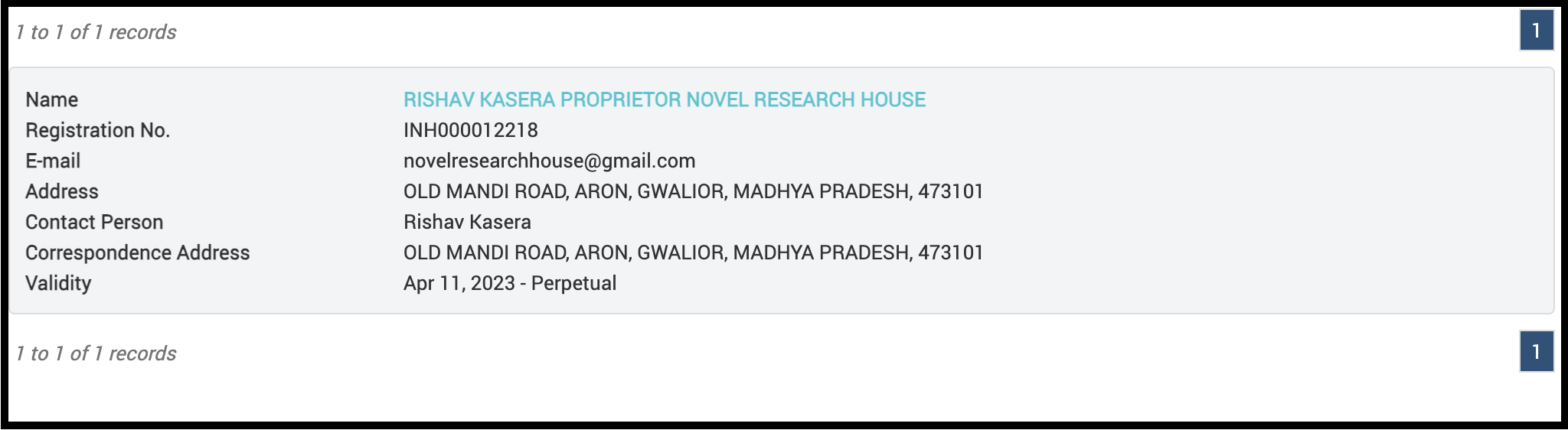
Yes, and INH000012218 is confirmed independently on SEBI’s own published Research Analyst list.
| Detail | Information |
|---|---|
| Name | Rishav Kasera, Proprietor of Novel Research House |
| SEBI Registration Number | INH000012218 |
| Validity | 11 April 2023, Perpetual |
| Address | Old Mandi Road, Aron, Gwalior, Madhya Pradesh 473101 |
| Correspondence Address | Same as registered address |
| Contact Person | Rishav Kasera |
| novelresearchhouse@gmail |
What the INH Prefix Permits
The INH prefix marks a Research Analyst. It permits publishing research and issuing recommendations to a subscriber base.
It does not permit personalised advice built around an individual client’s income, goals or holdings, trade execution, or portfolio management.
Why Are Eight Different Services All Priced the Same?
Basic Cash, Cash Prime Pack, Basic Future, Future Prime Pack, Basic Option, Option Prime Pack, Index Future/Option and MCX are all priced at exactly ₹15,000 plus GST monthly, or ₹37,500 plus GST quarterly, with no half-yearly or yearly option offered on any of them.
Cash market, futures, options, index derivatives and commodities are genuinely different products carrying different risk profiles and requiring different analysis.
Pricing all eight identically does not itself indicate anything improper, but it does mean the pricing page gives you no signal about which service the firm considers more or less resource intensive to produce, and it is worth asking directly what distinguishes the Prime Pack variant from its Basic counterpart for the same fee.
Novel Research House Pricing and the ₹1,51,000 SEBI Fee Cap
A Research Analyst may charge a maximum of ₹1,51,000 per annum per family, excluding GST, for individual and HUF clients who are not accredited investors.
Every price on this firm’s site is quoted with GST added separately, so the base figures are the correct ones to check against the ceiling.
The Published Price, Annualised
| Cycle | Base Price | Annualised | Against the Cap |
|---|---|---|---|
| Monthly | ₹15,000 | ₹1,80,000 | Over by ₹29,000 |
| Quarterly | ₹37,500 | ₹1,50,000 | Under by ₹1,000 |
Monthly Cycle Breaches The Ceiling, The Quarterly Cycle Sits Just Under It
Renewed every month for a year, any one of the eight identically priced services comes to ₹1,80,000, over the ceiling by ₹29,000.
Renewed quarterly instead, the same service comes to ₹1,50,000, staying under the limit by a narrow ₹1,000.
Choosing the quarterly cycle over the monthly one, for the same service, is enough to bring the annual cost back under the ceiling.
That margin is thin enough that adding any other cost, a partial month, a renewal at a different rate, or a second service, would likely push the total over ₹1,51,000 again.
If you hold more than one of these services at once, add the totals together before assuming you remain within the limit.
One protection applies regardless of the plan or cycle chosen.
On early termination, a client is entitled to a proportionate refund for the unexpired period, and a Research Analyst may not retain a breakage fee.
Also Read: TradeSpike Research owner, a real name attached to a registration. And to the pricing beside it.
Does Novel Research House’s Complaint Data Actually Add Up?
At first look, this firm’s annual complaint table appears to contain basic arithmetic errors.
Tracing the underlying numbers year by year shows something more specific, and one genuine gap that remains even after accounting for it.
Annual Complaint Data
| Year | Received | Resolved | Reported Pending |
|---|---|---|---|
| 2023 | 2 | 1 | 0 |
| 2024 | 9 | 7 | 0 |
| 2025 | 4 | 7 | 0 |
| 2026 | 0 | 0 | 0 |
| Grand Total | 15 | 15 | 0 |
What The Reported Pending Column Gets Wrong Every Single Year
In 2023, 2 complaints were received and only 1 resolved, leaving 1 that the table’s own arithmetic says should be pending or carried forward.
The table shows 0. In 2024, 9 were received and 7 resolved, leaving 2 unaccounted for. The table again shows 0.
In 2025, the direction reverses entirely: 7 complaints were resolved against only 4 received, which is only possible if older, previously unresolved complaints were being cleared that year.
The Backlog The Table Never Shows, Tracked By Hand, Actually Balances
If the 1 unresolved complaint from 2023 carried into 2024, and the 2 unresolved from 2024 carried into 2025, that gives 2025 a real opening backlog of 3, none of which the table’s Carried Forward column ever states.
Adding that backlog to 2025’s 4 newly received complaints gives 7 total complaints available to resolve that year, which is exactly the 7 the table records as resolved.
The running total across all four years, 15 received and 15 resolved, is internally consistent, and it only makes sense once you track the backlog that the Carried Forward and Pending columns never actually show.
This is worth crediting as a real finding rather than dismissed as a simple error.
The firm does appear to have resolved every complaint it received across this period.
The disclosure format itself, showing 0 pending and 0 carried forward in every single year regardless of what the underlying received and resolved figures imply, is not an accurate year-by-year picture, even though the multi-year total holds up.
Also Read: Rohan Sunil Shinde has a complaint table that can’t confirm whether its “current” figures are actually current.
One Gap Remains Even After Tracking The Backlog
The firm’s monthly complaint trend, covering July 2025 through June 2026, shows only 1 complaint, received and resolved in August 2025.
The annual table’s 2025 row states 4 complaints received.
Even allowing that the monthly table only covers July 2025 onward and cannot show anything from earlier in 2025, a gap of 3 additional complaints somewhere in 2025 has no matching entry in the monthly disclosure at all.
This is worth raising directly with the firm, since the monthly and annual tables should describe the same underlying complaints and currently do not.
The monthly table also has no coverage at all going back to 2023 or most of 2024, leaving a large part of the firm’s operating history with no month-by-month detail available, even though the annual totals for those years are published.
What Marketing Language on the Website Needs a Closer Look?
A handful of phrases across the site lean toward outcome language rather than a plain description of the research service.
The Option Prime Pack is promoted around “high risk to get higher returns,” language that can create a specific return expectation from a paid subscription.
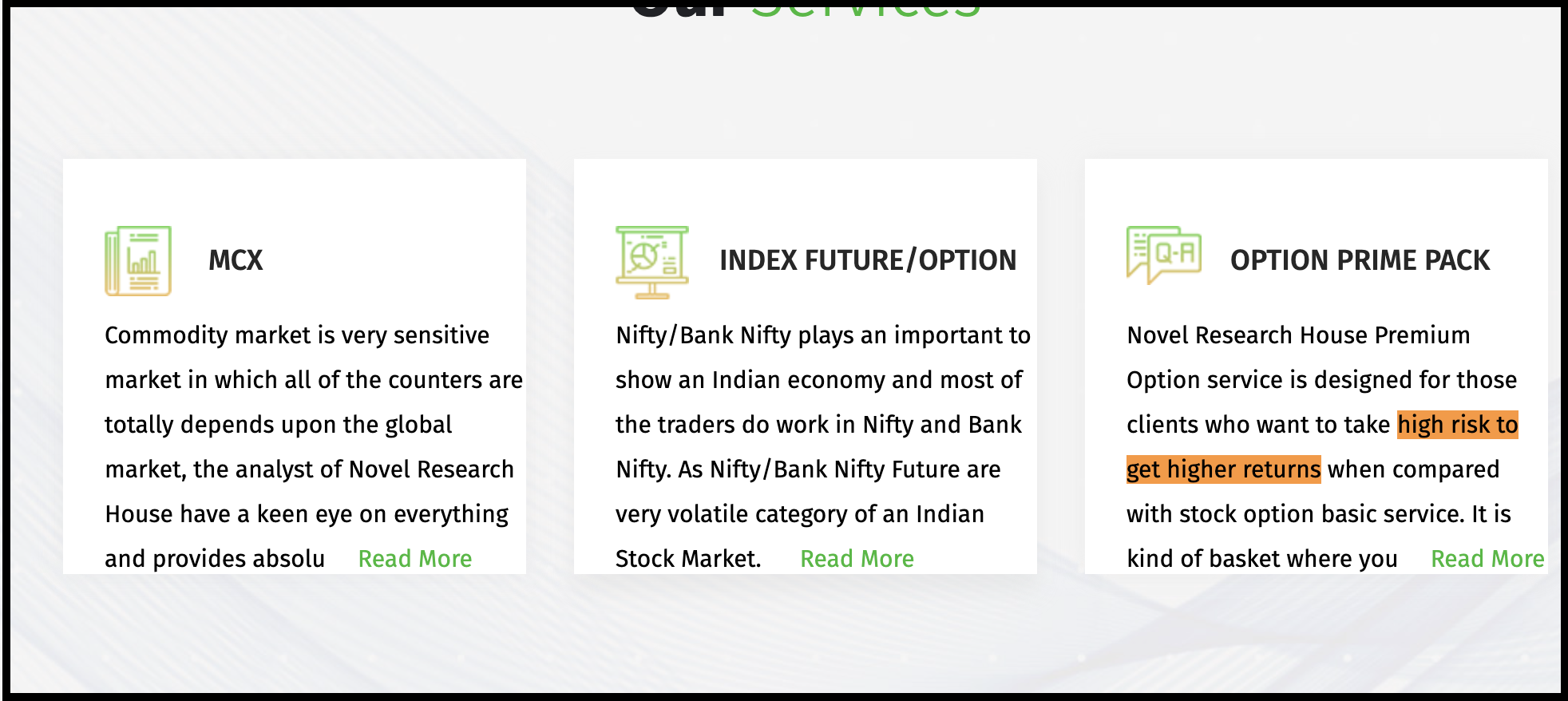
The SMS service is described as helping clients “enter or exit from market at right time,” and the About Us section states clients can “spot real opportunities of trading” with tools to “succeed the right way.”

The Basic Future service separately describes its calls as the “best and most selective stock Future tips.”
None of this amounts to an explicit guarantee of returns in the way SEBI orders have treated direct profit promises.
It is the kind of language a compliance review would ordinarily flag, particularly the timing and superiority claims, which sit close to the outcome-oriented phrasing SEBI’s advertisement standards for Research Analysts caution against.
Also Read: Ritu Chouhan with “maximising the profit” language sitting on top of an options service with a ₹3 lakh minimum investment.
How to File a Complaint Against Rishav Kasera?
Given the specific gaps above, a complaint here has firmer ground than a dispute over research quality alone, particularly if you were billed monthly rather than quarterly.
Start by checking which billing cycle you are on and comparing your actual annual total to ₹1,51,000.
Ask the firm directly to reconcile the 3 complaints missing from the 2025 monthly disclosure against the annual table’s figure for that year.
Send your grievance to the RA firm’s email ID, describing what you were told, what you paid, and what you want resolved.
Keep the sent record regardless of what comes back.
If the response is not satisfactory, escalation runs through a specific set of channels, and each one exists for a different stage of the dispute rather than as alternatives to pick from.
- SEBI SCORES: File your complaint on the SEBI SCORES complaint portal. This gets your grievance on record with the regulator and starts the formal clock on a response.
- SMART ODR: Move to structured conciliation through the SMART ODR portal if SCORES does not resolve it. A neutral third party steps in here to help both sides work toward a settlement.
- Arbitration: Where conciliation still does not settle it, arbitration in stock exchange proceedings end in a binding, enforceable award. Once this stage concludes, the outcome holds regardless of how either side feels about it.
Each stage exists to catch what the one before it couldn’t resolve, so it’s worth understanding the order before you start.
If you want to know the full process in detail, check our guide complaint against SEBI registered research analyst.
Billed monthly when quarterly costs less?
We total your invoices against the ₹1,51,000 ceiling, confirm which billing cycle you were actually charged under, and put the figure on record in a form the analyst has to respond to. Register with us for a free read on your situation.
Disclaimer
This page is based on Novel Research House’s own published material and the SEBI intermediary register, current as of September 2026, and alleges no wrongdoing since no SEBI order stands against the firm.
Registration details, pricing, and website content can change, so verify everything at source before acting. Treat this page as research, not legal or investment advice.
Conclusion
Rishav Kasera’s Novel Research House holds a genuine SEBI Research Analyst registration, INH000012218, active since April 2023, with all eight of its services priced identically across two available billing cycles.
The monthly cycle breaches the SEBI fee ceiling by ₹29,000 once annualised, while the quarterly cycle stays just ₹1,000 under it.
The firm’s annual complaint table, read on its own, looks internally broken, but tracing the implied backlog year by year shows the multi-year total genuinely balances: 15 received and 15 resolved, even though the yearly Pending column never reflects that backlog accurately.
One real gap remains: 3 of the 4 complaints the annual table records for 2025 have no matching entry anywhere in the firm’s monthly disclosure.
Before subscribing, choose the quarterly cycle over the monthly one if the fee difference matters to you, and ask the firm to reconcile the 2025 complaint figures directly.
Report. Recover. Stay Fraud Free.
Frequently Asked Questions
Yes. It is registered to Rishav Kasera, operating as Novel Research House, from 11 April 2023 and is perpetual. Confirm it directly on the SEBI register rather than relying on the website alone.
On the monthly cycle, yes, by ₹29,000 once annualised. On the quarterly cycle, the same service stays just ₹1,000 under the ceiling. Choosing quarterly billing brings the cost back under the limit.
Because complaints carried forward from 2023 and 2024 were being resolved during 2025 as well as new ones received that year, even though the table's own Carried Forward and Pending columns never show that backlog. Tracked by hand, the multi-year total is consistent.
Not fully. The annual table records 4 complaints for 2025, while the monthly trend for that year shows only 1. That gap is not explained by the monthly table's limited date range alone and is worth raising directly with the firm.
The site does not explain the reasoning behind identical pricing across cash, futures, options, index and commodity services. Ask the firm directly what distinguishes each service, and its Prime Pack variant, for the same fee.





 Add us as a preferred source on Google »

