
Quick Summary
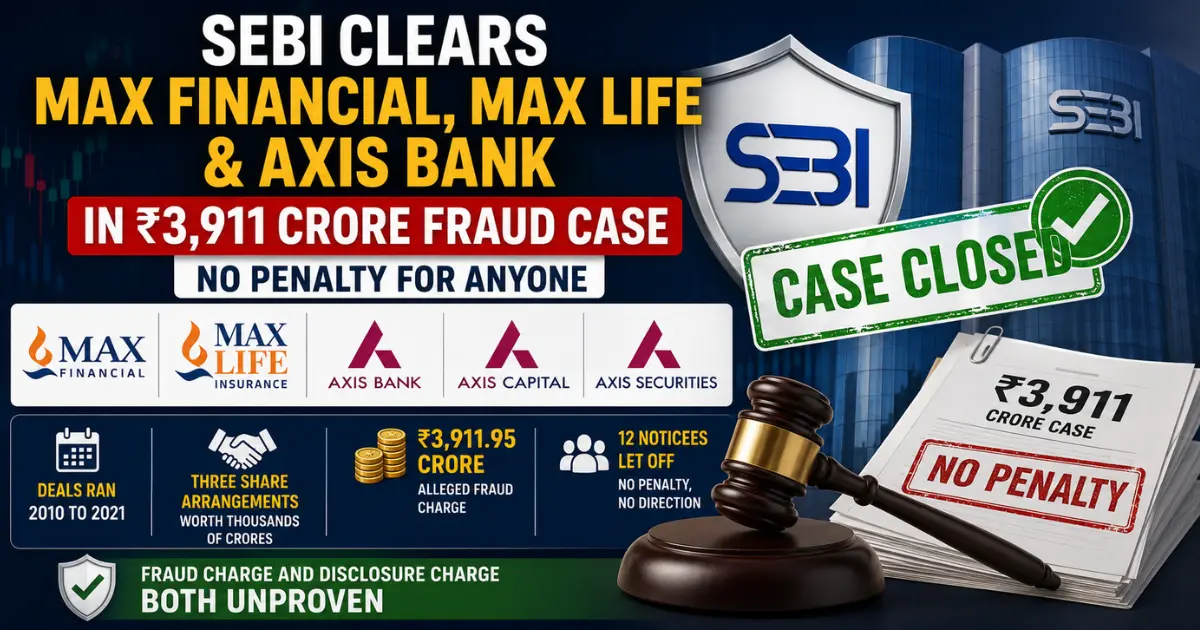
The Max Financial Axis Bank SEBI order, dated August 24, 2026, closes a case that had accused Max Financial Services, Max Life Insurance, Axis Bank, Axis Capital, Axis Securities and seven executives of a ₹3,911.95 crore fraudulent scheme running from 2010 to 2021.
After nearly two years of investigation and a year of hearings, SEBI found both the fraud charge and the disclosure charge unproven. All 12 noticees have been let off with no penalty and no direction.
SEBI investigated a decade of share deals between Max Financial and Axis Bank’s group, worth thousands of crores. Its final order says none of it was fraud, and closes the case with zero penalty.
What this case was actually about
Back in 2010, Max Life Insurance (then called Max New York Life) needed a strong bank partner to sell its policies. It picked Axis Bank.
To seal that partnership, Max and Axis entered into a web of share deals involving Max Life’s own shares. Max would issue or sell shares of its insurance arm to Axis Bank’s group at one price, and buy them back a few years later at a higher price.
This happened three times, and SEBI’s order refers to each round as an “arrangement.”
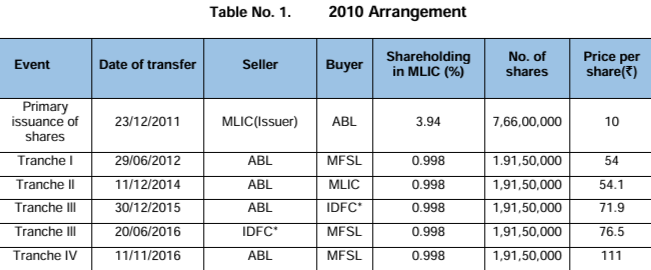
In the 2010 arrangement, Axis Bank was issued 7.66 crore shares of Max Life at ₹10 apiece in December 2011. Max then bought these back in four tranches between 2012 and 2016, at prices climbing from ₹54 to ₹111 a share.
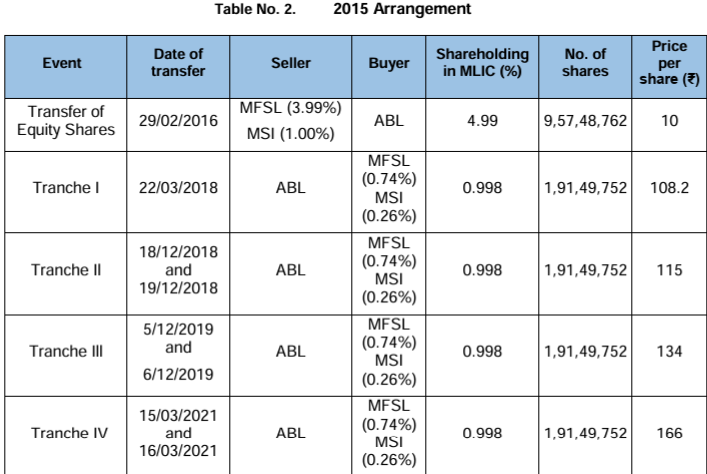
In the 2015 arrangement, Max and its Japanese partner Mitsui Sumitomo sold roughly 9.57 crore shares to Axis Bank, again at ₹10 apiece. This time the buyback ran from 2018 to 2021, in four tranches, with the price rising from ₹108 to ₹166 a share.
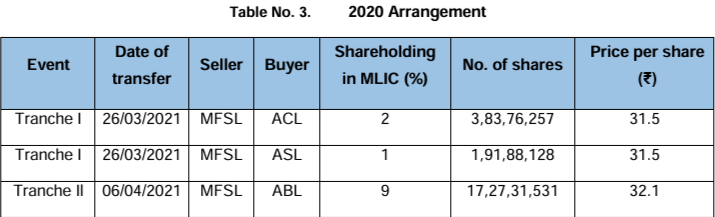
The 2020 arrangement worked differently. Instead of a buyback, Max sold a 29% stake in Max Life outright to Axis Bank, Axis Capital and Axis Securities in two tranches during 2021, at around ₹31.5 to ₹32 a share.
By April 2021, Axis Bank and its group companies together held nearly 13% of Max Life, and Axis Bank had become a co-promoter of what is now called Axis Max Life Insurance.
How this kind of deal actually works
If you’ve never seen a put and call option before, the basic idea is simple. Max gave Axis Bank the right to sell its Max Life shares back to Max at a pre-agreed formula. Max, in turn, had the right to buy those same shares back.
Neither side was forced to trade at a fixed price years in advance. The buyback price was tied to the fair market value of Max Life at the time the option was exercised, which is why the numbers climbed steadily as the insurance business grew.
SEBI’s notice treated this rising price trail as suspicious. Its argument was that Axis Bank was effectively being paid extra money through these share trades, on top of whatever commission it earned for selling Max Life’s policies.
Where SEBI came in
In November 2022, India’s insurance regulator IRDAI wrote to SEBI. IRDAI had already fined Axis Bank ₹2 crore and Max Life ₹3 crore for breaching its own rules on how much commission a bank can earn for selling insurance as a corporate agent.
Insurance regulations cap how much a bank can make from selling policies, precisely so that banks don’t push products purely to maximise their own cut. IRDAI’s view was that the Max-Axis share arrangement let Axis earn beyond that cap, dressed up as a share transaction rather than a commission payment.
That letter got SEBI looking at the securities law side of the same deals. SEBI’s investigation covered transactions from FY 2009-10 all the way to FY 2021-22, more than a decade of paperwork, board minutes and stock exchange filings.
In October 2024, SEBI issued a show cause notice to 25 people and entities connected to Max and Axis, asking them to explain why they shouldn’t face penalties and regulatory directions.
The allegation: a scheme to move money to Axis
SEBI’s notice made two big claims.
First, that Max Financial Services didn’t disclose the full details of these share arrangements properly to its own shareholders and to the stock exchanges over the years, particularly the later buyback tranches.
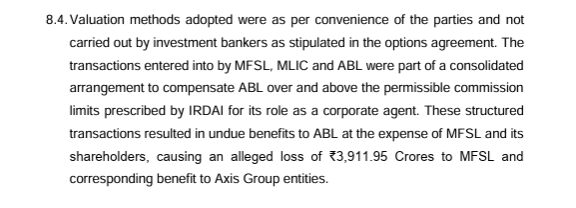
Second, and more seriously, that the whole structure, issuing shares cheap and buying them back expensive, was a deliberate scheme devised in connivance with Axis Bank, Axis Capital and Axis Securities. The idea, according to SEBI, was to let Axis earn money beyond what insurance rules allow, at the cost of Max Financial and its shareholders.
SEBI put a number on it: an alleged loss of ₹3,911.95 crore to Max Financial, which it said had benefited Axis Group entities instead. Around 80% of that alleged figure was tied to the 2021 transactions alone.
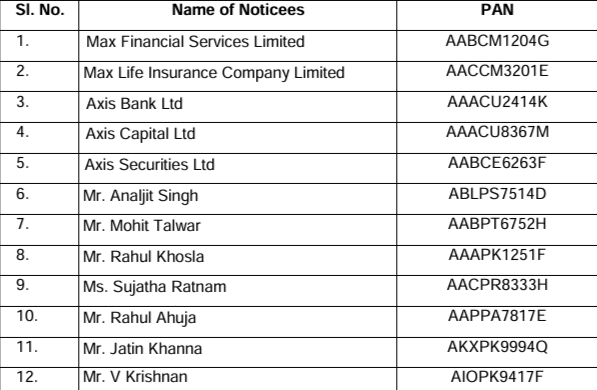
Twelve entities and people were named as noticees in this final order. That includes Max Financial Services, Max Life Insurance, Axis Bank, Axis Capital, Axis Securities, and seven individuals who held senior roles at Max over the years: former Chairman Analjit Singh, former Managing Director Mohit Talwar, former Managing Director Rahul Khosla, and four people who served as CFO, Group Financial Controller or Company Secretary at different points, Sujatha Ratnam, Rahul Ahuja, Jatin Khanna and V Krishnan.
A separate group of 13 non-executive and independent directors of Max Financial had already applied for settlement with SEBI, a process where a party can propose to resolve the case without an admission or denial of guilt. Their applications are still pending, so this final order does not decide their fate.
What SEBI found after hearing everyone out
Hearings ran through mid and late 2025, with the companies and individuals filing detailed written replies and appearing before SEBI’s Whole Time Member, Amarjeet Singh, who authored the final order.
On the disclosure question, SEBI’s own order says Max Financial had in fact disclosed the core terms of these arrangements, including the buyback pricing formula, in its annual reports and stock exchange filings at the relevant time. The transfer of shares to Axis Bank at ₹10 apiece and the plan to repurchase them at fair market value were both on record from 2016 onward.
Some individual tranches of the later buybacks weren’t disclosed as standalone events. But the order notes that SEBI’s own notice never actually showed why each of those smaller tranches counted as a “material” development requiring separate disclosure under the rules that applied at the time.
The order also makes a point about how disclosure rules have changed. India’s listing rules moved from a fairly loose 2015 framework to today’s much more detailed LODR regulations, with specific thresholds for what counts as material. Judging a 2016 disclosure by 2026 standards, the order says, isn’t fair.
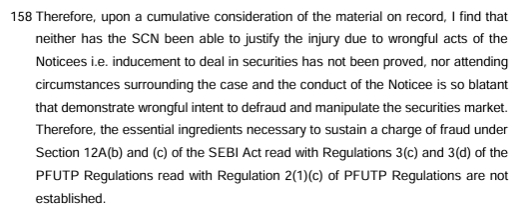
On the fraud question, the order is even more direct. To prove fraud under SEBI’s regulations, the regulator has to show either that someone was actually induced, meaning misled into buying or selling shares because of what was hidden, or that the conduct itself was so clearly dishonest that inducement doesn’t need separate proof.
SEBI’s own notice didn’t name a single investor who traded Max Financial’s shares because of these disclosures. There was no allegation that the stock price was pushed up or down artificially, and no claim of fake trading volumes or misleading market signals.
If anything, the numbers cut the other way. Max Financial’s share price appreciated over this period, and the company earned about ₹2,141 crore in dividends from its insurance arm as a result of the Axis partnership.
The 2020 round of the deal was also put to Max Financial’s shareholders directly, and 99.9% of the votes cast were in favour. Even the one board member who raised concerns, former director N. Rangachary, was only questioning whether Max could actually afford to pay out cash if Axis exercised its option down the line, not objecting to the bancassurance tie-up itself.
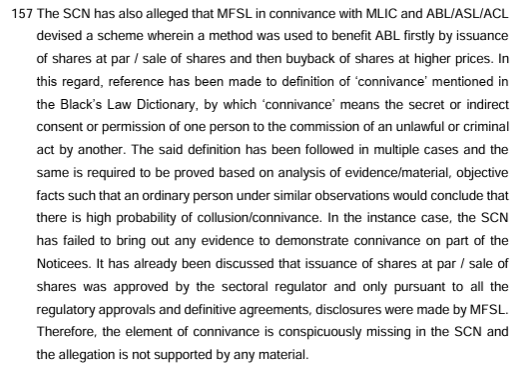
SEBI’s order also rejected the specific charge of “connivance,” meaning secret cooperation to do something unlawful. The order notes that every step of these transactions had gone through board approvals, shareholder votes and sign-offs from RBI and IRDAI, which doesn’t fit the picture of a hidden scheme.
What about the individual executives?
SEBI’s notice had also gone after the seven individuals personally, on the theory that as directors, CFOs, or the company secretary, they were vicariously responsible for whatever the company did.
The order shuts this down for a straightforward legal reason. Vicarious liability, where a person is held responsible for someone else’s violation purely because of their role, only kicks in once the company itself is found guilty of the underlying violation. Courts have said this repeatedly, including the Supreme Court in cases like Aneeta Hada vs Godfather Travels.
Since Max Financial wasn’t found guilty of anything, there was nothing left for its executives to be vicariously liable for.
There’s a second, more technical reason too. The legal provision that allows this kind of vicarious liability for civil violations, Section 27 of the SEBI Act, only started applying to civil cases after an amendment in March 2019. Most of the transactions under scrutiny, especially the 2010 and 2015 arrangements, happened well before that date.
For the individuals, SEBI’s order also draws a distinction based on actual role. It notes that simply attending a board meeting or signing a routine resolution doesn’t automatically make a director liable for everything that happens afterward, unless there’s specific evidence connecting that person to the alleged wrongdoing.
What happens to the other 13 people
The 13 non-executive and independent directors who filed settlement applications remain in a separate track. Under SEBI’s settlement rules, filing an application doesn’t pause the underlying case, but it does mean SEBI has to hold off on a final order against those specific individuals until their settlement proposals are either accepted or rejected.
That process is ongoing and wasn’t addressed in this order at all. It’s a reminder that this case isn’t fully closed for everyone connected to it, even though the 12 people and entities named in this particular order have been cleared.
The final word
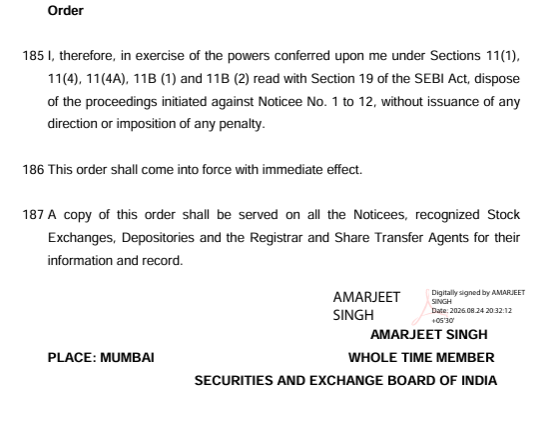
SEBI’s order closes with a simple line: proceedings against all 12 noticees are disposed of, without any direction and without any penalty.
No fine. No debarment. No restriction on trading. The case is over for Max Financial, Max Life, Axis Bank, Axis Capital, Axis Securities, and all seven individuals named.
A show cause notice is an allegation, not a finding. In this case, SEBI investigated for close to two years and its own order ended up siding with the noticees on every single count, from disclosure to fraud to individual liability.
What it means if you hold Max Financial or Axis Bank shares
For existing shareholders, this order removes a real overhang. A pending SEBI fraud investigation involving a ₹3,911 crore alleged loss is the kind of thing that shows up in every analyst note and every quarterly call until it’s resolved.
With the case closed and no penalty attached, that particular risk is off the table for Max Financial Services, Max Life Insurance, Axis Bank, Axis Capital and Axis Securities.
It doesn’t change the underlying business fundamentals of any of these companies, and it isn’t investment advice either way. But if you’d been watching this case as a reason to stay cautious on any of these stocks, the regulatory piece of that caution has now been resolved in the companies’ favour.
If you ever need to complain about a SEBI-registered entity
This particular case ended with a clean chit for everyone involved. But not every SEBI matter does, and it helps to know where to go if you ever have a genuine grievance of your own.
SCORES is SEBI’s official online portal for filing complaints against listed companies and market intermediaries, and we’ve covered how the SCORES complaint process works in detail.
When a complaint needs formal resolution rather than just a written response, it goes through the SMART ODR portal, SEBI’s online dispute resolution system for the securities market.
If your issue is specifically with a stock broker, the process for filing that complaint is slightly different from a general SEBI complaint.
The same goes for a registered investment adviser, and we’ve laid out the steps for that here.
Research analysts registered with SEBI have their own complaint route too, which we’ve explained separately.
Portfolio managers are covered under a distinct process as well, and here’s how that one works.
If your concern touches more than one SEBI-registered intermediary at once, there’s a combined complaint route for that.
NSE also runs its own investor grievance portal for issues involving its member brokers, and we’ve covered how to use it.
BSE has a similar portal for complaints against its own members, which we’ve detailed here.
What was Max Financial accused of? SEBI’s show cause notice alleged inadequate disclosure of share arrangements with Axis Bank’s group between 2010 and 2021, and a fraudulent scheme that allegedly caused Max Financial a loss of ₹3,911.95 crore.
Why did SEBI drop the fraud charge? SEBI found no evidence that any investor was induced or misled, no allegation of market manipulation, and noted that Max Financial’s share price rose and it earned around ₹2,141 crore in dividends during the period in question.
Are all the individuals involved cleared too? Yes, for the 12 noticees covered in this order, including former Chairman Analjit Singh and former Managing Director Mohit Talwar. A separate group of 13 non-executive and independent directors have pending settlement applications with SEBI that weren’t decided here.
What happened to the IRDAI penalty on Axis Bank and Max Life? That was a separate, earlier action by the insurance regulator IRDAI, which fined Axis Bank ₹2 crore and Max Life ₹3 crore for breaching its commission rules. This SEBI order does not disturb that.
How much money changed hands in these deals overall? Across the 2010, 2015 and 2020 arrangements, Axis Bank’s group acquired roughly 13% of Max Life’s shares in stages, at prices ranging from ₹10 to ₹166 a share as the buybacks and later sales progressed.
Can SEBI still act against Max Financial or Axis Bank for the same matter? Not on these charges. This order finally disposes of the proceedings against these 12 noticees on the allegations covered in the October 2024 show cause notice.
Frequently Asked Questions
No. The Max Financial Axis Bank SEBI order, dated August 24, 2026, disposed of the case against all 12 noticees without imposing any penalty or direction.
SEBI's show cause notice alleged inadequate disclosure of share arrangements with Axis Bank's group between 2010 and 2021, and a fraudulent scheme that allegedly caused Max Financial a loss of ₹3,911.95 crore.
SEBI found no evidence that any investor was induced or misled, no allegation of market manipulation, and noted that Max Financial's share price rose and it earned around ₹2,141 crore in dividends during the period in question.
Yes, for the 12 noticees covered in this order, including former Chairman Analjit Singh and former Managing Director Mohit Talwar. A separate group of 13 non-executive and independent directors have pending settlement applications with SEBI that weren't decided here.
That was a separate, earlier action by the insurance regulator IRDAI, which fined Axis Bank ₹2 crore and Max Life ₹3 crore for breaching its commission rules. This SEBI order does not disturb that.
Across the 2010, 2015 and 2020 arrangements, Axis Bank's group acquired roughly 13% of Max Life's shares in stages, at prices ranging from ₹10 to ₹166 a share as the buybacks and later sales progressed.
Not on these charges. This order finally disposes of the proceedings against these 12 noticees on the allegations covered in the October 2024 show cause notice.





 Add us as a preferred source on Google »

